
It might surprise some people to know that wars rage daily around the world, often in several locations at once. So prolific are humans at warring that Wikipedia has a page to list the 44 ongoing conflicts. It lists and additional 22 ongoing conflicts with fewer than 1000 casualties in the last year.
Wars don't always make the headlines. Thus, it's remarkable that our news feeds now reel from not one but two wars. On February 24th 2022, Russia invaded Ukraine. On October 7th 2023, Hamas struck Israel.
Why are these wars in the news and not all the others? This article explores the similarities and differences between them, as well as differences in the international community's response. We'll examine:
- the language used to describe these wars
- the events that provoked each incursion
- the combatants' supply chains
- what conclusions we can draw from all that we'll learn


The Reasons for These Wars
In both cases, the Western press emphasised that these attacks were out of the blue. 'Unprovoked' was the mot du jour, as though both Russia and Hamas were just bored. And then, one day, they decided it would be fun to lash out.
Both of these attacks follow years of deliberate and unrelenting pressure on the 'attackers'. Israel fenced in the Gaza Strip in 2007 and now controls the Palestinian population's food, water and movements. The Palestinian March for Peace in 2018 saw Israeli forces pick off unarmed demonstrators on the other side of the barrier wall. Random bombings and shootings have continued since then.
Provocations against Russia go back decades, too. Starting in the early 90s, Russian leadership told Western powers that they were/are against the North Atlantic Treaty Organisation (NATO) on their borders. Undaunted, this US-led body moved ever eastward, inviting nations on Russia's border to join. We should note that those nations are nowhere near the North Atlantic.
Ukraine was a particular sticking point. We know that, since 2014, United States (US) foreign policy manoeuvres undermined agreements that should have brought regional peace. Continued exhortations led successive Ukrainian presidents to resist collaboration with Russia.
With this understanding, we see that great powers choose who to paint as a victim and who the aggressor is. Israel's long history of badgering Palestinians qualifies it as the aggressor but it's painted as the victim. Russia has been the victim of Cold War machinations for decades but is labelled the aggressor.
Describing the Wars
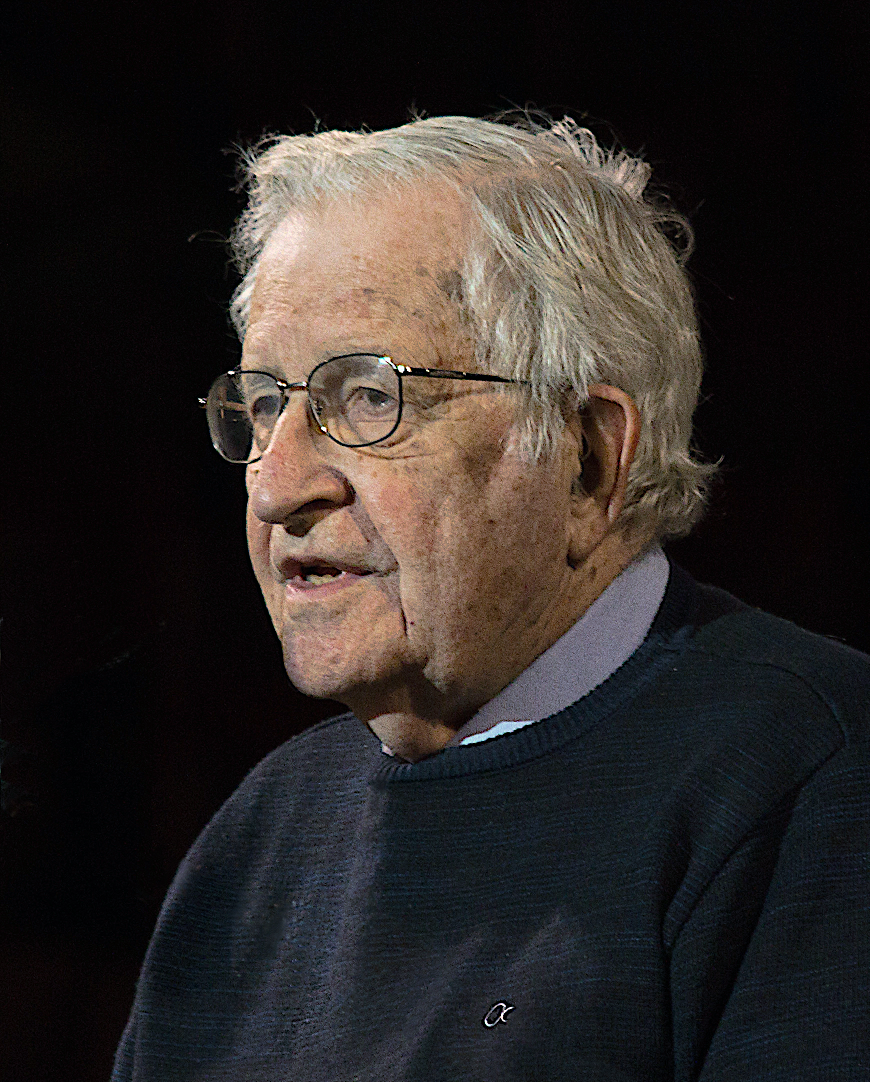
American intellectual Noam Chomsky co-wrote a brilliant book titled Manufacturing Consent. In it, he describes the concept of worthy and unworthy victims. Worthy victims are those that we identify with and feel compassion for. Unworthy victims are those we shouldn't care about. (Photo by Wugapodes)
Chomsky asserts that victims and aggressors are made. Public opinion is swayed by degrees, through increasingly emotional language. "They're attacking women!" elicits outrage. "Those young women died for no good reason" occasions sorrow. The rhetoric used to describe the aggressors - the unworthy victims, grows harsher in proportion.
In the Russia-Ukraine war, we heard about plucky Ukrainians who fought off beastly Russians by any means possible. They even lobbed tinned tomatoes! This war was often framed as David taking on Goliath. Ukrainians are worthy victims.
By contrast, resource-starved Palestinian people managing to bypass Israel's multi-billion dollar security apparatus merits no praise. The rhetoric used to describe their ingenuity implies that Palestinians somehow tricked the Israelis. Palestinians are unworthy victims.
Now, let's look at other ways this manufactured consent shapes our opinions and frames these two wars.
Talk of Genocide
In the Russia-Ukraine war's early days, Western media was quick to speculate on whether Russia was committing genocide. Going by the United Nations (UN) definition of genocide, one could make the case for such. But then, that definition is so broad that every war must be genocidal.
Accusations of a Palestinian genocide are absent in the Western press. Indeed, publications like The Atlantic and The Economist strenuously deny any act of genocide (or colonialism) on Israel's part. Individual voices speak of genocide but we hear no unified condemnation of Israeli offences against the Palestinian people.
The Right to Defend Oneself
Western media firmly asserts Israel's right to defend itself. The US has vetoed UN humanitarian relief proposals because they did not specifically mention Israel's right to self-defence. The US-led media is equally firm in asserting Ukraine's right to defend itself.
However, we know that since Israel's establishment in 1948, this nation has repeatedly attacked Palestinians. Furthermore, Israel enclosed the Gaza Strip in 2007 and has subjected the enclosure to violence. Nobody says anything about the Palestinian people's right to self-defence.
What of NATO's slow creep to the Russian border? In June 2023, Western media was in an uproar over China building a military base in Cuba, 90 miles from US shores. Nevertheless, Western powers ignored Russia's repeated requests for a buffer zone between it and NATO weaponry. Russia too must have the right to defend itself, even from a looming threat.
Attacks on Children
Much was made in the news about Russia kidnapping Ukrainian children. From the sound of it, youngsters were lifted from their mothers' very arms and shanghaied across the border. In all, Russian authorities state they evacuated 700,000 children.
More neutral stories reported that Russia evacuated the children from orphanages. Few if any media outlets reported the fact that some Ukrainian families gave their children to Russian relatives to get them out of the war zone. In all cases, this Russian act was painted as despicable.
As of this writing, more than 4000 children have been killed in the Gaza Strip since October 7th. That's nearly half the total victims since that day. Changes to Russian adoption laws could make returning Ukrainian children harder. But more than 4000 Palestinian children can never return.
Funding the Wars
As unworthy victims, neither Palestine nor Russia merits any financial aid. Indeed, they merit no economy whatsoever. Since Israel's Gaza Strip blockade in 2007, ~2.3 million Palestinians have been barred from virtually all economic activity. They've been wholly dependent on UN-funded humanitarian aid; this aid has now all but stopped.
Western powers were quick to seize and freeze Russian assets. The US levied punitive economic sanctions and blocked Russia's access to SWIFT, the international cross-border payment system. Recently, the European Union has debated spending the interest on seized Russian assets to fund Ukraine.
By contrast, the worthy victims enjoy lavish funding. Each year, the US earmarks more than 3,8 billion dollars for Israeli defence. Now that they're embroiled in this Israeli-Palestinian war, Israel will receive an additional $105 billion. That pales in comparison to the $350 billion Ukraine has received so far.
Further funding for Ukraine is questionable. As the war progressed, great powers baulked at Ukraine's demands for more lethal weaponry. At the NATO summit in July 2023, British and American leaders publicly remarked that the Ukrainian president should display more gratitude. All of this - and now that there's a new war to profit from, means Ukraine may become an unworthy victim.
A Tale of Two Wars
Russia at War
- labelled the aggressor
- war crime accusations
- International Criminal Court arrest warrant
- genocide accusations
- 'kidnapped' children
- seized assets/economic sanctions
Israel at War
- labelled the victim
- no war crime accusations
- no arrest warrant
- talk of genocide is forbidden
- dead children
- lavishly funded and supported
Ukraine at war
- labelled the victim
- lavishly funded and supported
- embraced and welcomed (initially)
- constant reminders of their plight
- described as a humanitarian crisis
- promises of reparations
- eventual welcome into great power bodies
Palestinians/Hamas at war
- labelled the aggressor
- not funded or supported
- stateless since the Second World War
- few to no reminders of their plight
- passing mention of humanitarian crisis
- two-state solution idea revived
- unwelcome even in their former lands
When compared side by side, we see that engineering these two wars serve a common strategic and geopolitical aim. The tactics and language are the same; only the labels reversed. Examining the facts, we see that the 'aggressors' were victims of provocation. But it's the 'victims' who reject calls for peace.
That defies logic. If you or I were getting pounded on, we'd cry uncle pretty fast. That is unless we knew we had someone bigger and stronger backing us up. A 'someone' who has an interest in our short-term pain for overall long-term gain - for them and (hopefully) ourselves.
We must never paint all Israelis or Palestinians with the same brush. A sizable part of each side's civilian population denounces what their leaders have done and continue doing. There's less evidence of such about the European combatants, for whatever reason, but it's a fair bet that they too are not all-in.
Likewise, choosing sides is folly. Whether firing the gun or catching the bullet, humans shape both sides of these wars. Perhaps, if we can recognise each other's humanity, our ambitions will finally take a back seat to our respect for life.
Summarise with AI:
Did you like this article? Leave a rating!


 Loading...