

Musical notation is how we can write music.³ It's a commonly used system that allows musicians and composers to share and preserve music so that it can be performed accurately.³ It's also a great way to help musicians understand pitch, rhythm, and expression. Learn how music notation works, and you can apply it to any instrument you know how to play.
Key Takeaways
- Musical notation is a written system for pitch, rhythm, and expression.
- The staff and clefs define pitch range and how notes are read.
- Notes show pitch and duration, while rests show silence.
- Time signatures organise rhythm into beats and bars.
- Accidentals and key signatures change pitch within a piece.
- Symbols work as a system, allowing music to be read and performed accurately.
Musical notation is a written system that represents music using symbols.³ It shows pitch, rhythm, dynamics, and expression so musicians can read, perform, and analyse music accurately. Most Western music is written using this system.


The Musical Staff and Clefs
The musical staff is what many call sheet music. In music theory, it's important that you know what these are and what they do. Musicians use them to read what music they have to play.
The musical staff consists of five horizontal lines and four spaces that represent musical pitch.³ Notes placed higher on the staff sound higher, while notes placed lower sound lower. Each line and space corresponds to a specific note, providing the visual framework for reading music.
The treble clef is used for higher-pitched notes and instruments. It is also known as the G clef because it curls around the note G.³ It is commonly used for right-hand piano, guitar, violin, flute, and most vocal music. Many beginner pieces are written in treble clef.
The bass clef is used for lower-pitched notes and instruments. It is also known as the F clef because its two dots surround the note F.³ It is commonly used for the left hand in piano, bass guitar, and cello, and for lower vocal ranges. The bass clef keeps low notes readable without excessive ledger lines.
Ledger lines are short horizontal lines added above or below the staff to extend its pitch range.³ They follow the same spacing pattern as the staff itself. Ledger lines allow very high or very low notes to be written clearly when they fall outside the standard staff.
Music Notes and Their Values
Music notes in notation indicate a note's pitch, its length, and even how it should be played.² Different shapes indicate different note lengths, and where it is indicates its pitch (vertically) and when it should be played (horizontally from left to right on a staff). Beats and note lengths are the foundation of music and rhythm, indicated by time signatures.
A music note is a symbol that represents both pitch and duration.² Where the note is placed on the staff shows how high or low it sounds, while its shape shows how long it is held.
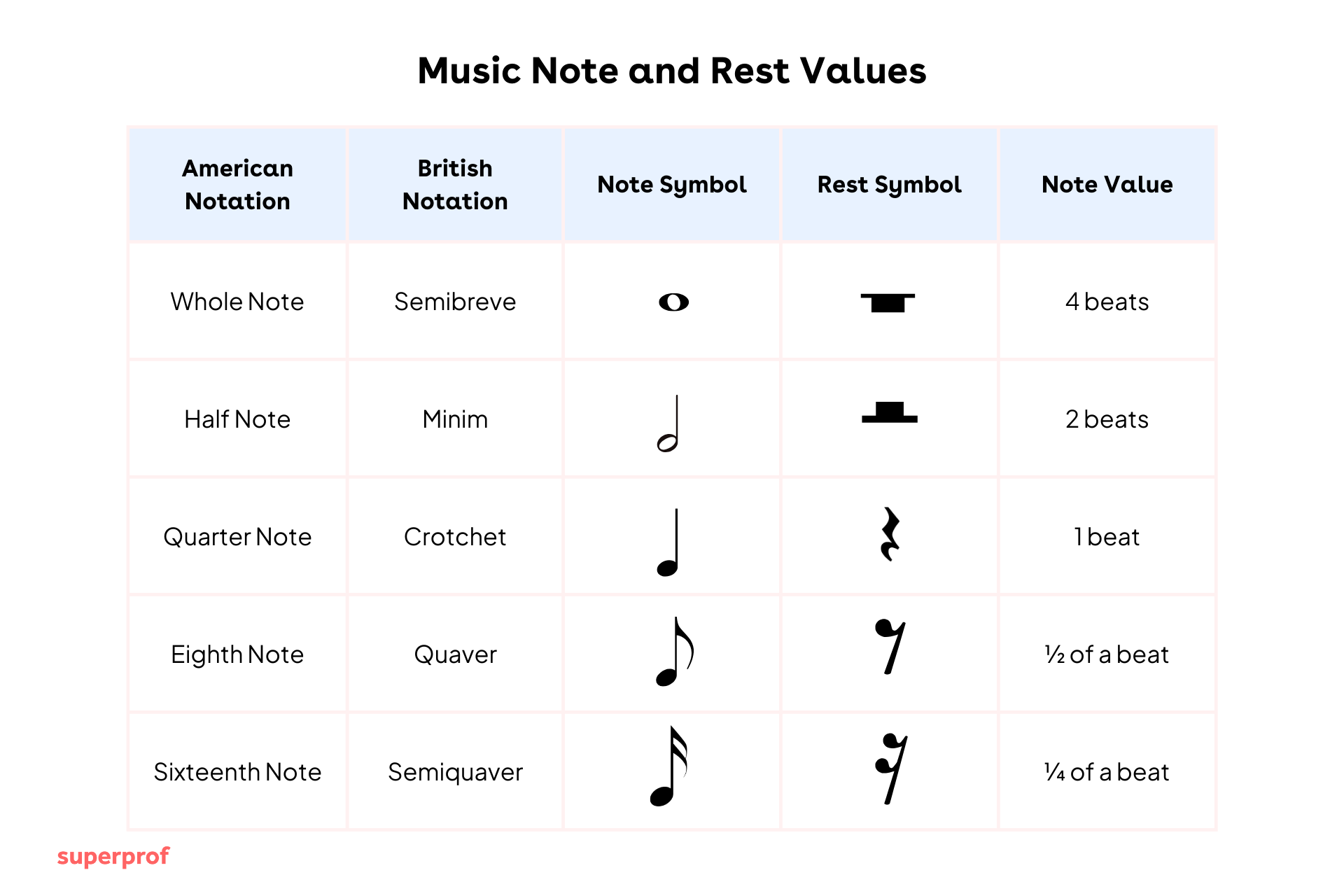
| Symbol Name | Alternative Name | Beats in 4/4 Time |
|---|---|---|
| Whole note | Semibreve | 4.0 |
| Half note | Minim | 2.0 |
| Quarter note | Crotchet | 1.0 |
| Eighth note | Quaver | 0.5 |
| Sixteenth note | Semiquaver | 0.25 |
| Whole rest | Semibreve rest | 4.0 |
| Half rest | Minim rest | 2.0 |
| Quarter rest | Crotchet rest | 1.0 |
| Eighth rest | Quaver rest | 0.5 |
| Sixteenth rest | Semiquaver rest | 0.25 |
Musical notes represent both pitch and duration, with their position on the staff showing how high or low a sound is and their shape indicating how long it should be held. Together, these elements allow musicians to read and perform music accurately.
Whole notes last four beats in common time and are written as an open note head with no stem.¹ They are often used for sustained sounds and to create a sense of resolution or space in music.
Half notes last two beats and are written with an open note head and a stem. They divide measures evenly and are commonly used in slower melodies and harmonic writing.
Quarter notes last one beat and are written with a filled-in note head and a stem. They form the basic pulse of most music and are usually the first note value beginners learn.
Eighth notes last half a beat and are written with a flag or joined by beams. They create quicker rhythmic movement and are common in melodies and rhythmic patterns.
Sixteenth notes last a quarter of a beat and use double flags or beams. They appear in faster passages and add rhythmic detail to music.
Dotted notes increase a note's duration by half its original value, such as a dotted half note lasting three beats. They are used to vary rhythm and avoid overly rigid timing.
Rests and Silence in Music
The notes you don't play are just as important as the notes you do. With rests, musicians control spacing, phrasing, and rhythmic balance. Rests have their own symbols and have a value for time. Naturally, since they don't have a pitch, their location on a musical staff is always the same so pitch and intervals don't apply to them.
Rests represent silence in music and have the same durations as their corresponding notes.² They are essential for shaping rhythm, phrasing, and timing.
Whole rests indicate four beats of silence and hang from the fourth line of the staff. They often represent an entire measure of rest in ensemble music.
Half rests indicate two beats of silence and sit on top of the third staff line. Their placement distinguishes them from whole rests, despite their similar appearance.
Quarter rests represent one beat of silence and use a distinctive zigzag symbol. They are commonly used to control rhythmic spacing within melodies.
Eighth and sixteenth rests represent very short silences and use flags similar to their note counterparts. They are frequently used in syncopated and fast rhythms.
Accidentals and Pitch Changes
Accidentals modify a note outside the standard pitch set.² They change how a note sounds without making any changes to the key signature. Accidentals are used when a note is in a position where it would be played differently because of the key signature.
Sharps, Flats, and Naturals
Sharps raise a note by one semitone, while flats lower a note by one semitone.² Natural signs cancel a sharp or flat and return the note to its original pitch. These symbols apply for the remainder of the bar unless cancelled.
How Accidentals Affect Pitch
Accidentals change pitch instantly, even if the same note appears earlier in the bar. They allow composers to introduce notes that don’t belong to the key signature. Understanding accidentals helps musicians avoid common reading mistakes.
Time Signatures and Rhythm Symbols
Music is counted and structured according to the time signature.¹ The time signatures basically tell musicians how many beats there are in a bar and what the value of a "beat" is. Is it in standard time or a waltz? The time signature will tell you.
A time signature tells musicians how music is counted.¹ It shows how many beats are in each bar and which note value receives one beat, helping performers stay in time.
Time signatures appear at the start of a piece and show how music is organised rhythmically. The top number indicates beats per bar, while the bottom number shows which note value gets one beat.
Common time is written as 4/4 and means there are four beats per bar, with the quarter note receiving one beat.¹ It is the most widely used time signature in Western music.
Bar lines divide music into equal sections called measures. They help musicians stay organised and play together accurately, especially in group settings.
Key Signatures and Tonality
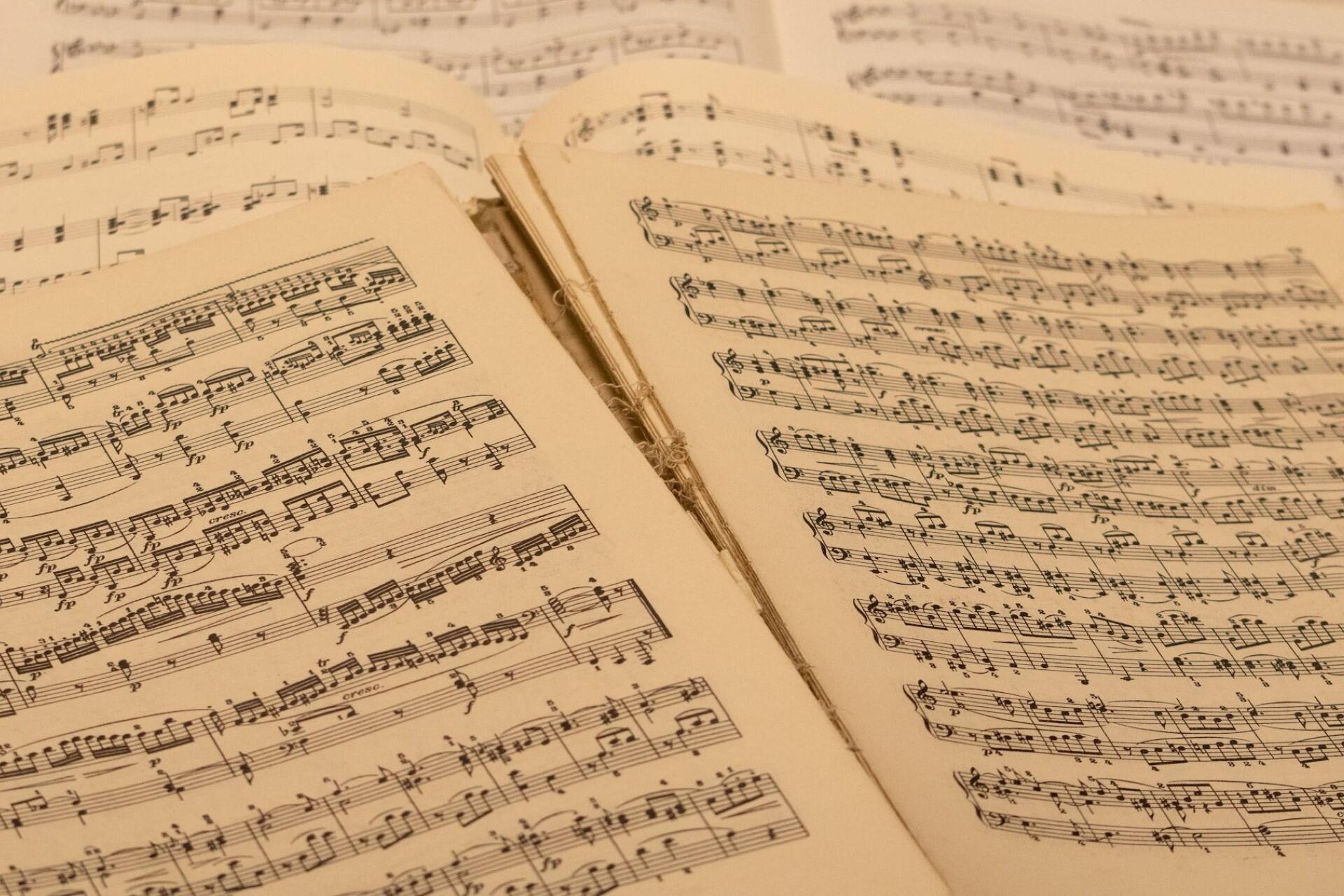
Key signatures work in the same way as accidentals, but they override every note on the indicated places so that you don't have to write a sharp, flat, or natural every time. If the key signature has the F as a sharp, for example, every time you see a note that's in the F position, you actually play an F sharp.
A key signature appears at the start of a piece of music and shows which notes are consistently sharpened or flattened.² It indicates the key the music is written in and helps musicians read more efficiently.
How Key Signatures Change Notes
Key signatures apply sharps or flats to specific notes throughout the piece. These changes remain in effect unless cancelled by an accidental. This system makes reading faster and keeps the notation clean.
Other Common Music Symbols
Ties connect two notes of the same pitch to combine their durations into a single sustained sound.⁴ They are commonly used to extend notes across bar lines.
Beaming groups short notes together to show rhythmic structure clearly. It replaces multiple flags and makes music easier to read at a glance.
Ledger lines extend the staff above or below its normal range to show very high or very low notes. They follow the same spacing rules as the staff itself.
Repeat signs indicate sections of music that should be played again. They reduce unnecessary repetition in written music and improve score readability.
Dynamic symbols indicate how loudly or softly music should be played, using markings such as p, mf, and f. They shape musical expression and contrast.
Accent marks highlight specific notes by giving them extra emphasis. They affect how a note is attacked and help shape rhythmic feel.
Notes, rests, and symbols work together to show pitch, duration, silence, structure, and expression. Combined, they form a complete written system that musicians can read and perform.
Reading Sheet Music in Practice
Learning to read sheet music will help you recognise pitch and rhythm.² Through practice, you'll start recognising patterns like common chords. The more you play along with sheet music, the more fluent you'll become.
How Music Symbols Work Together
Music symbols work as a system rather than in isolation. Notes, rests, clefs, and time signatures all interact to create meaning. Understanding how they connect improves reading speed and accuracy.
Tips for Reading Music Fluently
Reading music becomes easier when broken into small, manageable steps. Focusing on rhythm first often improves accuracy. Regular practice builds confidence and muscle memory.
References
- Germanna Community College. Music Theory: Note Values, Time Signature, and Meter. Germanna.edu, https://germanna.edu/sites/default/files/2024-03/Music%20Theory.pdf.
- musictheory.net. Lessons. https://www.musictheory.net/lessons.
- Open Music Theory. “Notation of Notes, Clefs, and Ledger Lines.” VIVA Open Publishing, https://viva.pressbooks.pub/openmusictheory/chapter/notation-of-notes-clefs-and-ledger-lines/.
- StaffPaper.org. “Music Symbols on Staff Paper: Clefs, Keys, and More.” StaffPaper, https://staffpaper.org/blog/music-symbols-on-staff-paper-clefs-keys-more.
Summarise with AI:
Enjoyed this article? Leave a rating!

 Loading...
