

Since 1870, the year the first Education Act was passed into law, compulsory education has been about preparing learners for their future in the workplace. Today, the jobs landscape is shifting – not just here and there, as before, but seismically. This article explores the ways the UK government and education system1 plan to arm its students with skills for the future job markets.
Needed Skills for the Future
- Digital skills: computer literacy, artificial intelligence (AI) skills, programming, and others.
- Life skills: financial literacy, media competency, emotional skills, and similar.
- Career readiness: workplace skills, transferable skills, employability, and more.
- Upskilling opportunities: continuous learning, adult education, and cross-training.


Youth Unemployment UK: Current Conditions
That statistic is valid as of October 2025; it represents a 2% increase over unemployed youths from the same period last year2. Note that this is only the most general expression of the youth unemployment UK. That percentage doesn't give reasons for being unemployed, nor does it assign 'blame'.
Nobody knows if the fault lies with employers who fail to make jobs available.
Or is it the youths who simply don't want to work?
That binary view oversimplifies this complex issue. Unfortunately, those points are the main ones discussed in the public forum. The Department for Education (DfE) takes a much more targeted view.
We must prepare our students for a future we can neither describe nor predict.
David Warlick, educator.
David Warlick, an American author, public speaker and educator hit the nail on the head. Around the world, teachers and governments debate the indescribable future and try their best to plot a course for student success. That, of course, starts with defining the challenges they face.
NEET: Not in Education, Employment or Training
This acronym surfaced in the UK in the late 1990s to replace the term 'no status', which carries a more negative tone3. This state of being is often compared to today's 'quiet quitting', 'the Great Resignation', and 'tang ping' - the Chinese 'lie flat' phenomenon. NEET represents potential workers who remain outside - or barely engaged in - the workforce for various reasons:
NEET doesn't seem to make provisions or account for 'great resigners' and 'lay flat-ers'. Those are people who've given up on the official job market (the rat race), and have found other ways to occupy their time.
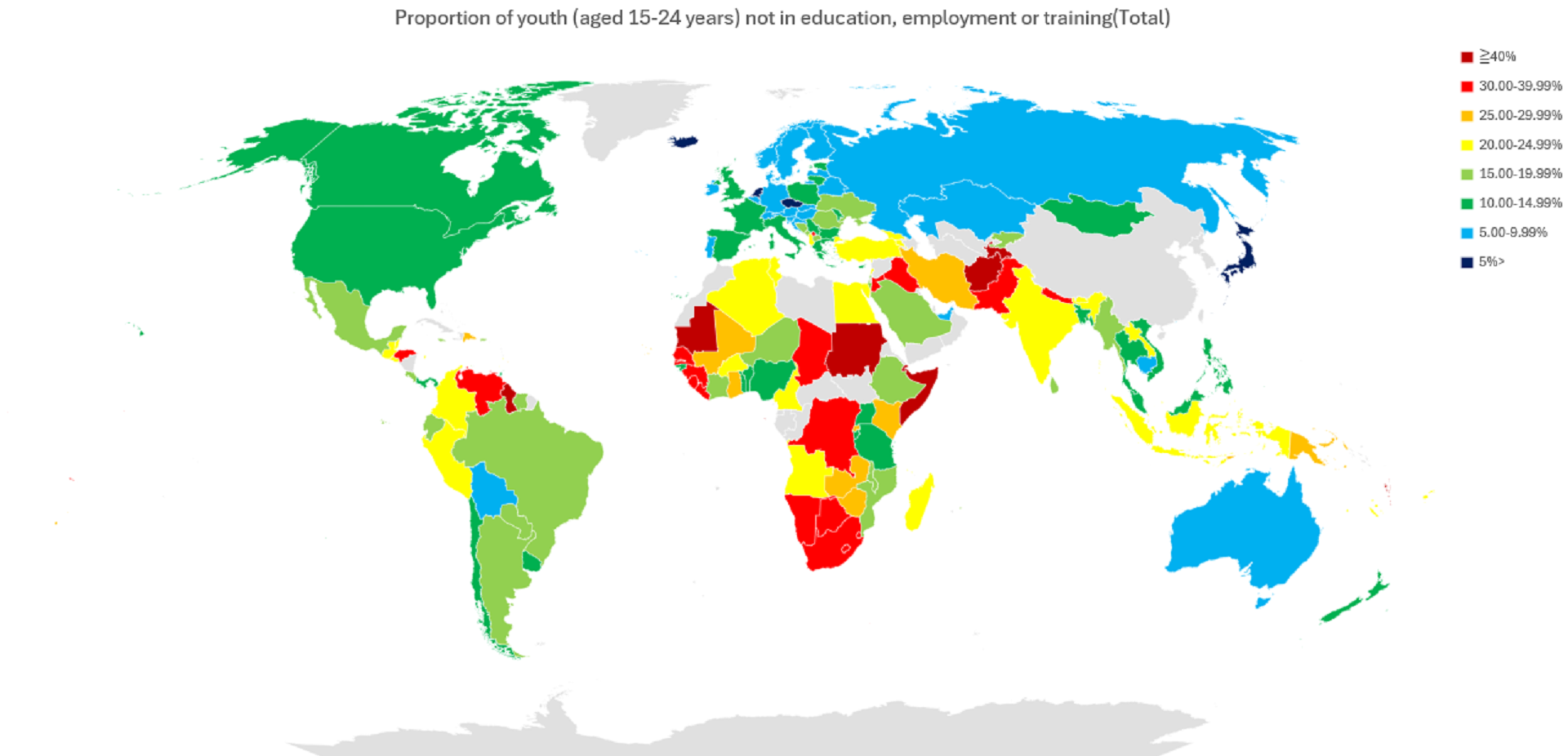
As noted above, NEET is by no means limited to the United Kingdom. This map shows NEET levels around the world in 2023.
Work Readiness: Closing the Employment Gap
Though much more pronounced in the last few years, NEET is not a new problem. As that acronym emerged more than 30 years ago, schools, governments, and other concerned organisations have had that long to find and implement solutions.
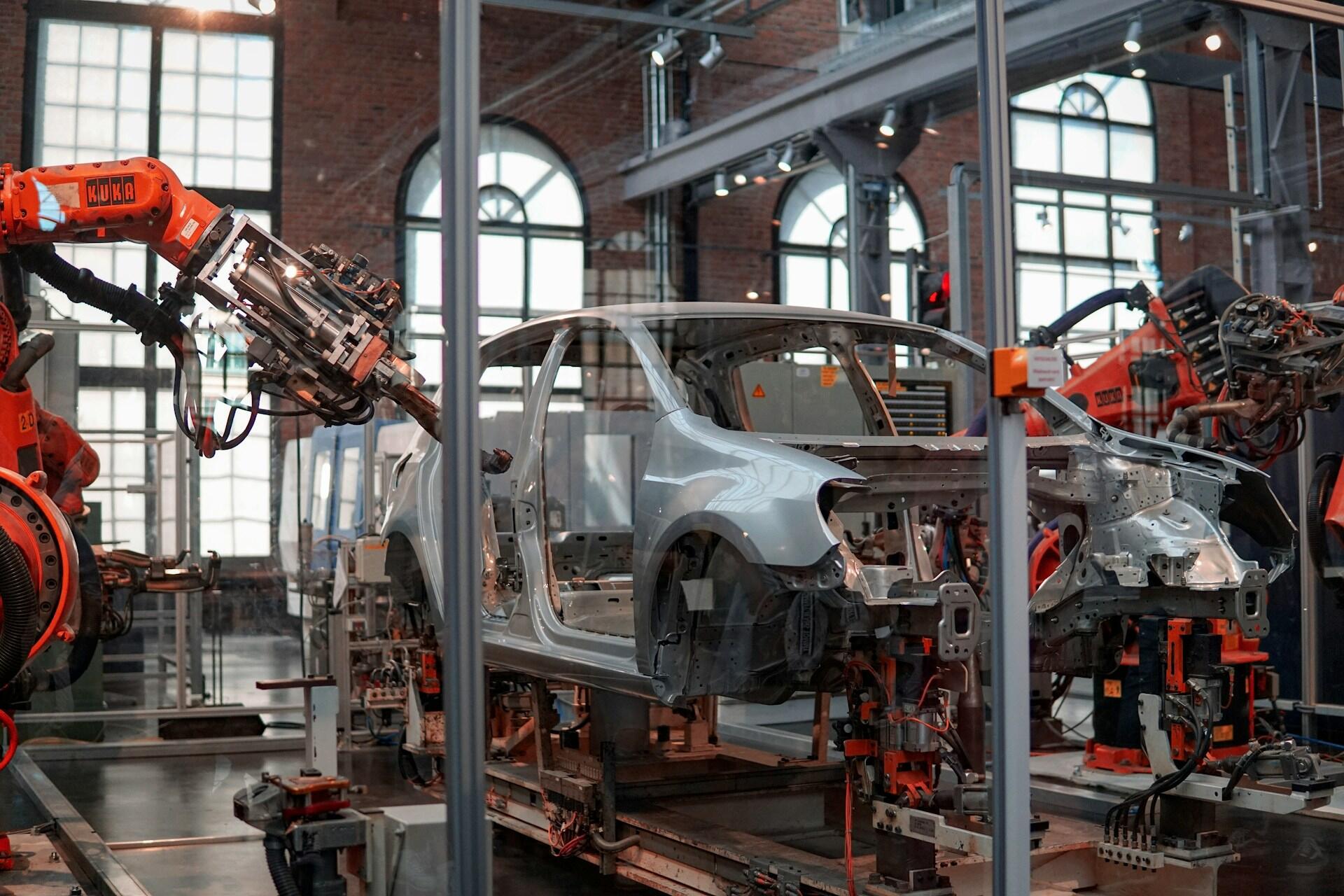
Franchises partner with universities to help place students in qualified jobs4.
Starting in the late 1990s, for-profit and non-profit groups have established partnerships with schools and governments. Their aim was to help students make seamless transitions from learner to worker. The government and schools funded those operations.
Unfortunately, that initiative has gone awry. Today, the government is cracking down on 'rogue' franchises5 that claim government funds to do less than their mandate.
With that initiative now tainted, what are schools and governments to do? The plan is now to get back to basics: teach students the skills they need for workplace competency. In fact, that is what the 2026 education reform plan is all about.
Life Skills: Financial Literacy, Media Literacy, and Emotional Skills
Before we explore the skills students need for their future success in the workforce, we must know which skills employers are prioritising6.
- analytical thinking
- (mental) agility
- adaptability
- flexibility
- leadership
All of these are soft skills: the type of personal skills that allow people to interact in a social or workplace environment. They cannot be counted or measured, and they are non-technical. So, how can they be taught?
Teaching life skills involves more than academic knowledge ...
Vince Gowman, teacher and spiritualist
It's shocking to know that only around two in five young adults are financially literate10. That means that most young people have no concept of finance or how money works. Nor do they know that finance isn't just about having and saving money; it's about your physical security and psychological stability. This is why financial literacy is a fundamental life skill.
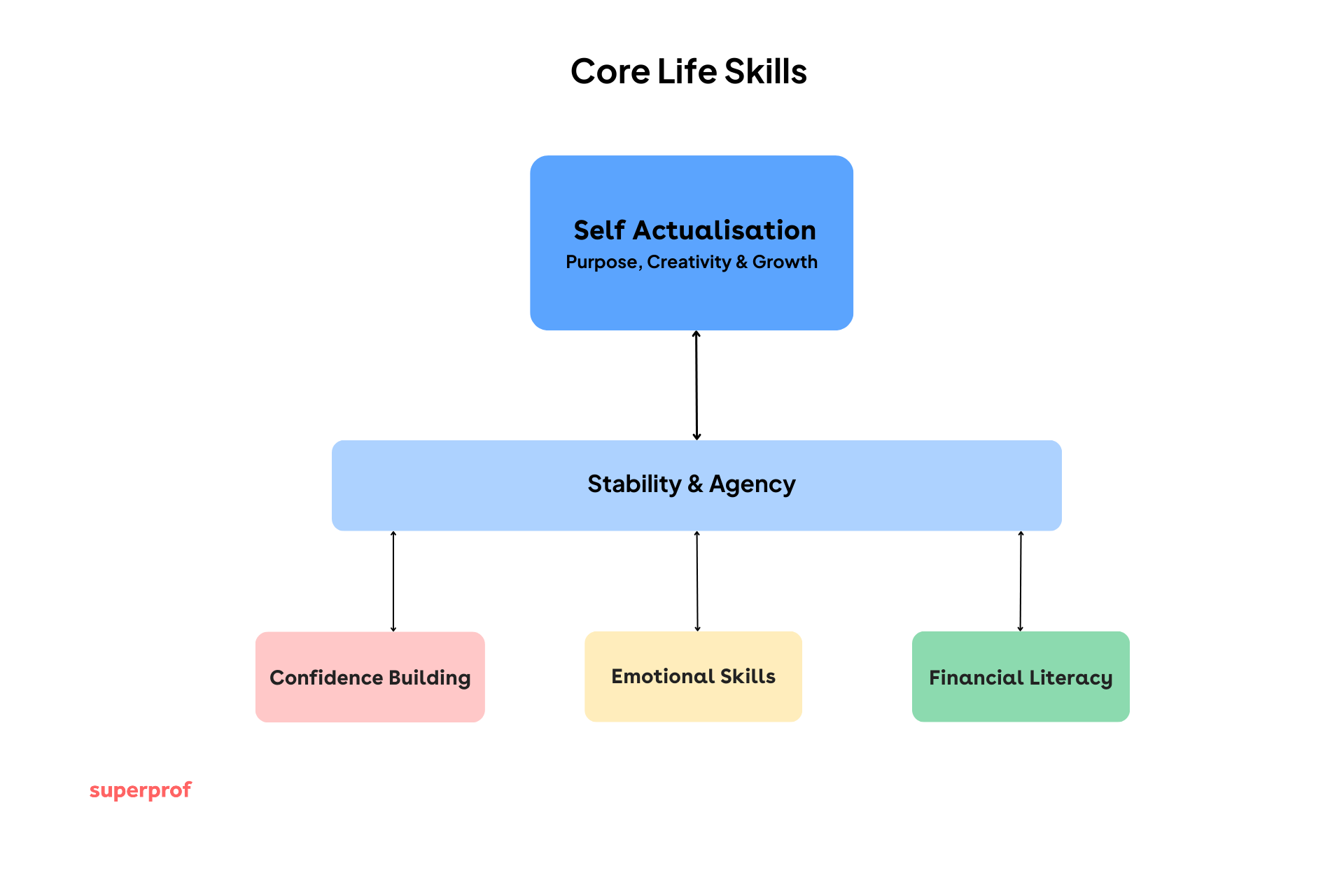
Our flowchart outlines the benefits of learning life skills. Curiously, it mirrors the Hierarchy of Needs8 that American psychologist Abraham Maslow established in 1943. Today, this hierarchy is an essential tool to help shape higher education as well as the business environment, despite the criticism often heaped upon it.
It appears that current efforts at revamping higher education means to follow this hierarchy more closely. As such, teachers will focus on helping students become financially literate, emotionally skilled critical thinkers. If that is, in fact, the case, future skills building holds a lot of promise - despite how troubled the immediate future seems to be.
Future Skills: Digital Literacy and Artificial Intelligence
With all that said, today's youth still need concrete skills to succeed in the workplace.
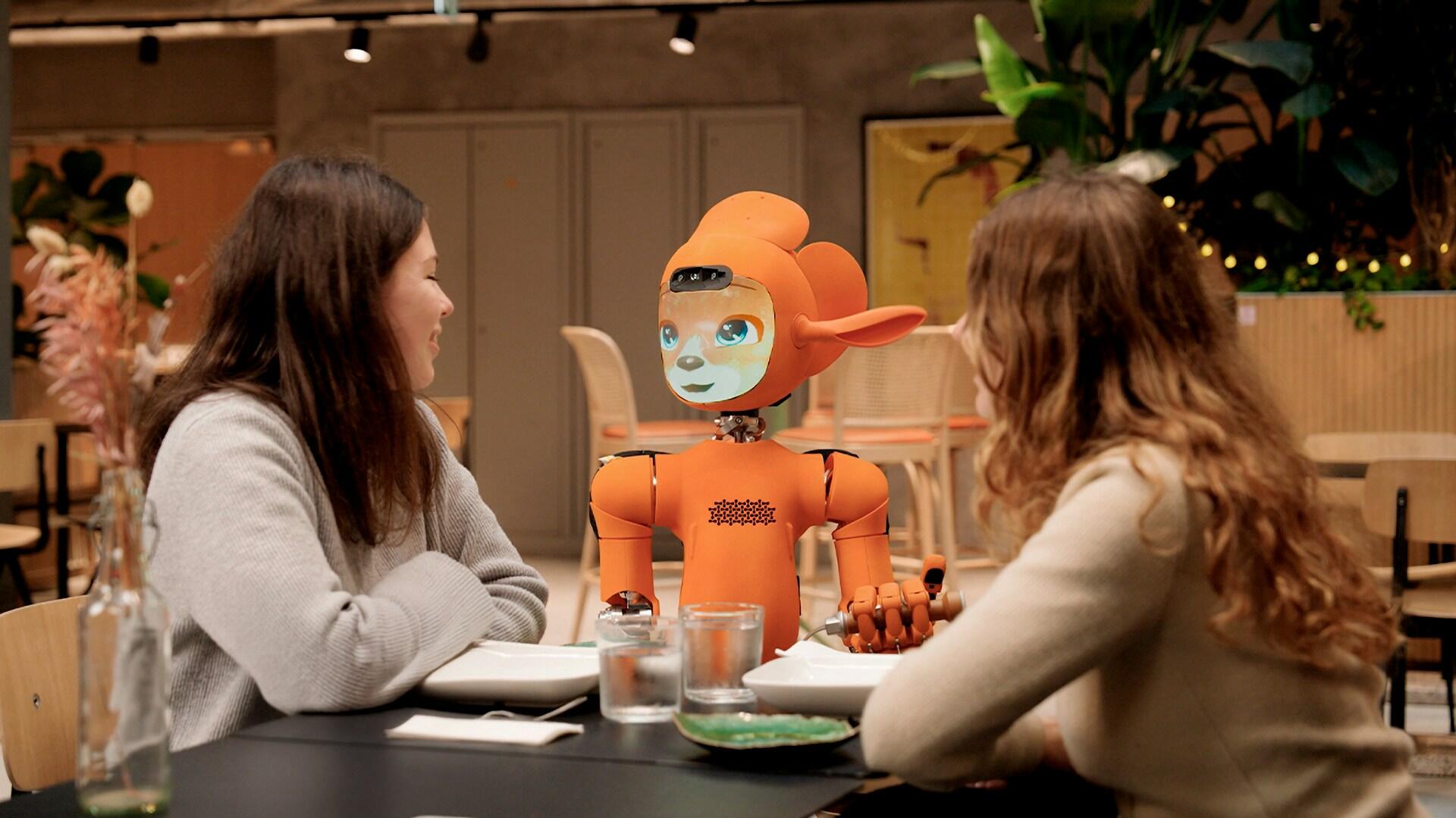
The debate is over; the future is digital. Even traditionally physical professions such as food service7 and plumbing are well on their way to becoming robot-driven.
As such, one career trend is towards building and managing robotic functions.
To help students develop work readiness, today's curriculum reforms prioritise computer skills and digital literacy.
Digital literacy comprises a range of skills, including the ability to locate, evaluate, create, and communicate information in the digital realm.
At this time, the emphasis must be on the second skill, the ability to evaluate information. Artificial intelligence (AI) is a new technology with infinite possibilities. However, just now, it's proven itself great at creating slop8, causing everyone trouble trying to determine what's real online. Unfortunately, AI's more remarkable accomplishments get practically no press.
Prioritising digital skills and literacy is one direction that current curriculum reforms are taking. This type of learning should happen alongside academic learning. What about practical skills, though? The type we typically learn in school?
AI has arguably shaken up the educational landscape more than any innovation in the past century. Today's students wonder what university degree plan might protect their future from AI advances. Clearly, the way forward is to master the skills AI can never perform. Digital and life skills top that particular list.
AI has already proven adept at coding, though work still needs to be done to improve AI code accuracy and functionality.
A few years ago, coding was THE degree to aim for. Today, anyone aiming for a career in the digital realm should shift their focus to programming. The difference between coding and programming is subtle but distinct:
Coding
Writing lines of code that instruct a computer program to execute specific functions in a certain order.
Programming
Concerns itself with the entire software development environment, from system architecture to designing algorithms.
Programming is a skill that AI will never be capable of, so you might consider it AI-proof. Otherwise, as long as you prioritise 'human skills', such as the ones this article details, you'll be well on the path to work readiness. Still, you should not discount mastering AI systems, as they are here to stay.
Work Readiness: Lifelong Upskilling
The only constant is change.
Heraclitus
This oft-used (and probably misinterpreted) statement hints at the one quality that guarantees survival and success in an ever-changing environment: adaptability.
People who can adapt to new conditions and circumstances are the ones who always manage to somehow land on their feet. But humans aren't the only animals with adaptive capabilities. Adaptation lies at the heart of Charles Darwin's evolution thesis.
However, the world humans have built for themselves demands conscious adaptability, not genetic. That, in turn, demands that people develop the skills needed to make themselves adaptable.

That is the overarching goal of the DfE's education reform initiatives. Being financially literate puts people in a position to ensure meeting their most basic needs: housing, food, and clothing. With those needs assured, people have the latitude to branch out in any direction they choose.
Also called lifelong learning and upskilling, it entails enhancing existing skills while developing new ones.
The updated curriculum proposes to educate legions of lifelong learners, be they SEND students in mainstream schools or top performers in elite learning facilities.
But lifelong learning doesn't mean staying in school forever. It means having a learning mindset that prioritises gaining knowledge. Any type of knowledge, be it formal work skills or skills for life. Cross-training is an extension of upskilling, sort of like a plumber learning how to be an electrician.
For far too long, people had the idea that, once they were done with school, they were done learning. As a society, we've finally concluded that that mindset is exactly what causes stagnation and decline.
It's not too late to pivot to a proactive learning strategy. After all, if change is the only constant, then having a wide range of skills to adapt to changes is the only possible way forward.
Future Skills: Where to Learn More
- ““It All Starts with Skills” Campaign Introduction and Background.” GOV.UK, 1 Apr. 2025, www.gov.uk/government/publications/it-all-starts-with-skills-campaign-introduction-and-background/it-all-starts-with-skills-campaign-introduction-and-background. Accessed 10 Jan. 2026.
- Jackson, Isabel. “UK Economy Losing £26bn a Year to Youth Unemployment, PwC Research Finds.” Peoplemanagement.co.uk, PeopleManagement, 12 Dec. 2025, www.peoplemanagement.co.uk/article/1942989/uk-economy-losing-26bn-year-youth-unemployment-pwc-research-finds. Accessed 10 Jan. 2026.
- Yates, Scott, and Malcolm Payne. “Not so NEET? A Critique of the Use of “NEET” in Setting Targets for Interventions with Young People.” Journal of Youth Studies, vol. 9, no. 3, July 2006, pp. 329–344, https://doi.org/10.1080/13676260600805671.
- The Franchise Network. “The Franchise Network - Unitemps Franchise.” Unitemps Franchise, 16 Oct. 2025, www.unitempsfranchise.com/the-franchise-network/. Accessed 10 Jan. 2026.
- Department for Education. “Government Crackdown on Rogue University Franchises.” GOV.UK, 9 Dec. 2025, www.gov.uk/government/news/government-crackdown-on-rogue-university-franchises. Accessed 10 Jan. 2026.
- Wilkin, Linda . “Future-Proof Your Career: Top Skills for 2030 | ABE UK.” Abeuk.com, 24 Sept. 2025, www.abeuk.com/future-proof-career-skills-2030. Accessed 10 Jan. 2026.
- BBC. “Japanese Cafe Uses Robots Controlled by Paralysed People.” BBC News, 6 Dec. 2018, www.bbc.com/news/technology-46466531. Accessed 10 Jan. 2026.
- Down, Aisha. “From Shrimp Jesus to Erotic Tractors: How Viral AI Slop Took over the Internet.” The Guardian, The Guardian, 27 Dec. 2025, www.theguardian.com/technology/2025/dec/27/from-shrimp-jesus-to-erotic-tractors-how-viral-ai-slop-took-over-the-internet. Accessed 10 Jan. 2026.
- McLeod, Saul. “Maslow’s Hierarchy of Needs.” Simply Psychology, 3 Aug. 2025, www.simplypsychology.org/maslow.html. Accessed 11 Jan. 2026.
- Money Ready. “Only 2/5 Young Adults Are Financially Literate - Money Ready.” Money Ready, 29 May 2025, moneyready.org/update/report-on-financial-education-in-schools/. Accessed 11 Jan. 2026.
Summarise with AI:
Did you like this article? Leave a rating!

 Loading...