
Philosophers debate whether the concept of time is manmade but physicists insist that time is an essential part of the universe. No matter where you stand on the time debate, you need words to describe how time passes and explain how to measure it. Prepositions of time serve those purposes; they connect our reality and activities to a given timeframe. These are the time prepositions we explore in this article.
| Preposition | Use when talking about... | Sample usage |
|---|---|---|
| in | parts of the day months seasons years | In the morning, in the afternoon. In November, in December In the winter, in the spring I haven't been home in years! |
| at | time of day mealtimes expressions holidays | I wake up at 6:00 AM. I eat lunch at noon. I don't know where he is at the moment. at Christmas, at New Years |
| on | days dates | The week starts on Monday. My birthday is on March 13. |
| for | a period of time | I've lived here for 5 years. |
| since | ongoing action from a specific time. | I've lived here since 2019. |
| from - to | something that lasts for a specific time. | Office hours are from 8:00 AM to 4:00 PM. |
| before | something that happened before a specific time. | I lived in China before moving here. |
| after | something that happens beyond a specific time. | We go back to school after the holidays. |
| during | something that happens while something else is going on. | I read my book during the train ride. |
| until | something that happens up to a certain time. | I'll wait for you until 5:00 PM, but not a minute longer! |
| ago | something that happened sometime in the past. | I used to like her but that was a long time ago. |
| by | a time something must happen. | Be home by 5:00 or suffer punishment! |


In: The Busiest Preposition of Time
Of all the prepositions you study during your English classes, 'in' is the busiest - not just of time, but of all. English speakers use 'in' to describe many events and conditions, but one of 'in's most frequent uses is to describe time.
- My dad goes to work in the afternoon.
- My birthday is in May.
- Harvests usually happen in autumn.
- I bought my car in 2023.
- People born in the 90s are in their 30s now.
- The two Great Wars took place in the 20th century.
- Many animal and plant species died off in the last ice age.
You likely learnt about using 'in' for parts of the day, months, and seasons early in your English lessons1. Here, you see that we also use in to describe decades, years, ages, and centuries.
Use 'in' to describe general timeframes and large measures of time.
The Right and Wrong Ways to Use 'In'
Above, you read that 'in' describes parts of the day: 'in the morning', 'in the evening', and so on. What about 'in the night'? When using 'night' as a thing, you must use 'in'. However, if you use 'night' as a unit of time, you must use 'at'. Study these sentence pairs to understand the difference.
- She awoke at night, calling his name.
- I hate hearing scary noises at night!
- The thief ran away at night, after hiding all day.
- She woke in the night, calling his name.
- I hate hearing scary noises in the night!
- The thief ran away in the night.
Because 'in' has so many uses, students of English and native speakers alike often make mistakes. These are some of the most common ones my pupils make, and the correct way to express these ideas.
The mistakes
- in Monday
- at 1998
- at winter
- in 7:00 AM
- I was born during July
Say it right!
- on Monday
- in 1998
- in winter
- at 7:00 AM
- I was born in July
Besides using 'in' to describe time, you'll use it to describe fixed locations. "I'm in my room", for example, or "The ice cream is in the freezer." You can't assume that every 'in' you see represents time. In fact, 'in-on-at' are prepositions describing a place, too.
At: The Specific Preposition of Time
Learning all about prepositions can be confusing, but thankfully, the rules for this preposition's usage are easy. When you talk about exact times, such as the hour you wake up or the time your class ends, you must use the preposition 'at'.
When speaking informally, you might say 'around' if you can't or don't want to state an exact time or date. "We eat dinner around 7:00 PM", for example. Or "People are more generous around Christmas". However, 'around' is an adverb, not a preposition of time. So, it's only suitable for informal speech, not your classwork!
Depending on the type of English you speak, you will use either 'at' or 'on' for weekends.
British English speakers say, "I like going out at the weekend."
American English speakers say, "I like going out on the weekend."
The Right and Wrong Ways to Use 'At'
Confusing in-on-at usage ranks among the top preposition errors English learners (and native English speakers!) make2. These are the ones I hear most often in my classroom, alongside the correct phrases.
- I will travel to home at Tuesday.
- We open our presents at Christmas Day.
- I don't know where my mum is in the moment.
- I have another class in 10:30.
- I will travel home on Tuesday.
- We open our presents on Christmas Day.
- I don't know where my mum is at the moment.
- I have another class at 10:30.
On: The Time Preposition for Days and Dates
Did you happen to notice the 'Christmas' mistake above? Remember that 'at' is for holidays; Christmas is a holiday. However, 'on' is the preposition for days. The sentence says 'Christmas Day', which signals that the 'day' preposition - 'on' - must be used.
Days of the week: on Monday, on Sunday, on Thursday, etc.
Specific dates: on the 14th of February, on May 20, on December the 21st, and so on.
Specific days: on my birthday, on Christmas Day, on a fine summer day, etc.
The Right and Wrong Ways to Use 'On'
Incorrect usage
- We're going to Singapore on August.
- We have a big meal in Christmas Day.
- I'm going hiking on the weekend.
Correct usage
- We're going to Singapore in August.
- We have a big meal on Christmas Day.
- I'm going hiking at the weekend.
That last sentence is tricky! Remember that if you're studying American English, 'on the weekend' is correct. British English speakers say, "... at the weekend."
Beyond In, On, At: Preposition of Time Examples
The 'Big Three' time prepositions, in-on-at, cover a lot of ground but they do not work for every time expression. For the ones that do not fit into the in-on-at framework, these prepositions step in3.
From - To / Until
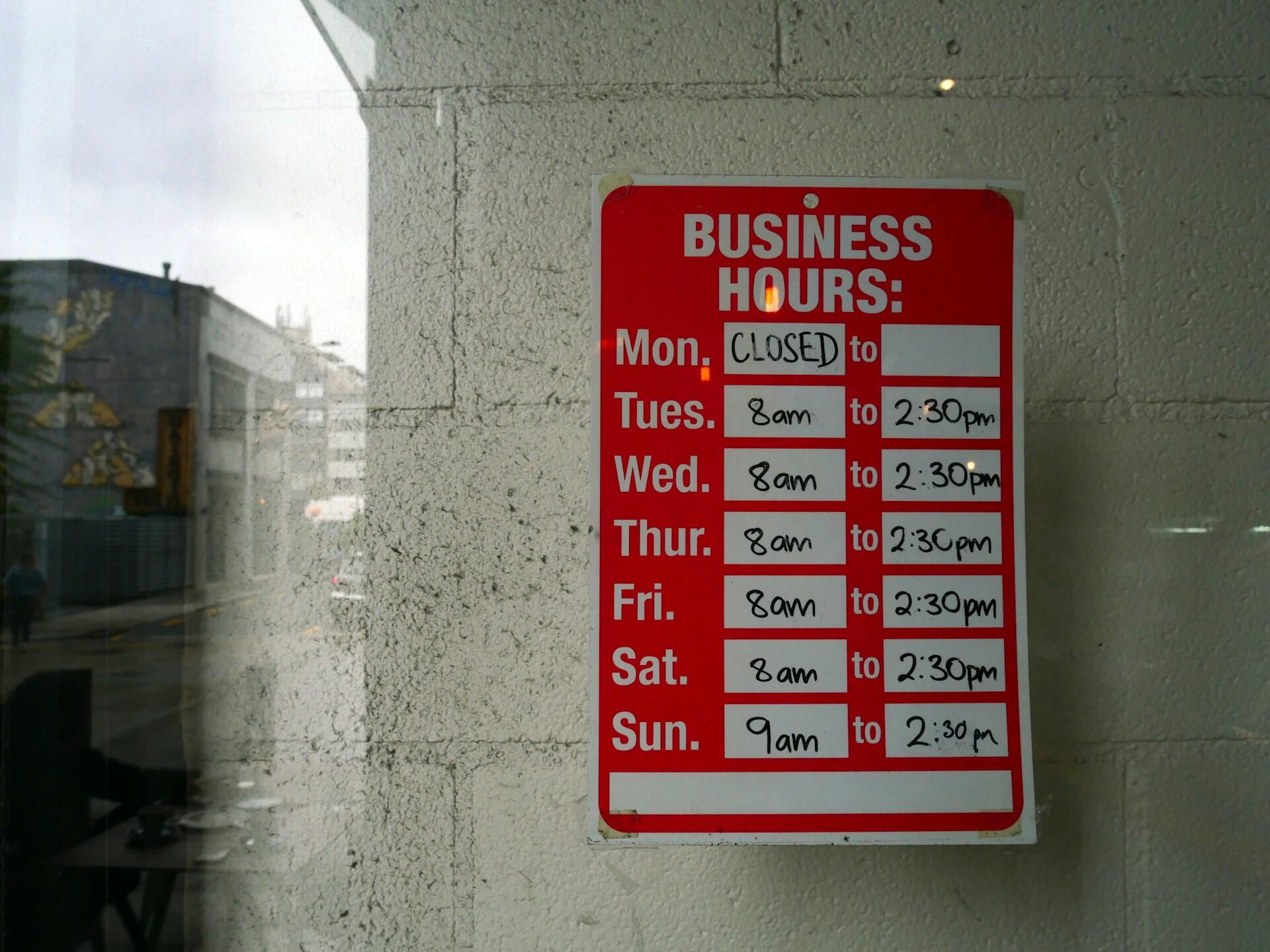
When you're talking about a window of time, these are the prepositions to use. 'From' opens the window, and 'to' closes it. 'Until' serves the same purpose as 'to'; you may use one or the other - but not both! - in your sentences.
Naturally, you may use 'from' and 'until' separately. "From 8:00 onwards, it was impossible to find a ticket.", for example. Or, "I'll wait until 6:00 PM but not a minute longer!"
Since and For
This preposition pair is the one that confuses students the most, in my classes as well as across the internet4. However, the rules are simple, as these examples demonstrate.
Since (from a firm date or time)
- "I've lived here since 2018."
- "They've been playing since 3 PM."
- "She's worked here since she was 28 years old."
For (the length of time something lasts)
- I've lived here for eight years.
- They've been playing for two hours.
- She's worked here for four years.
Unlike some of the prepositions describing the manner we do things, this preposition pair has clear and definite rules. If you're talking about an activity that started at a specific time, 'since' is the preposition you need. If you're talking about how long an activity has been going on, use 'for' every time.
During
During (preposition)
- It describes something that happens while something else is going on.
- Construction: "... verb-'during'-noun."
- Example: It snows during the winter.
While (adverb)
- It describes an action taking place as some other action takes place.
- Construction: "... while verb+ing"
- Example: Don't put your makeup on while driving!
Note the difference in construction between the 'during' and 'while' sentences. 'During' is followed by a noun; 'while' is followed by a verb (in gerund form). This is a handy way to decide when to use 'during' and when you should use 'while'!

Words that Act Like Time Prepositions but Aren't
Adverbs may seem like prepositions of time because they tell us when something happens. The easiest way to tell if you're dealing with such an adverb or with a preposition is to study how the sentence ends. If the 'time word' finishes the sentence, it is an adverb. These sentences provide examples of such.
If a noun follows the 'time word' (in, on, at, or others), you're dealing with a preposition of time. You may have noticed this pattern while reading all the sample sentences throughout this article. It the 'time word' ends the sentence, it's an adverb of time.
English speakers often use 'next' and 'last' to describe time.
However, they are also adverbs, not prepositions.
You can say "I graduated last year." but saying "I graduated in last year" is incorrect. Likewise, you can say "I will graduate next spring." but saying "I will graduate in next spring." is incorrect.
Practising With Prepositions of Time
Now that you know the rules and have examples to follow, it's time to put your knowledge to work. This flashcard deck isn't too challenging but it will help you practise your time preposition usage. Once you master this group of prepositions, you can begin studying prepositions that define movement.
Preposition of Time Examples in Action
- The British Council. “Prepositions of Time: “At”, “In”, “On.”” LearnEnglish, 9 Feb. 2023, learnenglish.britishcouncil.org/grammar/a1-a2-grammar/prepositions-of-time-at-in-on. Accessed 21 Feb. 2026.
- Vedantu. “Prepositions of Time with Rules and Examples.” VEDANTU, Vedantu, 28 Nov. 2020, www.vedantu.com/english/preposition-of-time. Accessed 21 Feb. 2026.
- elsaspeakadmin. “Prepositions of Time: Everything You Need to Know.” ELSA Speak - Your 24/7 A.I English Speaking Companion, 13 Oct. 2025, blog.elsaspeak.com/en/prepositions-of-time/. Accessed 21 Feb. 2026.
- “Confusion Regarding “Since” vs “For.”” English Language Learners Stack Exchange, 2024, ell.stackexchange.com/questions/354836/confusion-regarding-since-vs-for. Accessed 21 Feb. 2026.
Summarise with AI:
Did you like this article? Leave a rating!

 Loading...