

I don't like to admit to having taken piano lessons when I was a child. Not because I feel doing so somehow diminishes my social standing or credibility. I was just so terrible at playing! As best I recall, playing scales bored me silly and I don't think I even made it to arpeggios.
I remember vividly how my piano teacher told my mother I simply didn't have to talent to play. I believe that stinging remark was unfair. After all, unless a beginner player is a prodigy, they have to have the room to make intuitive leaps. Beyond the initial thrill of placing one's fingers on the keys for the very first time, does any novice player enjoy practising scales?
Maybe you're not wild about running piano scales and arpeggios either. But you won't ever have the chance to develop your piano technique unless you understand:
- why scales are important
- what arpeggios are (and why they are important)
- how fast you should play your scales and arpeggios
- how scales and arpeggios are used to make music
In this article, we won't talk about piano pedalling. The focus today is all on working your hands and developing piano technique. We will toss you a spoiler, though.
You must practise every day, minding your form and fingering as you play. It wouldn't do for you to injure yourself just as you start to learn, would it? And besides, bad posture and inadequate fingering will make it harder for you to play more difficult pieces.


Mastering the Scale
Contrary to popular opinion - including my own, way back when, piano scales are not torture devices meant to turn piano hopefuls away from learning. Bland and uninspiring as they seem, piano scales are crucial to developing technique. But they have another major point in their favour that you won't see if you only look at sheet music scales. These exercises feature in just about every melody line, even if just in miniature version.
Find out about taking piano lessons in Bristol here.

Scales run note by note, octave by octave, up and down the piano keyboard. You may already know that an octave consists of eight whole notes. More specifically, an octave represents the interval between one musical pitch and the next. For instance, the C major scale begins and ends with C - C D E F G A B C. Thus, the interval between the two C notes is one octave.
For our purposes, we'll use the C major scale because it's the simplest to understand. Before we get started, let's make clear that this scale has no black notes. Furthermore, like all major scales, C major comprises the same intervals - the same distance between notes.
There's just one question. If each of your hands has only five digits, how can you play eight notes? We'll explore the proper technique with your right hand, first.
Place your thumb on the low C and then, play D and E with your next two fingers. You'll play F by crossing your thumb under your third digit and then, use the rest of your fingers to finish the scale. Your small finger should have played the high C and it will do so again to come down the scale.
You'll play each note with a successive finger. With your thumb on F, cross your middle finger over your thumb to play the scale's final two notes. Once again, your thumb should play the lower C note. Make sure you feel comfortable with right-hand fingering before you tackle scales with your left hand.
As you pass your thumb under your middle finger, try not to rotate your wrist. This is where proper form is important. Your hand should hover over the piano keyboard with your fingers slightly curved. Keeping your wrist straight as you play is the best way to ensure your hand's position.
Once you're certain of your right-handed fingering, it's time to train your left hand. It works in reverse, with your little finger on lower C. You'll play five notes before crossing your middle finger over your thumb to play the final three. To run down the scale, simply play the first three notes, starting with your thumb on high C. Once your middle finger plays A, cross your thumb under that finger to finish the scale.
As soon as both of your hands can run the scale without any major fingering pauses, it's time to run two-handed scales. Depending on how comfortable you are using your hands separately together, it may take you a while to get used to this exercise. But of all the aspects of learning how to play the piano, getting scales down pat is the most crucial. So don't limit yourself to C major; run through all the octaves.
Taking piano lessons is the best way to master the piano scales. Your teacher can give you helpful and advice and correct your posture quickly so that you don't learn any bad habits.

Understanding the Arpeggio
We spent quite a bit of time on scales because they are the most vital practice you can undertake to get both your fingering and form right. After a few weeks of daily scale practice, you'll be ready for arpeggios. An arpeggio is essentially every other note in an octave. Sticking with our C major selection, you would successively play C E G C.
Start your right hand's thumb playing lower C. Your index finger will touch and release E and your middle finger will do the same on G. You'll pivot your hand slightly so that your little finger can play high C. Even if your hand can span a full octave, doing so is bad form and risks injury.
It's best to always keep your wrists straight and fingers slightly arched. You only need to swing your elbow out a bit to pivot your hand into the proper position to play the high C. But even so, try to keep your arm's motion minimal. You needn't make any dramatic moves.
The left-handed arpeggio mirrors the right-hand fingering. Notably, you won't exercise your ring (fourth) finger on either hand. As you learn to play major and minor arpeggios, note the differences in their tones.
Minor arpeggios tend to have more of a mournful quality compared to major arpeggios. If you want to learn to play jazz piano - and you should! - you'll need to master playing arpeggios. They tend to recur in piano jazz and classical music, too.
How Are Scales and Arpeggios Musically Relevant?
By now, you should have the idea that scales and arpeggios aren't just torture exercises. They provide the foundation upon which you will build all of your piano skills. They will help you identify note patterns in sheet music and recognise melodies. Learning piano chords and keys will be much easier, too.
To advance your playing, you might try listening for (and playing) arpeggios in Pachelbel's Canon in D. If you'd rather something more fundamentally classical, have a listen to the third movement in Beethoven's Moonlight Sonata. What a great way to train your ear!
Or how about something more challenging? Leonard Cohen's Hallelujah features left-hand arpeggios. Can your ear pick them out?
The Optimal Metronome Settings
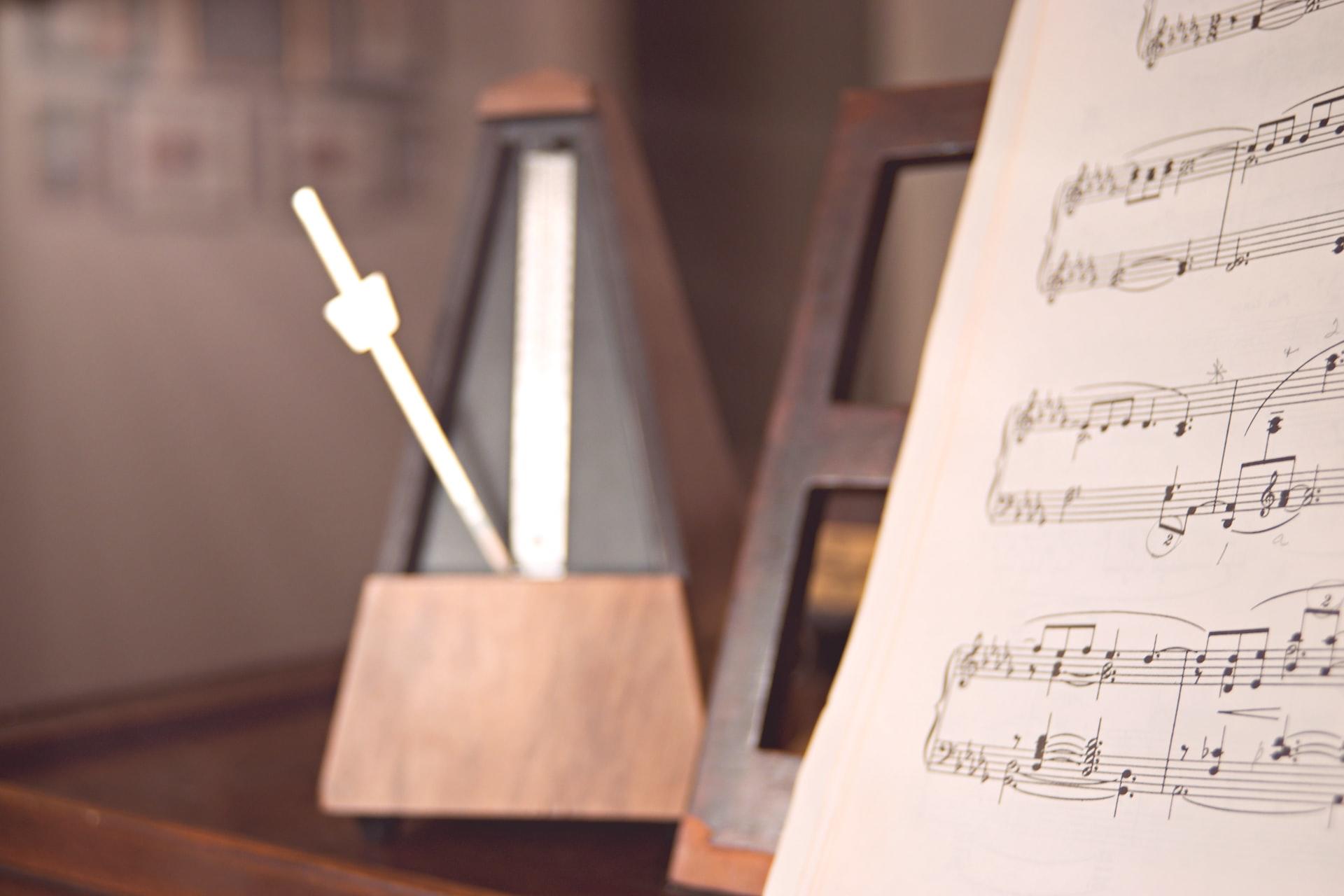
Tempo is the only thing left to talk about. How fast should you play your scales and arpeggios? Remembering my piano days, monotony set in pretty quickly but my teacher insisted on a maddeningly slow metronome. You should too, at first. If you'd like one-to-one guidance, consider piano lessons in London.
Give yourself time to develop good piano-playing habits. Mind your form and perfect your fingering. When you have the fundamentals firmly in hand, you can start to build speed.
In fact, you don't need to be at the piano to build speed. You can practise fingering as you walk, ride the bus or watch the telly. You may even download a virtual keyboard to help build up your dexterity. Those are great if others in your house don't want to hear you practise scales for hours on end, too.
But when you're at the piano, start with your metronome in a slow setting. As soon as you sense yourself racing ahead of your timing device, increase its speed by 10 beats per minute (bpm). In fact, when you have to hold yourself back to keep up with your metronome, start boosting its by speed of 10 bpm every week.
It wouldn't be a bad idea to video your practice sessions. That would be the best way to capture your fluidity of movement and your growing confidence as a piano player. You will also be able to spot form and posture flaws that could hinder your playing or cause an injury.
And if you have a chance to play a duet with a partner, you will definitely want to assess your performance. Sharing a piano bench and playing in sync is a whole other level of piano skill mastering scales and arpeggios can take you! So there you have another reason to view scales and arpeggios as valuable skill-building exercises.
Summarise with AI:
Did you like this article? Leave a rating!

 Loading...