The centralised QTS Professional Skills Tests in numeracy and literacy were abolished in March 2020. Prospective teachers in England are no longer required to sit a national numeracy skills test before beginning Initial Teacher Training (ITT).
Since October 2020, each ITT provider is responsible for assessing candidates' numeracy skills — typically through a maths test at interview or as a condition of offer. The practice material on this page covers exactly the same skills that were tested, and that ITT providers continue to assess today.
If you are applying for a PGCE, School Direct, Teach First, or any other route into teaching in England, you will almost certainly be tested on your numeracy skills at some point in the application process. While the old centralised QTS numeracy test no longer exists, ITT providers now set their own maths assessments — and they test the same core skills: mental arithmetic, percentages, ratio and proportion, averages, and the ability to read and interpret statistical data in an educational context. This page explains what those skills are, how they are assessed today, and gives you structured practice questions with full worked solutions so you can prepare with confidence.
The practice questions below are mapped to the topic areas covered by the original QTS numeracy test and by current ITT interview assessments. Each exercise carries a difficulty rating and a curriculum label so you know exactly what level of knowledge is being tested.






About QTS Numeracy Tests
The QTS Professional Skills Test in numeracy ran from 2000 until March 2020. From 2012, it became a compulsory prerequisite: candidates had to pass before they could begin an ITT course. The test had two sections.
A combination of factors led to its removal. Around 10% of candidates failed at least one sitting each year, creating a recruitment barrier at a time of acute teacher shortage. The test had also been subject to well-publicised administrative errors, high costs for resits, limited test centre availability, and criticism that 18 seconds per mental arithmetic question was not a realistic measure of classroom numeracy. In place of the national test, ITT providers now benchmark candidates against the DfE's defined set of literacy and numeracy standards, assessed through their own methods — most commonly a written test at interview.
What Has Replaced the QTS Numeracy Test?
Since October 2020, the ITT numeracy landscape had three main components, and it is important to understand which one applies to you.
What Skills Are Tested?
The table below maps each topic area to its corresponding curriculum level. All of this content appears on the GCSE Maths specification (any board) and is assessed by ITT providers today.
| Topic area | Curriculum level | Calculator? | Appears in |
|---|---|---|---|
| Mental arithmetic: four operations | KS3 / GCSE Foundation (Grade 1–3) | No | Mental arithmetic section; ITT interview |
| Fractions, decimals, percentages | GCSE Foundation–Higher (Grade 3–6) | No (mental) / Yes (written) | Both sections; GCSE equivalency test |
| Time and unit conversions | KS3 / GCSE Foundation (Grade 2–4) | No | Mental arithmetic; ITT interview |
| Ratio and proportion | GCSE Foundation–Higher (Grade 4–6) | Yes | Written data section; GCSE equivalency test |
| Mean, median, mode, range | GCSE Foundation (Grade 3–5) | Yes | Written data section; GCSE equivalency test |
| Reading tables and charts | GCSE Foundation–Higher (Grade 4–6) | Yes | Written data section; ITT interview |
| Percentage increase/decrease | GCSE Foundation–Higher (Grade 4–6) | Yes | Written data section; GCSE equivalency test |
QTS Learning Objectives:
Some of the skills you should be able to master for the QTS include:
- Perform mental arithmetic calculations involving fractions, decimals, percentages, time, and simple conversions without a calculator
- Calculate mean, median, mode, and range from raw data and from frequency tables
- Extract and compare information from tables, bar charts, and line graphs in an educational context
- Solve problems involving ratio, proportion, and percentage change in realistic teacher-relevant scenarios
- Apply these skills under timed conditions, recognising the format of ITT interview numeracy assessments
Mental Arithmetic Section
This section is an audio based test, hence the candidate is required to use headphones. It contains 12 questions, and it assesses the candidate's ability to solve arithmetic questions. These questions cover the following topics:
- the four basic operations
- time
- fractions
- decimals
- percentages
- measurement
- conversions
Written Arithmetic and Data Analysis Section
This section of the test contains a series of problems to assess the candidate's ability to interpret and use the written data to recognise trends, compare and interpret information or data. In this section, the candidate's ability to solve written arithmetic questions in different areas is tested. These areas include:
- time
- money
- proportion and ratio
- conversions
- averages and ranges.
Tips for ITT Interview Numeracy Assessments
Mental arithmetic: use benchmark values. For questions without a calculator, anchoring on friendly numbers saves time. 10% of any number is found by dividing by 10; build other percentages from there (e.g. 35% = 3 × 10% + 5%). For fractions, memorise the decimal equivalents of common fractions ( ,
,  ,
,  ).
).
Data questions: Read the table before looking at the question. Spend 15–20 seconds identifying what the rows and columns represent, what units are used, and what time period is covered. This prevents the most common error on data interpretation questions — using the wrong row or column.
Show your working even if a final answer is not required. In provider-set tests that are marked by a person rather than a computer, a correct method with a minor arithmetic error will often receive partial credit. Write down the calculation you are performing.
Check the question asks for a number, percentage, or fraction. A question asking "how many pupils?" requires a whole number answer. A question asking "what fraction?" requires a fraction in its simplest form. A question asking for a percentage to one decimal place penalises rounding errors. Always check the required form before writing your final answer.
QTS: Official Resources
The DfE no longer publishes or hosts QTS numeracy test materials, as the test has been abolished. The practice papers formerly circulated as "official past papers" were sample papers produced by the test provider (Learndirect) rather than genuine past papers in the way GCSE past papers are produced. The PDFs hosted on third-party sites have not been updated since 2020 and reflect a test format that no longer applies.
For current preparation, the most useful official and verified resources are listed below.
DfE official pages
- Changes to the professional skills test for teachers — the original DfE announcement (gov.uk) confirming the abolition of the QTS skills tests and the move to provider-led assessment
- Initial Teacher Training (ITT): criteria and supporting advice (2025–26) — mandatory guidance on entry requirements and the literacy and numeracy standards ITT providers must ensure trainees meet
- Qualified Teacher Status (QTS): qualify to teach in England — overview of what QTS is, who needs it, and how to obtain it
- What is QTS? (Get Into Teaching) — DfE's candidate-facing explanation of QTS, including entry qualification requirements
Finding and applying for ITT courses
- Find Teacher Training Courses — the official DfE service listing all accredited ITT courses in England; each course page shows whether the provider accepts equivalency tests and what numeracy/literacy evidence they require
- Apply for Teacher Training (GOV.UK) — the official application portal for postgraduate ITT courses in England
- Get Into Teaching (DfE) — free support and advice service from the Department for Education for prospective teachers, including subject knowledge enhancement, funding, and routes into teaching
GCSE Maths Equivalency Test (if you do not hold a GCSE grade 4 in maths)
- A Star Equivalency — the UK's most widely accepted provider of GCSE Maths, English, Science, and Biology equivalency tests; certificates accepted by the majority of ITT providers
- Book the GCSE Maths Equivalency Test — online booking page; exams available six days a week, year-round, with standard (10 working day) or fast-track (2 working day) results
- A Star Equivalency past papers (free with registration) — free access to past and sample papers for all equivalency test subjects after registering for an online account
- How the equivalency test works — step-by-step guide to the booking and sitting process, including what to expect on the day and how results are issued
QTS Practice Questions
Mark scheme notation:
M1 = method mark (awarded for a correct method even if the answer is wrong);
A1 = accuracy mark (awarded only for a correct answer following the correct method);
B1 = independent mark for a specific correct statement or value.
Each question is worth 1 mark in a real assessment, but the worked solutions below show the full method.
Mental Arithmetic
Exercise A1 ★☆☆ KS3
A school day is divided into 5 equal lessons. The school day runs from 08:50 to 15:20. How many minutes does each lesson last?
Step 1 — Find the total length of the school day.
From 08:50 to 15:20 is  hours and
  minutes
  minutes. (M1 — correct total)
Step 2 — Divide equally among 5 lessons. minutes per lesson. (A1)
Answer: 78 minutes.
Exam tip: Convert to a single unit (minutes) before dividing. Do not try to divide hours and minutes separately — this is the most common error on time questions.
Exercise A2 ★☆☆ GCSE Foundation
A teacher marks  of a set of 56 exercise books before lunch. How many books remain to be marked?
Step 1 — Find of  .
. books marked. (M1)
Step 2 — Subtract from total. books remaining. (A1)
Answer: 35 books.
Alternative method:  of 56 remain.
 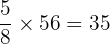 . Both methods earn full marks.
Mental Arithmetic: No calculator | KS3–GCSE Foundation
Exercise A3 ★☆☆ GCSE Foundation
A school trip costs £45 per pupil. 32 pupils attend. What is the total cost of the trip?
Step 1 — Multiply cost per pupil by number of pupils.
A useful mental method:  . (M1 + A1)
Answer: £1,440.
Exercise A4 ★★☆ GCSE Foundation
In a class of 30 pupils, 40% achieved a merit in their end-of-term assessment. How many pupils did not achieve a merit?
Step 1 — Find 40% of 30. pupils achieved a merit. (M1)
Step 2 — Subtract from total. pupils did not achieve a merit. (A1)
Answer: 18 pupils.
Mental shortcut: 40% of 30 = 4 × (10% of 30) = 4 × 3 = 12. Then 30 − 12 = 18.
Exercise A5 ★★☆ GCSE Foundation
A pupil scores 34 out of 40 on a test. Express this as a percentage.
Step 1 — Divide the score by the total and multiply by 100. (M1 — correct fraction formed)
Step 2 — Simplify.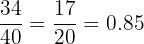 , so
, so  . (A1)
Answer: 85%.
Exercise A6 ★★☆ GCSE Foundation
A teacher travels 12.4 km to school each morning. She works 195 days per year. What is the total distance she travels to school in a year, in kilometres?
Step 1 — Multiply distance by number of days. (M1)
(M1)
Use a convenient split:  , then subtract
  .
. km. (A1)
Answer: 2,418 km.
Averages and Range
Exercise B1 ★☆☆ GCSE Foundation
A class of 8 pupils scored the following marks in a spelling test (out of 20):
14, 18, 12, 20, 15, 14, 17, 10
Find: (a) the mean, (b) the median, (c) the mode, (d) the range.
(a) Mean
Sum of scores:  (M1 — correct sum)
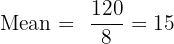 (A1)
(A1)
(b) Median
First, order the data:  (M1 — ordered correctly)
With  data points, the median lies between positions
  and
and  .
.
Values at positions 4 and 5 are  and
and  .
. (A1)
(A1)
(c) Mode appears twice; all other values appear once.
Mode  (B1)
(B1)
(d) Range (B1)
(B1)
Exercise B2 ★★☆ GCSE Foundation
A pupil's reading age is assessed four times across Years 7 and 8. Their scores (in months above chronological age) are:  . What is the mean deviation from chronological age?
Step 1 — Sum the four values, taking signs into account. (M1)
(M1)
Step 2 — Divide by the number of readings. months above chronological age (A1)
Answer: 4 months above chronological age.
Ratio and Proportion
Exercise C1 ★★☆ GCSE Foundation
A school allocates its annual book budget in the ratio of English : Maths : Science = 5 : 3 : 2. The total budget is £6,400. How much does the Science department receive?
Step 1 — Find the total number of parts. parts in total. (M1)
Step 2 — Find the value of one part.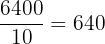 per part.
Step 3 — Multiply by Science's share (2 parts). (A1)
(A1)
Answer: £1,280.
Exercise C2 ★★☆ GCSE Foundation–Higher
In a year group of 180 pupils, the ratio of pupils who achieved the expected standard in reading to those who did not is 7 : 2. How many pupils achieved the expected standard?
Step 1 — Total parts:  . (M1)
Step 2 — Value of one part:  pupils.
Step 3 — Pupils achieving expected standard (7 parts):  . (A1)
Answer: 140 pupils.
Exercise C3 ★★★ GCSE Higher
A school's SEND team spends time supporting pupils in three year groups: Year 7, Year 8, and Year 9, in the ratio 4 : 3 : 1. The team works a combined total of 480 hours per term. Year 9 receives 4 hours more support than originally planned, without changing the total hours available. If the new Year 9 allocation is used, what fraction of the total support time does Year 9 now receive?
Step 1 — Find the original Year 9 allocation.
Total parts:  . One part
 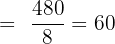 hours.
Year 9 originally receives  hours. (M1)
Step 2 — Apply the increase.
New Year 9 allocation  hours. (M1)
Step 3 — Express as a fraction of the total (still 480 hours). (A1)
(A1)
Answer:  of total support time.
Percentage Change
Exercise D1 ★★☆ GCSE Foundation
In 2022, a school had 840 pupils on roll. By 2024, this had risen to 903 pupils. Calculate the percentage increase in pupil numbers between 2022 and 2024.
Step 1 — Find the actual increase. pupils. (M1)
Step 2 — Express as a percentage of the original value.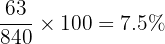 (A1)
(A1)
Answer: 7.5% increase.
Always divide by the original (starting) value, not the new value.
Exercise D2 ★★☆ GCSE Foundation–Higher
A school's absence rate was 6.5% in the autumn term. It fell by 20% in the spring term. What was the spring term absence rate?
Careful — this is a percentage of a percentage.
Step 1 — A 20% decrease means we multiply by  . (M1)
Step 2 — Apply to 6.5%. (A1)
(A1)
Answer: 5.2% absence rate in the spring term.
A common wrong answer here is  (subtracting percentage points). The question asks for a 20% reduction of the existing rate, not a 20 percentage point reduction.
Exercise D3 ★★★ GCSE Higher Grade 6
After a 15% increase in funding, a department's budget is £23,000. What was the budget before the increase?
Step 1 — After a 15% increase, the new amount represents 115% of the original.
So  (M1 — correct multiplier identified)
Step 2 — Divide to find the original. (A1)
(A1)
Answer: £20,000.
A common error is to subtract 15% from £23,000, giving £19,550. This is wrong — you cannot reverse a percentage increase by subtracting that same percentage from the new value.
QTS Numeracy Help Sheet
The help sheet below can be quite useful for you if you are planning to take QTS Numeracy test:
QTS Numeracy Practice Papers
These tests are freely available on the Department for Education website.
- QTS Numeracy Practice Paper 1
- QTS Numeracy Practice Paper 2
- QTS Numeracy Practice Paper 3
- QTS Numeracy Practice Paper 4
Summarise with AI:
Did you like this article? Rate it!

 Loading...