>

All questions on English language

COLLOQUIALISMS


Can anyone tell me what this means in English with regards to grammar. How does this play an important role in writing.

Answers
Colloquialism is language that is generally used in informal writing. It usually takes the form of phrases such as, 'I wasn't born yesterday' or 'how's it going?' This type of language is an important part of non-fiction or creative writing because it adds a sense of realism. For instance, it makes more sense for an American character to use language such as 'Hey guys! What's up?' to address a group of peers rather than a formal greeting of 'Hello, how do you do?'
Ava A.
25 September 2015
I apologise for my mistake, I intended to write 'fiction or creative writing.'
Ava A.
25 September 2015
In literature, colloquialism is the use of informal words, phrases or even slang. As writers we are naturally bound to add colloquial expressions Similar to the way we speak. However, writers also use such expressions intentionally as it gives their work a sense of realism. 
Rachel D.
04 October 2015
In literature, colloquialism is the use of informal words, phrases or even slang. As writers we are naturally bound to add colloquial expressions Similar to the way we speak. However, writers also use such expressions intentionally as it gives their work a sense of realism. 
Rachel D.
04 October 2015
phrases used when in an informal setting e.g. gonna, wanna, as opposed to I am going to go/ I want to go.hope this helps
Katie G.
14 October 2015
Colloquialisms is another way of saying slang. Its words that are familiar to a country but are not seen as proper English. It is an informal way of speaking. So towards grammar for example you should not use the word "init" and "earful" they are not used when talking to an important person and should not be used in essays.Hope this is helpful.Jess
Jessica P.
10 December 2015
This is a really good question. Colloquialisms are words that are very informal and are used in normal conversation. They sound exactly like they are said. Often, we can tell where a person is from because of Colloquialisms. They are very important in writing. In poetry, poets sometimes use colloquialisms to show where they are from. In the poem 'Half Caste' the poet uses colloquialisms to show his dialect:Explain yuselfwha yu meanwhen yu say half-casteWe can see that you is spelt 'you' - this is because he would pronounce the word as 'yu'. For more colloquialisms, read the entire poem 'Half Caste'
Katherine D.
10 July 2017
>
Add an answer

Similar questions

Grammar

Complete the blanks with the Past Simple, Past Progressive, Past Perfect Simple or Past Perfect Progressive of the verbs in brackets.

1) Last year I .....(go) on an exciting safari holiday in Namibia with my husband. 2) I remember it ....(rain) continously for several days in Brussels before we ....(leave), so I couldn't wait to board the plane which ....(head) for sunnier climes. 3) Our safari holiday ....(be) unique in that, unlike many other safari holidays, the aim was not just to show a bunch of tourists some wild animals; while on holiday we would be volunteering at a conservation centre. 4) Our first night in the bush, while the biologists ....(entertain) everyone with tales, I ....(sit) back and ....(gaze) at the patterns made by the stars. 5) At one stage I ....(get) up to stretch when all of a sudden I ....(see) a huge creature nestled on my husband's shoulder; I ....(let) out an embarrassing squek of fear. 6) Apparently it was just a stick insect. Not like any stick insect I ....(ever/see); it was as big as my forearm. 7) The next day we ....(set) off early; our task was to make a note of any wildlife we saw. 8) While we .... (walk) through the thick forest, we ....(hear) birds and monkeys chattering in the trees. However after three hours, the novelty ....(wear) off, and I was exhausted. 9) And then I ....(see) it. A deer ....(stand) under a tree just a few metres away from me; I proudly ....(make) a note on my pad. 10) The next day, while we ....(travel) to a nearby village, we ....(spot) a herd of elephants crossing the road. 11) All too quickly our two weeks in Namibia ....(draw) to a close and we .... (find) ourselves back at home. 12) Altough we were a little sad, we both felt a tremendous sense of satisfaction as we ....(not only/visit) a beautiful part of the world, but we ....(also/make) our own small positive contribution.

What is an Active Verb?

What is an active and passive verb?

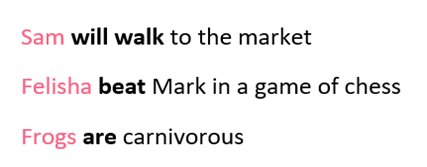
In order to understand active and passive verbs, let’s first define what a verb is. Take a look at the table below for the standard definition of a verb. action_verbs

DefinitionExamples
VerbExpresses an action or state that usually relates two thingsTo run, to walk, to swim, to laugh, to have

As you can see, verbs can sometimes make up the bulk of our dialogue. In the English language, verb conjugation is pretty simple in comparison to other languages. Compare the conjugation of the verb ‘to run’ in English versus french.

FrenchEnglish
I (je)coursrun
You (tu)coursrun
She/he (elle/il)courtruns
We (nous)couronsrun
They (elles, ils)courentrun

When we talk about active and passive verbs, then, we’re not really talking too much about the conjugation of the verb. Instead, it is dependent on what the subject in the sentence is doing. Take a look at the definition of active verbs below.

DefinitionSubject
Active verbWhen the subject of the verb is performing the actionWho or what the sentence is about (performing action verbs)

Now that we’ve covered an active verbs definition, let’s take a look at some active verbs examples. action_voice Let’s take a look at passive verbs definition:
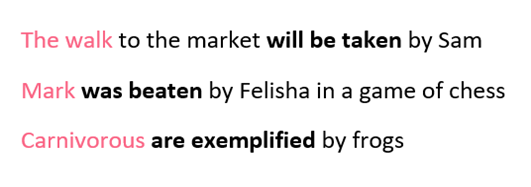
DefinitionSubject
Passive verbWhen the subject is being put through the verb actionWho or what is receiving the action of the verb

Let’s take a look at some examples of passive verbs.

How do you know if a verb is active or passive?

One easy way to spot the difference between an active and passive verb is to understand whether the speaker is taking an active or passive tone. Now that you understand what is and active and passive verb, let’s take a look at the definitions of an active and passive voice below.

DefinitionSubject
Active voiceUses an active form of verbsSubject is performing an action
Passive voiceUses a passive form of verbsSubject is receiving the action from the verb

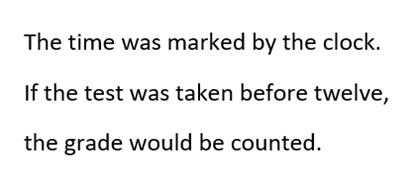
As you can see, when a speaker is using passive verbs, they are employing a passive voice. Let’s take a look at an example of a passive voice. passive_voice_verbs Here, we can break down each section as an example to see why the voice is passive or active.
SubjectPassive verb
The time was marked by the clockThe timeWas marked
If the test was taken before twelveThe testWas taken
The grade would be countedThe gradeWould be

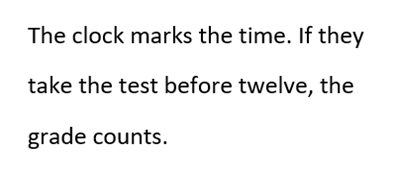
Let’s take a look at an example of an active voice. active_voice_verbs Again, breaking down each section gives us more clarity on why this voice is an active one.


SubjectActive verb
The clock marks the timeThe clockmarks
If they take the test before twelveTheytake
The grade countsThe gradecounts

What is an active verb example?

Let’s break down an example of an active verb. Remember that an active verb is used when the subject of the sentence is performing the verb. Let’s take a look at some examples. Try your best to break down each example and decide whether or not they are using an active verb or passive verb.

SentenceActive Verb?
Example 1Your grandma made the pierogies??
Example 2The tornado destroyed much of what was left.?
Example 3I wanted to go, but I was busy.?

Let’s take a look at the answers, as well as an explanation for why.

SentenceActive Verb?SubjectVerb Performed by Subject
Example 1Your grandma made the pierogies?YesGrandmamade
Example 2The tornado destroyed much of what was left.YesTornadodestroyed
Example 3I wanted to go, but I was busy.YesIwanted, was

When you use active verbs, you are using an active voice. Active voices are usually used in essays and in day-to-day life. active_voice

What is a passive verb example?

Now that we’ve looked at some examples of active verbs, let’s turn to look at passive verb examples. Recall that when we have a passive verb, the subject of the sentence is having the verb performed onto them. Looking at the examples below, try to identify which are passive verbs.

SentenceActive Verb?
Example 1The pizza was burned by the oven.?
Example 2Trains are driven by train conductors.?
Example 3You were gone by evening.?

Let’s take a look at the answers, as well as an explanation for why.

SentenceActive Verb?SubjectSubject Receiving Verb’s ActionReceived from
Example 1The pizza was burned by the oven.YesPizzaWas burnedOven
Example 2Trains are driven by train conductors.YesTrainsAre drivenTrain conductors
Example 3You were gone by evening.No---

When you use passive verbs, you are using a passive voice. Passive voices shouldn’t be used in essays. They are, however, often used in journalism. Listen to the news and you should find plenty of examples of sentences with passive verbs. passive_verbs

Why are passive verbs used?

There are many different reasons why passive verbs are used. When you’re writing in any academic setting, active verbs are usually encouraged because they produce an active voice. However, there are some instances where you might want to use passive verbs. Take a look at some of the reasons why you might prefer to use passive verbs overactive verbs. Along with each reason, you will find an example.

ReasonExampleHow
Focus on subject who is receiving the action rather than who is doing the actionGlass is made by melting down and chemically altering sand.We don’t focus here on who made the glass but how it is made.
Avoid stating irrelevant information.The car was designed to withstand lightning strikes.We don’t care who made the car but rather it’s features.
Avoid repeating informationThe impact of the study is discussed in the conclusion.The author is discussing it, so it is not worth repeating.
Taking on an academic/professional toneThe sample was taken from a representative group.We don’t have to use personal pronouns (we, I, etc.)