
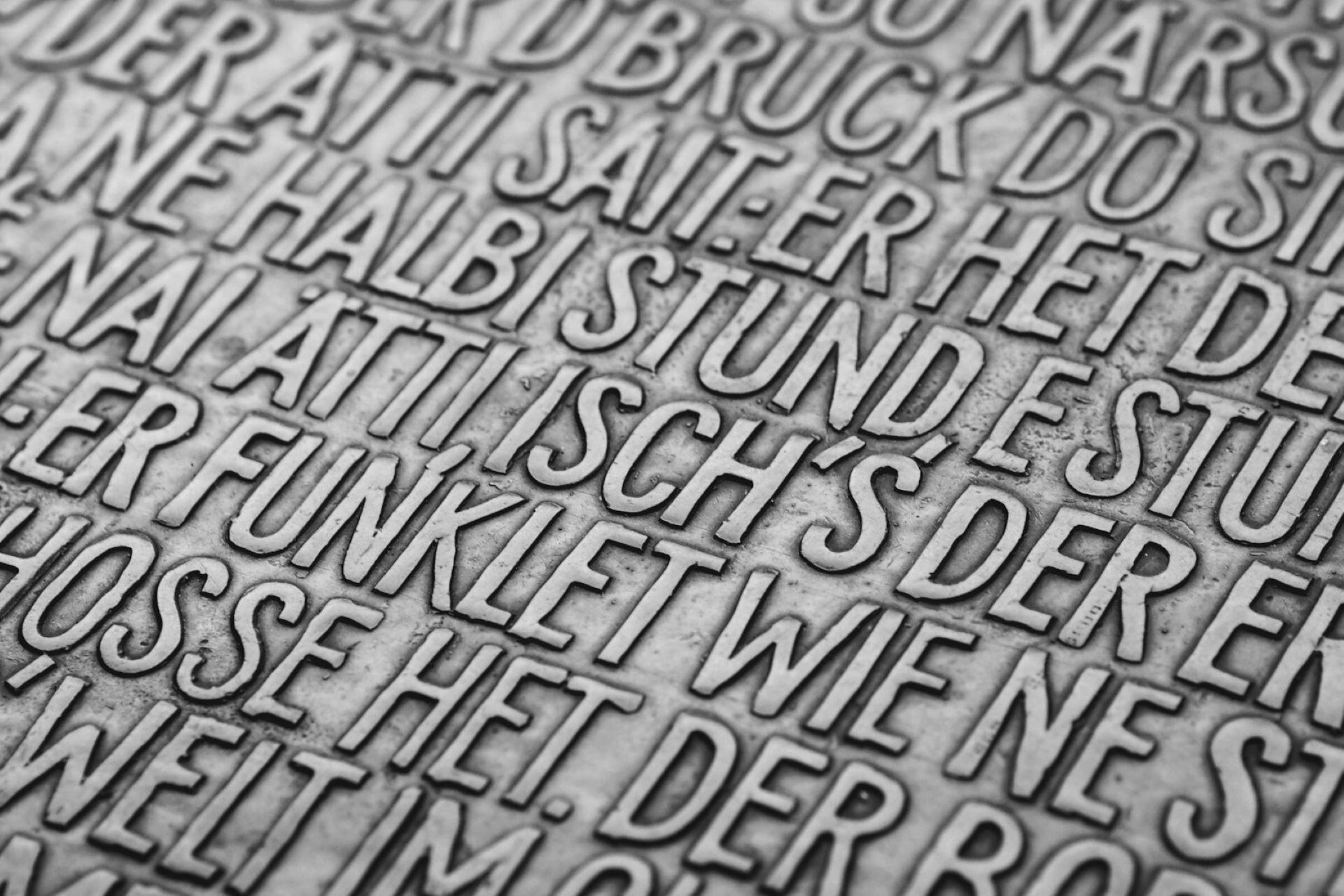

Perhaps you're studying German, or perhaps you're about to start. One thing you may notice is just how many words are capitalised within a sentence. This is because German capitalises nouns. Let's see why this is and how it works in practice.
Key Takeaways
- German capitalises every noun. This includes common nouns, proper nouns, compound nouns, abstract nouns, and words that have been turned into nouns.
- The rule developed gradually. German noun capitalisation grew out of older writing habits before becoming part of standard written German.
- Capital letters help readers. They make nouns easier to identify, which can help learners understand sentence structure more quickly.
- German treats nominalised words like nouns. Words such as das Lesen and etwas Neues are capitalised because they act as nouns.
- German is unusual, but not random. Most modern European languages do not capitalise every common noun, but German maintains this rule as part of its official writing system.


The Historical Evolution of Noun Capitalisation in German
As with rules in any language, there was a time before it was a rule and a time when it became generally accepted. Writing habits, manuscript traditions, printing, and grammar teaching would all reinforce these "rules". Over time, the habit became a standard feature of written German, which is why modern learners now see nouns capitalised in books, exams, dictionaries, and everyday texts both in High and Low German.⁸
Middle Ages
Capitals Used for Visual Emphasis
German writers and scribes began using capital letters inside sentences to draw attention to names, important words, sacred terms, and other meaningful parts of the text. This was not yet the modern rule that every noun should be capitalised. Instead, it was an early visual habit that helped certain words stand out.
16th and 17th Centuries
Noun Capitalisation Spreads
Sentence-internal capitalisation became more common during the Early New High German period. Research on historical German writing shows that this spread was gradual and influenced by several factors, including meaning, grammar, frequency, and writing context.⁹ This period is important because capitalisation moved closer to the noun-focused system learners recognise today.
18th Century
Grammar and Schooling Make the Rule More Stable
As grammar books, schooling, and printing practices became more standardised, noun capitalisation became a more regular part of written German. The rule did not suddenly appear, but by this stage, it was becoming a stable convention. This helped turn a writing habit into a grammar rule that learners could be taught.
Modern German
Noun Capitalisation Becomes Official Spelling
Today, capitalising nouns is part of the official German spelling system. The rule applies to ordinary, abstract, and compound nouns, as well as words from other categories when used as nouns.¹ For learners, this means noun capitalisation is not just a stylistic feature, but one of the basic German writing rules they need to recognise early.
Early Manuscripts and Emphasis
- German noun capitalisation did not appear as a finished rule overnight.
- Earlier writers used capital letters for emphasis, importance, names, and keywords.
- The habit became more consistent over time, especially in written German.⁸
- Modern learners do not need to copy older usage, but it helps explain why the rule exists.
Standardisation in the 18th Century
- German spelling became more regular as grammar books, schools, and printing practices spread.
- Noun capitalisation gradually became part of standard written German.
- Today, the rule is part of the official German spelling system.¹
- This is why learners see capitalised nouns in textbooks, exams, dictionaries, and everyday writing.
Functional Benefits of Capitalising Nouns
Capitalising nouns isn't just an arbitrary spelling habit. It can help readers and German learners get more information. It's easier to recognise certain ideas. Even before you've fully understood everything, you'll have recognised the nouns in a sentence.

Enhanced Readability
In English, a capital letter in the middle of a sentence indicates a name, place, title, or acronym. In German, it gives you an extra grammar clue: you're looking at a noun or a nominalised word. Research has shown that removing noun capitalisation can slow readers down, indicating that the rule has a real reading function as well as a grammatical one.⁷
A capital letter in the middle of a German sentence usually indicates that the word is a noun or is being used as one. This is especially useful for beginners because it helps separate key ideas from verbs, adjectives, and connecting words. Once learners start looking for capital letters, longer German sentences can feel less intimidating.
Distinguishing Word Categories
- A capital letter often shows that a word is a noun or is being used like one.
- This helps learners separate nouns from verbs, adjectives, articles, and connecting words.
- Words like das Lesen and etwas Neues are capitalised because they work as nouns.⁴ Duden also gives examples of nominalised adjectives such as das Gute, which shows how adjectives can become nouns in real German sentences.⁶
- Spotting these patterns can make German sentence structure feel less confusing.
German Capitalisation Rules: A Comprehensive Guide
The rule for capitalisation in German is pretty simple: capitalise the noun wherever it appears in the sentence. German capitalisation also helps mark particular word groups within a text, which is why it serves both a spelling and a reading function.² This rule covers common nouns, proper nouns, abstract nouns, compound nouns, and words that have been turned into nouns.
Universal Noun Capitalisation
Every German noun starts with a capital letter, and this rule applies alongside other basic cases such as sentence beginnings, names, and certain forms of address.⁵ It doesn't matter whether they're common nouns, proper nouns, abstract nouns, compound nouns, or words that have been turned into nouns; capitalise them. However, it's worthwhile knowing that German's compound nouns are only capitalised at the start, not for every constituent noun that is included in the word.³
German is famous for long compound nouns, and one of the best-known examples is Rindfleischetikettierungsüberwachungsaufgabenübertragungsgesetz. The word referred to a law connected to the transfer of duties for supervising cattle marking and beef labelling. It is useful here because it shows how German forms nouns by combining smaller words and why capitalising the final compound helps readers recognise the whole unit as a noun.¹²
Nominalisation of Other Parts of Speech
Exceptions and Special Cases
| German phrase | What is capitalised? | Why? |
|---|---|---|
| die Schule | Schule | It is a common noun. |
| das Gute | Gute | The adjective is used as a noun. |
| beim Lernen | Lernen | The verb is used as a noun. |
| am Abend | Abend | It is a noun used in a time expression. |
Comparative Perspective: Capitalisation in Other Languages
Throughout the history of the German language capitalisation has been a part of it. However, it's also used in other languages. English, French, and Spanish usually reserve capital letters for proper nouns and sentence beginnings. German uses them for every noun. Danish, interestingly, used to capitalise common nouns too, but removed the rule in its 1948 spelling reform.¹⁰ The reform also changed other parts of Danish spelling, including the introduction of å in place of aa.¹¹

Languages Influenced by German
| Language | Common nouns | Proper nouns | Sentence beginnings | Notes for learners |
|---|---|---|---|---|
| German | Capitalised | Capitalised | Capitalised | Every noun gets a capital letter, including abstract nouns and nominalised words. |
| English | Usually lowercase | Capitalised | Capitalised | Common nouns are only capitalised in special cases, such as titles. |
| Danish | Lowercase today | Capitalised | Capitalised | Danish used to capitalise nouns but dropped the rule in the 1948 spelling reform. |
| French | Usually lowercase | Capitalised | Capitalised | Common nouns are not capitalised in normal writing. |
| Spanish | Usually lowercase | Capitalised | Capitalised | Common nouns are not capitalised in normal writing. |
Unique Position of German
- German remains unusual because it still systematically capitalises common nouns.
- English, French, Spanish, and modern Danish do not capitalise every common noun.
- This makes German capitalisation rules look harder at first.
- Once learners understand the pattern, the rule can make reading easier rather than harder.
Which German grammar clue helps you most when reading?
| Rule | Example | Beginner tip |
|---|---|---|
| Capitalise all nouns | der Hund | Look for people, places, things, and ideas. |
| Capitalise nominalised verbs | das Lernen | Articles often signal noun use. |
| Capitalise nominalised adjectives | etwas Neues | Words after etwas, nichts, and viel are often capitalised. |
| Do not capitalise ordinary adjectives | ein gutes Buch | The adjective stays lowercase when it simply describes a noun. |
References
- Rat für deutsche Rechtschreibung. “Amtliches Regelwerk der deutschen Rechtschreibung.” Rat für deutsche Rechtschreibung, 2024, https://www.rechtschreibrat.com/DOX/RfdR_Amtliches-Regelwerk_2024.pdf. Accessed 5 June 2026.
- Leibniz-Institut für Deutsche Sprache. “D Groß- und Kleinschreibung.” Grammis: Amtliches Regelwerk des Rats für Deutsche Rechtschreibung, https://grammis.ids-mannheim.de/rechtschreibung/6161. Accessed 5 June 2026.
- Leibniz-Institut für Deutsche Sprache. “2.1 Substantive und Desubstantivierungen.” Grammis: Amtliches Regelwerk des Rats für Deutsche Rechtschreibung, https://grammis.ids-mannheim.de/rechtschreibung/6193. Accessed 5 June 2026.
- Leibniz-Institut für Deutsche Sprache. “2.2 Substantivierungen.” Grammis: Amtliches Regelwerk des Rats für Deutsche Rechtschreibung, https://grammis.ids-mannheim.de/rechtschreibung/6194. Accessed 5 June 2026.
- Dudenredaktion. “Groß- und Kleinschreibung.” Duden, Cornelsen Verlag, https://www.duden.de/sprachwissen/rechtschreibregeln/Gro%C3%9F-%20und%20Kleinschreibung. Accessed 5 June 2026.
- Dudenredaktion. “Groß- und Kleinschreibung substantivierter Adjektive.” Duden, Cornelsen Verlag, https://www.duden.de/sprachwissen/sprachratgeber/Substantivierungen-von-Adjektiven. Accessed 5 June 2026.
- Pauly, Dennis Nikolas, and Guido Nottbusch. "The Influence of the German Capitalisation Rules on Reading." Frontiers in Communication, vol. 5, 2020, https://doi.org/10.3389/fcomm.2020.00015. Accessed 5 June 2026.
- Barteld, Fabian, Stefan Hartmann, and Renata Szczepaniak. “The Usage and Spread of Sentence-Internal Capitalization in Early New High German: A Multifactorial Approach.” Folia Linguistica, vol. 50, no. 2, 2016, pp. 385–412, https://doi.org/10.1515/flin-2016-0015. Accessed 5 June 2026.
- Dücker, Lisa, Stefan Hartmann, and Renata Szczepaniak. “The Emergence of Sentence-Internal Capitalisation in Early New High German: Towards a Multifactorial Quantitative Account.” Advances in Historical Orthography, c. 1500–1800, edited by Marco Condorelli, Cambridge University Press, 2020, pp. 67–92, https://www.cambridge.org/core/books/advances-in-historical-orthography-c-15001800/emergence-of-sentenceinternal-capitalisation-in-early-new-high-german/C1178EB3091DF42DA349F73D3EA295D0. Accessed 5 June 2026.
- Dansk Sprognævn. “Hurtigt Overblik over Retskrivningsordbøger Gennem Tiden.” Dansk Sprognævn, https://dsn.dk/ordboeger/rohist/hurtigt-overblik-over-retskrivningsordboeger-gennem-tiden/. Accessed 5 June 2026.
- Sproget.dk. “Retskrivningsreformen Fylder 70 År.” Sproget.dk, https://sproget.dk/retskrivningsreformen-fylder-70-aar/. Accessed 5 June 2026.
- The Guardian. “The Longest Words in English: Do You Know What They Mean?” The Guardian, 4 June 2013, https://www.theguardian.com/science/shortcuts/2013/jun/04/longest-words-english-what-they-mean. Accessed 5 June 2026.
Summarise with AI:
Did you like this article? Leave a rating!

 Loading...
