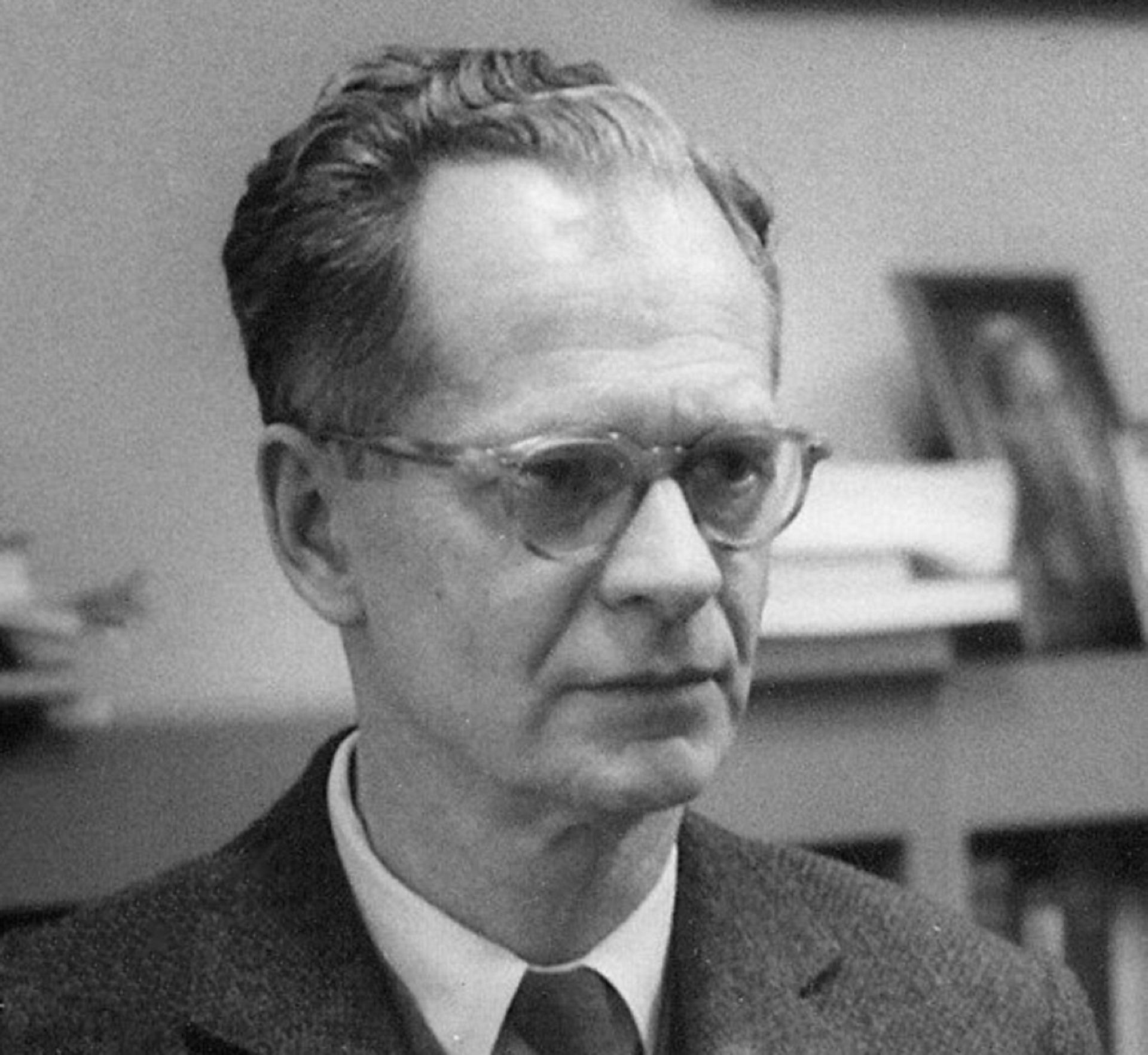

Psychologists often extend their extraordinary minds to different fields. Many are also authors, philosophers and educators. They may even embrace work in other fields unrelated to psychology. We touched on that idea in our article about Jean Piaget. He was the psychologist who pioneered studies in cognitive development.
In this respect, Jean Piaget cannot hold a candle to Dr Skinner's impressive resume. He was a psychologist, of course, but he was also a behaviourist and social philosopher; an author and inventor. As though that weren't enough, Dr Skinner was a psychology professor at Harvard University. Here is just part of his long list of accomplishments:
- he authored 21 books and 180 journal articles
- he established behavioural analysis as a legitimate field of study
- he also developed the philosophy of radical behaviourism, a school apart from the methodological study of behaviourism
- he invented the operant conditioning chamber - the Skinner Box
- he also invented an air crib, a teaching machine, a 'verbal summator' and the pigeon-guided missile (for which he was gently derided as the Pigeon Man)
B. F. Skinner faced much criticism, both for his work and ideas. Noam Chomsky was one of his most vocal critics. Chomsky, himself a philosopher and cognitive scientist, argued that much of Dr Skinner's work in the book Verbal Behavior boiled down to semantics. Likewise, British-born psychologist J. E. R. Staddon averred that Dr Skinner's theory of determinism must be wrong. Let's find out more about his ideas and why he defended them so staunchly.





B. F. Skinner: Life and Education
Burrhus Frederick Skinner was born in Susquehanna, Pennsylvania just after the turn of the century. His family was socially well-positioned and reasonably well-to-do. They were also deeply religious. Young B. F. turned away from religion when his teacher could not not calm his fear of hell as envisioned by his religious clan. His brother, two and a half years his junior, died at 16 years of age.
His abandonment of religion and the loss of his brother were the significant emotional events (SEEs) that shaped his life. He aspired to write but his penchant for intellectualism left him out of many social events. His time at school was spent in relative social isolation. Enrolled at Harvard - where he would later teach, his non-religious views clashed with the ethos of the time. He had trouble with many articles he wrote for the campus newspaper.

After he graduated from University, he lived with his parents and threw himself into novel writing, with little success. He felt he lacked the life experience to write convincingly. He also believed he lacked perspective. He could not present any ideas if he couldn't determine their origins. Later, he would refer to those days as The Dark Years.
He may have struggled to write fiction but he was inventive in other, more practical ways. His childhood friend, Raphael 'Doc' Miller was mad for gadgetry and contraptions of all sorts. The boys invented a telegraph system so they could communicate from their respective houses. It didn't work very well but their berry separator did. To earn pocket money, the boys decided to sell elderberries. They invented a device that sent ripe berries gushing into a bucket without disturbing unripe ones. None of the world's groundbreaking psychologists - of his time or since, were ever that inventive.
What Is Operant Conditioning?
Perhaps to divorce himself completely from his religious upbringing, B. F. Skinner rejected the concept of free will. That rejection coloured his views about behaviour. His first book methodically lays out how external conditions and events influence and control behaviour. Operant behaviours occur due to operant conditioning. Respondent behaviours may be 'programmed' through respondent conditioning.
The discovery was not new. Russian physiologist Ivan Pavlov and Edward Thorndyke had extensively studied respondent conditioning and operant conditioning decades before. B. F. Skinner added layers of complexity to the theories. He pondered how a response can be directed and controlled and how to explain novel behaviours. He also wondered where operant responses come from.
On that speculation, Skinner theory ran parallel to Charles Darwin's natural selection theory. Both scientists concluded that variation and selection answered any 'new' question, be it a new behaviour or physical characteristic. Controlling and directing operant behaviour depended on how the behaviour was reinforced.
Complex behaviours were harder to explain. Skinner posited that such elaborate (re)actions amounted to sequences of simple responses all chained together. However, he soon realised the argument's flaw. A person can ask for directions and succeed in finding the place they were looking for without any intervening steps. The behaviour (asking) and the result (finding) thus appear to be disconnected - not chained.

Operant Conditioning Examples
Not surprisingly, operant conditioning is an integral component of our daily lives. Most workers strive to be good employees to receive a pay rise or year-end bonus. Shops offer benefits, discounts and other rewards to provoke customer loyalty. A child might complete their homework or do their chores to merit praise and, perhaps, a bit of money. These are all positive reinforcement operant conditioning examples.
Speeding tickets serve as negative reinforcement conditioning. Unless you enjoy paying fines and losing driving privileges, you will avoid the behaviours that would lead to those conditions. Threats also fall into this category. "If you do this, I won't be your friend" conditions behaviour in several ways. First, it could sway an actor from or towards exercising a behaviour. It will also provoke a fear response.
What Is Positive Reinforcement?
Skinner's operant conditioning hypothesis and Albert Bandura's social learning theory have quite a bit in common. They both assume that people learn from external stimuli. Skinner took the broad view that anything can condition an operant. Bandura emphasised that we learn from other people what behaviours will be rewarded and which ones will be punished. In Skinner's terms, that represents positive and negative reinforcement.
Examples of Positive and Negative Reinforcement
A positive punishment dissuades bad behaviour. Such positive reinforcement usually happens after a negative behaviour. A parent might shout at their child when they spill their milk. The shouting will cause the child to be more careful with their drink in the future. Sitting in time out and getting sent to their room work on the same principle.
Negative reinforcements take away an expected positive response. A public speaker being heckled may discourage them from addressing a crowd again. Being criticised, jeered and laughed at would likewise make someone think twice about engaging in the behaviour that provoked such a response. And the aforementioned traffic fines do a stellar job of keeping our feet lightly on the gas pedal.

Skinner's Impact on Behavioral Psychology
By all accounts and despite all controversy, B. F. Skinner is considered the most influential psychologist of the 20th Century. That is mainly for his pioneering work in modern 'behaviorism' - behaviourism, as we would write. Mental health facilities and prisons make ample use of Skinnerian principles. For instance, a patient or inmate might see their good behaviour rewarded with candy, cigarettes or special privileges. Such a reward system is called a token economy.
Skinner's influence isn't limited to behavioural psychology. His book, The Theory of Teaching revolutionised American teachers' pedagogy. In it, he advocates restricting reinforcement to stimuli relevant to the learning task at hand. For instance, a rowdy science student may be called to the front of the class to explain aspects of the current lesson. This negative reinforcement serves to deter not only that student but everyone else in the class from engaging in similar behaviour.
He advocated for positive reinforcement in education. Students shouldn't be shamed, blamed or otherwise gamed to instil good behaviours. Instead, teachers should look for occasions to praise and reward students. Unfortunately, that idea doesn't account for students' competitiveness or their tendency to mock and demean.
For instance, Student A earned top marks on the latest class test. The teacher wishes to encourage this behaviour class-wide so they promote that student's diligence and hard work. Unfortunately, once outside of class, that student may expect to taunt, jeering and other types of put-downs. Thus, the teacher's positive reinforcement becomes negative reinforcement as far as the student is concerned. They may not try so hard to excel in the future.
Much of the criticism levied at Dr Skinner's work comes from such examples. You'll recall that he believed free will was an illusion. Thus, he would interpret Student A's actions - their refusal to perform as well, as the consequence of a series of events. His contemporaries saw it as the student making a deliberate choice - exercising their free will, to avoid future jeering. Student A could just as well have chosen to not care about being mocked; persevering for their own benefit.
Like the father of psychology, Wilhelm Wundt, Dr Skinner disdained naïve introspection. For him, everything had to be rational, logical and sequential. Had he been the introspective type, though, he might have wondered whether losing his religious beliefs and his brother at so young an age imposed his mind's rigidity.
Summarise with AI:
Did you like this article? Leave a rating!


 Loading...