
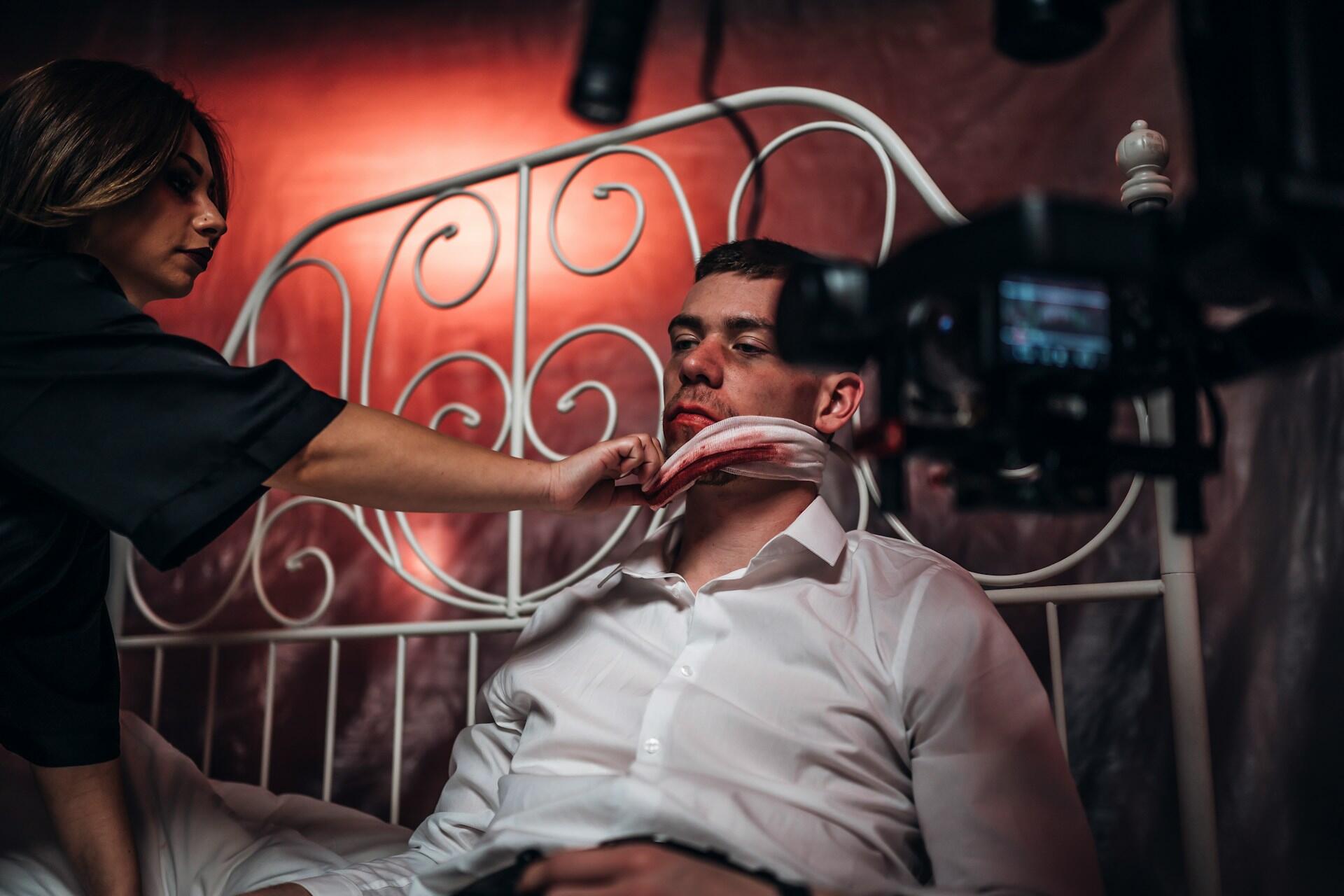

The Stanislavski Method is one of modern theatre and film's most important acting techniques. It was designed to help actors create believable performances by drawing on personal experience, imagination, and physical action. It was developed by the Russian director Konstantin Stanislavski and forms the foundation of many acting programmes and drama classes. In this article, we'll explore the key elements that make up the Stanislavski system, which are summarised in the diagram below.


What Are The Stanislavski Techniques?
Stanislavski techniques are a set of acting methods created by Russian theatre practitioner Konstantin Stanislavski to help actors perform more naturally and convincingly. His approach encourages actors to fully understand their characters—emotionally, mentally, and physically—so that their performances feel real and believable. Together, these techniques form what Stanislavski called 'The System'—a structured method of actor training designed to guide performers in preparing for a role.
'The System' refers to Stanislavski’s full method of actor training. It is a structured framework that guides actors in preparing for a role, helping them to connect with their character’s inner life, respond truthfully in the moment, and bring authenticity to the stage or screen. The System laid the foundation for many later styles of acting, including Method Acting.

Because the Stanislavski techniques are holistic and complex, it is essential to understand the language and concepts of the Stanislavski system techniques. Here is a list of the central ideas that we will review.
Psychological 🧠
- Emotional Memory
- Inner Monologue
- Attention/Focus
Imaginative 💭
- Magic If
- Given Circumstances
- Substitution
Physical 🏃♂️
- Method of Physical Action
- Tasks and Objectives
- Truthful Action
Experiencing the role
This exercise constitutes the inner, psychological aspect of a role, where the actor's individual feelings and personality prepare the actor for a performance based on experience, thus allowing it to experience the role.
In the language of an actor, to know is synonymous with to feel
Konstantin Stanislavski, Creating a Role
Given Circumstances
The ensemble of the circumstances given to the actor by the playwright and screenwriter, but also the choices made by the director, designer and other actors. All these elements will be incorporated into a performance called the given circumstances.
The Magic If
The "Magic If" is one of the core elements of the Stanislavski technique that encourages actors to explore authentic emotional responses by imagining themselves in their character's situation.
This concept describes the ability to imagine oneself in a set of fictional circumstances and envision the consequences and reactions of facing that specific situation in terms of action. It is essential to have fully grasped the meaning and elements of the given circumstances to be able to imagine the magic if.
An artist, and in this case, an actor, can not thrive without imagination. Imagination is what brings any art alive. Other methods, such as Uta Hagen's method, are also great advocates of imagination. In this technique, the main tool is the if, which sets the possibilities of imagining scenarios and circumstances for anything.
Attention
This is a difficult aspect for actors to address. Where should they focus or look while acting? To address this, the technique relies on the actor having a point of attention.
This will help the actor stay in the scene and away from the audience. Another way of applying this technique is to create a circle of attention with the help of different objects, lights, or other actors. This circle of attention can move with the actor in the scene.
Tasks and Action or Units and Objectives
A task or sequence of tasks is a problem entrenched in the given circumstances of a scene that the character needs to solve. A scene can have several tasks, and the given circumstances are constantly evolving. As a result, a sequence of tasks will form the line of action, which unites the different units or 'bits' of tasks. Elizabeth Hapgood's English translation also identified tasks as 'objectives'. Thus, a sequence of tasks leads to a major objective in a scene.
In other words, action means doing something, which is way more difficult on stage than it might be in a rehearsal. Every action in the task sequence serves a purpose: to bring the right emotions in you and then transmit them to the audience.
Emotional Memory
Emotional memory consists of recalling a past event in your life that is similar to the given circumstances. This is to get to the points that move you, allowing you to create new feelings for the scene.
Method of Physical Action
Stanislavski elaborated on the physically grounded rehearsal process, which is called the method of physical action, to complement all the psychological and emotional sides of his system. This is where the active analysis of magic is, and experiencing the role would require improvising under given circumstances and using the physical world to take action.
Truthfulness
As an actor, you have to put life into all the imagined circumstances and action until your sense of truth is satisfied and create faith in what you are doing.
Konstantin Stanislavski
Overview of Stanislavski Techniques
| Terminology | Definition |
|---|---|
| Emotional Memory | Using personal past experiences to evoke emotions needed for a character. |
| Given Circumstances | The specific conditions, facts, and details that define the world of the character, including background, relationships, and environment. |
| Magic If | A tool for actors to imagine themselves in the character's situation by asking, 'What would I do if I were in this situation?' |
| Objectives | The goals or desires of the character in each scene, driving their actions and decisions. |
| Super-Objectives | The overarching goal or main driving force behind the character’s actions throughout the entire play. |
| Through Line of Action | The consistent progression and logical sequence of the character’s actions and objectives throughout the performance. |
| Subtext | The underlying meaning or unspoken thoughts and emotions beneath the character’s dialogue and actions. |
| Relaxation | Techniques used to release physical and mental tension, ensuring the actor’s body and mind are prepared and responsive. |
| Concentration | The actor’s ability to focus attention on their role and the imaginary circumstances, blocking out distractions. |
| Observation | Developing the skill of closely observing people, objects, and events to gather material for character development and performance. |
| Imagination | Using creativity to fill in the details of the character’s life and circumstances, beyond what is provided in the script. |
| Tempo-Rhythm | The pace and flow of the character’s actions and speech, contributing to the overall energy and mood of the performance. |
Once you have mastered all the above techniques, you will be able to create faith. Doing your action with full conviction without going overboard is the delicate balance that will make your audience believe you as much as you believe yourself.
What Is the Stanislavski Method?
The Stanislavski Method, often referred to as "The Method," particularly in American acting, typically refers to a specific interpretation and application of Stanislavski’s original techniques. This method was further developed and popularised by practitioners like Lee Strasberg at the Actors Studio. The method is an actor training approach composed of a variety of tactics intended to assist
performers in building credible characters and enabling them to inhabit their roles fully.
While it draws heavily on Stanislavski’s original ideas, it emphasises particular aspects, such as:
- Emotional Memory/Recall: A strong focus on using personal emotional experiences to bring authenticity to the character's emotions.
- Sense Memory: Utilising all five senses to create a more vivid and realistic portrayal of the character’s experiences.
- Improvisation: Using spontaneous, unscripted exercises to explore and develop the character.
- Relaxation: Like the broader technique, a focus on physical and mental relaxation to enhance performance quality.
The Stanislavski techniques focus on enabling performers to realistically convey the emotions of their characters by drawing on their own personal experiences, thereby fostering a genuine connection with the audience.
Stanislavski Methods vs Stanislavski Techniques
| Stanislavski Technique | Stanislavski Method | |
|---|---|---|
| Definition | Comprehensive system designed by Stanislavski | Specific interpretation and application of Stanislavski’s work |
| Focus | Balanced use of emotional memory, given circumstances, objectives, and physical actions | Strong focus on emotional memory and sense memory |
| Application | Used in a broad range of global actor training programmes | Common in American acting schools (e.g. Actors Studio) |
| Approach | Holistic and systematic | Introspective and emotionally driven |
| Practitioners | Based on Stanislavski’s original writings and productions | Popularised by Lee Strasberg and others in the U.S. |
The terms "Stanislavski Technique" and "Stanislavski Method" are often used interchangeably in modern acting circles, but they can represent slightly different interpretations of Konstantin Stanislavski's work.
While both the Stanislavski Technique and the Stanislavski Method aim to create truthful and authentic performances, the Technique is the comprehensive system developed by Stanislavski himself, and the Method is a particular interpretation and application of his work, often associated with American acting schools and practitioners.

Who Was Konstantin Stanislavski?
Konstantin Stanislavski, also written Stanislavsky, was a Russian theatre practitioner who developed the Stanislavski system in the first half of the twentieth century.
Stanislavski was a Russian actor and director best known for creating "The System". This approach to actor training transformed modern theatre.
He co-founded the Moscow Art Theatre in 1898, refining his methods and collaborating with playwrights like Anton Chekhov. His ideas laid the foundation for modern acting techniques, including Method Acting.
A History of the Stanislavski System
There are no small parts, only small actors.
Konstantin Stanislavski
The Stanislavski System evolved over decades of experimentation and reflection. After founding the Moscow Art Theatre, Stanislavski worked on his techniques with actors and playwrights.
Rehearsals served as a testing ground for psychological and physical approaches to acting, and by 1909, he had developed an early version of the system. The method was adopted into rehearsals in 1911 and evolved into the framework that ultimately integrated emotion, intention, imagination, and physical action.
Search for acting lessons near me on Superprof.
Find out more about Stanislavski's method here.
Why Study the Stanislavski System?
Stanislavski's system continues to be immensely popular in the history of film and theatre, which means that his method and techniques have been proving their efficiency for over a hundred years!
Benefits and Limitations of the Stanislavski System
Benefits
- Builds emotional depth
- Encourages truthful performances
- Focuses on character motivation
- Works across stage and screen
- Widely taught and respected
Limitations
- Emotionally demanding
- Time-consuming
- Not suited to all performance styles
- Often misunderstood or misused
- Requires strong self-awareness
Despite the popularity of his techniques, Stanislavski encouraged actors to take a personal and individualised approach to acting and to find a system that works for them.
Regardless of your level or ability, if you are looking to create something and feel, this system is a helpful tool for everyone. It will enrich your acting experience and will help you unlock certain skills you are lacking, whether on the psycho-emotional or physical side.
Create your own method. Don't depend slavishly on mine. Make up something that will work for you! But keep breaking traditions, I beg you.
Konstantin Stanislavski
For learning more about Stanislavski's system, search here on Superprof.
Summarise with AI:
Did you like this article? Leave a rating!


 Loading...




It’s awesome 👍👍
This is so amazing and I will come back again
Thank you for the wonderful feedback! 😊 We’re thrilled you enjoyed the article on the Stanislavski Technique. Looking forward to having you back for more insights. Happy exploring! 🎭📘
I love this
An article about the Stanislavski technique unexpectedly became a lifeline in my journey. As I navigated through the challenges of personal growth and self-discovery, I stumbled upon this piece that delved into the profound impact of Konstantin Stanislavski’s approach to acting on individuals beyond the realm of the stage. The article not only elucidated the intricacies of the technique but also unveiled its transformative potential in fostering authentic connections and understanding one’s own emotions. It served as a guide for navigating the complexities of real-life scenarios, offering a methodology to approach challenges with empathy and sincerity. In embracing the principles of the Stanislavski technique, I found a renewed sense of purpose and a set of tools to navigate the intricate performance of existence, ultimately contributing to a life-saving paradigm shift in my perspective and well-being.
This is wonderful to hear, thanks so much for sharing your experience!
Awesome insight into the Stanislavsky technique and method, indeed your analysis and breakdown is very interesting and helpful, thanks so much.
Thank you so much! 😊
I’m really glad you found the breakdown of Konstantin Stanislavski’s technique helpful. It’s such a powerful approach to creating truthful, authentic performances.
Appreciate you taking the time to comment!