


The world of poetry can be complex, confusing, and overwhelming for some, but it can also bring great insights, raw emotion, and rich imagery to readers. One of the ways that poetry writing can shine is through the use of poetic techniques and devices. Together, the use of such poetry techniques can help one poem to stand out from another, and really draw the reader into an emotional state and help them to understand the true meaning of that poem.
| Poetic Device | Definition | Example |
|---|---|---|
| Alliteration | Repetition of initial consonant sounds | Peter Piper picked a peck of pickled peppers. |
| Assonance | Repetition of vowel sounds within nearby words | Hear the mellow wedding bells. |
| Consonance | Repetition of consonant sounds, typically at the end or middle of words | The lumpy, bumpy road. |
| Anaphora | Repetition of a word or phrase at the beginning of successive lines or clauses | We shall not flag or fail. We shall go on to the end... |
| Onomatopoeia | Words that imitate sounds | Bang, crash, hiss, buzz. |
| Rhyme | Repetition of similar sounding words at the end of lines | Twinkle, twinkle, little star / How I wonder what you are. |
| Personification | Giving human characteristics to non-human things | The wind whispered through the trees. |
| Enjambment | A line continues without a pause beyond the end of a line or stanza | The sun hovered / between the hills... |
| Metre | A rhythmic structure of stressed and unstressed syllables | Shall I compare thee to a summer's day? |
| Caesura | A strong pause within a line of poetry | To be, or not to be — that is the question. |
| Mood | The emotional atmosphere created by the poem | Dark, eerie, joyful, nostalgic... |
| Tone | The poet's attitude or voice in the poem | Sarcastic, formal, admiring, angry... |
| Symbolism | Using an object or idea to represent something deeper | A dove symbolising peace. |
| Allegory | A poem where characters/events symbolise broader moral or political meanings | Animal Farm as a political allegory. |
| Allusion | A reference to another work, person or event | He met his Waterloo. |
| Euphony | Pleasant, harmonious sounds | Season of mists and mellow fruitfulness... |
| Cacophony | Harsh, jarring sounds | With throats unslaked, with black lips baked... |
| Chiasmus | Reversal of grammatical structures in successive phrases | Never let a Fool Kiss You or a Kiss Fool You. |
| Antimetabole | Repetition of words in reverse order | Ask not what your country can do for you — ask what you can do for your country. |
| Couplet | Two consecutive rhyming lines with the same metre | So long as men can breathe or eyes can see, / So long lives this... |
| Poetic Forms | Types of poem structure (sonnet, ballad etc) | A 14-line Shakespearean sonnet. |
| Free Verse | Poetry without consistent rhyme or metre | Modern, conversational poetry without a strict form. |
| Concrete Poetry | Poetry where the visual arrangement of text contributes to meaning | Words shaped like a tree to reflect the poem's theme. |
| Confessional Poetry | A personal, often emotional or autobiographical form of poetry | Sylvia Plath’s 'Daddy' or 'Lady Lazarus.' |



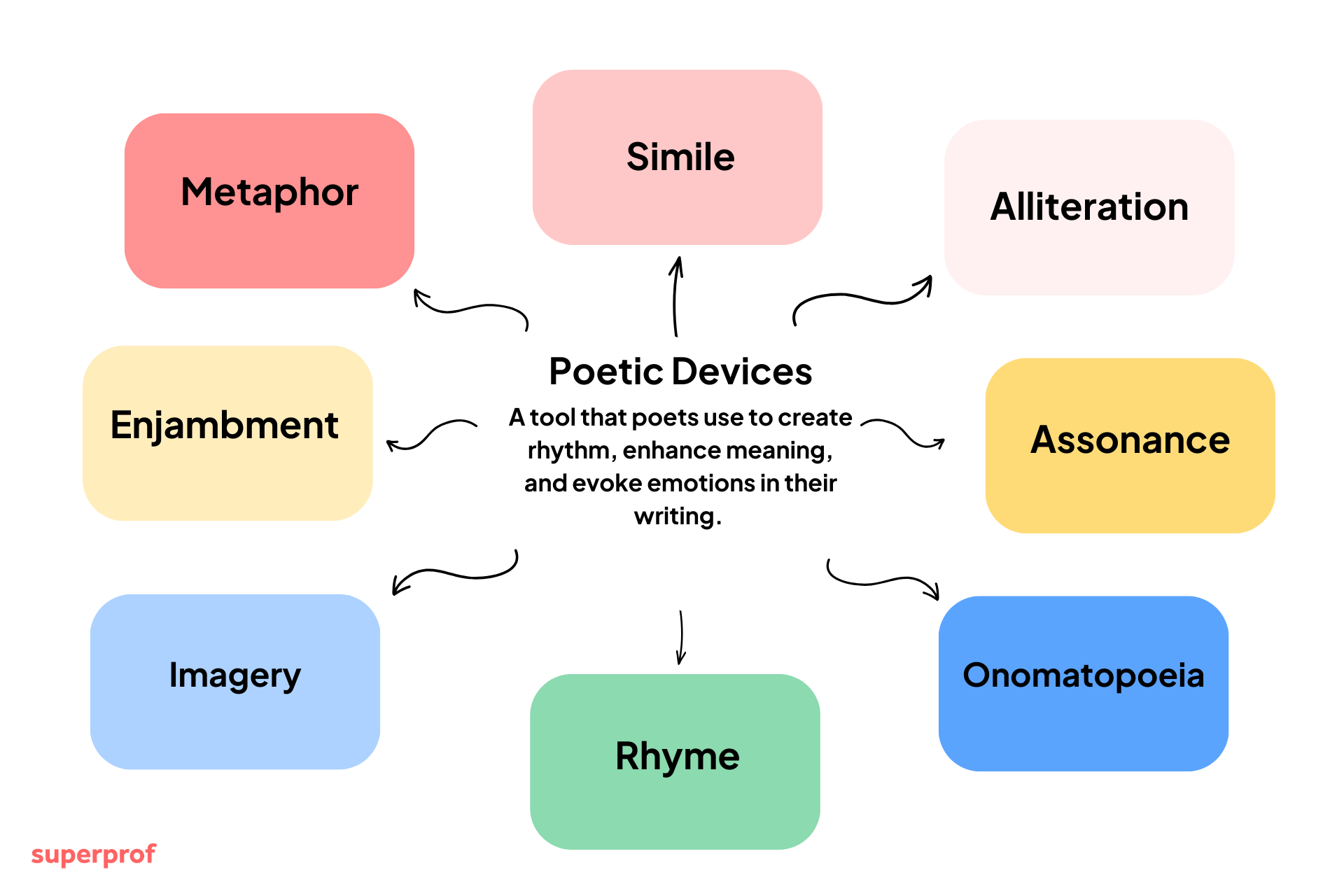
Poetic Structural Devices
Poetic structural devices are techniques that shape the form and framework of a poem—such as line breaks, stanza patterns, metre, and visual layout—helping to organise ideas, guide rhythm, and enhance meaning.
- Refers to how a poem is shaped and structured (line by line)
- Examples include rhyme schemes, metre, and enjambment
Enjambment
A sentence or phrase runs over into the next line or stanza without pause.
Example:
"I think that I shall never see
A poem lovely as a tree."
Purpose: Builds momentum and can surprise or shift tone.
Couplet
A couplet consists of two lines of poetry that typically rhyme and have the same metre. Couplets are often used to conclude a poem or emphasise a point.
Example: "So long as men can breathe or eyes can see,
So long lives this, and this gives life to thee."
Caesura
A pause in the middle of a poetic line, often marked by punctuation.
Example: "To be, or not to be — that is the question."
Purpose: Adds drama, tension, or rhythm variation.
Metre
Definition: The structured rhythm of a line, measured in feet (like iambs, trochees).
Example: "Shall I compare thee to a summer’s day?" — iambic pentameter
Purpose: Gives poems a rhythmic base and helps with flow.
Rhythm
Rhythm in poetry refers to the pattern of beats or stresses in spoken or written language. It’s created by the arrangement of syllables—both stressed and unstressed—and is central to a poem’s musicality and flow. While metre refers to a specific measured pattern (like iambic pentameter), rhythm is the overall sound and cadence of the poem, which may or may not follow a strict metrical structure.
Purpose: Rhythm guides how the poem is read, sets the emotional pace, and can echo the poem’s theme—slow and steady for calm, quick and erratic for tension.
Example (from William Blake’s “The Tyger”):
"Tyger Tyger, burning bright / In the forests of the night..."
The repeated stressed syllables create a strong, memorable rhythm.
Important exam tip: When analysing a poem, it's important to identify the poetic devices in terms of their primary function and direct examples. Let's look at these two examples of metre and enjambment.
| Poetic devices | Purpose | Explanation |
|---|---|---|
| Metre | Creates a sense of rhythm and pattern in the poem through stressed and non-stressed syllables | Pattern of da-DUM da-DUM da-DUM da-DUM da-DUM |
| Enjambment | Creates a sense of flow ot tension | When a line of poetry doesn’t end with a full stop or comma and the sentence continues to the next line |
Poetic Forms
Poetic forms refer to the specific structures and patterns that poems can follow. Each form comes with its own set of rules regarding line length, metre, rhyme scheme, and stanza organisation. These forms help shape the content, tone, and rhythm of a poem, often reflecting tradition or enhancing meaning through their constraints.
While some poets use fixed forms like sonnets or villanelles to explore tight structure and repetition, others use free verse to break from convention and create more fluid, expressive works. Recognising poetic forms allows readers to better understand a poem’s purpose and the poet’s stylistic choices.
| Form | Description | Example |
|---|---|---|
| Sonnet | 14-line poem, usually iambic pentameter, with a set rhyme scheme (e.g. Shakespearean or Petrarchan) | Shakespeare's Sonnet 18: 'Shall I compare thee to a summer's day...' |
| Haiku | 3-line poem with 5-7-5 syllable structure, typically about nature or moments of beauty | An old silent pond / A frog jumps into the pond— / Splash! Silence again. |
| Villanelle | 19-line poem with two rhymes and repeating lines; structured as 5 tercets and a quatrain | Dylan Thomas's 'Do not go gentle into that good night' |
| Limerick | 5-line humorous poem with AABBA rhyme scheme and bouncy rhythm | There once was a man from Peru / Who dreamed he was eating his shoe... |
| Ballad | Narrative poem in quatrains with ABAB or ABCB rhyme, often tells folk tales or tragic love stories | 'The Rime of the Ancient Mariner' by Samuel Taylor Coleridge |
| Ode | Formal, often lyrical poem praising a person, place, or thing | 'Ode to a Nightingale' by John Keats |
| Elegy | Reflective poem lamenting the dead or loss | 'Elegy Written in a Country Churchyard' by Thomas Gray |
| Epic | Long narrative poem about heroic deeds and events significant to a culture | Homer's 'The Odyssey' |
| Free Verse | Poetry without regular metre or rhyme; follows natural speech patterns | Many works by Walt Whitman or Langston Hughes |
| Blank Verse | Unrhymed iambic pentameter | Milton's 'Paradise Lost' |
| Concrete Poetry | Poetry in which the layout or shape on the page contributes to the meaning | A poem shaped like a tree when describing one |
| Acrostic | Poem where the first letter of each line spells out a word or message | S-U-N spells down the side: 'Shining high / Under skies / Never failing' |
| Epigram | Brief, witty, and often satirical poem | “Candy / Is dandy / But liquor / Is quicker.” — Ogden Nash |
| Narrative Poem | Tells a story with characters and plot, often in verse form | 'The Raven' by Edgar Allan Poe |
| Dramatic Monologue | Single speaker addresses a silent listener, revealing character and situation | 'My Last Duchess' by Robert Browning |
Free Verse 📝
Poetry without consistent rhyme or metre.
Example: "The fog comes / on little cat feet." — Carl Sandburg
Purpose: Allows creative freedom and conversational tone.
Concrete Poetry 🏗️
Visual layout reflects the poem’s meaning.
Example: A poem about a tree shaped like a tree.
Purpose: Blends visual art with poetic expression.
Poetic Devices: Sound and Rhythm
Different types of poetic techniques are used in literature to create a memorable listening experience, as readers are more likely to remember them due to their engaging phrasing and pleasing sound.
One of the most effective ways to make a poem memorable is through the use of sound devices, as it is recited. First, let's take a look at the three most-used sound devices in poetry.
Aliteration
- Repetition of the initial consonant in a series of words
- Easy to spot as it involves the first letter or the first two blended sounds
- Example: Soon the sun’s warmth makes them shed crystal shells
Assonance
- Repetition of vowel sounds in a series of words
- Usually appears in the middle of a phrase or stanza, whether as a vowel or vowel sounds
- Example: And the silken sad uncertain rustling of each purple curtain
Consonance
- Repetition of consonant sounds in a series of words
- Usually appears in the middle of a phrase or stanza, whether as a consonant or consonant sounds
- Example: Tyger Tyger, burning bright,/ In the forests of the night
While the above three sound devices focus on single-sounded vowels and consonants, there are other poetry techniques that create a beautiful sense of melodic rhythm through repetition of similar-sounding words, as well as imitation of certain sounds.
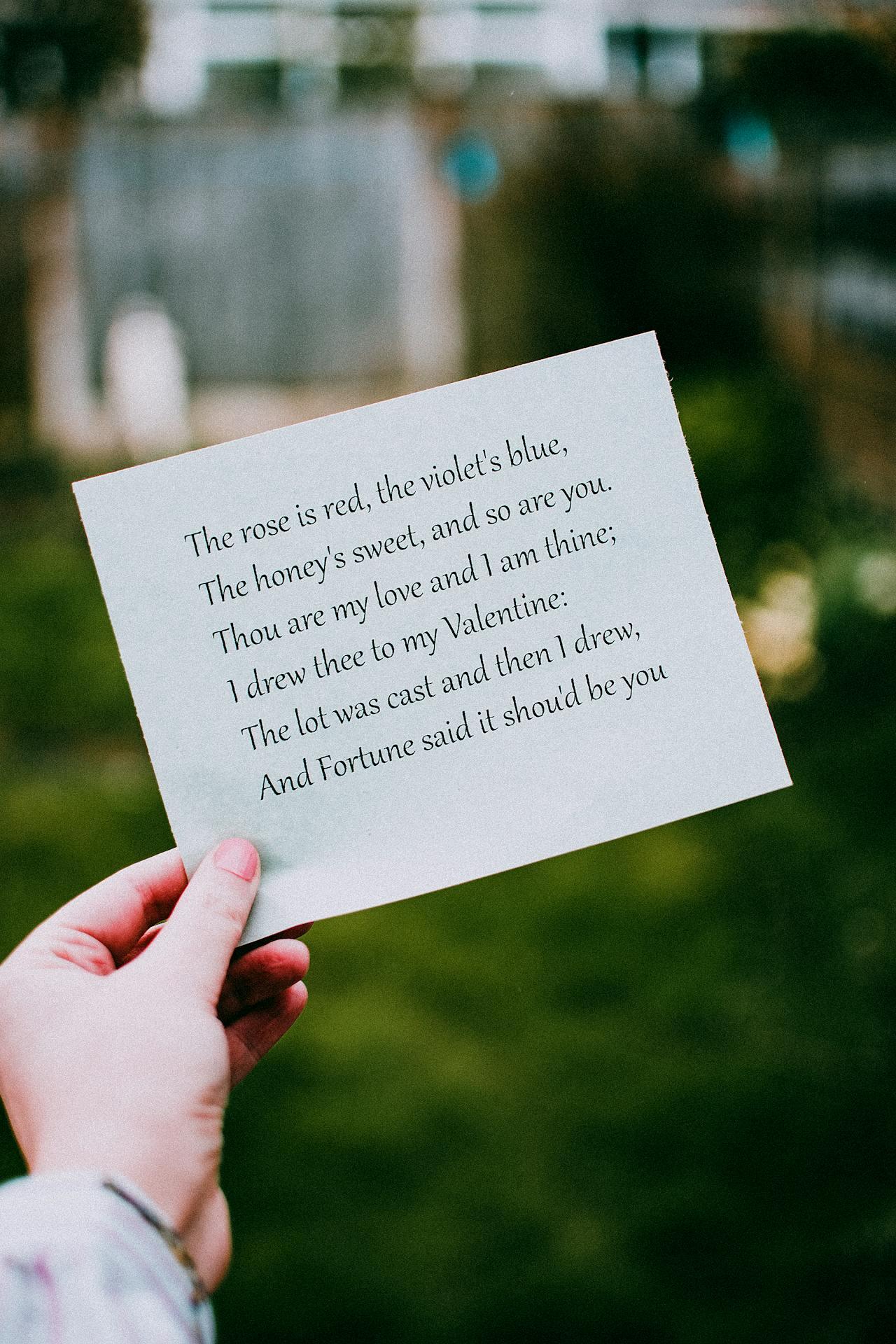
Example:
Blue, you, thine, Valentine, drew, you (as seen in the poem on the right)
Example:
“water plops into pond
splish-splash downhill
warbling magpies in tree
trilling, melodic thrill”
Cacophony 🔊
- Harsh, jarring sounds.
- "Grate on the scrannel pipes of wretched straw,
The breaking twigs snapped underfoot with crunch and crack."
- ✅ Why it works: Harsh consonant clusters (gr, scr, cr) and plosive sounds (k, t, g) create a jarring, discordant effect.
Euphony 🎶
- Pleasant, harmonious combinations of sounds.
- "Softly the evening came with the sunset breeze, Whispering through willows, gentle as the dusk."
- ✅ Why it works: It uses soft consonants (f, s, w) and long vowels (ee, oo) to create a calm, flowing sound.
Meanwhile, feel free to explore poetry courses in Glasgow.
Poetic Devices: Meaning & Interpretation
Besides the use of sound devices, figurative language is another technique that is widely used by writers through deliberate descriptive words and phrases. They help to expand on symbolic and meaningful ideas, as well as convey emotions through deliberate comparison and emphasis.
Symbolic and abstract expression
Figurative language is also commonly employed in poetry to create vivid imagery, depth, and an emotionally layered experience in the reader’s mind, with the following examples:
Example: "The night swallowed the sun."
Purpose: Makes abstract ideas relatable and vivid.
Example: "The scent of rain-damp earth curled through the open window, mixing with the sweet sting of lilacs and the distant rumble of thunder."
Purpose: To immerse the reader in the scene or emotion by engaging the senses, enhancing mood, setting, and tone.
Example: George Orwell’s Animal Farm as an allegory for Soviet communism.
Purpose: Communicates moral or political messages.
Example: "He met his Waterloo."
Purpose: Adds intertextual richness and context.
Example: A rose symbolising love; a raven symbolising death.
Purpose: Adds depth and layers of interpretation.
For instance, William Shakespeare famously used the sun in summer as a symbol to describe beauty, warmth and the brevity of youth in Sonnet 18.
“Shall I compare thee to a summer’s day?”

Figurative comparison and emphasis
Besides evoking emotions through symbolic meanings, figurative language is also used to compare and emphasise ideas, drawing the reader’s attention through a meaningful correlation of concepts or objects and exaggerated descriptions like the examples below:
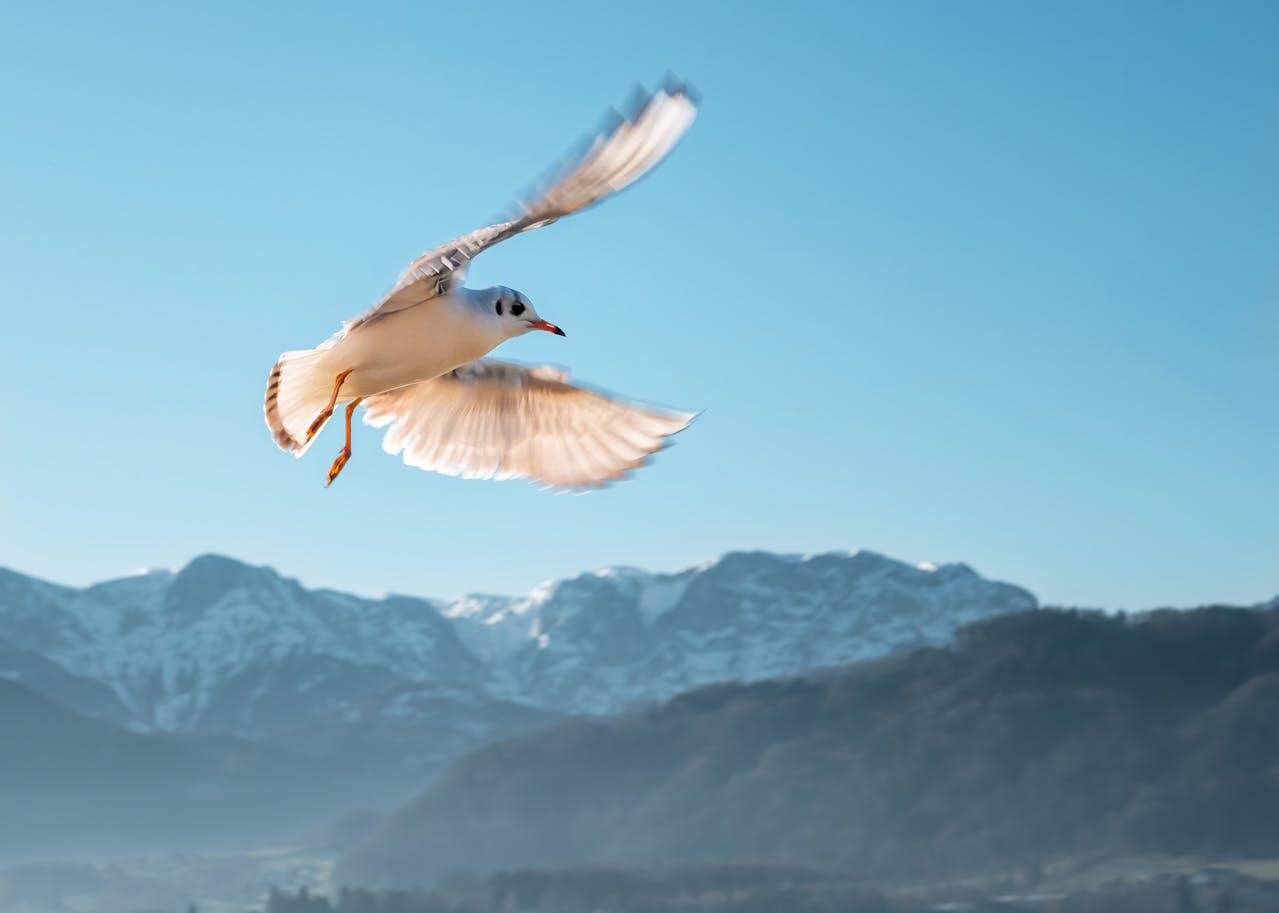
For instance, American poet Emily Dickinson compares human hope to a bird, suggesting it’s uplifting even in hard times in the poem “Hope” is the thing with feathers"
“Hope is the thing with feathers / That perches in the soul…”
Don't forget to check out how to find an experienced teacher to take poetry lessons in London.
Mood and Tone in Poetry
The poet’s attitude or emotional stance.
Example: Angry, satirical, joyful, melancholic.
Purpose: Influences how the reader interprets the poem.
The poet’s attitude or emotional stance.
Example: Angry, satirical, joyful, melancholic.
Purpose: Influences how the reader interprets the poem.
Rhetorical Devices in Poetry
Rhetorical devices in poetry are techniques used to persuade, emphasise, or create memorable language through repetition, contrast, and structure. These devices often overlap with those used in speeches and prose, enhancing the impact of a poem’s message or theme.
| Technique | Definition | Example |
|---|---|---|
| Anaphora | Repetition of a word or phrase at the beginning of successive lines or clauses | We shall not flag or fail. We shall go on to the end. We shall fight... |
| Epistrophe | Repetition of a word or phrase at the end of successive lines or clauses | ...of the people, by the people, for the people. |
| Antithesis | Juxtaposition of contrasting ideas in a balanced structure | It was the best of times, it was the worst of times... |
| Chiasmus | A phrase or sentence repeated in reverse structure (not necessarily the same words) | Never let a Fool Kiss You or a Kiss Fool You. |
| Antimetabole | Exact repetition of words in reverse grammatical order | Ask not what your country can do for you – ask what you can do for your country. |
| Hyperbole | Deliberate exaggeration for emphasis | I’ve told you a million times. |
| Litotes | Understatement using a negative to affirm a positive | He’s not unfamiliar with poetry. |
Are Poetic Devices and Techniques the Same Thing?
A poem can feature a wide variety of literary devices (also known as literary devices) and poetic techniques. Ultimately, such techniques build upon each other and work together to help bring a poem to life and make the scene the poem is portraying more vivid to the reader or listener.
These two terms are often used interchangeably as they eventually point us in the same direction — to help us study the poem through different lenses. But for clarity and further distinction in the study of English literature, poetic devices usually refer to the tool itself, while poetic techniques refer to the method of how the tools are executed.
Poetic device: Anaphora (tool)
Poetry technique: Repetition of words at the beginning of the stanza successively to create emphasis (method)
In every cry of every Man,
In every Infant’s cry of fear,
In every voice, in every ban.
Poem: London by William Blake
Important tip: Don't get confused when you see these two terms while revising for your English Literature subject. If you are currently a GCSE student, it's best to consult with your English teacher on the preferred term that is used for poetry analysis for the actual exam.
Learning GCSE Poetry Techniques
Now that you have reviewed the above poetic devices and how these techniques are applied in poetry, you will have developed a comprehensive understanding of both the emotional and thematic messages conveyed by writers, as well as the technical craft of composing an effective poem in terms of form and structure.
Whether you are an aspiring poet or a student who is passionate about English literature, you can always try to write your own poem. Many successful poets today started small by posting some of their works online before publishing a whole poetry collection, like Rupi Kaur and Atticus.
Poetry is when an emotion has found its thought and the thought has found words.
Robert Fost
While thinking about the topic, you might wonder how words come together harmoniously through various techniques. For instance, how can you include rhyming words or incorporate metaphors to make your poem memorable without making it feel ‘overloaded’?
One way to boost your poetry writing with a mixture of style and substance is to hire an experienced English tutor near you. At Superprof, you can receive one-to-one guidance on poetry through private tutoring at your home, your tutor's home or online. Depending on your learning level, learning needs, and learning pace, your tutor will come out with a personalised teaching methodology that matches your preferences.

For example, if you want to learn how to incorporate rhyme into your poem, your tutor will teach you how to use a poetic technique such as rhyming couplets.
A rhyming couplet features two lines of equal length that rhyme. From there, your tutor will probably assign you to read a couple of Shakespeare’s sonnets, which often featured rhyming couplets, if you’re looking for good examples to learn from.
Ultimately, the decision of which poetic techniques are best to use is very personal and will likely change on a poem-by-poem basis.
Another way private tutoring can come in handy is by helping students who are sitting for their GCSE English Literature paper to read, compare and analyse poems effectively. An experienced English tutor will be well-versed in various exam syllabi under different GCSE exam boards, such as:
- AQA (Assessment and Qualifications Alliance)
- Edexcel (Pearson Edexcel)
- OCR (Oxford, Cambridge and RSA)
- WJEC Eduqas (mainly used in Wales)
Here's what you can expect in a private poetry lesson as a GCSE student, on mastering the steps to improve your poetry writing and analysing skills.
Step 1
Read the poem out loud
Step 2
Identify the poem's form and available poetic devices
Step 3
Relate the poem to the author (his or her background) as you analyse the themes and messages
We hope this article has offered you some interesting insights into various poetry devices and how to apply these techniques aptly and effectively, especially for beginners. A deeper understanding of poetic devices will certainly help you to achieve your desired grades for your GCSE English literature papers. All the best!
Enjoyed this article? Leave a rating!


 Loading...
Please I’d like to know if there is any particular differences between the terms ”poetic techniques” and ”poetic devices”.
Understandable!!!