
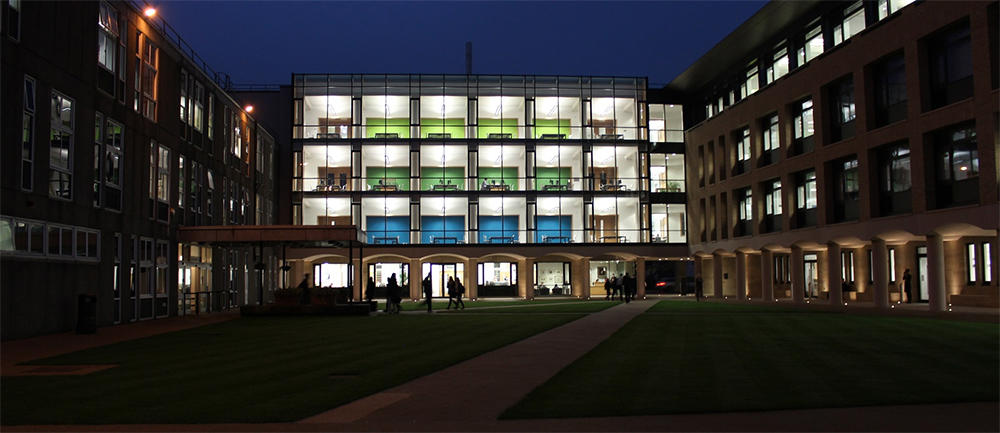

St Paul’s School and St Paul’s Juniors are located next to the River Thames in Barnes, London.
The school was originally opened in 1509 and has since become one of the most sought-after
schools in the country.
That certain mystique notwithstanding, St Paul's School has plenty to offer:
- An outstanding record in competitive sports, particularly rowing and rugby
- A stellar record of academic performance, as shown by students' GCSE and A-Level results
- Access to the International GCSE (IGCSE) exams in science and maths
- A superior track record of enrolment in the best higher education schools
- A consistent ranking as the finest all-boys' school in England





Overview of St Paul's School
🥸 History and Reputation
📚 Academic Excellence
👩🏫 Admissions Philosophy
There is a certain allure that comes with the idea of sending your child to a school with a deep history rooted as far back as 1509. Even more so when the school has had a track record of success since then.
But even with its dated buildings, the school has embraced change over the years, adopting modern teaching methods and striking a unique blend of tradition and innovation.

Getting into St Paul's School isn't necessarily as time-consuming and stressful as, say, getting into Eton College. But make no mistake: entry into St Paul's is competitive at every level. We aim to show you how you can help prepare your child for success.
Outlined below is a short guide on how to get into St Paul's School, with a focus on the maths and English test, as well as the interview. Although these stages are challenging, having the right preparation can greatly improve their chances of success.
History and Reputation
So why does the school strike such a chord among teachers and parents across the UK? Well, it was founded by the Dean of St. Paul's Cathedral all the way back in the Renaissance period, which, if nothing else, certainly makes for a nice bragging point!

The school has also stood the test of time, having made it through significant moments in the city’s history, such as the Great Fire of London.
So even before we get into the world-class standard of education provided within the school’s walls, we already begin to see some justification for the reputation the school holds.
Academic Excellence
While it's not the be-all and end-all of the school selection process, the academic track record of a school is generally one of the search criteria most heavily weighed upon by parents looking to set their child up for a successful career.
- In 2024, at A Level, 61% of grades awarded were A* and 90% were A* or A
- At GCSE, 73% of grades awarded were at Grade 9, and 92% were Grade 8 or 9
- Over a quarter of those studying in the UK go on to Oxford and Cambridge, and 87% go
on to Russell Group universities
- 32 pupils chose to accept places at top American universities, including Harvard, Yale
and Dartmouth
There is a lot to be impressed with when it comes to the learning experience provided at St Paul's. For starters, the school has a strong track record for success, with a substantial portion of its pupils going on to study at top universities after their years of schooling.
Given the doors that open to students who perform well in the A-level exams, it’s only natural that this is one of the first things that parents look for when shortlisting candidate schools.
Well, seeing as of 2023, 53% of A-level entries at St Paul's School attained an A* grade, with 87.04% of entries achieving at least an A grade, there is plenty of incentive when it comes to the performance of the students.
34% of pupils accepted places at universities within the top 10 in the 2022 QS World University Rankings.
If you go through the list of schools that you’re likely considering sending your child to, it is unlikely that any of them will rival the proportion of students who go on to study at leading universities.
Admissions Philosophy
One of the most attractive incentives for parents to value the learning experience that is offered is its inclusivity and diversity. This is also rooted back to the school's history, where it was established with the vision of providing education to 153 scholars "of all nations and countries indifferently".

So, having your child learn in a collaborative and diverse environment allows them to develop crucial skills outside of academic success.
For example, many multinationals in today’s world value candidates who can work with diverse teams from a mix of educational and cultural backgrounds. This is definitely a point that you might want to consider when thinking about the student your child will become over the course of their learning at the institution.
Notable Alumni
There are a few gauges for telling of the education provided at a school, such as taking a look at some of the students who have come out the other end of the learning process in the past.
St Paul's has produced numerous distinguished alumni who have enjoyed success across various fields. Here are a few of St Paul's most renowned alumni throughout the years:
| Name | Field/Accomplishment |
|---|---|
| John Milton | Poet, author of Paradise Lost |
| Sir Roger Penrose | Physicist, Nobel Prize winner |
| Sir James Mirrlees | Economist, Nobel Prize winner |
| Kwame Anthony Appiah | Philosopher, cultural theorist |
| Sir Ernest Shackleton | Explorer, Antarctic expeditions leader |
| Sir Austin Bradford Hill | Epidemiologist, pioneer in medical statistics |
| Sir John Gurdon | Developmental biologist, Nobel Prize winner |
| John Cleese | Comedian, actor, Monty Python |
| Michael Faraday | Scientist, pioneer in electromagnetism |
| Alec Guinness | Actor, Academy Award winner |
| Sir Andrew Motion | Poet Laureate of the United Kingdom |
| Sir David Attenborough | Broadcaster, natural historian |
The buck doesn’t stop at literature, with recent alumni having made significant contributions to politics and the arts. So, by sending your child here, they’ll be joining some big names as well as learning alongside some of the UK’s brightest!
If you like what you hear and have already studied the school’s website, you’re likely wondering about the steps that are involved before you can send your child through those school doors.
This is important to note since depending on what year you’re going to be enrolling your child in will dictate what admissions process you’re going to be following.
7+ and 8+ Entry Admissions Procedure
Boys can register for St Paul’s Juniors from February when they are in Year One. Approximately 50 boys join at this 7+ entry point.
Boys entering St Paul’s Juniors at 8+ join the Upper First Year. Boys may be registered for St Paul’s Juniors from February when they are in Year Two. For entry at 8+, a boy’s eighth birthday must fall on or before 31 August in his year of entry.
In applying for a place for your son, an ID will be required, as well as a £240 registration fee.
Due to the general similarity in the structure and level of the testing, both 7 and 8 plus will be discussed together.
The elements tested are as follows:
- Verbal Reasoning
- Mental Arithmetic
- Mathematics
- Reading (Comprehension)
- Non-Verbal Reasoning
- English Dictation
Verbal Reasoning
The test is fairly time-intensive, with boys being expected to work efficiently and quickly. Each question should be completed in less than 30 seconds. Timing takes a while to develop, and it is worth practising with past papers.
The test requires an awareness of :
Non-Verbal Reasoning
The general advice on timings from verbal reasoning is consistent here: around 30 seconds a question is required.
The test requires a good knowledge of the following topics:
English
The test is typically a multiple-choice comprehension, though there is some scope for a written element (some answers requiring writing).
Texts are usually classic in nature, including children’s stories such as ‘The Wind in the Willows’ and ‘Alice in Wonderland’. Students should be able to read these passages and work out the five W’s - who, where, why, what and when. Advanced vocabulary is present in these texts and students should either know words or be able to work them out from context. Students should be able to grasp themes, the overall message of the story and literary devices such as metaphor, simile, sense language and personification. They should also be able to analyse elements like personality traits and atmosphere.
There is currently no creative writing element for St Paul’s.
For personalised support beyond his exam preparation, your child can also benefit from working with the expert team at JM Consulting, a UK‑based educational consultancy specialising in elite school and university admissions.
Mathematics
Students should be able to work comfortably within the syllabus for their year group, but there are ‘stretch’ questions that introduce concepts that are more advanced. For example, knowledge of fractions and equivalent percentages is desirable, as is knowledge of perimeter, area and volume. The test doesn’t focus on testing just knowledge, but application in terms of word problems that have more than one step. For example:
I want to eat 2/3 of the food in the fridge. My friend wants to eat ¼ and my other friend wants to eat 1/5. Who wants to eat the most and who wants to eat the least?
Dictation
Students are asked to write down sentences that are repeated out loud. There is very little time between each repetition, so students have to work quickly and accurately. Spelling, grammar and punctuation will be marked vigilantly as well as accuracy.
Group assessment advice
Students will complete a maths lesson, an English lesson and a group problem-solving task. The problem-solving tasks can involve group activities where animals from around the world are placed on maps to match their country of origin. Another test has involved putting historical events/characters in order, such as Henry VIII and the Black Death. Another involved asking children which inventions were more important and why.
The following books are recommended
The Wind in the Willows (Kenneth Grahame)
Iron Man (Ted Hughes)
Alice in Wonderland (Lewis Carroll)
13+ Admissions Process
As you might expect the preliminary step to be with any admission process, you’re going to need to register. Registration is between April and October, and closes on October 17th, 2025.
Parents need to provide ID and pay a £240 registration fee.
This fee is separate from the deposit that you’ll be required to play if your child is offered a place at the school.
This deposit is £3,300 but is returnable once your child exits from the school, but you’ll have to part ways with this money if your child fails to demonstrate continued strong academic performance and adherence to the school's rules of conduct.

There are 3 stages to the application: the ISEB pre-test, written assessments and an interview.
Advice for a successful application – 13 plus
Please note that this advice is correct at the time of writing. Schools can occasionally adjust their application procedures.
ISEB pretest
This is an electronic test that is taken on a computer. The tests cover maths, English, verbal reasoning and non-verbal reasoning.
Many platforms offer practice, but Atom Learning is perhaps the most well-known. It is recommended that the tests on here are completed weekly in the run-up to the exams. A mark of around 130 (based on Atom Learning) in each subject is normally enough to pass the first stage.
English
This will require writing a discursive piece. This is a balanced argument that looks at different sides of an issue, before possibly ending with a personal response.
It is expected that boys will be able to write around a page of A4. They must be able to write in paragraphs, consider more than one side of an argument and use a range of persuasive techniques, including rhetorical questions and emotive language. Planning is very important and the school will look for evidence of this.
Interview Questions in English:
- Is it ever ok to lie?
- A picture is worth a thousand words – do you agree?
- Should children be allowed to work?
Mathematics
The paper will contain approximately 20 questions of increasing difficulty. It is not necessary to complete the paper.
Questions will cover the standard year 6 curriculum, although familiarity with topics like simultaneous equations and more advanced algebra would be advantageous.
The test is largely comprised of word-based problems that require careful reading. They often have multiple steps.
I am selling loaves of bread. 1 in 5 loaves are damaged and have to be sold at a discount of 10%. The normal price of a loaf is 80p, which is sold at a profit of 20p for £1. Assuming that there are no other costs, how much profit will I make if I sell 1000 loaves?
St Paul's School Interview Questions and Format
In recent years, the interviews have been with more than one teacher, and the specific staff member depends on the boys’ interests. Boys have previously filled out a form that highlights their strengths and passions.
Previous years have also involved detailed questions in areas of science, geography and history. This has also included a detailed thematic and stylistic analysis of an unseen poem.
However, last year, a more condensed approach was favoured:
- There were questions based on English, based on a poem, comprehension or balanced piece (these tasks were rotated between different students)
- Mental Math questions were asked in the interview. For example, take the number 103. How many times can you divide it by two? (decimals are allowed). The first division is 51.5, the second is 25.75, and so on
- General questions that cover extra-curricular activities
Rather than specific knowledge of topics, the school looks for attributes like curiosity, the ability to solve problems, and the ability to have balanced discussions on issues. Topical issues such as pollution and technology have been mentioned in the past, and the boys have been expected to come to balanced conclusions when discussing these issues.
New Scientist magazine - New Scientist | Science news, articles, and features
A Christmas Carol – Charles Dickens
1984 – George Orwell
The Time Machine – H.G. Wells
Overall advice on applying to St Paul’s:
16+ Admissions Process
If it’s 16+ entry that you are eyeing up, your application journey will begin with an online application.
For this entry point, you’ll be required to part ways with a non-refundable exam fee of £75. Provided that your child is successful in their application, just like in the 13+ admission process, they’ll need to pay an additional deposit. For the 16+ admissions process, you can expect your child to be put through more stages.
Applicants are required to sit entrance exams in their chosen A-level subjects, which will take place on the school grounds in November.
If they’ll be applying as an overseas candidate, their exam will be facilitated at your local British Council on the same date, subject to approval.
While you and your child might breathe a sigh of relief after being successful in the entrance exam, it’s important to note that it’s not quite plain sailing from there. The final stage of the admission process involves an interview process conducted by the heads of departments or senior teaching staff in each of the chosen subjects.
St Paul's School Entrance Preparation
The interviews for St Paul's School are much like the ones students undergo to get into Harrow School and other boys' schools. It will consist of questions about the student and why they want to enrol in the school. The school may ask you to bring a personal item to talk about.
The interviews are generally short (up to 15 minutes). Formats may vary, but they're often conducted one-on-one. Sometimes, interviewers will mix in subject-specific questions, such as a bit of mental maths or a question about the use of metaphors in literature.
As a preamble, we should state that all Year 6 11+ candidates are required to take the Independent Schools Examination Board (ISEB) online pre-test. This is not unusual; many schools, including Radley College, require prospective students to take some sort of entrance examination.
Maths Assessment
When it comes to the entrance exam, you and your child should go over the most challenging areas of the 11+ maths curriculum. Elements include ratio, symmetry, and cubed and squared numbers. Naturally, the entrance exam will feature algebra, volume and nth term. Practice the ‘right’ types of questions, like the one illustrated here:
I have a swimming pool measuring 3m by 6m by 12m and a container carrying a volume of water of 2.5m cubed. It takes me 6 minutes to fill and empty the container, and I have a 14-minute break every hour. How long will it take me to empty the swimming pool, including breaks?
This question requires candidates to understand volume and apply it to a problem. Notice that it doesn’t mention volume in the question – the student has to spot this. There are also a number of different steps needed to get to the answer, so it is easy to make a mistake. Underlining keywords, phrases and numbers in the question and then showing the work is vital for these kinds of problems.
English Assessment
For the English portion of the assessment, prose is favoured, so don't neglect to read poetry. It is always possible that the ISEB could change the exam's format or, at least, its questions. Some schools, such as the City of London Boys' School, are starting to ask candidates to compare passages as well. Perhaps incorporating such practice exercises into your revisions would be a good idea.
The English test for St Paul's School is a passage that tests students' reading comprehension. It requires extended written answers. Candidates will need to be able to understand a complex passage; their responses must be more detailed than a typical 11+ might give.
This exam should last no more than 20 minutes. Your child will have fewer questions to answer, but they will be worth more points. For example, a single question may be worth 15 marks or more.
Unlike entry exams for Haberdashers' Boys School, inference, or 'reading between the lines' is another important skill St Paul's tests on. Students will also have to be able to spot devices like metaphors and similes and comment on their effects. Asking why the writer used them is an effective way to train this skill.
St Paul's Application Timeline
When applying to St Paul's School, you'll need to follow a specific timeline and process in order to maximise your child's chance of securing a place at the school.
Having an understanding of the application timeline will help you prepare your child's application thoroughly and submit it on time!
Here are the dates that you'll need to mark in your calendar if you intend to enrol your child in the 13+ entry process:
Friday, September 26th, 2025
7+ and 8+ Entry Registration Deadline (September 2026)
Friday, September 30th, 2025
16+ Entry Registration Deadline (September 2026)
Friday, October 17th, 2025
11+ Entry Registration Deadline (September 2026)
5 January 2026
Stage Two
Written assessments in Mathematics and English for selected candidates
January - February 2026
Stage Three
Interviews for selected candidates
Mid-June 2026
Acceptance of Main List Places
If you are trying to enrol your child to study at St Paul's for the 16+ admissions process, then there is a separate set of dates on which you'll be setting your sights on.
You must make sure to double-check that you are following the appropriate timeline to ensure that you don't miss out on any approaching deadlines!
Here are the dates corresponding to the application process for 8+, 11+, 13+, 16+:
| Entry Level | Stage / Assessment | Scheduled Date(s) | Notes |
|---|---|---|---|
| 13+ (2028 Entry) | Stage One – ISEB Online Pre-Tests | Autumn 2025 | Completed in autumn term |
| 13+ (2028 Entry) | Stage Two – Written Assessments (Maths & English) | 5 January 2026 | Held on-site |
| 13+ (2028 Entry) | Stage Three – Interviews (selected candidates) | 31 January & 7 February 2026 | Invitation only |
| 16+ (2026 Entry) | Stage Two – Entrance Examinations | 7 November 2025 | Written exams |
| 16+ (2026 Entry) | Stage Three – Interviews | 22 November 2025 | Following exam results |
| 11+ (2026 Entry) | ISEB Online Assessment | 1 December 2025 | Online testing |
| 11+ (2026 Entry) | Interviews | 22–27 January 2026 | Individual sessions |
| 8+ (2026 Entry) | Entrance Exams | 7 January 2026 | Written papers |
| 8+ (2026 Entry) | Interviews | 12–14 January 2026 | Shortlisted candidates |
At this point, you have a sense of whether or not St Paul is the right next step for your child's education and future career.
Hopefully, now that you're armed with an understanding of what the admissions process entails for students looking to enrol at the school and some tips on how to ensure that they are well-prepared for every step of the journey, you'll be more than capable of getting started with the process.
If your child seeks help when preparing for any part of the admissions process, then they can avail of one of the experienced admissions tutors over on Supeprof.
These professionals will have coached countless students in their very positions through the process and will be able to improve the quality of their applications. Superprof Admissions tutors can help your child get into Dulwich College, too!
Summarise with AI:
Enjoyed this article? Leave a rating!


 Loading...
Can you provide interview practice remotely for 13+ St Paul’s next week?
Thanks for reaching out! You can find a tutor who specializes in interview preparation for St Paul’s through our platform. Many tutors offer remote sessions and can help with practice for 13+ exams. If you need assistance finding the right tutor, feel free to contact our support team at hello@superprof.com.
Who is the author of this article? Do they work for Superprof or are they a tutor?
Why have they used my name at the top of the article (James M). They have also stolen some of the detail from my own work.
Please clarify
Hi James, thanks for your comment. This article was part of a migration following Superprof’s acquisition of another website, which included the rights to its content. We’ll reach out to you by email to follow up directly.
Dear all, the comments below are from a previous draft of the article. The article has since been updated. Thanks for your attention. James M (author)