

AI writing tools have been around for a long time, as far back as the early 80s. And then, Grammarly debuted in 2009; it was a sensation for writers of all types1. Other web-based spellcheckers soon followed, adding more features, like grammar checking and word substitution. Today's AI productivity tools have much more to offer; here, we review the best of them.
| 💻 Platform | 🧩 Features | ✅ Pros | ❌ Cons | 💳 Price |
|---|---|---|---|---|
| Anthropic Claude | - outline generators - idea suggestions - concept clarification - arguments and counter-arguments | - credible tone - structured reasoning - accurate | - overly cautious in some topics - limited functions on the free tier - no native image generation capability - questionable citations | limited free tier Pro plan: £16/month |
| ChatGPT | - great for brainstroming - essay outline generator - grammar/spelling checker - citation generator | - equally suitable for long and short texts - works like a virtual editor as you write - fast and accurate | - lack of depth and originality - factual inaccuracies may use outdated data | limited free tier Plus access for £16/month |
| Notion AI | - takes and organises notes - summarises notes - revision guide builder | - many functions great for group collaborations - an efficient study companion | -no writing assistant - steep learning curve - more for organisation than production | free plan available subscriptions from £8/month |
| Microsoft Copilot | - writing tools you already know (docs, excel, etc.) - spellchecker and grammar suggestions - built-in writing style and formatting recommendations | - spell-check as you write - automated drafting and analysis - research and analysis - AI tools streamline writing process | - very expensive (if your school doesn't have a licence) - frequent interface updates - prone to hallucinations | free if your school offers access personal plan: ~£27/month |
| Grammarly | - checks grammar, spelling, punctuation, and writing style - copy/paste document or write on the platform. - proofreads and checks for plagiarism | - error detection - plagiarism prevention - suggestions to improve readability | - frequent inaccuracies - risk of hallucinations - no citation management | free basic tier Premium tier: £~10/month |





What to Know About AI Writing Tools
In fact, spell checkers were around as far back as the 1950s; it's just that ordinary people didn't have access to computers back then. In the 1960s, the Massachusetts Institute of Technology (MIT) developed ELIZA, one of the world's first conversational AI utilities2.
ELIZA used pattern recognition to mimic human conversation.
That is the same ability that today's AI tools use.
What Defines an AI Writing Tool?
By definition, an AI writing tool is any software application that leverages artificial intelligence (AI) to help create, edit, and optimise written content. These tools rely on natural language processing (NLP), predictive analysis, and pattern recognition to provide a range of services. Generally, they fall into two categories.
Generative tools
- create content
- draft outlines and complete texts
- provide content suggestions
- require a specific prompt
Editing and optimisation tools
- work to refine text
- strive to enhance tone
- summarise information
- correct grammar and spelling
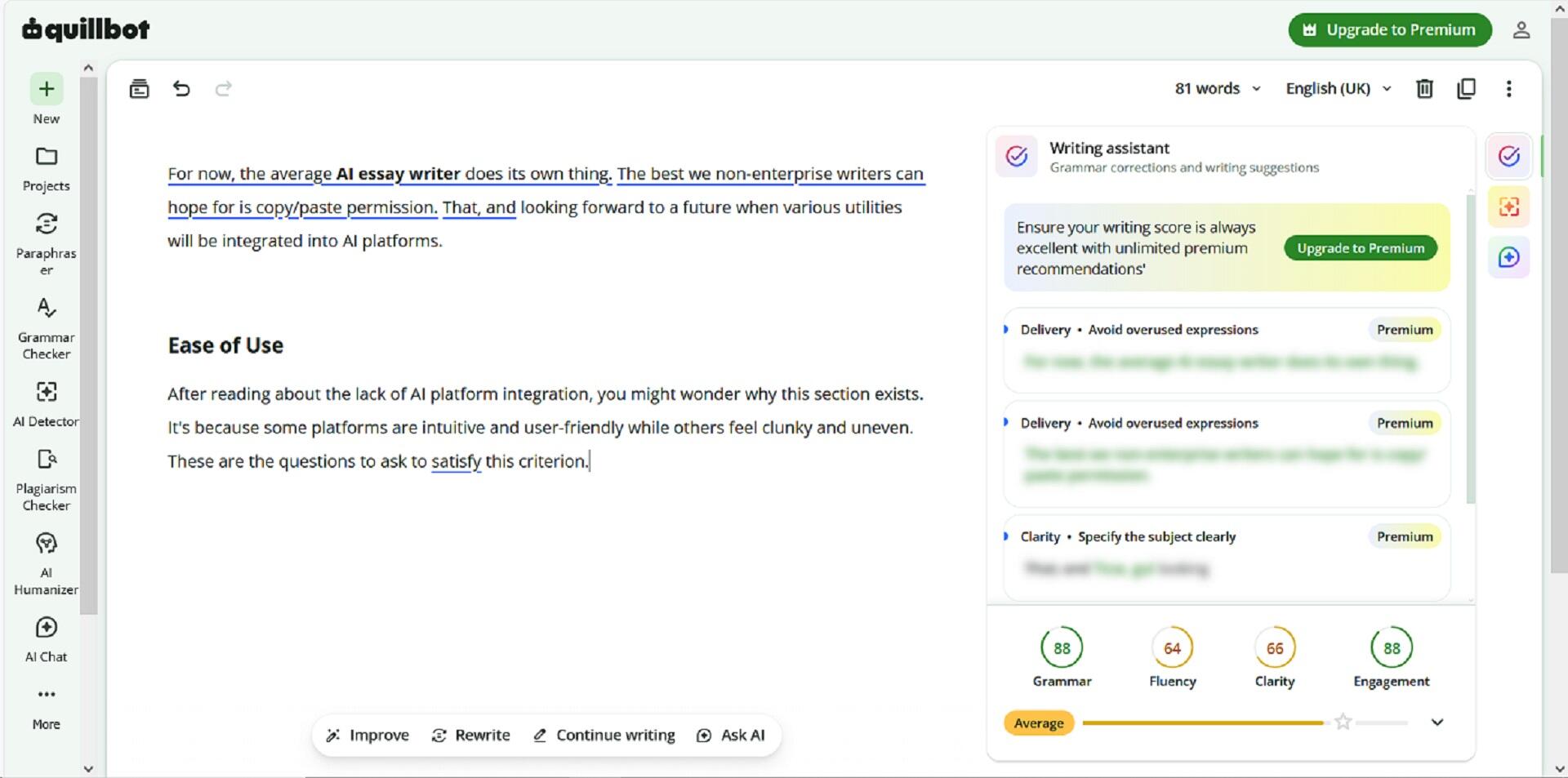
- examples: Grammarly, Quillbot
AI writing tools rely on large language models (LLMs) to understand context and provide suggestions based on users' prompts. These platforms do their best to provide human-sounding text, though they may fall short of that aim, at times.
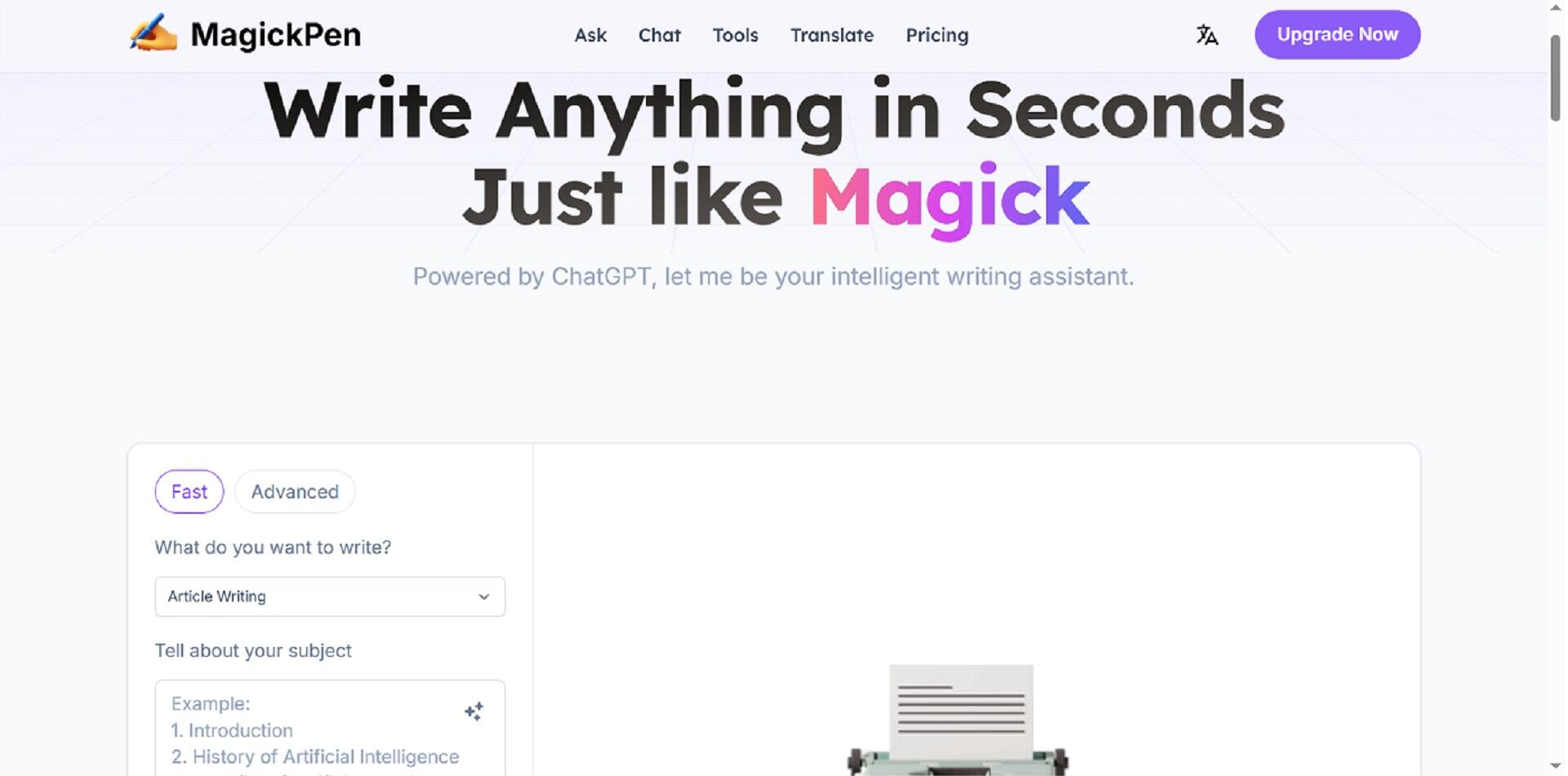
The Benefits of Using an AI Writing Assistant
Doing anything on command is challenging; very few people can cry on command, for example. Even fewer can write a grade-worthy paper on the spot. For students with writing assignments, figuring out how to start and what information to include stops them cold. This is where AI writing tools can help.
Anthropic's Claude and Open AI's ChatGPT are great for brainstorming ideas. You can ask "What's the most important thing to know about [my topic]?" You should specify that you're writing at your grade level, and who your target audience is. The AI will return a list of talking points and related ideas.
As a professional writer, I routinely use AI writing tools, including spell- and grammar checkers.
Writers must take their AI grammar checker and other AI writing output with a grain of salt. Its recommendations may not suit one's writing style or target audience. Correction suggestions might change the writer's intended meaning. You don't have to follow every suggestion your AI puts forth; I certainly don't.
With that said, I confess to giving a small salute to the platforms I use. It would be mortifying to publish aimless, misspelt, grammatically poor articles! 😱
Top AI Writing Tools for Students
Besides spellcheckers and grammar checkers, today's students have access to a broad range of AI writing tools. Of them all, these three stand out9.
Claude
If you're a university student working on your thesis, this is the AI writing assistant for you. Claude is best for long, structured writing. Its reasoning capabilities are a cut above, making it ideal for academic compositions.
ChatGPT
Multiple sources tout this AI platform as the best all-around for students. Granted, the free tier offers limited functionality in AI writing tools. However, the Plus tier opens the floodgates to all the writing tools any student (or writer) could hope for.
Notion AI
If you're a student who struggles with keeping notes organised and schedules on track, this is the AI tool for you. Granted, it does not feature a writing tool. However, Notion can help you organise your information such that, when it comes time to write, you'll have all your resources in line.
How to Evaluate an AI Writing Assistant
In the news and on social media, we constantly hear about AI goofs. Lately, AI hallucinations have made headlines5, too. How are you supposed to trust any AI writing tools for students if they can't tell you how many Rs are in 'strawberry'?
Output Quality
As the clip above emphasises, you should not accept AI results without first verifying that they're correct and targeted to your needs. These are the qualities to look for.
Even the best AI writing tools in use today are mistake-prone. They may insist on their correctness or agree with you when you challenge its answer, giving you no reason for its change in position. This phenomenon is called AI sycophancy6, and neither it nor insistence on its own rightness is acceptable.

Integration Capabilities
Nobody operates in a vacuum, especially not writers. We use dictionaries, thesauruses, and bibliography generators, along with a host of other digital tools to create our work. However, AI platforms have yet to catch up.
ChatGPT is fairly generous in allowing users to copy/paste its results into other platforms, such as flashcard generators and mind map creators. However, it doesn't 'talk' with them directly - it's not integrated.
These are generally enterprise-grade applications to streamline workflow across AI and other platforms4.
For now, the average AI essay writer does its own thing. The best non-enterprise writers can hope for is copy/paste permission; that, and looking forward to a future when various utilities will be integrated into AI platforms.
Ease of Use
After reading about the lack of AI platform integration, you might wonder why this section exists. It's because some platforms are intuitive and user-friendly while others feel clunky and uneven. These are the questions to ask to satisfy this criterion.
Pricing
Should you subscribe to an AI platform when you'll only use it occasionally? Do you need the extra functionality that basic AI access doesn't deliver? In these tough financial times, why pay for something you don't absolutely need?
But if you do need an AI subscription, shop around. Look for platforms that offer the functions you need at the lowest price. See if they offer a student discount and be sure to ask if your school has a code to secure a lower price.
Make sure that any platform you subscribe to gives you a clear way to cancel your subscription.
Future Trends for AI Writing Tools
AI isn't going anywhere.
Bernard May, CEO of National Positions
Seeing as it's not going anywhere, what does the future hold for AI? These are the questions everyone's asking.
Natural Language Processing Advancement
Despite monumental advances in NLP since the days of ELIZA, getting an AI to talk like a human is challenging. These machines know millions of words and can predict what the next word in a sentence should be.
However, they cannot seem to grasp linguistic nuance, nor do they rank well in understanding context7. For this reason, anyone using an AI writing assistant must beware of potential flags the platform might throw on their text. Is it a genuine mistake or something the AI cannot understand?
The ongoing efforts to train AI in understanding language complexity yielded few results. So, engineers have pivoted to making the systems less prone to hallucination and bias.
Ethical Considerations
When is it okay for a writer to use an AI paragraph generator? If writers use it once, they'll likely use it a thousand times. If so, can they then claim the work as their own?
This is a question that UK school administrators have been wrestling with since 2023. Once ChatGPT usage became widespread, they noticed an uptick in AI-related misconduct8. Today, several AI tools exist to detect AI writing, but their success rate is hit and miss.
Penalties for turning in AI-generated work range from zero marks to expulsion.
Today, academics debate whether students marking their work as AI-assisted should be acceptable. Many favour a return to in-person exams and scrapping online lessons altogether. Fundamentally, the issue lies with the students.
You're in school to learn how to manipulate and use information. Kudos to you if you're already so good that you can use AI to manipulate knowledge on your behalf. But what does that do for you?
The bottom line is this: it's fine to use AI tools to help you revise for exams. It's not fine to let AI take your exam for you. You don't need a teacher or administrator to tell you that.
References
- ContentoBot.com. “History of AI Writing: How Did This Technology Start?” ContentoBot.Com, 18 May 2023, https://contentobot.com/blog/7/history-ai-writing-how-did-technology-start. Accessed 13 July 2026.
- Balraj, Bawa . AI’s Early Writing Tools. https://www.confai.com/technical-writing-blog/artificial-intelligence/ai’s-early-writing-tools. Accessed 13 July 2026.
- “How to Evaluate Generative AI Output Effectively | Clarivate.” Academia and Government, 6 May 2025, https://clarivate.com/academia-government/blog/evaluating-the-quality-of-generative-ai-output-methods-metrics-and-best-practices/. Accessed 13 July 2026.
- Patel, Kaushal. “AI Integration Services: How to Embed AI into Existing Systems - Enqcode Blog.” Enqcode.Com, ENQCODE Technologies, 8 Oct. 2025, https://enqcode.com/blog/ai-integration-services-how-to-embed-ai-into-existing-systems. Accessed 13 July 2026.
- Choi, Anna, and Katelyn Mei. “What Are AI Hallucinations? Why AIs Sometimes Make Things Up.” The Conversation, 21 Mar. 2025, https://theconversation.com/what-are-ai-hallucinations-why-ais-sometimes-make-things-up-242896. Accessed 14 July 2026.
- Talby, David. “So, You Agree—AI Has a Sycophancy Problem.” CIO, 30 Aug. 2024, https://www.cio.com/article/3499245/so-you-agree-ai-has-a-sycophancy-problem.html. Accessed 14 July 2026.
- “The 10 Biggest Issues Facing Natural Language Processing.” I2group.Com, https://i2group.com/articles/the-10-biggest-issues-facing-natural-language-processing. Accessed 14 July 2026.
- abdullahsaleem. “AI Vs. Plagiarism: Is Using AI Considered Plagiarizing In 2026?” Academic Universe, 14 Feb. 2026, https://academicuniverse.co.uk/is-using-ai-plagiarism-uk-universities-2026/. Accessed 14 July 2026.
- The AI Tools Team. “Best AI Tools for Students in the UK 2026 – the Best Guide to AI Tools.” Aitoolsww.Co.Uk, 15 Mar. 2026, https://aitoolsww.co.uk/best-ai-tools-for-students-in-the-uk-2026/. Accessed 14 July 2026.
Summarise with AI:
Did you like this article? Leave a rating!

 Loading...