

Throughout most of history, studying for exams revolved around textbooks and notes students took. This revision method caused a lot of frustration and boredom, as the students in the picture above seem to feel. But today, we have a range of AI revision tools to make studying for exams engaging and thought-provoking. These are some of the top AI tools for students and the benefits of using them.
| 🤖 Platform name Function | 🧩 Features | 😍 Platform pros | 😟 Platform cons | 💷 Cost |
|---|---|---|---|---|
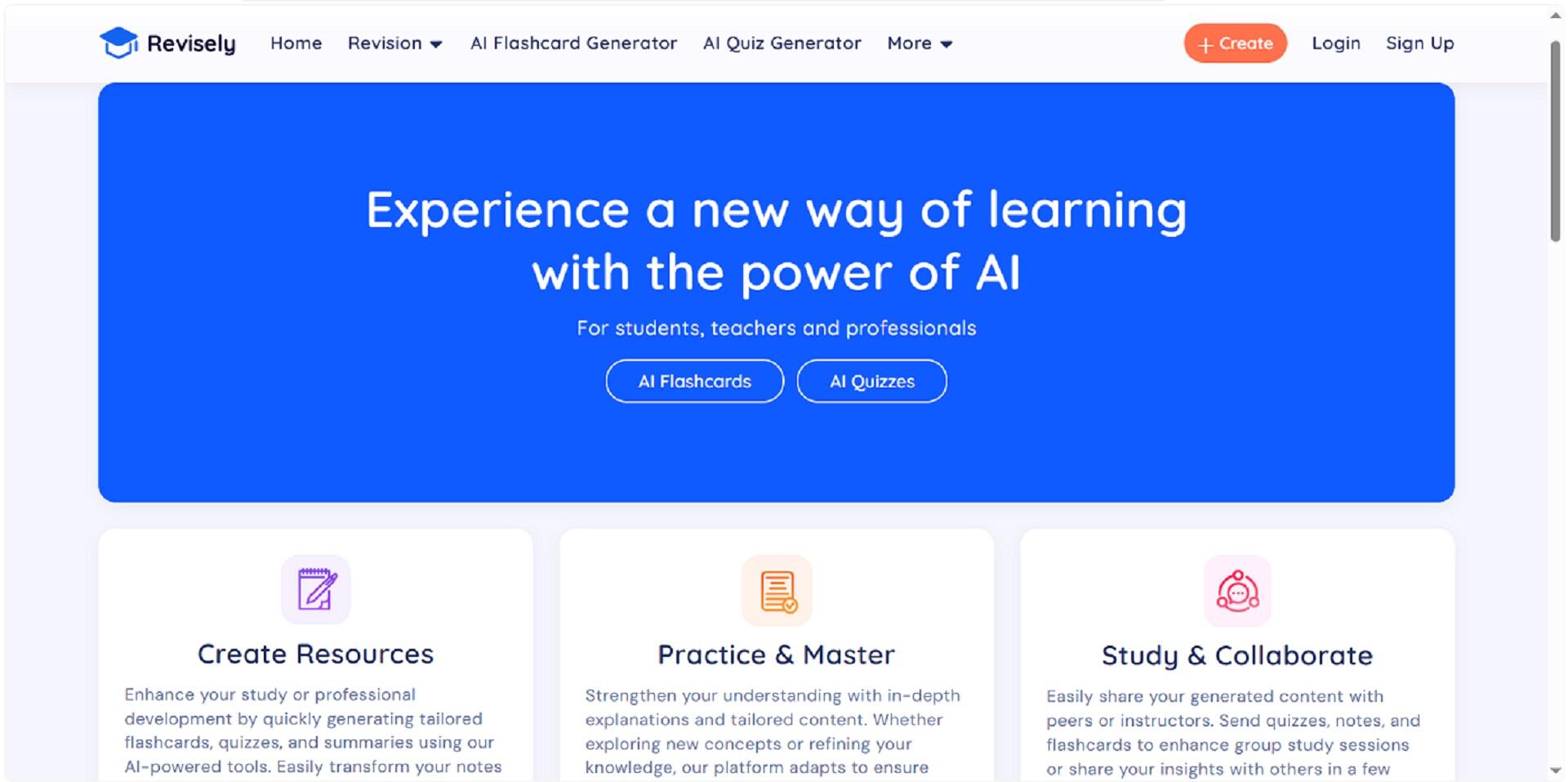
| Revisely flashcard creator | - cards generated from your notes - arranges decks by colour and subject - multi-device access | - clear layout - attractive visuals - card/deck categorisation | - text format only - paid plan required for export | Basic access is free Premium access starting at £6/month Annual plan: around £30 per year. |
| Perplexity search engine | - provides answers with source citations - summarises difficult texts - access on the web and mobile app | - sourced answers - accurate summaries - suitable for all academic levels | - minimal interface - not always up-to-date - lacking customised responses | Basic access is free Pro version is ~ £17/month |
| Consensus University publication summariser | - reviews and summarises academic sources - answers your questions about selected papers | - great for evidence-based assignments - answers based on published research findings - best for uni-level work | - limited database - no mobile version - less suited to younger students | Basic access is free Monthly plan is ~ £7/month |
| Quizgecko quiz generator | - choice of true/false, open-end, and multiple-choice formats - a variety of input methods - Export and share capabilities | - very fast! - works with URLs, PDF, pasted text and uploaded docs - content analysis leads to more relevant questions | - English-only interface - no tweaking questions to make them more accessible - regular use requires a paid plan | Basic access is free, but with daily limits Premium plan: ~£5/month (limited features) Ultra plan: ~£22/month (greater AI access) |
| MyMap AI mind map generator | Automatic mind map generation based on your prompts. Organises concepts in order of significance. Navigate between information nodes and zoom in on them. | - quickly organises concepts - groups study materials by category - presents information visually. Shows connections between related ideas. | -a bit difficult to use at first - poor integration with other AI tools - limited maps on the free tier - no mobile availability | Limited features available at the free tier. Monthly premium subscription: ~£17/month |





Understanding AI Revision Tools
AI revision tools are (mostly) internet-based applications that can help you create personalised study aids. This includes flashcards and quiz generators, subject summaries and topic overviews, and video creators to animate your learning. AI study solutions can be both efficient and effective, cutting down the time you spend preparing revision materials.
How Are AI Revision Tools Different Than Traditional Revision Methods?
AI is the most recent iteration of social evolution ...
Martin Hilbert, Professor of Communication, UC Davis
In 2001, education author and speaker Marc Prensky coined the term 'digital native' to describe learners born during the Information Age1. That's the time when technology made astounding leaps forward, when personal computing became an everyday affair.
Digital natives are people who've never known the world without internet connectivity. Today, all students are digital natives. They are perfectly comfortable using technology and, indeed, often prefer to do so.
That being the case, it's no surprise that today's students increasingly rely on digital tools to aid their studies. But how do these learning and revision methods compare with traditional study tactics?
💻 AI revision tools 💻
- demand engagement
- may remind you to study
- abundant materials
- accessible to many utilities
- create a variety of study resources
- tailored to individual learning needs
- up-to-date information
- possibility of incorrect information
- can provide feedback and assessment
- permits engagement even when studying alone
📝 Traditional revision 📝
- relies on passive learning
- no study reminders
- materials are limited
- cannot be manipulated or configured
- limited study resources
- one-size-fits-all, regardless of preference
- information dated to when books were published
- information less likely to be wrong
- engagement only through group or tutor-assisted study
- assessment and feedback only after exams
To be sure, both revision methods have their good and bad aspects. But, in the end, students' dedication to studying makes all the difference, whether they use digital or analogue study tools. Still, as today's students are digital natives, having study tools they're comfortable using presents a decided advantage.
Professor Hilbert, quoted above, focused on social evolution in his statement.
He said that while reflecting on the historical pattern of technology-driven knowledge growth that advances societies. His words suggest that the pivot to AI is inevitable.
AI for Revision: Key Features
At the risk of stating the obvious: a digital device cannot do anything without human interaction. In the context of AI exam prep, this mandatory engagement is a key feature. To frame this advantage more clearly: a book doesn't care whether a student turns the page and can't sense eyes moving over its content.
By contrast, if a student doesn't engage with their digital study platform, it will prompt them to action. These nudges may be as simple as "Are you still there?" or elaborate, such as automated study reminders. Beyond that key property, these aspects make AI tools outstanding study companions.
The best student AI tools feature a combination of 'nudges' to ensure engagement. They offer a variety of customisations for students to design their digital learning environment. They may operate on a reward system, either gamifying learning or providing positive feedback. For digital natives, these are all to the good.
Top AI-Powered Learning Resources
Your school may present you with a list of approved AI-powered learning resources. If your teacher hasn't yet done so, consider these platforms (and the ones in the table above), tailored to UK learners.
Leo AI
Leo can help you organise your notes and turn them into flashcards; it also specialises in summarising key points. You may then play your flashcards using Leo's audio mode so you can move around as you revise.
Leo's structured revision plan function makes this platform unique. Another key Leo feature is its target audience: it's built for younger learners.
✨ Features ✨
- quickly creates lesson summaries
- organises content by theme
- nudges towards deeper study
✅Pros/cons❌
✅ great for younger learners
❌ web access only
✅ makes targeted suggestions
❌ limited subjects
💳 Price 💳
- free (limited) basic version
- subscription: £17/month
Scholarcy
This AI revision tool summarises articles of all types: PDF, generated reports, and other documents. It then turns that information into flashcard decks for easier study. It also cites bibliographic references and generates summaries you can export into printable documents.
✨ Features ✨
- automatic document summary
- creates targeted flashcards
- interprets long documents.
✅Pros/cons❌
✅ fast
❌ not always accurate
✅ great for organising reading materials
❌ limited basic features
💳 Price 💳
- limited basic level is free
- subscription starts at £7/month
ChatGPT
In 2022, ChatGPT broke the large language model (LLM) ceiling - 'went viral', in today's speak. ChatGPT was among the first AI platforms incorporated into education and remains the most popular2. It is best suited to higher-level study, particularly university learning.
In all, ChatGPT for exam review isn't as reflexive and intuitive as other platforms mentioned here. That may have something to do with its higher-level target audience. However, this platform is making great strides towards building revision tools targeted at younger learners.
✨ Features ✨
- flashcard creator
- quiz generator
- text clarification
- feedback capability
✅Pros/cons❌
✅ most popular
❌ not always accurate
✅ easily accessible
❌ clumsy feel
💳 Price 💳
- Free basic version (limited access)
- higher tiers start at £20/month
How to Choose the Right AI Exam Prep Platform
Learning to choose is hard.
Barry Schwartz, Psychologist
It's an understatement to say we're spoilt for choice when it comes to AI platforms. How to know which one is right for you? One way is to pick from the list your school provides (if it does). The best way, by far, is to consider these factors3.

Assess Your Revision Needs
AI won't magically make you a better student, nor can it guarantee you exam success. However, when you choose the right revision tools for your needs, you'll be better positioned to reach your study goals. These are the points to consider as you evaluate AI platforms.
Evaluate Platform Features
Once you know what level of AI assistance you need, it's time to start reviewing platforms. Unfortunately, you have no easy way of doing this, not even with AI. Lists like this one (or the ones your school provides) are a good place to start.
Integration: how well does the AI mesh with other online functions?
Accuracy: as 'young' as current AI systems are, they are prone to making mistakes.
Usability: ease of use and the level of support it offers.
Data quality: where does the AI pull its information from (and is it prone to hallucinations)?
Consider Value for Your Money
It's tempting to believe that paying the most gives you the most, but that's not the case, more often than not. Besides, why pay the highest price or commit to a lengthy subscription when basic-level access is all you need? On the other hand, you're free to pay fees if you'd rather establish a long-term relationship with a platform that satisfies all your study needs.
You're not limited to just one AI platform. You may sign up for one that offers a free flashcard utility, another that generates free mind maps, and yet another that summarises texts for free.
How to Integrate Your AI Learning Assistant Into Your Revision Routine
Let's say you've picked Revisely to create flashcards, Quizgecko to generate multiple-choice questions, and ChatGPT as your go-to AI writing tool. Once you've settled on one (or more) platforms, it's time to get to work - and to put your AI to work. This chart shows you how and why you should.
| 🦶 Step to take | 👷♂️ How to do it | 🌟 Expected results |
|---|---|---|
| Create a study plan | Access your platform's study planner. Input your courses, materials, desired revision schedule, and length of time to study each subject. | A printable revision schedule that includes all the data you've input. Reminders of study times. |
| Use the right tools | Flashcards are great for testing yourself on 'information nuggets'. Quiz tools are tops for multiple-choice and true/false questions. Mind maps are best for making connections between concepts. AI writing tools work great to improve your essay writing skills. Maximise the AI tools at your disposal. | Compartmentalising your revision tasks helps you hone individual skills, boosting your cognitive flexibility. |
| Track your progress | Request feedback from your AI tools during each study session. Prompt your AI to conduct real-time analytics of your work. Prompt for pattern recognition to find areas of weakness in your reasoning and workflow. | AI-generated feedback tells you exactly where improvement is needed, allowing you to target the skills you need to work on. |
| Adjust your learning strategies | Based on AI-provided feedback, hone in on tasks and subjects you show lagging performance in. | As you get more comfortable using AI to guide your studies, you'll find your revision process more streamlined and efficient. |
References
- Coviello, Kehley. “Digital Native.” Science.Jrank.Org, https://science.jrank.org/programming/Digital_Native.html. Accessed 12 July 2026.
- Conrad, Matthias, and Henrik Nuebel. “Learners’ Acceptance of ChatGPT in School.” Education Sciences, vol. 15, no. 7, 16 July 2025, p. 904, https://www.mdpi.com/2227-7102/15/7/904, 10.3390/educsci15070904. Accessed 13 July 2026.
- Jabari, Mori. “Best AI Tools for GCSE and A-Level Students | British Online School | iBOS Online Education | Online British.” British Online School | iBOS Online Education | Online British School, iBOS, 11 June 2026, https://ibos.school/best-ai-tools-for-gcse-and-a-level-students/. Accessed 13 July 2026.
Summarise with AI:
Did you like this article? Leave a rating!

 Loading...