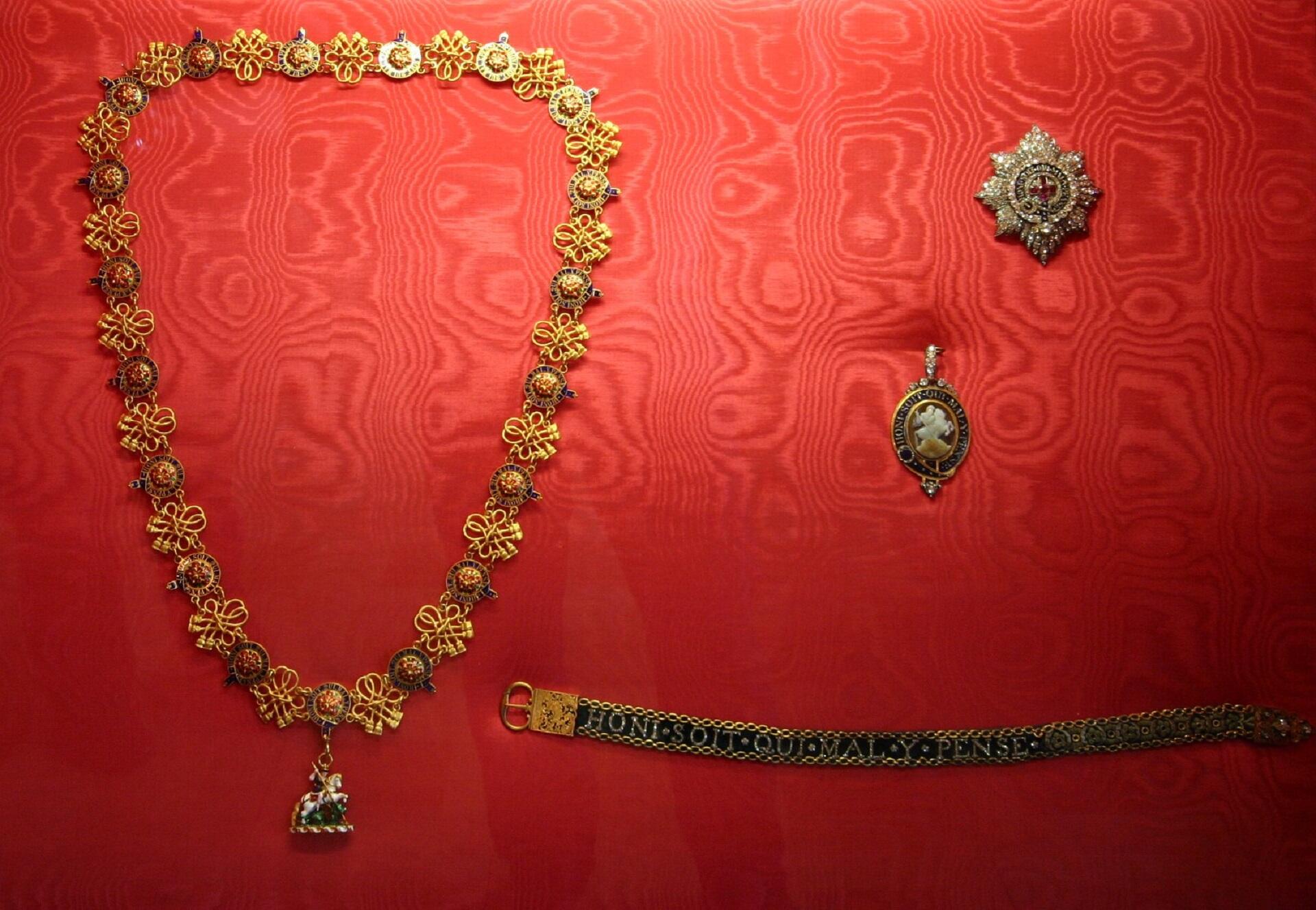

Orders of chivalry and knighthood in the UK have existed for hundreds of years; they trace their history to around 1099, the time of the Christian military Crusades. Since then and still today, various orders exist that grant membership, honours, and rank to members based on service, loyalty, and merit. Today, we find many such orders in state bodies, as well as religious orders, dynastic orders, and societies. This article describes their history, status, and insignia, medals, and the titles they accord.
What Is an Order of Chivalry?
- Orders of chivalry and knighthood are structured societies that one may become a member of.
- These orders reflect traditional values of loyalty, discipline, and faith.
- Members wear distinctive regalia: capes, hats, and special clothing, as well as insignia, pins, and chains, according to their rank.
- Orders may be religious in nature, or dynastic, or official/state supported, such as the British order of chivalry.


What Is an Order of Chivalry?
'Chivalry' comes from the French word 'chevalerie', meaning 'horse soldiery'. In French society, a 'chevalier' - a horseman, was typically one of aristocratic standing, most likely of noble ancestry.
Knowing this word's history is the key to understanding the depth of meaning and tradition it implies. Only well-positioned men with the money to afford the care of horses merited the chevalier title. Such men tended to be loyal to the ruling class - or be a part of the ruling class. They were generally considered of good moral standing, well educated, and religiously inclined.
These traditions shape the concept of orders of chivalry today, even though few people own or ride horses. Such orders welcome members who embody the qualities their order represents, each of which has four key features to distinguish it from other orders1.
Key Characteristics of Chivalric Orders
These orders exist around the world, albeit to varying degrees. The differences in these orders lie in each culture's traditions. Across them all, we must make this important distinction.
An order is the body with the authority to accord memberships, establish ranks, and oversee duties and rituals.
A knighthood is a high rank that an order may award a member once they meet the criteria for this merit-based award.
All orders have ranking systems for their members, but not all orders feature knighthood as a rank2. Some civil orders, such as Germany's Order of Merit, go out of their way not to invoke anything to do with knighthood3. Furthermore, many orders award ranks below a knighthood; the honours system in the UK is such a one.

Origins and History of the Order of Chivalry
As noted in this article's introduction, orders of chivalry have their roots in Mediaeval Europe4. The High Middle Ages was a time of population and economic growth, and growing power of the Roman Catholic Church. The Crusades, military expeditions to reinforce Christian beliefs and lands, launched the concept of military-monastic orders.
The Crusades endured for some 200 years (1095-1291). The orders that attached rank to worthy fighters remained, evolving from their fighting roots into state and monarchical orders.
The Evolution From Military-Religious to Courtly and Royal Orders
People in Britain who receive a CBE honour bear the 'Commander' title, but they're not necessarily military commanders. The British Order of the Empire system maintains the military ranking tradition, but it is a courtly order.
The best way to demonstrate the gradual change from military to royal awards is to map them5. This timeline traces their evolution from their Mediaeval founding, when they were mostly military-religious, to their present-day 'civilian' status.
1099-1291
Military-religious orders emerge
Order of the Holy Sepulchre (ca. 1099), Knights Hospitaller (ca. 1099), Knights Templar (ca. 1118), The Teutonic Knights (ca. 1192).
1326
The first secular chivalristic order emerges
The Order of Saint George embraced secularlism, quickly followed by the Order of the Knights of the Band (1332).
1348
Britain establishes the Order of the Garter
Appointments are made by the monarchy exclusively.
1430
The Duke of Burgundy founds the Order of the Golden Fleece in Bruges
This is a Catholic order of chivalry, established on the occasion of the Duke's wedding.
1572
The military Order of St. Maurice (est. 1434) merges with the religious Order of St Lazarus (est. 1130)
This merger helped them consolidate resources and preserve Hospitaller traditions.
1687
King James VII of Scotland establishes the Order of the Thistle
Membership is limited to 16 knights and 'extras', including the British Royal Family.
1739
The Order of Aviz becomes secularised
Portugal's political and religious reforms compelled the move.
1838
The Order of Calatrava becomes secularised
Its original military mission ended, leaving its knights with nothing to do.
1917
King George V establishes additional ranks in the Order of the British Empire
He added civilian MBE, OBE, and CBE ranks to make the order more inclusive.
The Main Types of Orders of Chivalry
As noted above, several types of orders exist. Some blur the lines between military and dynastic or courtly, while others remain purely ceremonial. For instance, a British citizen with an OBE has a ceremonial honour; they have no meetings to attend or duties to fulfil. Here, we distinguish between the various orders.
State Orders of Chivalry
This is the most common type of order today; nearly every country's government awards deserving citizens official honours. Typically, these orders are a part of the national honours system in which the head of state or their designee distributes the awards. Our Order of the British Empire honours system is a state order of chivalry.

Dynastic Orders
These orders are typically associated with a royal house or ruling dynasty, even if they no longer rule. The Russian House of Romanov orders are a top example. Though the Romanov dynasty ended in 1917, its 12 dynastic orders still award honours based on loyalty, merit, and service. Honourees are not privileged within the Russian state, but the Russian Orthodox Church recognises them.
Religious Orders
These orders still exist, but they are far less common than state orders. Furthermore, they tend to remain at the heights of church hierarchies. For instance, some Papal orders of knighthood are limited to Catholic heads of state.
Established in 1192, the Teutonic Order is no longer a military order but a wholly religious society. The Knights Templar (est. 1118) were suppressed in 1309 but exist in limited forms today.
Self-styled, Unrecognised Orders
Around the world, organisations and societies exist that mirror the structures and philosophies of ancient orders. The Freemasons is perhaps the most renowned self-styled order; it is a global order with officer ranks and degrees. Freemasons have no official connection to state or religious bodies, and they have no legal or sovereign protections.
It can be confusing to distinguish one order from the next. It's hard to tell what each type of order stands for, what they do, which causes they embrace, and where its power comes from. This table summarises those questions.
| 🎩 Type of order | 👨🎓 Who grants authority | 😇 What it does | 🔎 Examples |
|---|---|---|---|
| State order | The head of state or their designee | Recognises members of the public, civil service, and military personnel for contributions to society. | Order of the British Empire. Germany's Order of Merit. |
| Dynastic/monarchical order | The sovereign or their designee. | Philanthropy, public service, charity, cultural preservation. | The Order of the Garter. The Order of the Thistle. |
| Religious orders | The head of the church | Teaching, missionary work, caring for the poor and sick. | The Benedictines, the Jesuits, etc. |
| Hospitaller orders | The head of the church | Humanitarian and medical relief and aid. | The Sovereign Military Order of Malta. Equestrian Order of the Holy Sepulchre of Jerusalem. |
| Self-styled orders | The order's founder or their designee | Fulfils the order founder's agenda. | Sovereign Military Order of the Temple of Jerusalem (SMOTJ). Order of Saint Blaise. |
How to Tell Whether an Order of Chivalry is Legitimate
With scams so prevalent nowadays, it's not hard to imagine receiving a text or email that you've been nominated for some great honour. Just as you would any other too-good-to-be-true offer, fact-checking is essential. These are the steps to take to ensure the legitimacy of any order you might aspire to.
Some 'orders' are, in fact, commercial 'membership' clubs where one must pay dues and buy titles, regalia and insignias. If your 'order' insists you do so, those are signs that you're dealing with an illegitimate order. Other signs include a too-fantastic backstory, a lack of historical continuity, and no link to any official body.
Are Orders of Chivalry and Knighthood Still Relevant?
The age of chivalry is never past, so long as there is a wrong left unredressed on Earth.
Charles Kingsley, English clergyman and historian
Consider the table above, where you read all the good deeds orders of chivalry reward: public service, helping the downtrodden, and preserving culture. Arguably, these actions are exactly what our world needs today. In fact, it's no stretch to say that our Earth has plenty of wrongs left unredressed.
However, the honours do not precede the deeds; that is, one doesn't perform good deeds because they're a member of an order. Typically, recipients receive their awards after doing the work that they would likely continue, even with no honour.

Many people express frustration over the honours systems6, because they contend that the state should do more to fund and steer good endeavours, not pat people on the back after the work is done.
Reinforcing the class structure is another cause of public ire. Not everyone can or will receive an award - and especially not a peerage, as those awards are limited to a certain social class.
The list of reasons against Orders of Honour is much longer, but those two stand as good representations of the popular discontent. Is there a flipside to that coin? Of course, there is.
Recognition of service and of exceptional work is always good. These honours are meant to encourage significant achievement; they hold honourees up as role models and examples of shared values. They also help reinforce tradition, heritage, and cultural norms.
Granted, the MBE award you might receive won't put more money in your pocket. However, it testifies to your good character and may open doors to opportunities you might not otherwise have had.
Some might (do!) find that distasteful. Still, the honours system is well entrenched in Britain and in countries around the world. As official orders will remain, perhaps advancing the discussion to themes more relevant today may help overcome that distaste.
References
- Kid Encyclopaedia. “Order of Chivalry Facts for Kids.” Kiddle.Co, 2025, https://kids.kiddle.co/Order_of_chivalry. Accessed 14 Sept. 2026.
- preceptor8. “The Order of the Temple - Yesterday and Today.” Knightstemplar, 28 Feb. 2018, https://www.knighttemplar.org/single-post/2018/02/28/the-order-of-the-temple-yesterday-and-today. Accessed 14 Sept. 2026.
- Contributors to Monarchies Wiki. “Order of Chivalry.” Monarchies Wiki, Fandom, Inc., 2019, https://monarchies.fandom.com/wiki/Order_of_chivalry. Accessed 14 Sept. 2026.
- Aubin, Hermann, and Judith Eleanor Herrin. “History of Europe - the Middle Ages.” Encyclopædia Britannica, 7 Dec. 2018, https://www.britannica.com/topic/history-of-Europe/The-Middle-Ages. Accessed 14 Sept. 2026.
- Moeller, Charles . “CATHOLIC ENCYCLOPEDIA: The Military Orders.” Www.Newadvent.Org, https://www.newadvent.org/cathen/10304d.htm. Accessed 14 Sept. 2026.
- Aaronovitch, David. “The Patronage That Undermines Britain’s Peerage.” The Atlantic, theatlantic, 10 Aug. 2023, https://www.theatlantic.com/ideas/archive/2023/08/britain-honors-system-peerage-lords/674963/. Accessed 15 Sept. 2026.
Summarise with AI:
Did you like this article? Leave a rating!

 Loading...