

Before anything else, preparation is the key to success.
Alexander Graham Bell
As a student, you would probably resonate with this quote and the significance of having a solid revision strategy, especially if you are preparing for the SQA exams next year. In this article, we will look at ways to maximise your SQA Higher English grades by maximising one of the best revision resources — past year papers.


🔍 Where to Access Official Higher English Past Papers & Mark Schemes
Thanks to the Internet, your access to the the High English SQA past year papers and other revision resources is just a few clicks away, literally. Here are some online platforms to find them.
🎯 SQA website
First, head to the SQA homepage and click the "Past Paper" button option to begin searching for past year papers and marking instruction for every subject.
Once you are directed to the Past Paper homepage, search for your subject area (English) and indicate your qualification type (in this case, Higher), and tick the box to include matching marking instructions.
Additionally, specimen question papers for SQA Higher English are offered under a different webpage to help students familiarise and practice with additional questions, with relevant marking schemes. Check out the direct links to download the specimen paper and complete marking scheme for RUAE and Critical Reading.
The SQA official homepage offers five years of exact past year papers alongside their complete marking criteria, where you can download them in PDF files for free. They are reliable and will be updated every year.
🎯 Understanding Standards
This website stands out for not only offering High English past year papers, but also answers by actual candidates alongside a commentary on how marks are awarded for both the RUAE paper and Critical Reading paper. Currently, this website offers past-year marking commentaries from 2015 to 2024.
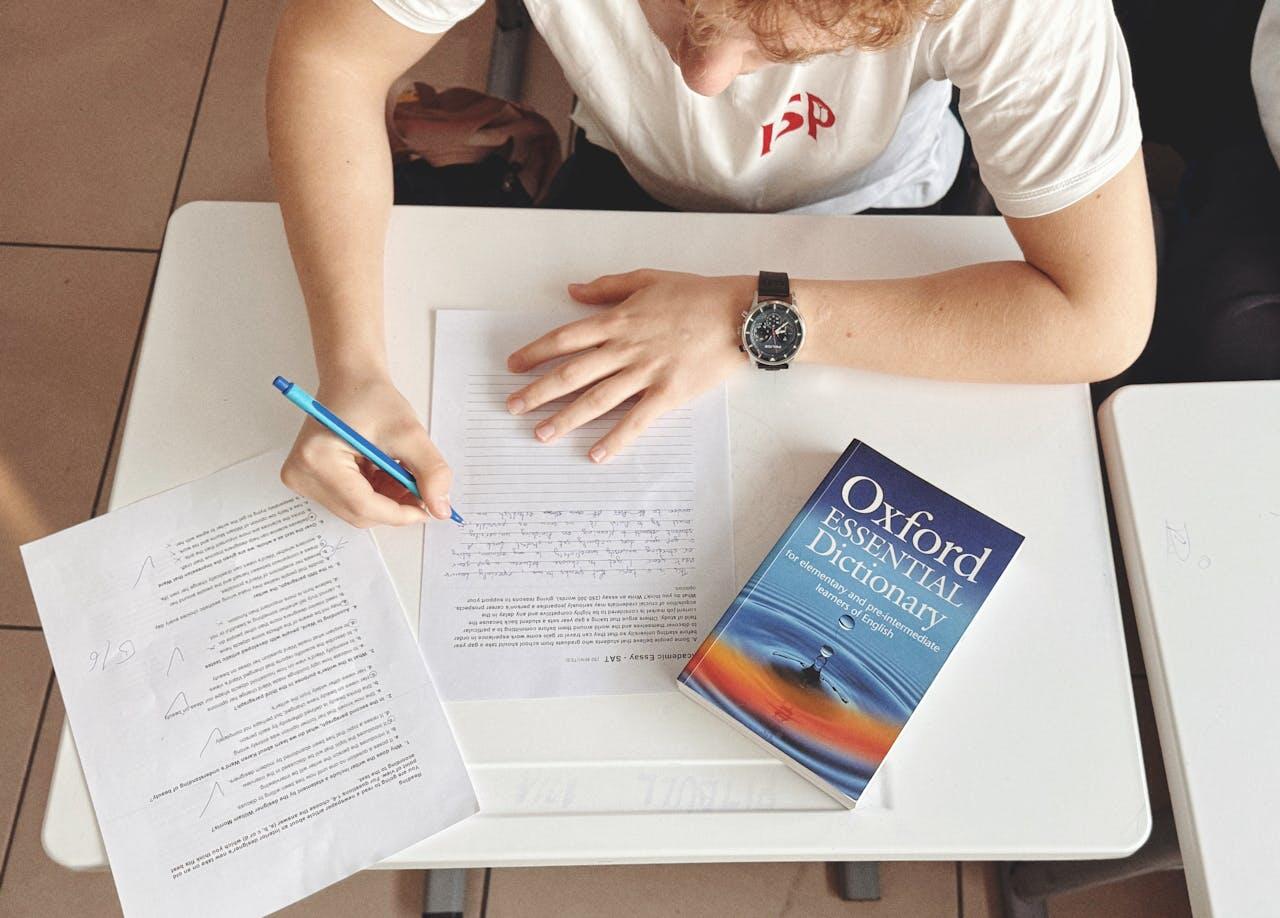
🎯 Sqa.my(Archive)
This is a special archived website which offers past year papers for different SQA subjects and learning levels. You can access past year papers and the marking scheme of Higher English from 2015 to 2025 as well as review the grade boundaries (each year), and course reports to read the details of the students' performance for the actual paper from 2022 to 2024.
💡 How to Use Past Papers to Improve Your SQA English Skills
Now that you know where to get the papers, it's time to use these resources in the best way possible for your exam preparation. If you need more tailored support alongside your self-study, you could also consider English tutor online options to fit revision around your schedule.
First and foremost, these past year papers come with official marking instructions. The breakdown of marking allocation for every question will help students to know exactly how marks are awarded and what the examiners are looking for. Here's an example of how the critical essay is graded for SQA Higher English 2025, according to the 19-20 marks benchmark (full marks: 20)
| Component | Marking Criteria for 19-20 marks |
|---|---|
| Knowledge and understanding | The essay showed through understanding of the text and perceptive focus of the focus of the questions The essay showed perceptive selection of textual evidence to support line of argument which is fluently structured and expressed |
| Analysis | The essay showed perceptive analysis of the effect of features of language/filmic techniques |
| Evaluation | The essay showed evaluative and committed stance with respect to the given text and task |
| Technical accuracy | The essay showed few errors in spelling, grammar, punctuation, sentence construction and paragraphing |
Mastering the actual grading criteria would help students to self-mark as they compare their answers with the model answers offered side by side during revision. In the long run, this would help students identify the common mistakes made and avoid certain pitfalls.
Students sometimes show very little textual evidence to support their point, which gives the impression that their answers lack structure and clarity, leading examiners to think that they have not really understood or answered the question.
Tip: Don't just state what happened, but explain how it happened, and elaborate on its effects.
Next, practising past papers allows students to identify long-term exam trends and recognise recurring question types, such as poetry themes or language techniques. This familiarises them with the exam format, helps them understand how to approach different types of questions, and deepens their knowledge of these recurring areas through consistent practice.
Finally, past papers are a great way to have a mock exam-like experience where you are exposed to actual questions with similar phrasing, wording under the same timing constraint as other previous candidates.

When you are used to answering within this timed practice, you will gain confidence and be less anxious. Your accuracy and speed in answering will increase hand in hand.
📖 RUAE Techniques: Mastering Close Reading & Analysis
To ace the Reading For Understanding, Analysis and Evaluation (RUAE) paper, you'll need to carefully read and review two given passages. The time allocation for this paper is 1 hour and 30 minutes.
When reading the question, pay attention to the right command words in the given questions and the lines that are paired with them.
Additionally, answers must be written in your own words, without any straight lifts from the passage, unless for questions which require giving direct examples from the passage.

Here are some examples of past year questions with the relevant keywords that you need to take note of:
Read lines 6 –7.
Explain the function of these lines in the development of the writer’s argument. You
should refer to the passage in your answer. [2 marks]
Read lines 48 – 54.
By referring to at least two examples, analyse how the writer uses language to create
a forceful tone. [4 marks]
Look at both passages.
Both writers agree on the negative impact of cars on society. Identify three key areas on which they agree. You should support the points you make by referring to important ideas in both passages. [5 marks]
Now, let's look at how you can gain maximum marks for these types of questions:
Explain
- Show understanding of the writer's ideas
- Include quotations for maximum marks
Analyse
- Showcase solid analysis skills
- Demonstrate the relationship between what is asked (comment + evidence)
Identify
- Summarise and select the main ideas of the writer's arguments
- Answers must be supported with detailed evidence for full marks
⏳ Critical Essay Strategies: Planning, Structuring & Timing
Now, let's look at how you can score well on your critical essay component. The critical essay is the second section tested in the Critical Reading paper for the SQA Higher English subject. If you’d like guided practice with planning and feedback, English tuition can be a helpful way to build confidence ahead of the exam. The time allocation for this paper is also 1 hour and 30 minutes.
Choose to answer one question from a selected Scottish text (drama, prose or poetry texts)
Choose to answer one question from drama, prose (non-fiction, fiction), poetry, film and television drama or language
Important: The chosen question must be of a different genre from Section 1.
4 questions for each genre, ranging from 2 marks, 4 marks and 10 marks (only answer 1 question)
Total questions = 20 marks
Total only one question = 20 marks
Planning is very important for this paper because there cannot be an overlap of questions (genre) for Section A and Section B. Hence, the first thing to do when you get the paper is skim through the given texts and questions in both sections and select the two options that you are most confident in. Quickly identify the keywords as you glance through the questions before you go into deep reading.
For instance, if you have decided to choose drama for Section A, you have to choose another genre like poetry for Section B.
Next, it's structuring. Here's a suggestion on how you can structure your answers for both sections in this paper:
Scottish Text
- For short answer questions (2 to 4 marks), go straight to the point
- Use this formula: Detailed comment + quotation/reference
- For a 10-mark question, always indicate references from the extract and another comparison text that's required
Critical Essay
- Introduction: Indicate your chosen text, author, context and link it to the genre (at least 2 sentences)
- Body paragraphs: Points+ textual evidence, solid analysis which shows a clear stand in terms of arguments (3 to 4 paragraphs)
- Conclusion: Summarise your points of argument
Now, let's talk about the importance of timing. Here’s a suggested timeline breakdown for both Section A and Section B of your Critical Reading paper, according to the 90-minute answering time.
5 minutes
Skim through both sections, decide on the two texts and start preparing for Section A
20-25 minutes
Annotate the important texts and questions in Section A. Answer the short structured questions according to the mark allocation
12-15 minutes
Answer the final 10 mark question (3 to 4 points with linked reference)
8-10 minutes
Plan the essay skeleton of Section B (intro, body, conclusion)
25-30 minutes
Write the essay according to your planned structure and textual support
5 minutes
Read through all the answers from Sections A and B, proofreading for any spelling or grammatical errors
📝 Revision Tips: Simulating Exams & Reviewing Your Answers
Once you have finished studying the subject syllabus and familiarised yourself with the exam format for both RUAE and Critical Reading, you can start using past year papers to fortify your revision through these two steps.
🕒 Simulating Exams
Choose a quiet place to have an exam simulation for both RUAE and Critical Reading, with a strict timed practice session for 1 hour and 30 minutes without interruption for each paper. Stay true to the rules of the actual exam by writing your answers in the past year paper answer sheet template using a blue or black pen.
Allocate more time for questions with higher mark allocation, but try not to exceed 1 minute per mark. For instance, 10 minutes for a 10-mark question. Structured questions should not be too long, as compared to the 20-mark critical essay question.
👩🏫 Answer Review
After completing the past year's papers, compare your answers with the model answers and self-mark objectively with the marking scheme.
Self-marking tip: Highlight the important points and keywords that are listed in your own answer and in the official marking scheme, and give yourself a tick on the overlapped ones.
As you go through the marking, note down the questions that you did not score full marks on or those you are not too confident in. If you want someone to talk through tricky questions with you, finding an english tutor harrow can make revision feel far more manageable.
You might want to keep other past year papers for your next mock exam practice. So, you can check your improvement by redoing specimen papers, as they are also designed according to the official exam board's guidelines.
You might want to receive personalised and more constructive feedback from someone experienced after submitting your answers. We highly recommend connecting with a tutor on Superprof to help you with your SQA Higher English revision, especially on how to self-mark and plan your essays. If you're unsure where to start, try searching for an English tutor near me to compare profiles and find the right match. Just head to the Superprof homepage to start searching for an English tutor near you.

As you view a wide selection of tutors' profiles, you'll learn more about their tutoring experience, qualifications, teaching methodology, teaching level, and hourly rates. Once you've decided on the tutor, you can contact the tutor via the messaging feature to book your first lesson!
Time to put on your revision gear, practice consistently with your past papers and ace your paper with confidence!
Summarise with AI:
Did you like this article? Leave a rating!

 Loading...