
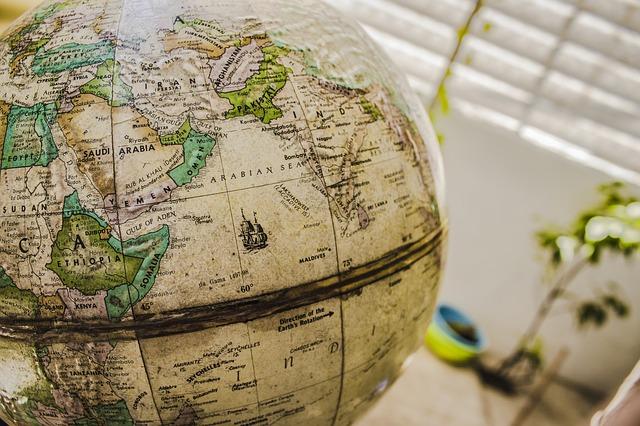

Geography is how we study and understand places. From changing coastlines to growing cities to migration and climate change, we can approach these from various perspectives and branches of geography. At GCSE and A Level, students are expected to understand what they are and how people, places, and natural processes affect and interact with the environment. For students seeking targeted support with these topics, online geography tutors can provide personalised guidance for GCSE and A Level study.
Key Takeaways
- Geography can be broadly grouped into human, physical and environmental geography, although these areas frequently overlap.⁹
- GCSE Geography covers physical and human geography alongside fieldwork and geographical skills.⁷
- There is no single official list of 7 types of geography; broader lists can include fields such as population, economic and regional geography.
- Population geography examines patterns including migration, fertility, mortality and population distribution.⁸
- Maps, GIS, data analysis and fieldwork are important geographical tools used across different branches of the subject.¹


What Does Geography Mean?
Geography has stimulated my mind and given me the attitude to go out and see for myself, rather than be told by others.
Michael Palin
Geography is the study of places, people, environments and the relationships between all of the above. It's at the crossroads between the natural and social sciences, which means geographers can investigate physical processes and how people organise, use and change different places.⁹
For GCSE and A Level, students explore physical and human geography. The GCSE subject content includes physical geography, human geography, fieldwork and geographical skills, with students expected to understand how processes interact across different environments.⁷ A Levels build upon this with students gaining a greater understanding of connections between people, places, processes and environments.⁶ AQA's A Level Geography specification includes Physical Geography, Human Geography and a Geography Fieldwork Investigation.³
Geography is the academic study of the Earth's landscapes, environments, and the relationships between people and their environments. It helps us understand the physical features of our planet, such as mountains, rivers, and climates, as well as human activities, like cities, cultures, and economies.
Geography combines knowledge from the natural sciences and social sciences to explore how we interact with the world around us and how we can manage our resources sustainably.
The 3 Main Types of Geography
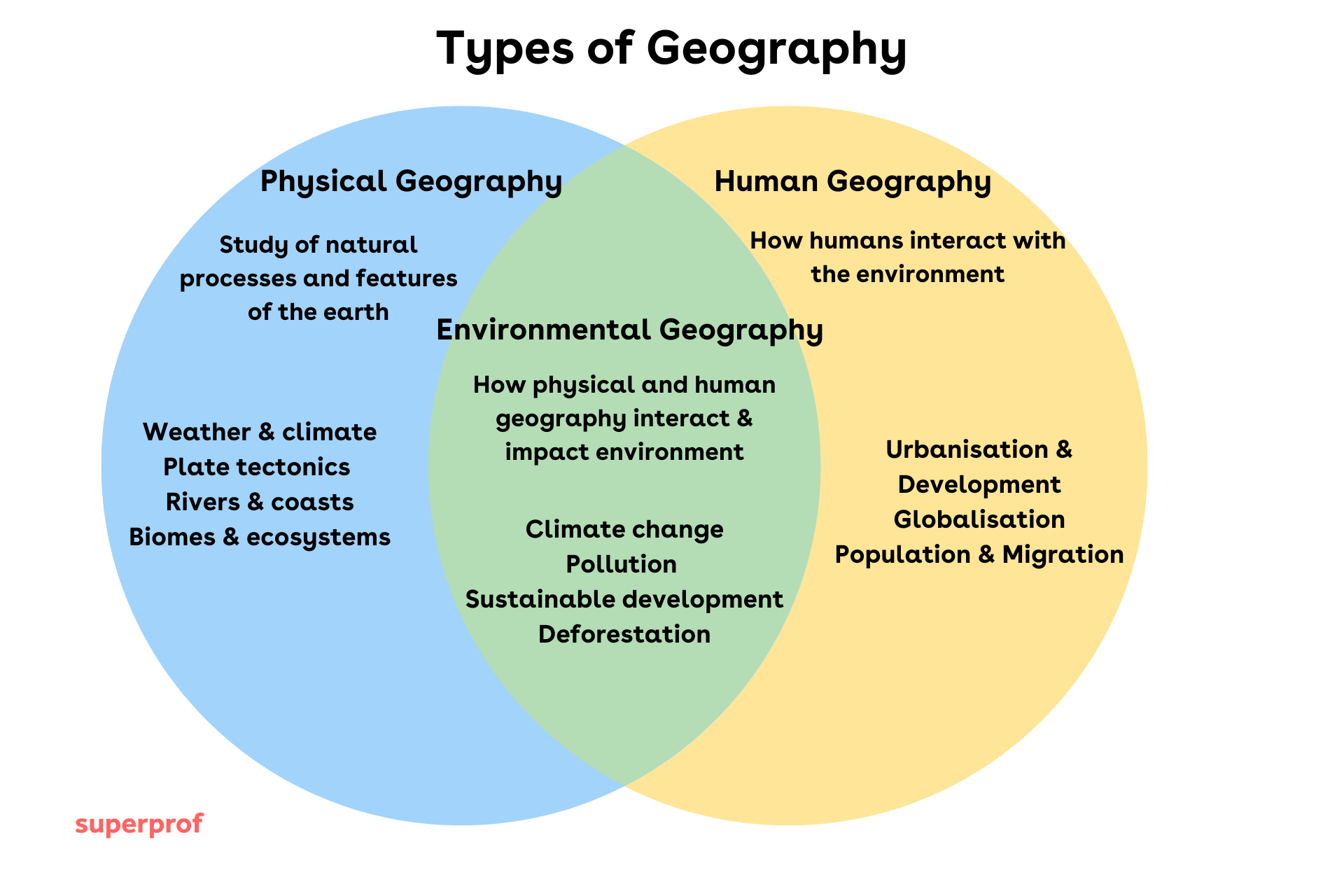
For the purposes of GCSE and A Levels, we can classify geography into three broad types: human, physical and environmental geography. We could also classify Gerography into 5 themes, too. However, GCSE typically organise around physical and human geography, with environmental questions connecting the two.⁴ There's a lot of overlap between them, but it's a good place to start if you're trying to work out what geography questions are really asking.
| Type of geography | What it studies | GCSE and A-level examples |
|---|---|---|
| Human geography | People, societies, economies, cultures and the places they create. | Urbanisation, development, migration and globalisation.⁴ |
| Physical geography | Natural environments, landscapes and the processes that shape them. | Rivers, coasts, ecosystems, weather and natural hazards.⁴ |
| Environmental geography | Relationships between people and the natural world, including human impacts and environmental responses. | Resource management, climate change, sustainability and flood management.⁶ |
Human Geography
Geography is an essential branch of geography that studies people, cultures, economies and the interactions that they have with the environment.
- Population and migration: How populations are distributed and why people move between places.
- Urbanisation: How towns and cities grow and how this affects housing, transport and services.⁴
- Economic development: How jobs, trade, resources and standards of living vary between places.

Physical Geography
Physical geography studies the physicalcharacteristics of the earth. That refers not only to the earth's surface, but what is under and around the exterior of the planet. Physical geography is a significant sub-discipline of two broader academic subjects, geography, and earth sciences.
- Rivers and coasts: How erosion, transportation and deposition shape landscapes.
- Natural hazards: The causes and effects of events such as earthquakes, volcanoes and extreme weather.⁴
- Ecosystems: How climate, vegetation, soils and other natural processes interact.
Environmental Geography
Environmental geography is also known as integrated geography or human-environmentgeography. It is the study of the interactions between humans and the natural environment, focusing on the impact of human activities on natural systems and the development of sustainable practices to manage and conserve natural resources.
- Climate change: How environmental changes affect people, ecosystems and economies.
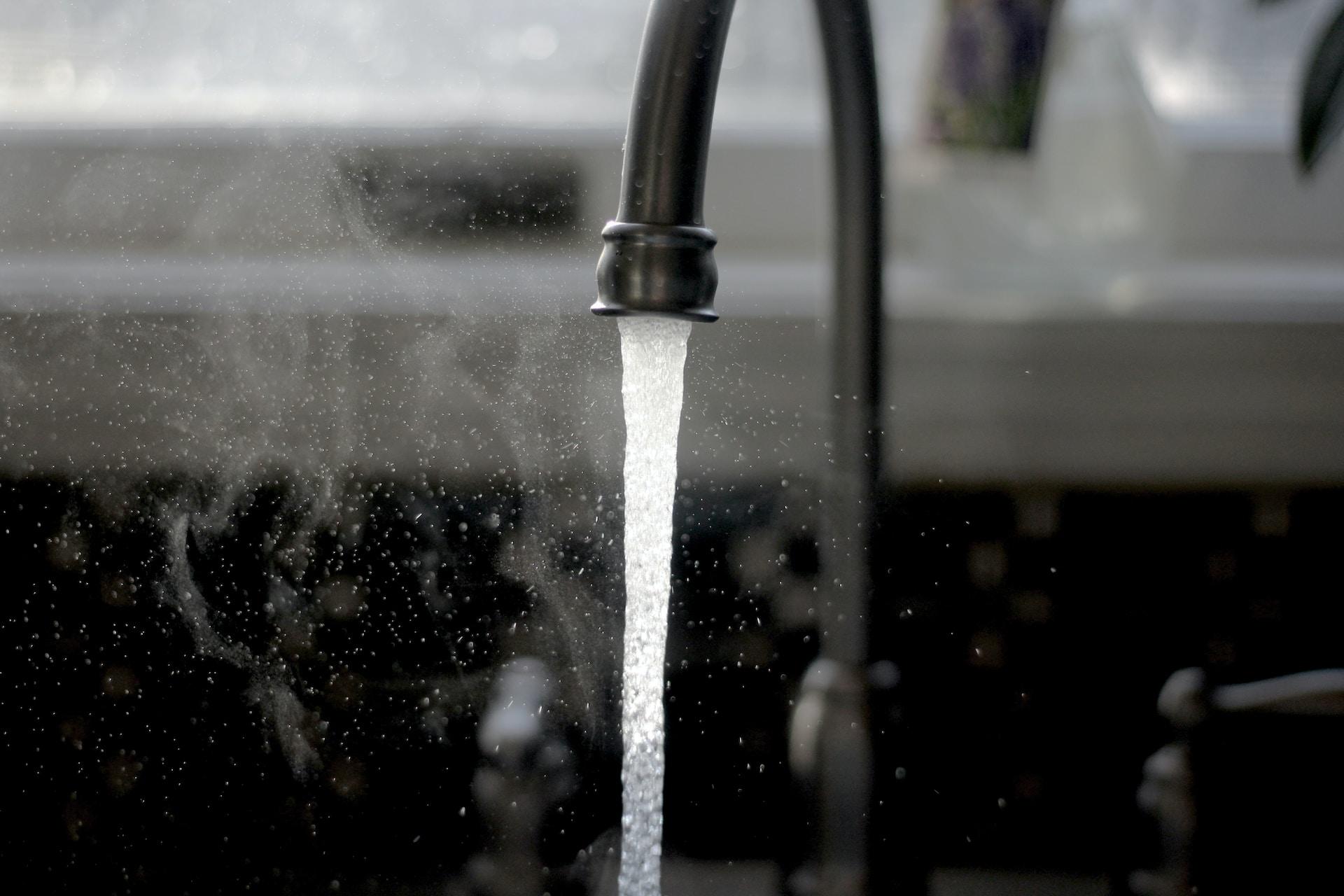
- Resource management: How water, energy and other resources can be used more sustainably.
- Human-environment interactions: How people alter environments and how environmental conditions influence human activity.⁶
Branches of Geography: 7 Common Types Explained
Beyond the three broad classifications that we saw earlier, there are 7 common types of geography seen in GCSE and A Level geography. However, remember that different universities, textbooks and courses may group the branches of geography in different ways. The seven areas below are useful examples, but not an official classification. Some types are broad classifications while others are very specific, providing tools and approaches for studying aspects of geography. They can coexist without necessarily contradicting one another, and famous geographers may operate using different lenses and perspectives from the different branches.
- Human geography: Studies people, societies, cultures, economies and places.⁹
- Physical geography: Examines natural landscapes, environments and Earth processes.⁹
- Environmental geography: Focuses on relationships between people and the natural environment.⁶
- Regional geography: Brings together different geographical features to understand a particular place or region.
- Population geography: Studies patterns in population distribution, migration, fertility, mortality and population change.⁸
- Economic geography: Looks at where economic activities take place and how trade, employment, resources and development vary between places.
- Cartography and GIS: Use maps and spatial data to represent, investigate and analyse geographical patterns.¹⁰
Geography Examples in Real Life
The different types of geography become easier to see when you can see how they apply to real-world problems and interesting geography facts. With issues involving physical processes, human decisions, and environmental consequences at the same time, geographers need to approach problems from various perspectives. GCSE Geography B encourages students to explore links between the natural world and people and society rather than treating them as completely separate areas.⁵
Flooding
- Physical geography: Studies rainfall, river discharge, geology and drainage to understand why flooding happens.
- Human geography: Looks at where people build, who is at risk and how flooding affects homes, businesses and communities.
- Environmental geography: Examines flood management, land use and ways to reduce risk while protecting natural environments.
City Growth
- Human geography: Studies migration, employment, housing, transport and the reasons cities expand.
- Physical geography: Considers how relief, rivers, climate and available land influence where cities develop.
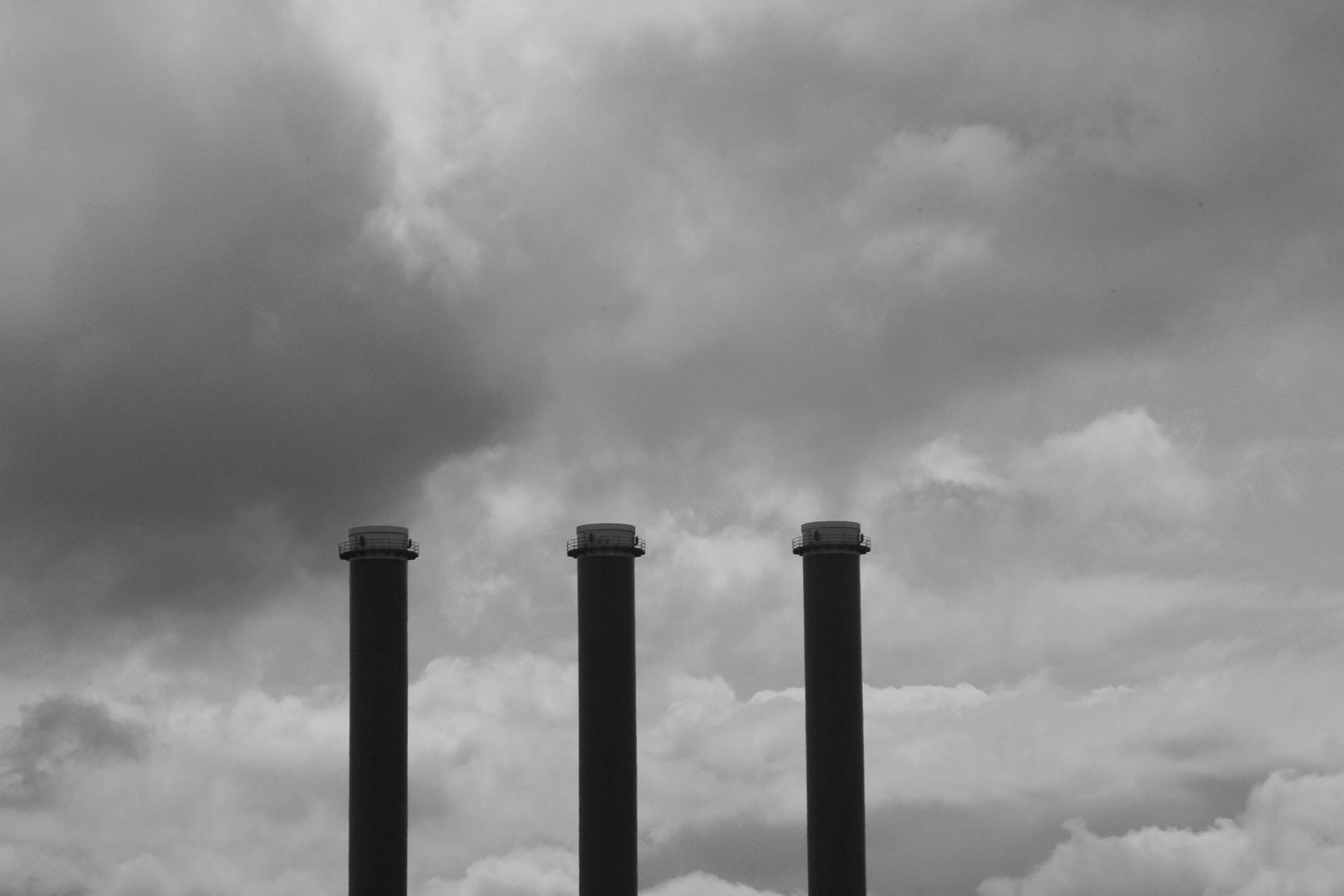
- Environmental geography: Looks at issues such as pollution, flood risk, water demand and access to green space.
Climate Change
- Physical geography: Studies climate systems and the physical processes behind changes in temperature, rainfall and weather patterns.
- Human geography: Examines causes and impacts linked to populations, economies, energy use and inequality.
- Environmental geography: Brings these together by studying mitigation, adaptation and the effects of climate change on people and ecosystems.⁶
Geography Skills and Tools: Maps, Cartography, GIS and Fieldwork
Geographers need skills as much as they need the knowledge gained from the academic discipline of geography. Maps, data, field observations and digital tools help them identify patterns, compare locations and test geographical ideas. GCSE students are expected to develop cartographic, graphical, numerical and statistical skills and apply them throughout their geographical studies.¹
You'll find these skills useful across human, physical, and environmental geography, not just one branch. Cartography and GIS can help you represent and analyse spatial information. Fieldwork helps you learn how to collect evidence directly from real environments. At A Level, students have to complete an independent investigation based on fieldwork, which forms a distinct part of the qualification assessment.² This means these tools can help you go from simply learning about geography to asking questions, gathering evidence, analysing patterns and reaching supported conclusions.
Cartography, Maps and GIS
Cartography is the branch of geography that focuses on the creation, design, and interpretation of maps, providing visual representations of spatial information and geographic data.
Fieldwork and Geographical Enquiry
Summary: How to Remember the Types of Geography
Without a geography glossary, the simplest way to remember these types of geography is by thinking about the questions that you're being asked. Luckily, most of the names are fairly obvious: human geography focuses on people, physical on the actual world, and environmental on how the two interact. However, remember that more often than not, all three are at play.
Human geography = people and places
Physical geography = the natural world
Environmental geography = people and nature interacting
References
- AQA. “Geographical Skills.” GCSE Geography 8035, 16 Feb. 2016, https://www.aqa.org.uk/subjects/geography/gcse/geography-8035/specification/subject-content/geographical-skills. Accessed 10 Aug. 2026.
- AQA. “Scheme of Assessment.” A-Level Geography 7037, 6 Feb. 2016, https://www.aqa.org.uk/subjects/geography/a-level/geography-7037/specification/scheme-of-assessment. Accessed 10 Aug. 2026.
- AQA. “Specification at a Glance.” A-Level Geography 7037, 6 Feb. 2016, https://www.aqa.org.uk/subjects/geography/a-level/geography-7037/specification/specification-at-a-glance. Accessed 10 Aug. 2026.
- AQA. “Specification at a Glance.” GCSE Geography 8035, 16 Feb. 2016, https://www.aqa.org.uk/subjects/geography/gcse/geography-8035/specification/specification-at-a-glance. Accessed 10 Aug. 2026.
- Cambridge OCR. “Specification at a Glance.” GCSE Geography B (Geography for Enquiring Minds) (9-1) - J384, https://www.ocr.org.uk/qualifications/gcse/geography-b-geography-for-enquiring-minds-j384-from-2016/specification-at-a-glance/. Accessed 10 Aug. 2026.
- Department for Education. “GCE AS and A Level Geography.” GOV.UK, 18 Dec. 2014, https://www.gov.uk/government/publications/gce-as-and-a-level-geography. Accessed 10 Aug. 2026.
- Department for Education. “GCSE Geography.” GOV.UK, 9 Apr. 2014, https://www.gov.uk/government/publications/gcse-geography. Accessed 10 Aug. 2026.
- Franklin, Rachel S. “Population Geography.” Oxford Bibliographies in Geography, Oxford University Press, 26 Feb. 2013, https://academic.oup.com/reference/62356/reference-article-abstract/554492599. Accessed 10 Aug. 2026.
- Royal Geographical Society. “What Is Geography?” Royal Geographical Society, https://www.rgs.org/about-us/what-is-geography. Accessed 10 Aug. 2026.
- University of Wisconsin–Madison Department of Geography. “Cartography and GIS Major.” University of Wisconsin–Madison, https://geography.wisc.edu/undergraduate/cartography-and-gis-major/. Accessed 10 Aug. 2026.
Summarise with AI:
Did you like this article? Leave a rating!


 Loading...

Lord it
huh
Your lesson was interesting
Fascinatingly impacting!
really sank well! Your lectures were concise and relevant
Thank you so much.its helpful . give more information about geography
it was amazing