Linear programming is a mathematical method used to find the maximum or minimum value of an objective function (like profit or cost) that depends on two or more decision variables, subject to certain constraints (like time, materials, or capacity).





Linear Programming Word Problem Example
A company produces two types of products: A and B. Each unit of A requires 2 hours of labour and 1 hour of machine time. Each unit of B requires 1 hour of labour and 2 hours of machine time. A total of 100 labour hours and 80 machine hours are available. Profit per unit is $40 for A and $50 for B. How many of each product should be produced to maximise profit?
Step 1 – Define the decision variables
x = number of product A units
y = number of product B units
Step 2 – Write the objective function
We want to maximise profit:

Step 3 – Write the constraints
Labour time:

Machine time:

Non-negativity:

Step 4 – Graph the constraints
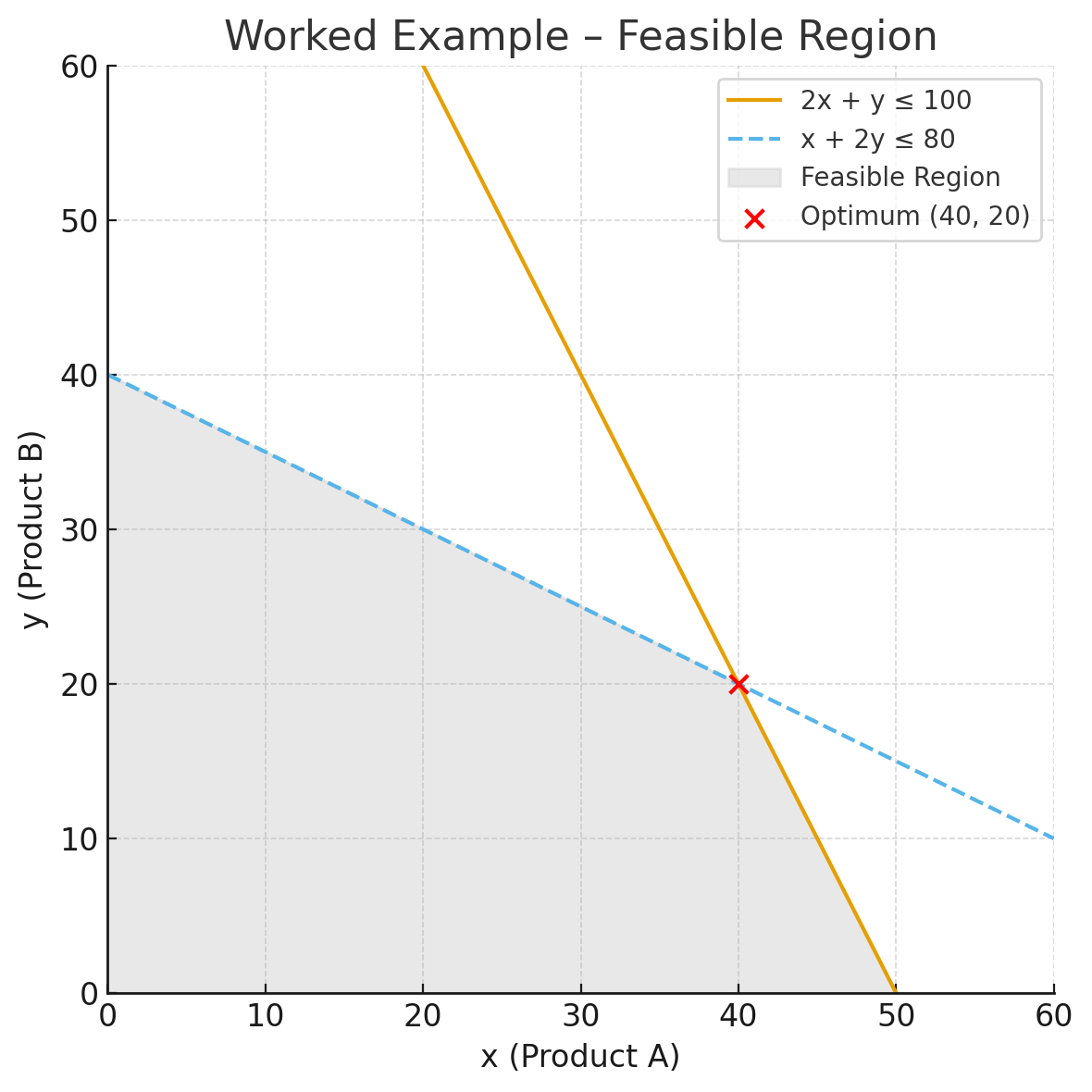
Step 5 – Find intersection points
Solve the system:


Multiply the second by 2 and subtract:


Substitute back:

So the intersection point is (40, 20).
Step 6 – Evaluate profit at each vertex
Vertices: (0,0), (0,40), (40,20), (50,0)




Step 7 – Choose the maximum
The maximum profit is $2600 at (40, 20).
Answer:

A shop makes chairs (x) and tables (y). Calculate the maximum profit given the below constraints:
Chair: 2 hrs carpentry, 3 hrs painting.
Table: 3 hrs carpentry, 2 hrs painting.
Max: 60 carpentry hrs, 48 painting hrs.
Profit: $30 per chair, $40 per table.
Step 1 – Define variables
x = number of chairs
y = number of tables
Step 2 – Objective function
Maximise: P = 30x + 40y
Step 3 – Constraints
2x + 3y ≤ 60 (carpentry)
3x + 2y ≤ 48 (painting)
x, y ≥ 0
Step 4 – Draw graph
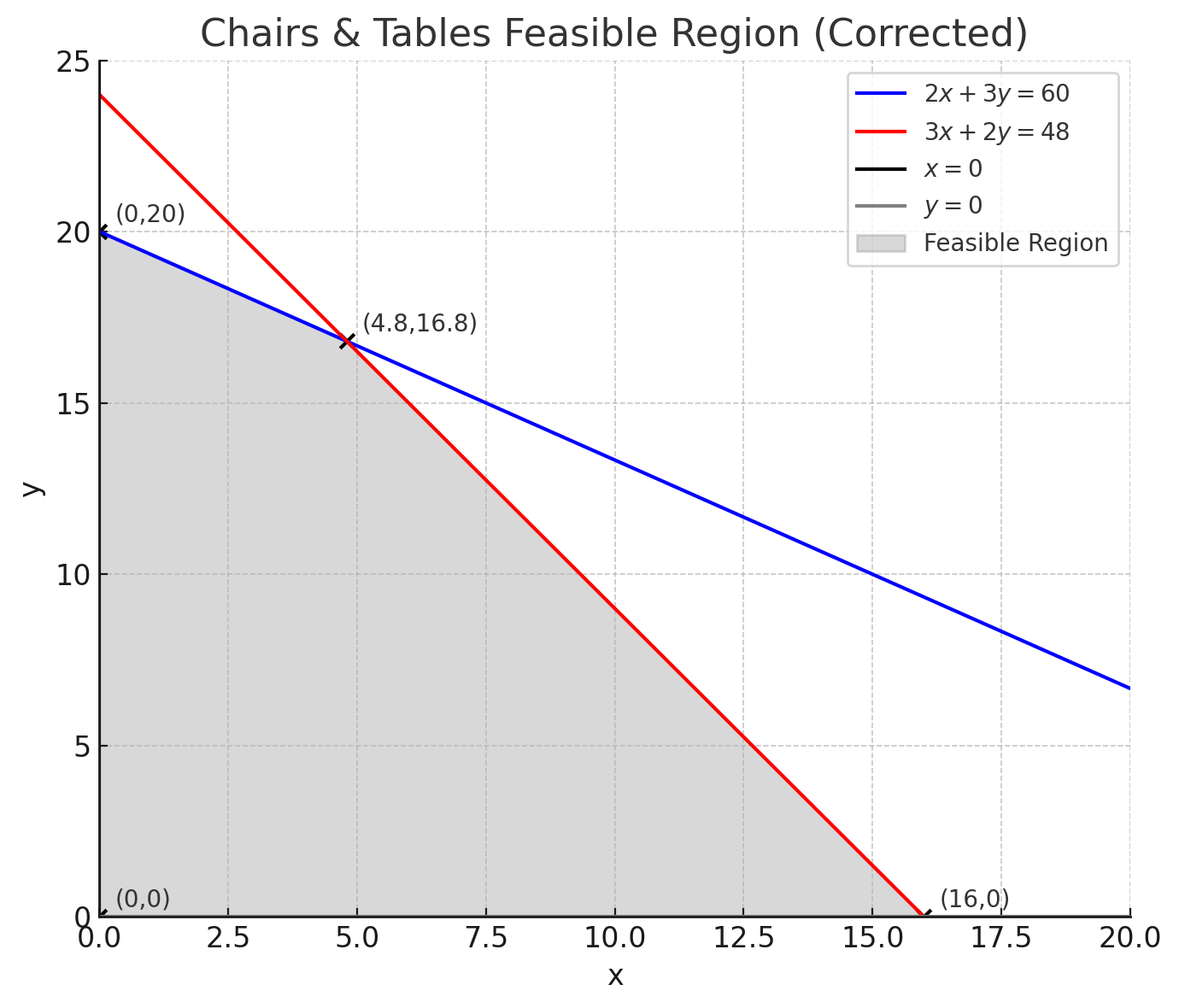
Step 5 – Corner points(0,0), (16,0), (0,20)
Intersection of 2x + 3y = 60 and 3x + 2y = 48 → (4.8,16.8). However, we cannot have fractional numbers of chairs and tables so this vertex can be discarded.
Step 6 – Evaluate objective function
P(0,0) = 0
P(16,0) = 480
P(0,20) = 800
Step 7 – Conclusion
Maximum profit = $800 at (x,y) = (0,20)
A factory makes products A (x) and B (y). Calculate the maximum profit given the below constraints:
A: 1 unit raw material, 3 hrs labour
B: 2 units raw material, 2 hrs labour
Available: 8 raw units, 12 labour hrs
Profit: $20 per A, $30 per B
Step 1 – Define variables
x = number of A
y = number of B
Step 2 – Objective function
Maximise: P = 20x + 30y
Step 3 – Constraints
x + 2y ≤ 8 (raw materials)
3x + 2y ≤ 12 (labour)
x, y ≥ 0
Step 4 – Draw graph
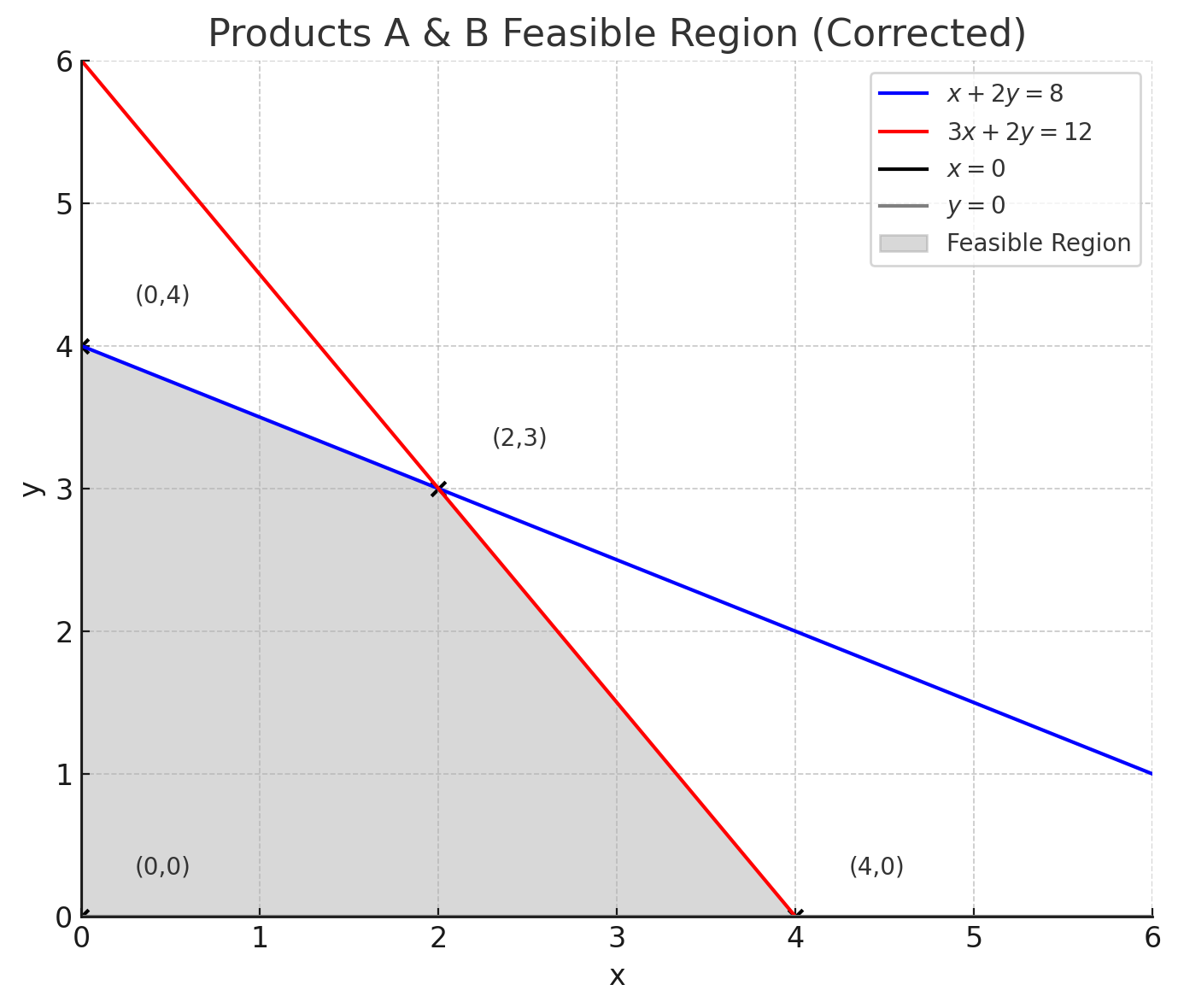
Step 5 – Corner points
(0,0), (4,0), (0,4)
Intersection of x + 2y = 8 and 3x + 2y = 12 → (2,3)
Step 6 – Evaluate objective function
P(0,0) = 0
P(4,0) = 80
P(0,4) = 120
P(2,3) = 130
Step 7 – Conclusion
Maximum profit = $130 at (x,y) = (2,3).
A company makes orange juice (x) and apple juice (y). Calculate the maximum profit given the below constraints:
Orange juice: 2 oranges + 1 hr per litre
Apple juice: 3 apples + 2 hrs per litre
Available: 40 oranges, 60 apples, 40 hours
Profit: $4 per orange juice, $5 per apple juice
Step 1 – Define variables
x = litres of orange juice
y = litres of apple juice
Step 2 – Objective function
Maximise:
P = 4x + 5y
Step 3 – Constraints
2x ≤ 40 → x ≤ 20 (oranges)
3y ≤ 60 → y ≤ 20 (apples)
x + 2y ≤ 40 (time)
x, y ≥ 0
Step 4 –Draw Graph
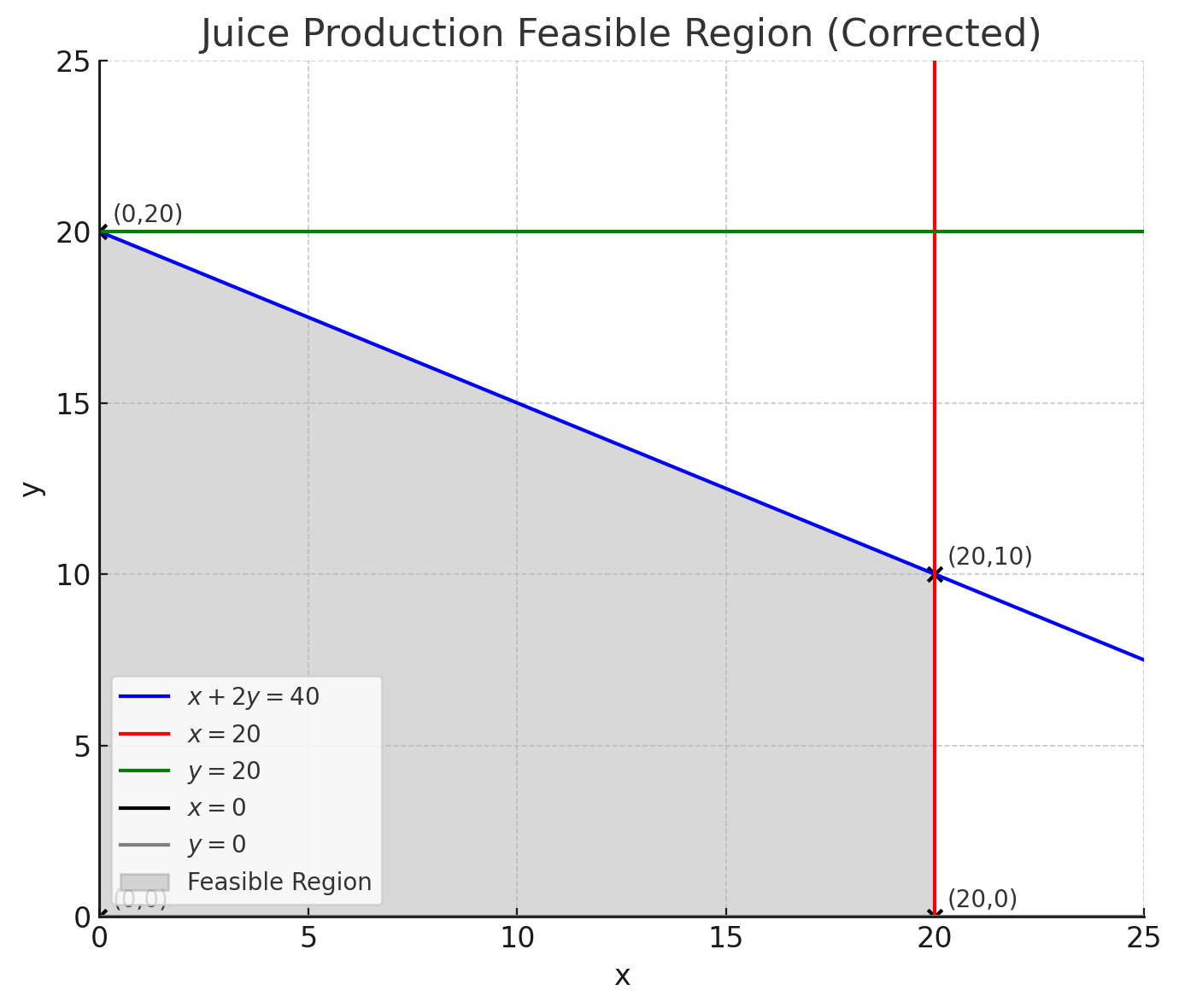
Step 5 – Corner points
(0,0), (20,0), (0,20), (20,10)
Step 6 – Evaluate objective function
P(0,0) = 0
P(20,0) = 80
P(0,20) = 100
P(20,10) = 130
Step 7 – Conclusion
Maximum profit = $130 at (x,y) = (20,10).
Summarise with AI:
Did you like this article? Rate it!


 Loading...
At a university.Professor Abdul Sattar wishes to employ two people,Farhan and Sarfaraz,to grade papers for his classes,Farhan is graduate student and can grade 20 papers per hour;farhan earns $15 per hour fpr grading papers. Sarfraz is post doctoral associate student and can grade 30 pages per hour;Sarfaraz earns $25 per hour for grading papars,Each must be employed at least one hour a week to justify their employment.If professor Abdul sattar has at least 110 papers to be graded each week,how many hours per week should he employed each person to minimize the cost?
Very good:
I’m so happy
Thanks alot my dearest🙏🙏🙏🙏🙏
Nice
Thank You for helping with linear programming .