
The Commonwealth Games welcome athletes from 72 nations and territories. Specifically, countries in Africa, the Americas, Asia, the Caribbean, Europe, and Oceania have a presence in these Games. Participants range from large, wealthy nations like Australia and Canada to smaller territories such as the Falkland Islands and Niue.
| 🌍 Region | 📍 Countries |
|---|---|
| Africa | Botswana, Cameroon, Eswatini, The Gambia, Ghana, Kenya, Lesotho, Malawi, Mauritius, Mozambique, Namibia, Nigeria, Rwanda, Seychelles, Sierra Leone, South Africa, Tanzania, Uganda, Zambia. |
| Americas | Bahamas, Belize, Canada, Falkland Islands, Guyana, Saint Helena. |
| Asia | Bangladesh, Brunei, India, Malaysia, Maldives, Pakistan, Singapore, Sri Lanka. |
| Caribbean | Anguilla, Antigua and Barbuda, Barbados, British Virgin Islands, Cayman Islands, Dominica, Grenada, Jamaica, Montserrat, Saint Kitts and Nevis, Saint Lucia, Saint Vincent and the Grenadines, Trinidad and Tobago, Turks and Caicos Islands. |
| Europe | Cyprus, England, Gibraltar, Guernsey, Isle of Man, Jersey, Malta, Northern Ireland, Scotland, Wales. |
| Oceana | Australia, Cook Islands, Fiji, Kiribati, Nauru, New Zealand, Niue, Norfolk Island, Papua New Guinea, Samoa, Solomon Islands, Tonga, Tuvalu, Vanuatu. |



What to Know About the Commonwealth Games
The Commonwealth Games is an event for everyone.
Denise Lewis, two-time heptathlon gold medal winner, Commonwealth Games (1994, 1998)
The Games celebrate the shared history and values of the Commonwealth, fostering unity and friendly competition among its diverse members.
How the Games Began and How They've Changed Over Time
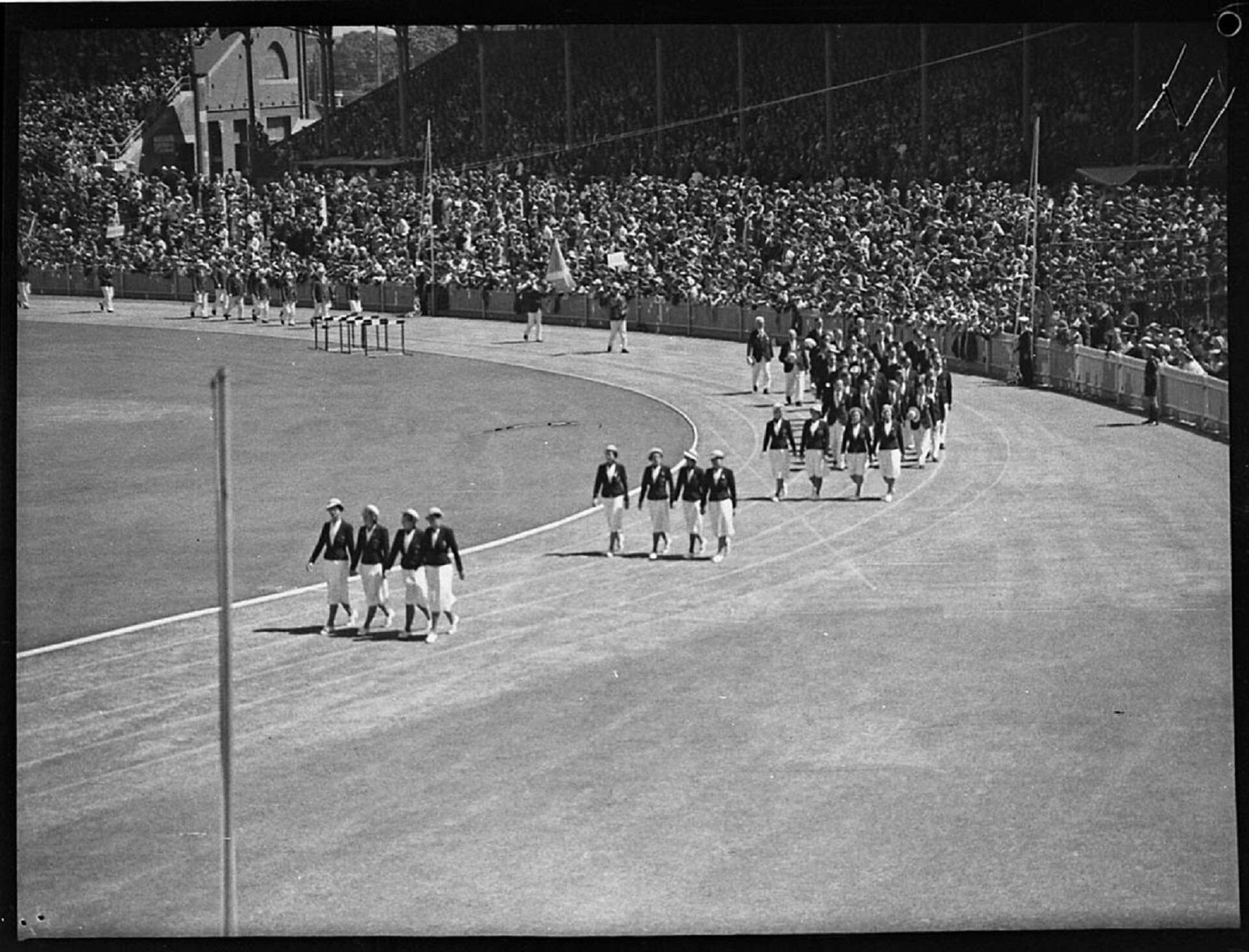
The Commonwealth Games' history is relatively short but significant, nevertheless1. Then known as the British Empire Games, the idea for a sports event arose in the late 19th century. The initiative didn't see light until 1930. It appears that, initially, this competition, held in Canada, should have been a standalone event.
However, Australian athletes clamoured for their chance to host a Commonwealth sports meet. It got its chance (Sydney, 1938). This event debuted the baton relay concept, a feature Australian runner NAME proposed and lobbied for ahead of the Games.
As the British Empire waned, the British Empire Games (1930–1950) underwent three rebrands.
1️⃣ The British Empire and Commonwealth Games (1954–1966)
2️⃣ The British and Commonwealth Games (1970–1974)
3️⃣ The Commonwealth Games (1978–Present)
From the outset, the Games were a male-orientated sports event, though women were allowed to compete in a couple of disciplines. Over time, and as more sports were added, women were granted a presence in more events. It wasn't until 2018, at the Gold Coast (Australia) Games, that women gained full Games equality.
Para-athletes were another 'lesser' qualified demographic. Like competing in the Olympics or other global sports events, these participants' contests were separate from the standard Games. In 1994, the Commonwealth Games Federation (CGF) began integrating para-athletes into main events. Full inclusion was completed in 2002, making them full medal-winning, team-belonging athletes.
Commonwealth Games Membership Criteria
Membership has eligibility criteria and rules (and benefits!) at two levels: for the athletes and the nations they represent2. In some cases, they align or run parallel; in others, they're entity-specific.
Athlete membership criteria
- must represent a Commonwealth country or territory
- must have a claim to citizenship or residency
- may transfer allegiance to another Commonwealth entity only with approval
- must comply with CGF selection policies
Nation membership criteria
- commitment to democratic processes
- respect for human rights, judicial independence, and the rule of law
- must have a strong public sector and transparent public accounts
- new members require a constitutional link to an existing member
The CGF publishes updated manuals for Commonwealth Games guidance that outline those and other rules upon any changes or updates. Those guides typically include new sports petitioning for inclusion into Games events and other relevant information.
What Countries Are in the Commonwealth Games?
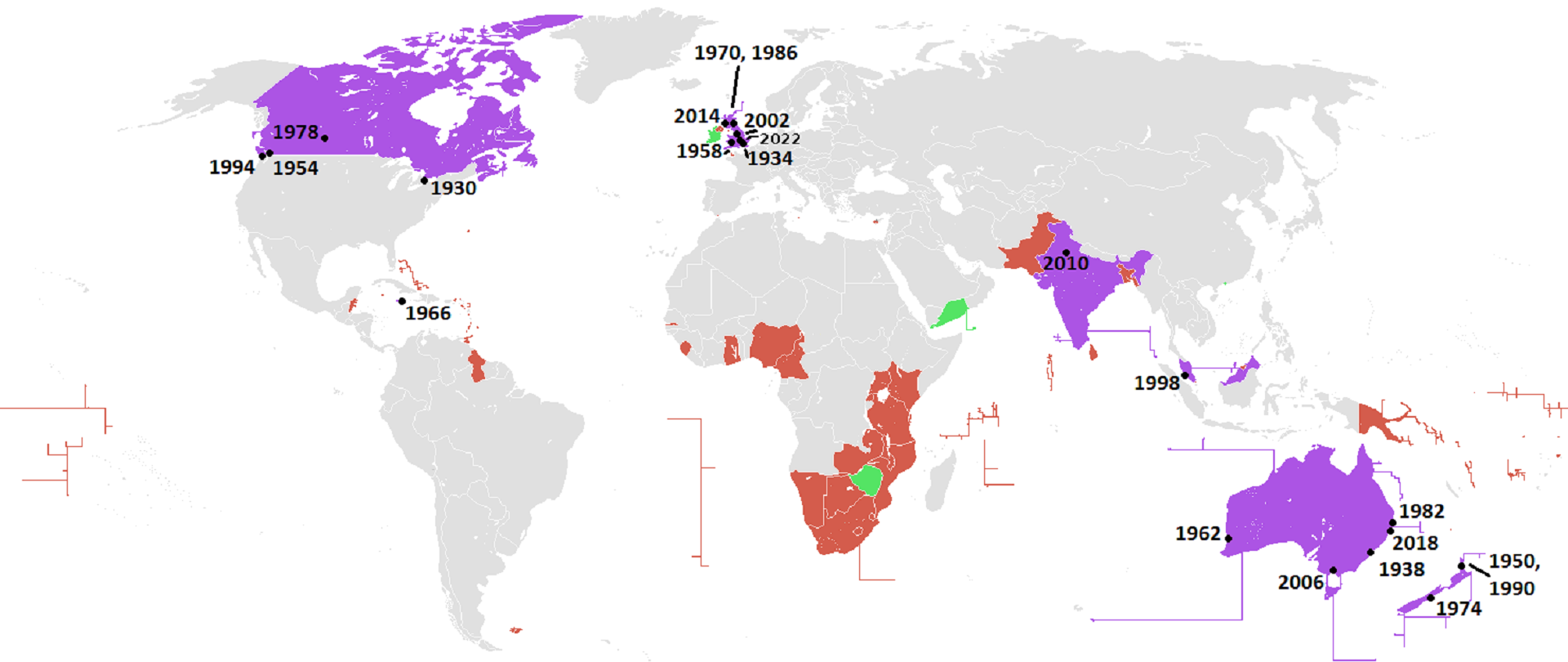
In the map above, the areas shaded purple have hosted Commonwealth Games events, along with the cities and dates they hosted. The countries highlighted in brown participate in the Games but have never hosted.
The countries in green have participated in past games but no longer send their athletes to events, and aren't necessarily Commonwealth members any more. Now, let's drill down into every region to discover distinguishing facts for each3.
Commonwealth Games Participation Africa
Botswana, Cameroon, Eswatini, The Gambia, Ghana, Kenya, Lesotho, Malawi, Mauritius, Mozambique, Namibia, Nigeria, Rwanda, Seychelles, Sierra Leone, South Africa, Tanzania, Uganda, Zambia.
To date, no African country has hosted the Games. Durban (South Africa) was slated to host in 2022 but had to give up the honour due to financial constraints. Nigeria is currently in the running to host, but no word on a decision yet. Otherwise, this continent has produced amazing athletes.
Nigeria
- 212 medals
- of which 61 gold
- participated in 13 Games
Kenya
- 221 medals
- of which 81 gold
- participated in 15 Games
South Africa
- 352 total medals
- of which 117 gold
- participated in 12 Games
Athletes from the Americas Take Part
Bahamas, Belize, Canada, Falkland Islands, Guyana, Saint Helena.
Canada has hosted the Games twice, including the initial edition (1930) in Hamilton, Ontario. Vancouver hosted in 1954. Elsewhere, sports fans look forward to Bahamian athletes in sprint events, where these athletes have a strong track record.
Commonwealth Games Nations and Territories in Asia
Bangladesh, Brunei, India, Malaysia, Maldives, Pakistan, Singapore, Sri Lanka.
Malaysia hosted Asia's debut Commonwealth Games event in 1998, in Kuala Lumpur. India hosted for the first (and so far only) time in 2010, in Delhi. Besides hosting, that edition put India at the top of the medals count, finishing second behind Australia.
The Caribbean Region and the Commonwealth Games
Anguilla, Antigua and Barbuda, Barbados, British Virgin Islands, Cayman Islands, Dominica, Grenada, Jamaica, Montserrat, Saint Kitts and Nevis, Saint Lucia, Saint Vincent and the Grenadines, Trinidad and Tobago, Turks and Caicos Islands.
Jamaica is legendary for its successes in the Athletics (track & field) category. Trinidad and Tobago athletes shine in sprinting events.
Commonwealth Games and Europe
Cyprus, England, Gibraltar, Guernsey, Isle of Man, Jersey, Malta, Northern Ireland, Scotland, Wales.
While UK nations compete under one banner at other global sports events, each one competes under its own flag at the Games. Of the four, Team England carries the highest medal count and consistently shows the strongest performances.
Oceania Representation in the Commonwealth Games
Australia, Cook Islands, Fiji, Kiribati, Nauru, New Zealand, Niue, Norfolk Island, Papua New Guinea, Samoa, Solomon Islands, Tonga, Tuvalu, Vanuatu.
Hands down, Australia rules these Games. It has hosted the most editions - five - and sits at the very top of the all-time total medals table. The 2018 Gold Coast Games edition made history for being the first event featuring the same number of male and female athletes.
However, Australia isn't the only Oceania nation to shine. Fiji constantly demonstrates a strong showing in rugby sevens. And while we're here, let's applaud the Cook Islands and Vanuatu for earning their first medals (one and three bronze, respectively) in 2018, after decades of participation.
Commonwealth Games' Impacts on Member Nations
'Commonwealth' definition: a group of countries who are friendly towards each other and have something in common.
Collins Dictionary
Indeed, these sports events are known as "The Friendly Games" because every participant speaks English. Unlike other global contests, athletes needn't struggle to overcome language barriers4. This fact alone facilitates cultural exchange and boosts the sense of unity felt across the athletes' corps.
Those effects aren't limited to the Commonwealth Games or participating athletes. As an international sports event, the Games have as high a profile as international or regional championship contests.
These Games were the first to count an equal number of events for male and female athletes. They are also the first to count para-athletes as fully fledged members of the athletic teams.
Socioeconomic Benefits
These levels of inclusion underscore the Commonwealth's longstanding progressive ethos. That, in turn, provides hosting countries with many real-world benefits, particularly in the social and economic realms.
Economic benefits
- income boosts from tourism
- sponsorship and advertising deals
- potential for investments and partnerships
Social benefits
- superior infrastructure to support the games
- neighbourhood revitalisation
- improved districts of interest
- better road maintenance
- increased volunteering
- more jobs
All this and more is reflected in CGF's recently introduced Games Reset Framework, which aims to reduce hosting costs by more than half. Prioritising the 'five pillars of wealth' prioritises using existing sports infrastructure, which drives the focus on community engagement, rather than glitzy new stadiums.
Sport, social, cultural, diplomatic, and economic assets.
Impacts on the Sports World
Larger global sports events generally resist adding new sports to their roster of events. That's not the case with the Commonwealth Games, where inclusion of novel fitness challenges has a far lower threshold of acceptance.
The CGF will trial a new sport first through a demonstration performance. The sport may then be added to the roster ahead of the next Games edition and be allotted its share of medals.
Often, sports bodies such as the Olympics drop sports from their rosters in favour of emerging sports. That leaves traditional sports such as lawn bowls, netball, and squash with no international presence. Fortunately, the Commonwealth Games counts them as staples in their competition line-up, giving those athletes a venue to showcase their skills.

Benefits to Athletes
Large, wealthy nations such as Australia, the UK, and India generally have the resources to train and promote athletes into major world competitions such as the Olympics and World Championships. Conversely, those nations' long history of athletic representation gives them an automatic 'in' to any event they might wish to send athletes to.
For smaller, less wealthy and less developed nations, breaking into those elite circles is a much greater challenge. Too often, promising athletes are compelled to leave their home countries, competing under an 'established' country's flag.
The Commonwealth Games give athletes from the smallest nations an equal place on the global sports stage.
The Commonwealth Games don't just showcase the athletes; they also highlight the countries and territories those competitors hail from. In a sense, we could say that the Commonwealth Games function as an official promotional machine. They raise the profiles of remote lands, as well as their peoples and culture, which magnifies the Games' uniting effects and their social and economic benefits.
References
- “Commonwealth Games.” Britannica Kids, kids.britannica.com/kids/article/Commonwealth-Games/437592. Accessed 4 June 2026.
- to, Contributors. “Commonwealth of Nations Membership Criteria.” YourStudent Gemini Wiki, Fandom, Inc., 2026, yourstudent-gemini.fandom.com/wiki/Commonwealth_of_Nations_membership_criteria. Accessed 4 June 2026.
- “Topend Sports | Sports Science, Fitness Testing & Event Analysis.” Topend Sports, 2026, www.topendsports.com/events/commonwealth-games/countries/regional.htm. Accessed 4 June 2026.
- Means, Richard . “Commonwealth Games | EBSCO.” EBSCO Information Services, Inc. | Www.ebsco.com, 2024, www.ebsco.com/research-starters/sports-and-leisure/commonwealth-games. Accessed 4 June 2026.
Summarise with AI:
Did you like this article? Leave a rating!

 Loading...