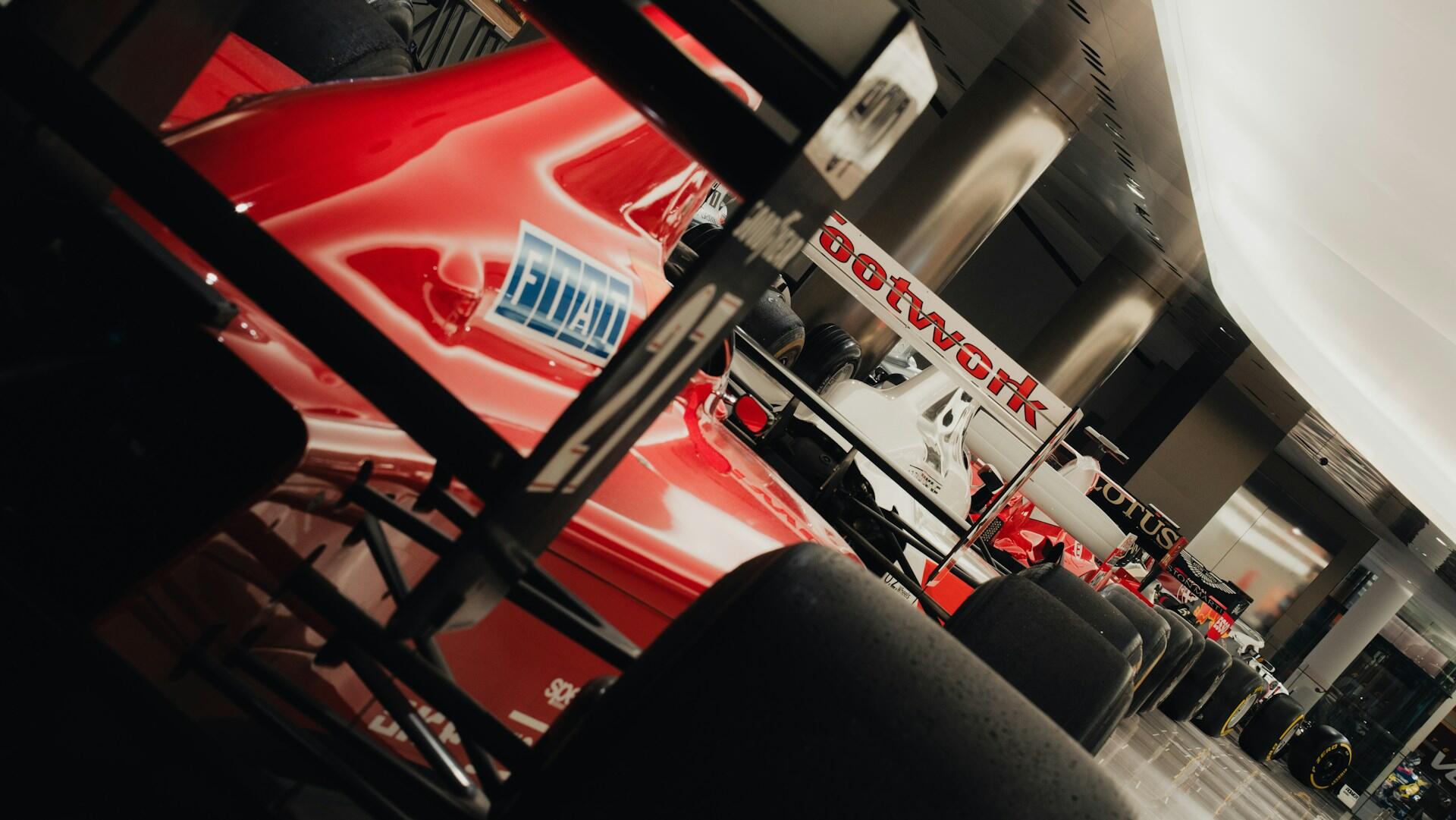

A Formula 1 car can scream past at over 200 mph; what does it take- and cost nearly $20 million- to build that carbon-fibre missile? An F1 car isn't just "a very fast car". Behind every Grand Prix lap sit some of the most expensive, tightly regulated, and technologically advanced machines ever built for sport, engineered to withstand violent impacts, with an aerodynamic package designed down to the millimetre.
This guide breaks down what an F1 car actually costs, FIA's technical regulations, how the "power unit" (the engine) really works, what buttons on the steering wheel do, and why these cars (including their fully electric cousins in Formula E) are still faster than almost anything else on four wheels.


What Is A Formula 1 Car?
Formula 1 Car Basics
A Formula 1 car is a single-seater, open-wheel racing car built for one purpose: to lap a circuit faster than anything else in motorsport while staying within the FIA's (Federation Internationale de l'Automobile) strict technical regulations.
Every wing, vent and duct earns its place by improving speed, cooling, braking or cornering grip, all while meeting the crash-safety standards that are among the toughest in any sport. Every car on the grid shares the same broad architecture:
🏁 A carbon-fibre monocoque chassis
⚙️ A hybrid V6 turbo power unit sitting behind the driver
🪽 Aerodynamic surfaces front and rear designed to push the car into the track.
Why Formula 1 Cars Are Different From Other Race Cars
Other race categories, such as GT cars, IndyCars, and even Formula E, make trade-offs between cost, standardisation, and performance, while F1 doesn't.
An F1 car unit is built as elite, purpose-built competition machinery, where teams design (or, for smaller outfits, buy in) almost every component to a bespoke specification, chasing a balance of aerodynamics, lightweight construction, and raw power that no other series attempts at this budget or complexity.
F1 has historically been a testbed for technology that eventually reaches road cars. Mercedes has adapted turbocharger energy-recovery technology developed for F1's MGU-H into its AMG road-car turbochargers, and hybrid energy-recovery concepts pioneered in F1's KERS era have since influenced hybrid road-car development more broadly. Some of the main aspects and key details to know in depth about the F1 machinery:
- Wheelbase-to-lap-time sensitivity: every extra 10kg of weight costs roughly 0.3–0.4 seconds a lap
- Minimum weight (2026 regulations): 768kg, including driver, excluding fuel
- Wheelbase: 3,400mm (reduced from 3,600mm for 2026)
- Overall width: 1,900mm (reduced from 2,000mm for 2026)
- Power unit: 1.6-litre turbocharged hybrid V6
- Combined power output: over 1,000bhp
- Gearbox: eight-speed semi-automatic sequential, paddle-shift
- Tyre supplier: Pirelli (18-inch wheels, five dry compounds C1–C5)
How Much Does A Formula 1 Car Cost?
Total Cost Of A Formula 1 Car
An F1 car is never sold, but it's possible to estimate its cost. Motor Sport Magazine, working with former F1 chief technical officer Pat Symonds, put the pure manufacturing cost of a current-generation F1 car at just over 20 million dollars (roughly £14.6 million), with the hybrid power unit alone accounting for close to a third of that figure.
That estimated number covers chassis, engine, aerodynamics, electronics and testing components. A separate budget would cover the ongoing research and development.
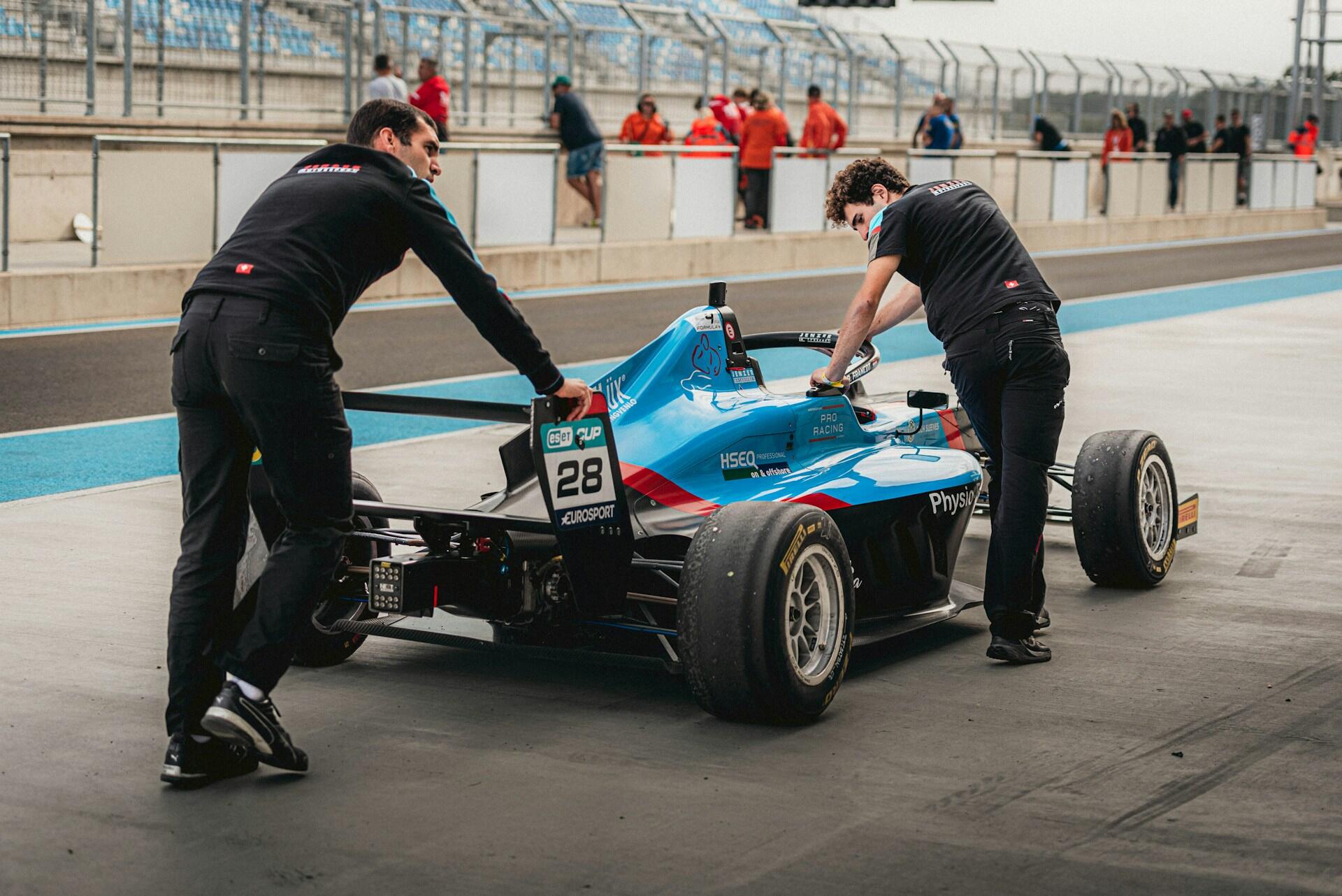
of a current-generation F1 car.
Cost Breakdown By Major Components
What are the main parts to build an F1 car, and what do they cost? Take a look at the list including chassis, wings, floor, halo, power unit, gearbox, steering wheel, hydraulics, brakes, fuel tank and tyres 1:
| Component | Estimated Cost Range (USD) | Key Notes |
|---|---|---|
| Chassis (carbon-fibre monocoque) | $707,000 | Twelve layers of carbon fibre; roughly twice as strong as steel |
| Power unit (customer supply price) | $18,300,000 | Includes ICE turbo MGU-K battery and control electronics |
| Front wing / nosecone | $141,500 | The most intricate aerodynamic component on the car |
| Rear wing and active-aero assembly | $85,000-$150,000 | Cheaper than the front wing but developed race by race |
| Floor and bargeboards | $141,000 | Generates the majority of the car's aerodynamic load |
| Gearbox | $354,000 | Eight-speed semi-automatic sequential unit |
| Steering wheel | $50,000 | Carbon fibre construction with custom electronics |
| Hydraulic system | $170,000 | Controls active aero clutch differential and more |
| Complete brake system | $78,000 | Discs pads calipers and master cylinders |
| Halo | $17,000 | Titanium structure that protects the driver's head |
| Fuel tank | $31,000 | Virtually indestructible polyurethane and kevlar bladder |
| One set of Pirelli tyres | $3000 | C1 to C5 compounds from 2026 onward |
Why F1 Cars Are So Expensive
The main parts to build an F1 car are hand-built or machined to microscopic tolerances, made from exotic materials such as carbon-fibre composites and titanium, and validated through extensive research and development, simulation, and wind-tunnel testing before they ever touch a track.
Most components of an F1 car are produced in tiny volumes, sometimes just a handful of units per season. And the cost per part climbs quickly; for instance, a single crash-damaged front wing can cost a team well over $100,000 to replace.
What Teams Spend Beyond The Car Itself
The car itself is only part of the bill. Teams must also invest in simulator and CFD development, wind-tunnel testing (both strictly rationed under FIA aerodynamic testing restrictions), trackside upgrade packages introduced race by race, and the spare parts and logistics needed to ship two cars' worth of equipment to more than 20 races a year.
The cap is currently set at $215 million for the 2026 season under the FIA's Formula 1 Financial Regulations, a 30.3% jump tied to the new technical rules; it covers far more than just building the car and its bodywork. The approximate cost includes development, testing and extensive research.
Formula 1 Engine: How It Works
Is It An Engine Or A Power Unit?
Since F1's hybrid era began in 2014, the FIA and every team now refer to the engine as a power unit, because the internal combustion engine is only one part of a much larger hybrid propulsion package.
That package combines a traditional combustion engine with electric motor-generators, a battery and control electronics, which is why "power unit" is the technically accurate term, even though "engine" still works fine in everyday conversation.
Main Components Of A Formula 1 Engine / Power Unit
Every power unit on the 2026 grid is built from the same core elements:
One notable change for the F1 2026 season is that the Motor Generator Unit-Heat (MGU-H), which used to harvest energy from exhaust gases to spin the turbocharger, has been dropped entirely. The much more powerful MGU-K has effectively absorbed its job.
How The F1 Engine Delivers Performance
Combined, the ICE and the electrical systems produce more than 1,000bhp. This output, according to Formula 1's own explainer on the 2026 power unit rules, is now split roughly 50/50 between the combustion engine and the electrical system, a far more balanced hybrid split than the previous generation. Drivers manage exactly when that electric power gets deployed, choosing the moment in a lap where it will do the most good.
Why F1 Engines Are Technologically Unique
No road-car engine spins as hard, as reliably, or as efficiently as an F1 power unit. The F1 units run at extreme RPMs for entire race weekends without failing, all while operating above 50% thermal efficiency, well beyond that of a typical road-car combustion engine.
If we add the strict fuel-flow limits and the requirement to use 100% sustainable fuel from 2026 onward, you get an engine that has to be blisteringly fast and remarkably efficient at the same time.
| Component | Main Function | Notes |
|---|---|---|
| ICE (Internal Combustion Engine) | Generates power by burning sustainable fuel | 1.6-litre turbo V6 revving up to ~15000rpm |
| Turbocharger (TC) | Boosts intake air pressure | Single unit mounted between the cylinder banks |
| MGU-K | Recovers energy under braking and feeds it back into the drivetrain | Output boosted to 350kW for 2026 (previously 120kW) |
| Energy Store (ES) | Stores the recovered electrical energy | High power-density lithium-ion battery pack |
| Control Electronics (CE) | Manages the power split between the combustion engine and electrical system | Compared by engineers to aircraft avionics |
| MGU-H (retired in 2026) | Recovered thermal energy from the turbocharger | Used from 2014 to 2025; removed under the 2026 regulations |
Formula 1 Steering Wheel: More Than Just Steering
What Controls Are On A Formula 1 Steering Wheel?
An F1 steering wheel is closer to a cockpit control panel than a conventional wheel; the standardised ECU supplied by McLaren Applied Technologies limits every wheel to a maximum of 20 buttons, nine rotary switches and six paddles, though every team programs those controls differently for its own cars and drivers. Typical functions include 2:
🏁 Paddle-shift gear changes (plus a manual clutch paddle for starts and pit exits)
🟡 Brake balance/brake bias adjustment, shifting stopping power between front and rear axles.
⬆️ From 2026, an "Overtake" push-to-pass button (originally unveiled as "Manual Override Mode"), replacing the DRS button used from 2011–2025
⚙️ Engine and fuel-mix mode selection
↖️ Differential settings for corner entry, mid-corner and exit
🏎️ Pit-lane speed limiter activation
🔉 Radio communication with the pit wall
How Drivers Use It During A Lap
On a single lap, a F1 driver might adjust brake bias heading into a heavy braking zone, tweak the differential to control corner-exit traction, and switch engine modes to save fuel or push for an overtake, all in the space of a few corners, without lifting a hand off the wheel.
During a Safety Car period, F1 drivers use the wheel to manage the pit limiter and adjust brake temperatures, since cooling systems behave very differently at reduced speed.
Why The Steering Wheel Is So Advanced
Every wheel of an F1 unit is custom-built around a driver's hand size, grip preference and control layout, right down to where the display screen sits and how the paddles are shaped.
Despite weighing only a couple of kilograms and being designed for split-second precision at 300km/h, a modern F1 steering wheel can cost around $50,000 to produce, reflecting the carbon-fibre construction and bespoke electronics it packs. Some of the basic info to retain about the current buttons and controls of the steering wheel of the F1 unit:
What Makes Formula 1 Cars So Fast?
Aerodynamics And Downforce
- Downforce is what lets an F1 car corner at speeds that would be impossible for a normal road car.
- The front wing shapes airflow around the front tyres; the rear wing (since 2026, an active three-element design) generates stability under braking and through fast corners; and the floor and diffuser remain the single biggest source of downforce on the car.
- For 2026, the FIA deliberately reduced total downforce by around 30% and cut drag by roughly 55% to make the cars easier to follow and overtake while maintaining high top speeds.
Lightweight Carbon-Fiber Construction
The monocoque chassis at the heart of every F1 car is built from around a dozen layers of carbon-fibre composite. According to McLaren, that structure is around twice as strong as steel while being roughly five times lighter, improving both performance and crash safety.
Tires And Grip
- Pirelli, F1's official tyre supplier, produces five dry-weather compounds for 2026: C1 (hardest) through C5 (softest), after dropping the C6 compound because Pirelli found too small a lap-time gap between C5 and C6 to justify keeping both in the range.
- Softer compounds generate more outright grip but degrade faster; harder compounds last longer but cost lap time.
Braking, Suspension, And Traction
F1 cars can decelerate from well over 300km/h to under 100km/h in a couple of seconds, using carbon-carbon brake discs alongside brake-by-wire systems that blend friction braking with electrical energy recovery through the MGU-K. Suspension setups are fine-tuned circuit by circuit to balance mechanical grip against aerodynamic performance.
| Factor | How It Contributes To Speed | Data Point |
|---|---|---|
| Aerodynamics (wings and floor) | Generates downforce for more grip in corners | Floor produces most of the load; downforce cut by 30% for 2026 |
| Minimum weight | Every extra 10kg adds roughly 0.3-0.4 seconds per lap | Minimum weight for 2026: 768kg (previously 798-800kg) |
| Hybrid power unit | Combines combustion power with recovered electrical energy | Over 1000bhp combined; MGU-K boosted to 350kW from 2026 |
| Pirelli tyres | Determine available grip and how it degrades | Five compounds (C1-C5) from 2026 onward |
| Brakes and brake-by-wire system | Enables extreme deceleration and energy recovery | Slows from 300km/h+ to under 100km/h in seconds |
| 2026 drag reduction | Less air resistance on the straights | Drag cut by 55% versus the previous generation |
Team Strategy And Driver Input
An F1 car's ultimate pace also comes down to how it's set up and driven. Teams constantly trade off one-lap qualifying pace against race-long tyre management; this is why driver feedback remains as central to F1 car development as any wind-tunnel session.
Formula 1 Car Vs Formula E: What's The Difference?
Performance And Speed
F1 remains the fastest car over a full lap. Current F1 cars have reached in-race speeds of around 372.5–372.6km/h: Bottas hit 372.5km/h at the 2016 Mexican GP, a mark matched (and still officially recognised by Guinness World Records as the outright race record) by Montoya's 372.6km/h during the 2005 Italian Grand Prix at Monza. A specially modified Honda RA106 later hit an unofficial 397.36km/h at Bonneville in 2006.
Power And Energy Systems
F1 runs a hybrid system; Formula E runs fully electric. An F1 power unit combines a 1.6-litre turbocharged combustion engine with hybrid motor-generators to deliver combined output above 1,000bhp. Formula E's Gen3 Evo produces around 350kW (475 bhp) in qualifying trim; the incoming Gen4 is rated at around 600kW (815 bhp).

Design Philosophy
F1 cars are optimised purely to be as fast as possible over a lap. Formula E cars manage a finite battery across a full race distance on tight street circuits; every design decision flows from that energy-management priority.
Audience Expectations And Race Format
F1 cars race over roughly 305km over 1.5–2 hours on permanent circuits and street tracks. Formula E races are shorter; up to 45–60 minutes and under 100km, almost exclusively on temporary city-street circuits.
Which Is More Advanced, an F1 or a Formula E car?
It depends what you're measuring. For top speed, cornering and aero complexity, F1 is unmatched. For acceleration and electric-powertrain efficiency, Formula E leads the comparison; its Gen3 Evo hits 0–100km/h in ~1.86 seconds, quicker off the line than a current F1 car.
| Category | Formula 1 (2026) | Formula E (Gen3 Evo / Gen4) |
|---|---|---|
| Top speed | 372.5km/h in-race record; 397.36km/h unofficial test | 322km/h (Gen3 Evo); 335km/h+ (Gen4) |
| Combined power | Over 1000bhp (combustion + electric) | 475bhp in qualifying trim (Gen3 Evo); 815bhp (Gen4) |
| 0-100km/h acceleration | 2.6 seconds | 1.86 seconds (Gen3 Evo) |
| Propulsion system | Hybrid: 1.6L turbo V6 + MGU-K + battery | 100% electric: battery + electric motors |
| Minimum weight | 768kg (with driver excluding fuel) | 840kg (Gen3 with driver) |
| Race distance | 305km / 1.5-2 hours | Up to 100km / 45-60 minutes |
| Circuit type | Permanent circuits plus some street tracks | Almost exclusively temporary street circuits |
| Tyres | Pirelli, C1-C5 compounds (dry) | Single all-weather tyre (no in-race tyre changes required) |
Formula 1 Cars Through The Years
The design of F1 cars has evolved with each decade, bringing changes in how they look, how fast they go, and in safety. Some of the major development milestones of F1 cars through the years:
1950
The FIA World Championship begins at Silverstone
It began with front-engined cars powered by naturally aspirated engines that bear little resemblance to today's machines.
1959
The Cooper T51
Cooper popularises the rear/mid-engine layout with the Cooper T51, shifting the engine behind the driver, still a configuration every F1 car has used ever since.
70's
The RS01 and the Lotus 79
In 1977, Renault introduces the first turbocharged F1 car, the RS01, kicking off the sport's turbo era. The next year, Lotus's ground-effect Lotus 79, using underbody airflow to generate huge downforce, dominates the season and reshapes aerodynamic design across the grid.
1981 - 1983
McLaren's carbon-fibre monocoque
McLaren's MP4/1, designed by John Barnard, becomes the first F1 car built with a fully carbon-fibre composite monocoque; a safety and performance leap so significant it became the industry standard within a few seasons. Ground-effect aerodynamics are banned on safety grounds; teams switch to flat-bottom cars.
1986
Turbos are banned
Turbocharged qualifying engines peak at over 1,300 horsepower from 1.5-litre units, before turbos are banned entirely at the end of 1988 (the grid switches to 3.5-litre naturally aspirated engines)
90's
Big safety improvements
Electronic driver aids (active suspension, traction control, ABS) are banned to put more control back in drivers' hands, and mid-race refuelling is reintroduced. Cars are made 20cm narrower and grooved tyres replace slicks, both aimed at reducing cornering grip for safety.
2014
The hybrid era begins
The 2.4-litre naturally aspirated V8S are replaced by 1.6-litre turbocharged hybrid V6 power units that combine a combustion engine with sophisticated energy recovery systems (ERS).
2022
Aerodynamics big shift
Ground-effect aerodynamics return for the first time since the early 1980s, alongside 18-inch wheels, to enable closer wheel-to-wheel racing.
2026
A big technical overhaul in F1 history
A new generation of power units arrives: the MGU-H is dropped, MGU-K output roughly triples, and active aerodynamics replace the DRS system used since 2011.
References
- How much does an F1 car cost? – Motor Sport Magazine (January 2025). Available at: https://www.motorsportmagazine.com/articles/single-seaters/f1/how-much-does-an-f1-car-cost/ (Accessed: August 2026)
- How fast is the current generation of F1 cars? – Motor Sport Magazine (October 2025). Available at: https://www.motorsportmagazine.com/articles/single-seaters/f1/how-fast-is-the-current-generation-of-f1-cars/ (Accessed: August 2026)
- Breaking Down the $20+ Million Price Tag of A Formula 1 Car – Formula One Forever / Medium (August 2025). Available at: https://medium.com/formula-one-forever/breaking-down-the-20-million-price-tag-of-a-formula-1-car-6d7e40231c9b (Accessed: August 2026)
- Cost Cap Administration – FIA (Federation Internationale de l'Automobile). Available at: https://www.fia.com/events/fia-formula-one-world-championship/season-2025/cost-cap-administration (Accessed: August 2026)
- 2026 REGULATIONS EXPLAINED: All you need to know about F1's new power units – Formula1.com. Available at: https://www.formula1.com/en/latest/article/2026-regulations-explained-all-you-need-to-know-about-f1s-new-power-units.14jfv7a36905uDJDdNyfQd (Accessed: August 2026)
- The 2026 Formula 1 Regulations: A New Era of Cars, Power and Racing – Formula 1 Las Vegas Grand Prix. Available at: https://www.f1lasvegasgp.com/2026/01/new-era-of-cars-power-and-racing/ (Accessed: August 2026)
- The range of compounds for the 2026 season has been set – Pirelli Press. Available at: https://press.pirelli.com/the-range-of-compounds-for-the-2026-season-has-been-set/ (Accessed: August 2026)
- The family tree of Formula 1's 11 teams and how they came to be – Formula1.com. Available at: https://www.formula1.com/en/latest/article/the-family-tree-f1-11-teams-and-how-they-came-to-be.2QBA1PPMf0bC8mp2xxqZeq (Accessed: August 2026)
Summarise with AI:
Did you like this article? Leave a rating!

 Loading...