

Around the world, people recognise the Guy Fawkes mask as a symbol of dissent and anti-establishment sentiment. The man behind the mask, the real Guy Fawkes, embodied those qualities only accidentally. In fact, he was an ordinary bloke from York with firm religious beliefs, who made an extraordinary life for himself. We associate him mainly with the failed Gunpowder Plot - often mistakenly as its mastermind. This Guy Fawkes biography aims to set the record straight.
Ten Facts About Guy Fawkes
- He was baptised in York on 16 April 1570; his actual birthdate is unknown.
- His immediate family and paternal grandparents were Church of England members.
- His mother's family were recusant Catholics; one cousin became a Jesuit priest.
- His father died in 1579; his mother married a recusant Catholic.
- Further Catholic influences include other relatives and St Peter's School.
- He met John and Christopher Wright, both key figures in the Gunpowder Plot, while at school.
- In 1591, he sold his inherited estate to join Catholic Spain's efforts in the Eighty Years' War.
- In 1604, Thomas Wintour recruited him as an explosives expert for the Gunpowder Plot.
- Once captured, he stood staunchly by his beliefs and the moral validity of the plot.
- He was tortured into confession, then sentenced to hanging, drawing and quartering.


Who Was Guy Fawkes?
Guy was born 2nd in a family that eventually grew to include four children. He was baptised into the Anglican church on 16 April, making his approximate birthdate 13 April 1570. His father held a respectable position as a proctor at York's consistory court.
In all visible aspects, his life was safe and conventional, in compliance with the religious laws of his day. What didn't surface was his mother's religious affiliations. She and her extended family were recusant Catholics; she married a Catholic after her Anglican husband died in 1579.
1️⃣ Religious persecution was a fact of life for any non-Anglican in those times.
2️⃣ Religious conviction dictated Guy Fawkes' life and actions.
Other than the religious aspect, records show that Guy enjoyed a normal childhood1. He went to school, made friends, and acquired knowledge. Out of school, he embarked on a life of service, first to the 1st Viscount Montagu, then to the 2nd Viscount.
Sometime during his youth, he fully embraced Catholicism. His religious convictions sent him abroad in 1593 to fight on Catholic Spain's behalf, against the New Dutch Republic. England and Spain were still technically at war at the time, so this Englishman joining the Spanish fighters signalled where his true loyalties lay. Somewhere along the way, he began introducing himself as Guido.
1️⃣ Military convention: It was common for soldiers to Latinise their names so as to fit in better with the fighting forces they joined.
2️⃣ Religious signalling: He may have intended to communicate his religious commitment by using the Latin version of his name.
While still fighting on Spain's behalf, Thomas Wintour recruited him to the Gunpowder Plot. The conspiracy's mastermind, Robert Catesby, had dispatched Wintour to the Continent to plead for Spain's support and assistance. While there, he was introduced to Fawkes. Realising that such an experienced explosives handler would help their cause, he wasted no time enlisting the idealistic Fawkes.
Guy Fawkes' Significance in the Gunpowder Plot
Once told about the plot and what his role would be, Guy went all-in on the plan. He returned to England in 1604 with Thomas Wintour.
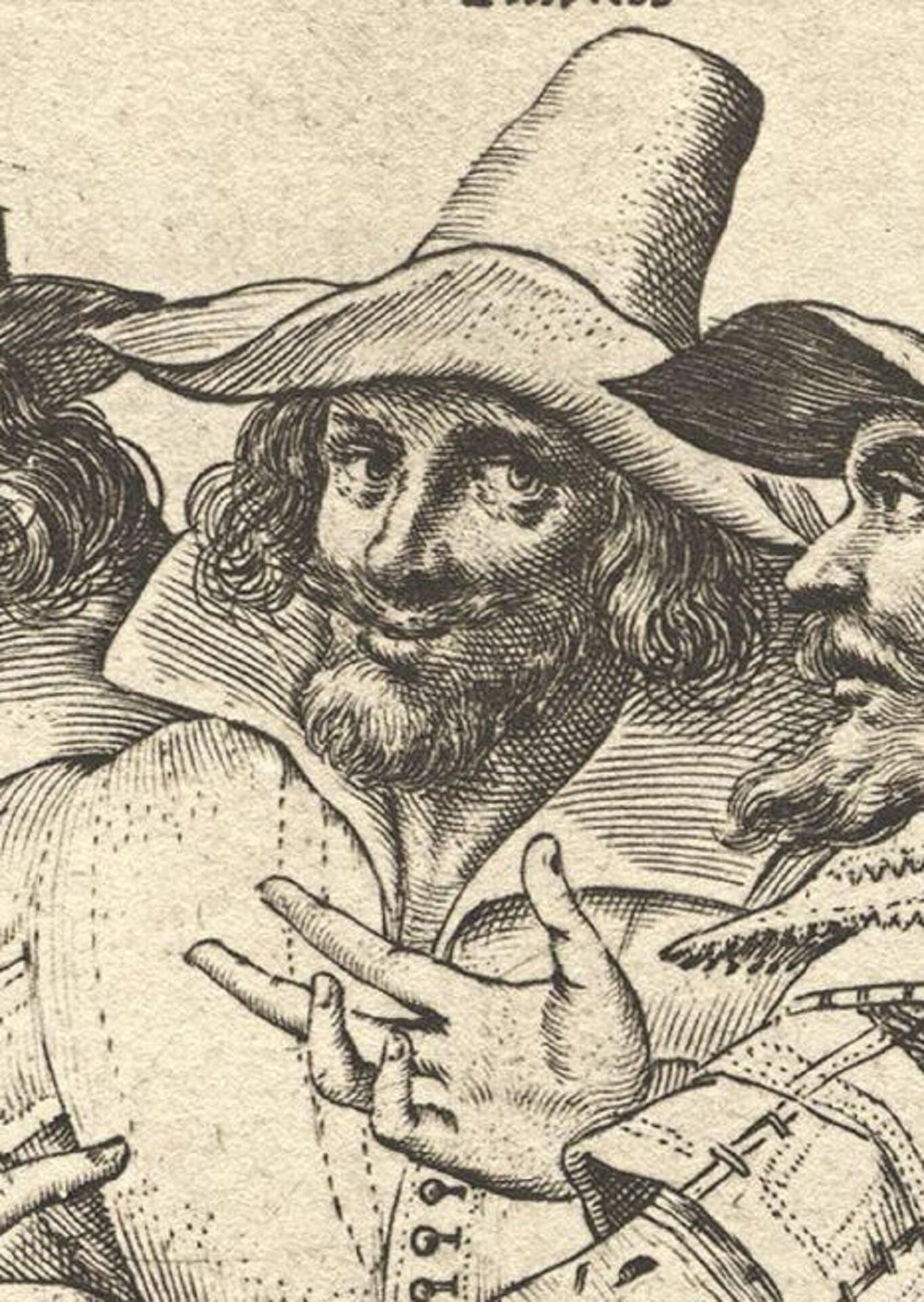
It's too easy to say he was put in charge of the gunpowder and was to set off the explosions because he had experience. In fact, the plot and Guy's role in it were far more complex, involving many more people.
Robert Keyes guarded the gunpowder for nearly a year, while Guy - Guido, as he called himself then - travelled abroad.
He tried once again to secure Spanish help for the cause, hoping that his service in the Spanish army would have some sway. He came away disappointed, yet more determined than ever to carry out the plot.
He took custody of the gunpowder once it was on Parliament grounds, safely tucked behind piles of logs and stacks of coal. There he stood, next to the pile, unaware that the plot was already foiled when inspectors prowled through the Parliament's undercroft.
Was it by design or was he an unusually quick thinker? When asked what he was doing there and who all that wood belonged to, he replied that it belonged to his master, Thomas Percy. The lie made sense, as Percy had leased the undercroft in his name. It worked well enough to send the king's investigators on their way2.
Thomas Percy, socially well positioned but known to have Catholic sympathies, made more credible the anonymous letter that warned of the plot.
The king insisted that the undercroft be inspected again and that this man must be questioned more intensely. Upon the searchers' return to Parliament's cellars, they found Guy once again, this time wearing a long coat and holding a lantern. They arrested him and hauled him before the king.
What Happened to Guy Fawkes Next?
Guy remained defiant after his arrest, giving only a name - John Johnson, and his mother's name. He admitted his intention to blow up the House of Lords and made his regret plain that the plot hadn't succeeded.
[My intention was] to blow you Scotch beggars back to your native mountains.
Guy Fawkes, when interrogated in the king's privy chambers.
The king admired 'John Johnson's forthrightness, even as his outrage grew over the plot on his life and defiance of the law. He ordered the offender to the Tower of London to be tortured. It took four days to wrest a confession out of Guy Fawkes, upon which he was put on trial for treason.
As the standard sentence for treason was hanging, drawing, and quartering, that was to be Guy's fate3. He remained defiant to the end, pitching himself off the gallows platform to snap his own neck. Had he endured his full sentence, he would have been hanged nearly to death, then disembowelled and dismembered while still conscious.
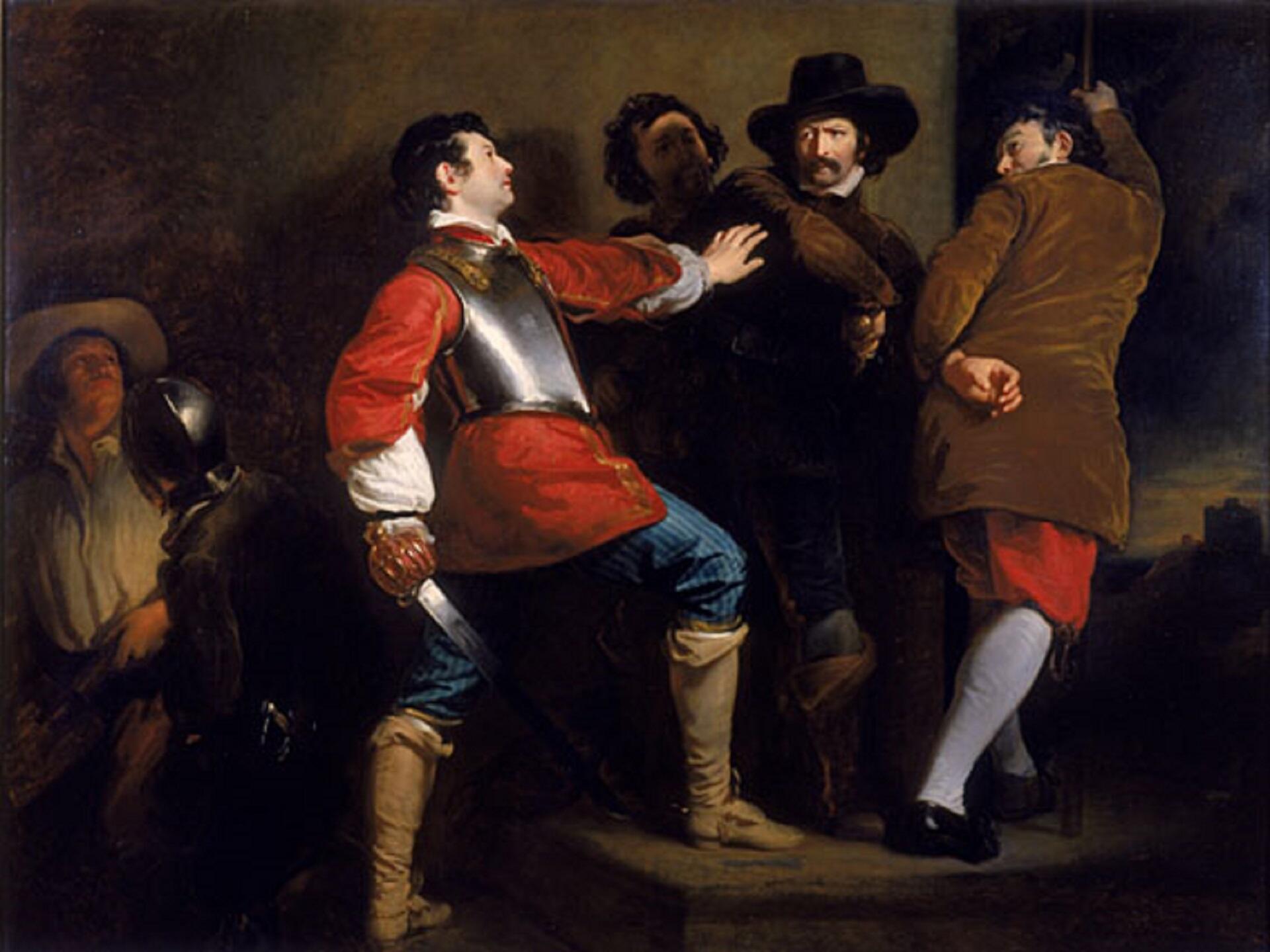
Guy Fawkes and Bonfire Night
Guy Fawkes was arrested as John Johnson, a typically English name meant to make him inconspicuous. He signed his confession letter 'Guido Fawkes', a nod to his Catholic beliefs. He was sentenced as "Guido Fawkes, otherwise known as Guido Johnson."
To this day, we commemorate him as 'Guy' every time we throw a 'guy' effigy on our 5 November bonfires. Our bonfire tradition traces back to 1605, when Londoners lit fires to signal their joy at the king's survival4.
Though Robert Catesby masterminded the plot, Guy Fawkes was its most high-profile participant. So, 'Guy' became synonymous with the plot.
Originally, the guys symbolised the Pope and Catholic figures, in general. In the earliest bonfires, the burning of effigies was a rejection of Catholicism, not Guy Fawkes himself. But because of Guy Fawkes' infamy, the effigies soon became 'guys', as we still call them today.
Bonfire Night was written into law as the Observance of 5th of November Act 1605, which was repealed in 1859. Over those two-and-a-half centuries, the tradition took root, becoming a part of our cultural fabric. To this day, we gather round the bonfire on that day with no law making us do so.
Guy Fawkes Significance Today
Guy Fawkes was just 35 when he died. He might have remained a faceless, mildly important figure from the past, but for a remarkable revival in graphic novel form. V Is For Vendetta exploded onto British bookshelves in 1982, telling the story of an anarchist determined to bring down the fascist state.
Already we can see a loose connection to the Gunpowder Plot. We only need to substitute 'anarchist' with 'Catholic' and 'Protestant' for 'fascist'. The parallels are drawn yet clearer by the title character, V, hiding behind a Guy Fawkes mask. History and this story have other similarities - and more than a few differences.
The Gunpowder Plot
- planned for 5 November
- a fight against religious oppression
- Robert Catesby ringleader
- an attack on the monarchy
- motivation: religious persecution
- the plot's failure reinforced Protestant rule
V is for Vendetta
- planned for 5 November
- a fight against fascism
- Guy Fawkes ringleader
- an attack on a political party
- motivation: personal vendetta
- the plot's success collapses the government
Guy Fawkes and the Fawkes' Mask Symbolism
Guy Fawkes was a young man, firm in his religious convictions, and willing to die for his cause, no matter how misguided his efforts. Today's Guy Fawkes mask represents a totally different ethos.
1️⃣ Despite briefly using an alias, Guy Fawkes lived, fought, and died as himself.
2️⃣ Today's wearers of masks conceal their identity as they go about their deeds.
Guy had one cause: to end the oppression of Catholics. To that end, he was willing to destroy the Parliament building and end several lives. V, the graphic novel's protagonist, had much larger and less well-defined goals, with no plan for what would come afterwards.
Wearers of masks today often engage in disruptive activity over single-issue matters, only some of which are political. Seldom does any such group present a defined, workable solution to the issues they agitate against. As such, the Guy Fawkes representation has taken on a new meaning, less focused on systemic change.
References
- The Editors of Encyclopaedia Britannica. “Guy Fawkes | Biography, Gunpowder Plot, & Death | Britannica.” Encyclopædia Britannica, 2019, www.britannica.com/biography/Guy-Fawkes. Accessed 5 Oct. 2026.
- Royal Museums Greenwich. “Gunpowder Plot: What Is the History Behind Bonfire Night?” Rmg.Co.Uk, 2025, www.rmg.co.uk/stories/royal-history/gunpowder-plot-what-history-behind-bonfire-night. Accessed 5 Oct. 2026.
- Historic Royal Palaces. “Guy Fawkes and the Gunpowder Plot.” Historic Royal Palaces, 2019, www.hrp.org.uk/tower-of-london/history-and-stories/guy-fawkes-and-the-gunpowder-plot/. Accessed 6 Oct. 2026.
- Sky History. “History of Bonfire Night.” Sky HISTORY TV Channel, 2026, www.history.co.uk/article/history-of-bonfire-night. Accessed 6 Oct. 2026.
Summarise with AI:
Did you like this article? Leave a rating!

 Loading...