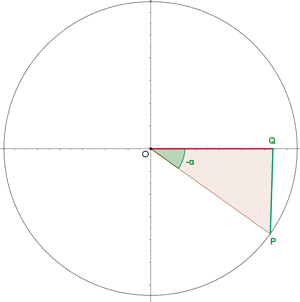
At this point, you might be familiar with the identities when the angle is moving anti-clockwise. At every quadrant, there are some specific identities for different trigonometric ratios. However, you might know that the angle moves anti-clockwise, the angle can vary but they all will remain positive, but this isn't the only case. The angles can also move in the clockwise direction as well! We call them negative angle angles. The angles will be written with a negative sign and the quadrants will have new angles for example, in the fourth quadrant, the angle ranges from

to

but when the angle is moving in the clockwise direction, the fourth quadrant's angle will range from

to

. This will ultimately change everything! from angle to the trigonometric values and many more. If you know how to find angles from different quadrants, irrespective of angle movement, then you won't have any problems with angle moving anticlockwise direction as well. However, you will be needing some help with trigonometric identities which are called Even-Odd Identities. These identities are very easy to learn and not to mention that their concept is easy as well. Let's clear one thing, the value of

will always be negative when the angle is moving clockwise.


Trigonometric Identities
Below are the even-odd trigonometric identities:


For
is an acute angle. Let's interpret the above trigonometric identities. If the angle of the

is negative that means the value of the
for that angle(positive) will also change its sign. For example:

is equal to

but if the angle's sign becomes negative then

. The reason is simple, the value of

is positive in

and

quadrants. For the

ratio, if the angle becomes negative angle, it will not have any impact on the value of
. In simple words, the value of

will remain the same. For example:

is equal to
, however,

will also be equal to
because
is positive in
and

quadrants. Last but not least, if the angle moves clockwise direction that means the value of

with a negative angle will be equal to negative value. For example:

is equal to

but if the angle is negative, hence

then the answer will be

because

is positive in
and

quadrants.



Summarise with AI:
Did you like this article? Rate it!


 Loading...