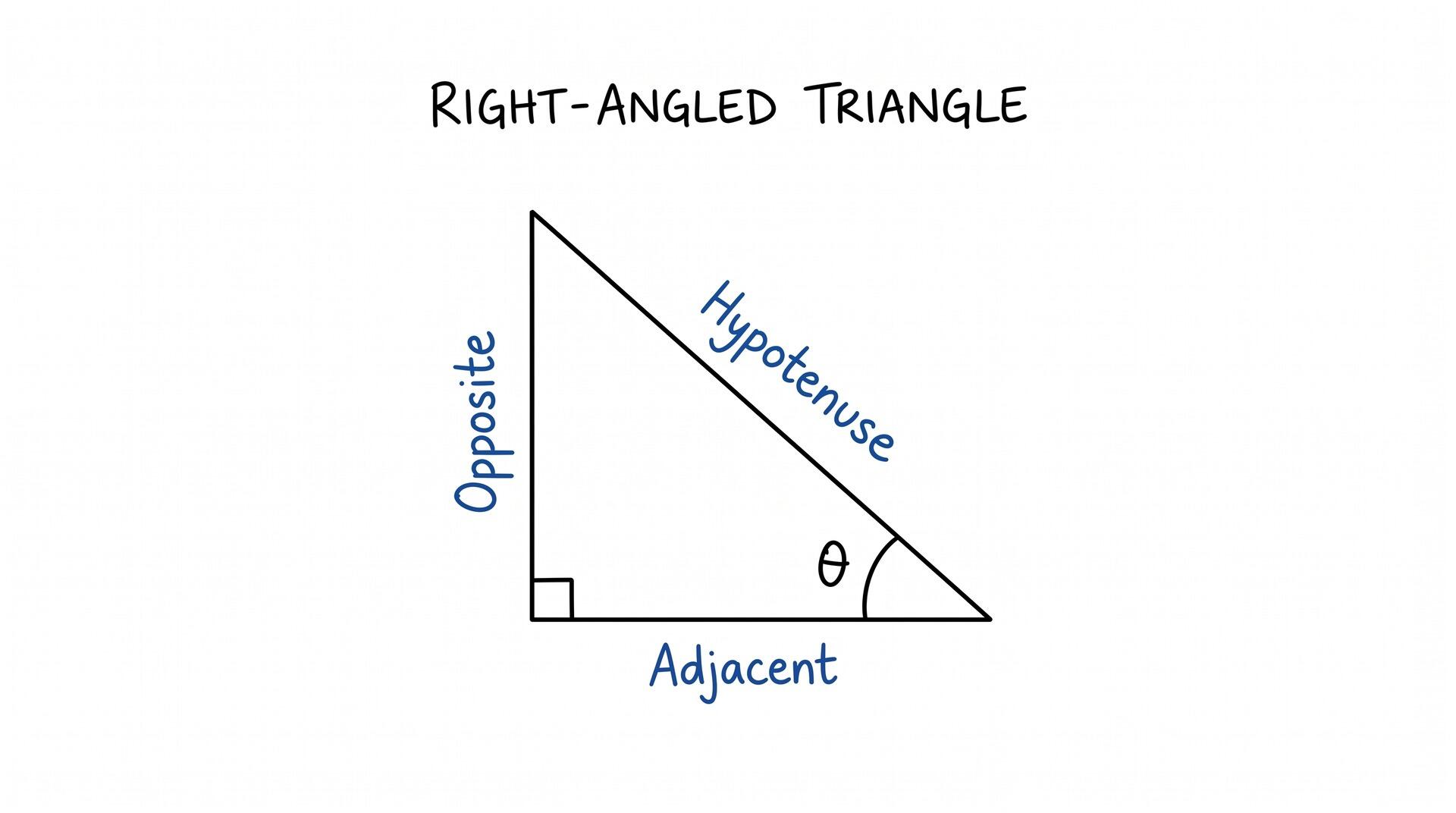
A right-angled triangle is a three-sided polygon containing one interior angle of exactly . In real-world contexts, right-angled triangles appear wherever vertical structures meet horizontal ground, when direct lines of sight connect two points at different heights, or when objects navigate along perpendicular compass bearings.
Solving word problems involving right-angled triangles requires two foundational mathematical tools:
- Pythagoras' Theorem: Used when calculating an unknown side length from two known side lengths.
- Right-Angled Trigonometry (SOH CAH TOA): Used when connecting side lengths with acute interior angles.
Pythagoras' Theorem
For any right-angled triangle where c represents the hypotenuse (the longest side opposite the right angle) and a and b represent the two shorter perpendicular legs:
- To find the hypotenuse:
- To find a shorter side:
The Trigonometric Ratios (SOH CAH TOA)
For an acute angle :


Practice Questions & Solutions
A painter places a ladder of length  against a vertical wall. The foot of the ladder rests on horizontal ground
 away from the base of the wall.
(a) Calculate the height up the wall reached by the top of the ladder.
(b) Calculate the angle that the ladder makes with the ground, giving your answer to one decimal place.
(a) Calculate the height reached on the wall using Pythagoras' Theorem:
Let the height be h. The ladder forms the hypotenuse  and the ground distance is
 :




(b) Calculate the angle  between the ladder and the ground:
Using the cosine ratio with adjacent and hypotenuse :
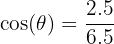
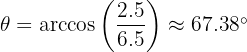
The angle made with the ground is  .
A surveyor stands on horizontal ground at a distance of  from the base of a telecommunications mast. The surveyor measures the angle of elevation to the top of the mast as
 . The surveyor's measuring instrument is positioned on a tripod
 above the ground.
Calculate the total height of the mast to one decimal place.
Step 1: Calculate the height of the mast above the instrument level
Let the vertical distance from the instrument to the top of the mast be y:
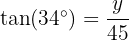

Since  :

Step 2: Add the height of the instrument above the ground


The total height of the mast is  .
A lighthouse keeper stationed at the top of a vertical coastal cliff  above sea level spots a navigation buoy in the water. The angle of depression from the keeper to the buoy is
 .
(a) Calculate the direct straight-line distance from the keeper to the buoy.
(b) Calculate the horizontal distance from the base of the cliff to the buoy. Give both answers to one decimal place.
The angle of depression of means the angle of elevation from the buoy to the top of the cliff is also .
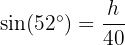
(a) Calculate the direct line of sight distance (hypotenuse d):
Using the sine ratio with opposite side :
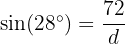
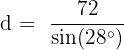
Since  :
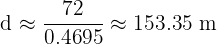
The direct distance is  .
(b) Calculate the horizontal distance x from the cliff base:
Using the tangent ratio:
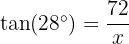
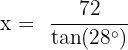
Since  :
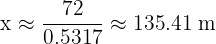
The horizontal distance is  .
A rectangular timber gate has a width of  and a vertical height of
 . A diagonal metal brace is fixed across the gate from the bottom-left corner to the top-right corner.
(a) Calculate the length of the diagonal metal brace.
(b) Calculate the angle that the brace makes with the horizontal base of the gate, to the nearest degree.
(a) Calculate the length of the brace using Pythagoras' Theorem:
Let the length of the brace be L:



(b) Calculate the angle with the horizontal:
Using the tangent ratio:
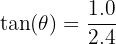
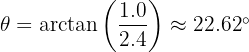
To the nearest degree, the angle is  .
A child flies a kite attached to a taut string of length  . The string makes an angle of
 with the horizontal. The child holds the spool of string
 above the ground.
Calculate the vertical height of the kite above the ground, to two decimal places.
Step 1: Calculate the vertical height gained by the kite from the child's hand
Let the vertical rise be h:

Since  :

Step 2: Add the height of the child's hand above the ground

The kite is  above the ground.
Building safety regulations state that the maximum angle of inclination for an outdoor wheelchair ramp is  . A clinic needs to build a straight ramp to reach a doorway raised
 vertically above ground level.
(a) Determine the minimum horizontal distance required for the run of the ramp.
(b) Calculate the minimum length of the ramp surface itself. Give both answers to two decimal places.
(a) Find the minimum horizontal run x:
The vertical rise is and the maximum angle is :
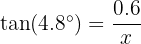
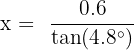
Since  :
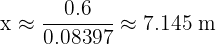
The minimum horizontal distance is  .
(b) Find the minimum length of the ramp surface L:
Using the sine ratio:
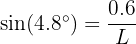
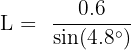
Since  :
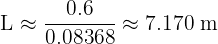
The minimum ramp surface length is  .
A walker leaves a checkpoint A and walks  due East to point B. The walker then turns and walks
 due North to point C.
(a) Calculate the direct distance from checkpoint A to point C.
(b) Find the three-figure bearing of point C from checkpoint A, to the nearest degree.
(a) Calculate the direct distance from A to C:
Because East and North are perpendicular, triangle ABC has a right angle at B:



(b) Find the three-figure bearing of C from A:
Find the angle North of East:
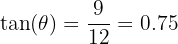

Bearings are measured clockwise from North. Since East is on a bearing of  :

Written as a three-figure bearing to the nearest degree:

An observer standing at point P on level ground observes the top of a monument at an angle of elevation of  . After walking
 directly towards the monument to point Q, the angle of elevation to the top becomes
 .
Calculate the height of the monument, giving your answer to one decimal place.
Step 1: Set up two trigonometric equations for height h
Let the horizontal distance from point Q to the base of the monument be x.
The horizontal distance from point P to the base is  .
From the right-angled triangle at Q:

From the right-angled triangle at P:

Step 2: Equate the expressions for x
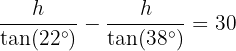
Factor out h:

Step 3: Evaluate trigonometric reciprocals and solve for h
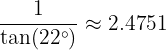
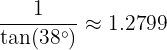



The height of the monument is  .
A vertical radio antenna of height  is secured to horizontal ground by a steel guy wire attached to its top. The wire is anchored into concrete at a point where the angle between the wire and the ground is
 .
(a) Calculate the length of the guy wire.
(b) Calculate the distance from the base of the antenna to the ground anchor point. Give both answers to one decimal place.
(a) Calculate the length of the guy wire L:
Using the sine ratio with opposite height and angle :
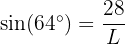
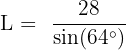
Since  :
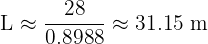
The length of the guy wire is  .
(b) Calculate the anchor distance d from the base:
Using the tangent ratio:
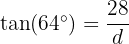
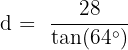
Since  :
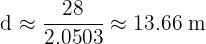
The distance from the base is  .
A ship departs from harbor P and travels due South for  to point Q. It then changes course and sails due West for
 to point R.
(a) Calculate the straight-line distance from harbor P to point R.
(b) Calculate the three-figure bearing of point R from harbor P, to the nearest degree.
(c) Calculate the three-figure bearing of harbor P from point R, to the nearest degree.
(a) Calculate the distance from P to R:
Triangle PQR has a right angle at Q:



(b) Find the bearing of R from P:
Calculate the angle between South and the line PR:
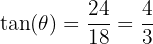
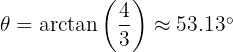
Because the ship travels South ( ) and then West:

To the nearest degree, the bearing is  .
(c) Find the bearing of P from R:
The back bearing is obtained by reversing the direction by :

Written as a three-figure bearing to the nearest degree:
Summarise with AI:
Did you like this article? Rate it!


 Loading...
