Imagine two lines that are going to intersect at a point. The point at which they intersect will create an angle. The angle is the deviation of another line from a reference. Basically, an angle is the region of the plane between two rays with a common origin. The rays are called sides and have a common origin, the vertex.

In the above image, the a and b are sides but in some textbooks, they are denoted by arms as well so don't get confused in terminologies, they both are the same. The point O is the vertex and a vertex is a point where both lines or planes meet each other. An angle is positive if rotated in a counterclockwise direction and negative when rotated clockwise. There are different types of angles, let's take a look at them:


Types of Angles
1. Right-Angle
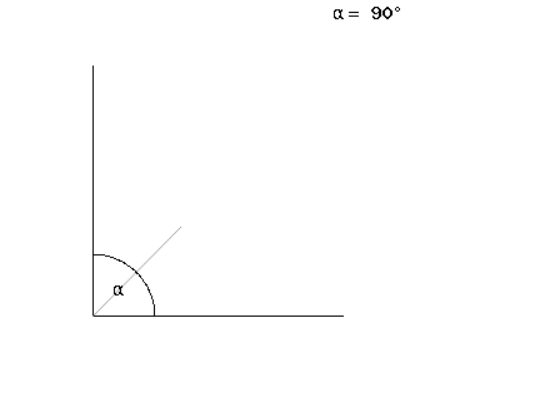
If the two straight lines/rays/planes (one horizontal and one vertical) meet each other, they will create a right angle. The identification of the right angle is that it will always be equal to

. 
2. Acute Angle
If the angle created by the rays/planes/lines is less than
, that means you are dealing with an acute angle. 
3. Obtuse Angle
If the angle created by the rays/planes/lines is greater than
, that means the angle is an obtuse angle. 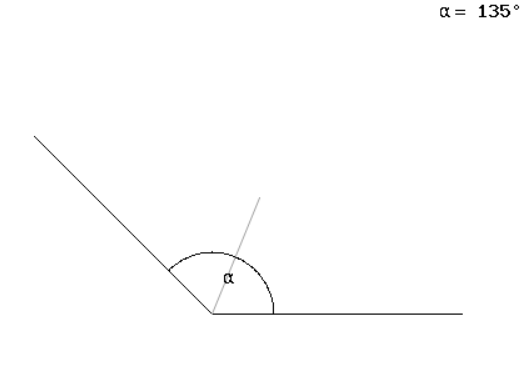
4. Straight Angle
If two straight lines/planes/rays (both either horizontal or vertical) meet each other, they will create a straight angle. A straight angle will always make

. 
5. Complete Angle
A complete angle is formed when two planes/rays/lines overlap each other completely hence resulting in an angle of

. 
6. Reflex Angle
If the angle is more than
but less than
, that means you are dealing with a reflex angle. 
Types of Units For Measuring Angles
1. Sexagesimal degree (°)
If the circumference of a circle is divided into 360 equal parts, the central angle corresponding to each of its 360 parts is an angle of one-degree sexagesimal, (  ).
A degree has 60 minutes (') and a minute has 60 seconds ('').
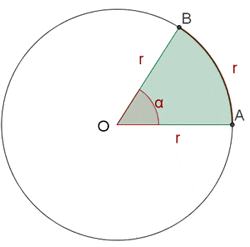
2. Radian (rad)
It is the measure of an angle whose arc is a radio.


Convert

to radian.


Cross multiply:


Convert

to degrees.




Summarise with AI:
Did you like this article? Rate it!


 Loading...