


The laws of logarithms are a set of rules that help simplify and manipulate logarithmic expressions. These rules allow us to break down complex expressions, solve exponential equations, and simplify formulas in everything from finance to physics. These laws provide guidelines for combining, splitting, and evaluating logarithms, making it easier to solve complex equations involving logarithmic functions. In this guide, we’ll walk you through the key logarithmic laws with clear explanations and examples—no advanced maths degree required.
| Rule Name | Log Rule Equation | Explanation |
|---|---|---|
| Product Rule |  | Log of a product is the sum of the logs. |
| Quotient Rule |  | Log of a quotient is the difference of the logs. |
| Power Rule |  | Log of a power is the exponent times the log. |
| Change of Base Rule | 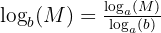 | Allows changing the base of a log to a different base. |
| Zero Exponent Rule | 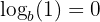 | Log of 1 is always 0, regardless of the base. |
| Log of One |  | Log of the base to itself is always 1. |
| Log of Base |  | The base raised to the log of a number returns the number. |
Without further ado, let's get underway, looking at some of the logarithm laws, and how you might use them in practice to solve tricky questions.







The Laws of Logarithms
There's something to bear in mind when looking at logarithm laws - in all the examples below, we just use "loga", the notation normally used with logarithms is either "log", when the logarithm function is using base10, or "loga", where "a" is a number, when the logarithm is using a different base.
Any law can be applied to any base system, provided there's no change of base in the expression. For example, all these laws apply to base3 numbers as well, as long as you use base3 for every number in your expression.
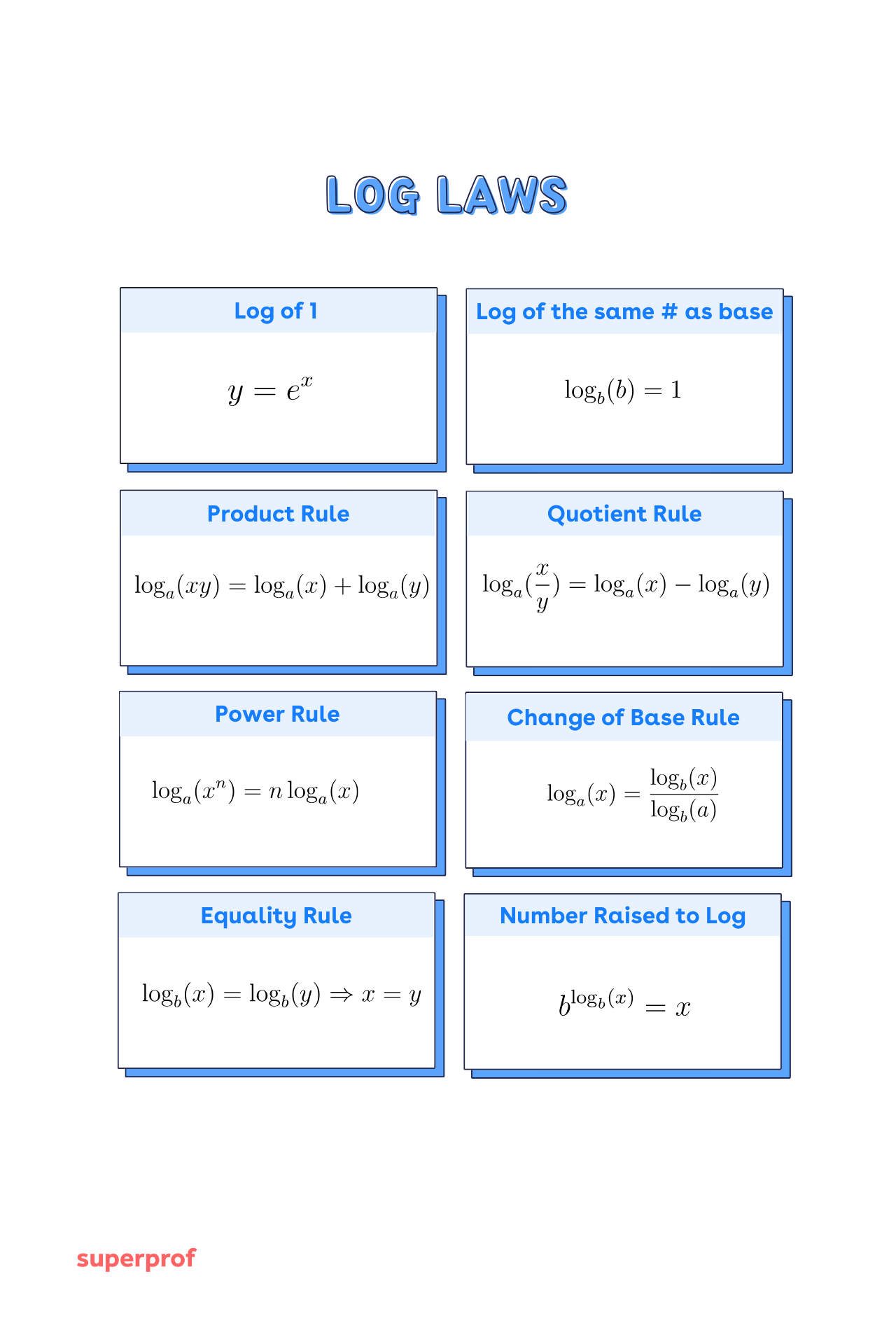
Fundamental Laws of Logarithms
The fundamental laws of logarithmic functions Consist of three primary rules. They derive from exponent properties that allow the simplification and manipulation of logarithms1.
These fundamental laws require that the logarithm bases be greater than or equal to zero.
Furthermore, all the inputs (arguments) must be positive.
Product Rule
Multiplying inside the log becomes addition outside — logs turn multiplication into simpler addition.

This law uses addition and multiplication properties.
The first law states that adding the logarithms of two numbers (of the same base!) together is the same as taking the logarithm after we multiply the numbers together. Multiplying inside the logarithm turns into addition:

Quotient Rule
The second law states that subtracting the logarithms of two numbers (again, of the same base), is equivalent to dividing the two numbers and taking the logarithm of the result.
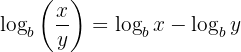
Dividing inside the logarithm becomes subtraction:

Power Rule
If something inside a log is raised to a power, you can move that power to the front as a multiplier.

The final logarithm law we'll look at may seem familiar to you - it's very similar to differentiating a term of an expression! The logarithm of a number raised to a power is the same as the whole logarithm being multiplied by that exponent, removing the exponent from the original expression.
An exponent inside the log moves to the front:

Beyond these three fundamental laws, logarithms exhibit two further essential properties.
Log of 1 Rule
The log of 1 is always 0 because any number to the power of 0 equals 1.

Since any non-zero base raised to the power of 0 equals 1:

Log of a Number Equal to Its Base
The log of a number that’s the same as the base is always 1, because you raise it to the power of 1 to get itself.

The exponent needed to raise the base to itself is 1:

Laws of Logarithms: Additional Properties
Logarithm's four basic properties, Product, Quotient, Power, and Change of Base, are the foundation of this mathematical system. Beyond them exist three more noteworthy rules. If you do find yourself struggling with these concepts, you might consider using Superprof to find a maths tutor who can give you a helping hand remembering these identities.

Change of Base Rule
You can rewrite a log in a different base using this formula — this is important to bear in mind when using calculators.
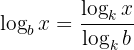
This allows you to convert a logarithm from one base to another — especially useful when using a calculator that only supports base 10 or natural logarithms (base e).
For example: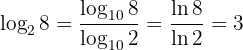
It works because both sides represent the same exponent when rewritten in exponential form.
Equality Rule
If two logs with the same base are equal, then the values inside must be equal too.

If two logarithms with the same base are equal, then their arguments must be equal. This is a one-to-one property of logarithmic functions. This property is especially helpful for solving log equations.
For instance, if:
then
Inverse Rule (Logarithms and Exponents)
Logs and exponents undo each other — they are opposites like adding and subtracting.


These two rules show that logarithms and exponents undo each other, like reverse operations:
First rule: Raising the base b to the power of the log of x gives x:
Second rule: Taking the log of a base raised to x gives back x:
Together, these rules confirm that logarithms are the inverse functions of exponentials. But did you know that these rules may also apply to Mechanic Forces?
How to Solve Logarithmic Equations
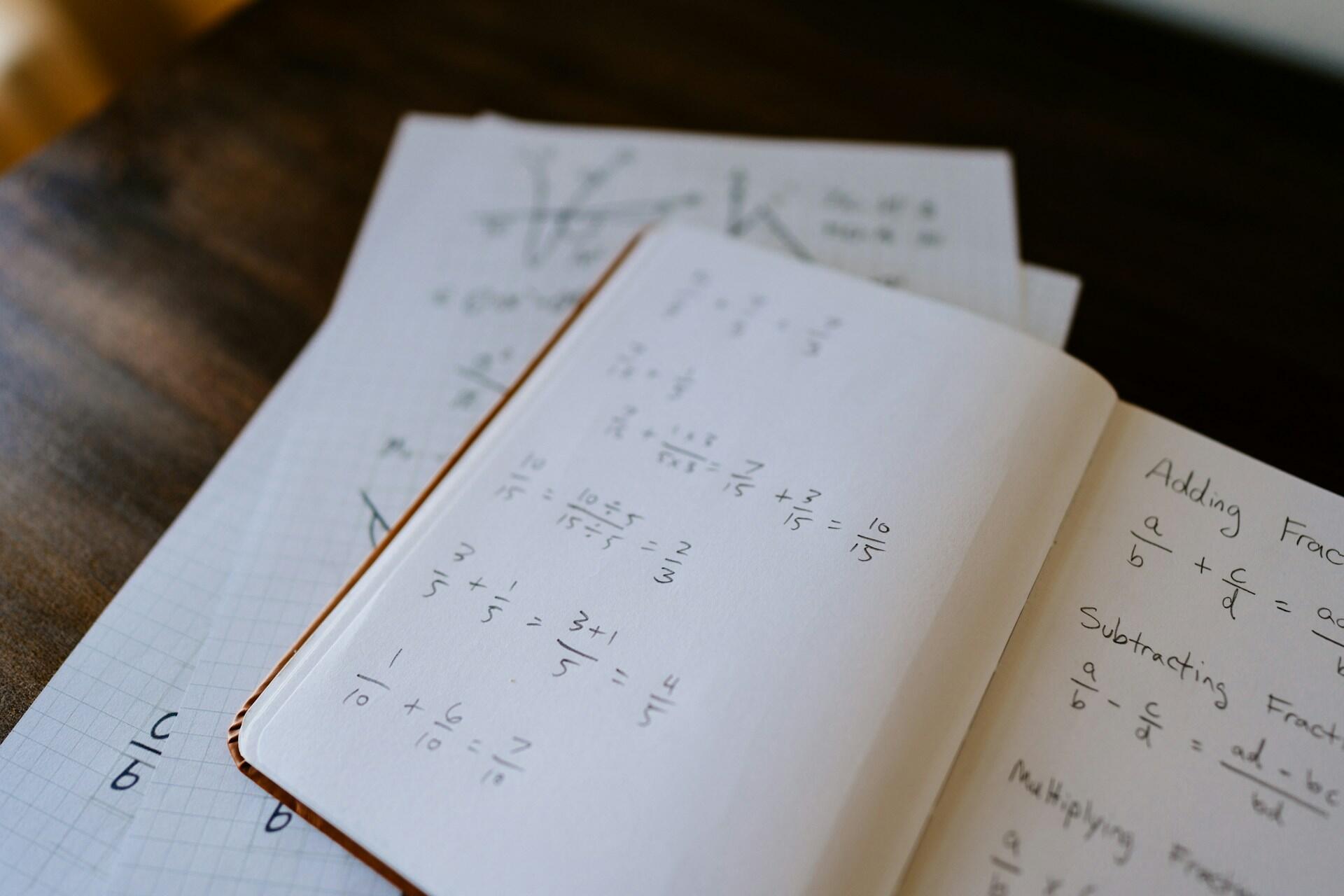
The law logs look pretty simple in isolation, but unfortunately, it's rarely so easy in an exam. Normally you'll be faced with the prospect of using any number of combinations of logarithmic functions in order to come up with an answer.
While this may seem daunting at first, as always, the best way to approach these problems is to tackle them in bitesize chunks: splitting the question into smaller problems. Solving logarithmic equations involves applying the properties of logarithms and algebraic manipulation. Here's a step-by-step guide:
- Evaluate Logs: If the unknown variable is outside the logarithm, use the base of the logarithm to evaluate the logarithm itself. For example, if you have ( \log_b(x) = y ), you can rewrite it as ( x = b^y ) to solve for ( x ). This is straightforward when the base and the argument of the logarithm are easy to work with, but may require a calculator for more complicated values.
- Convert to Exponential Form: If the unknown variable is inside the logarithm, rewrite the equation in exponential form. For example, for the equation ( \log_b(x) = y ), rewrite it as ( x = b^y ). This allows you to solve for the unknown variable by raising the base of the logarithm to the power of the other side of the equation.
- Combine Logs: If there are multiple logarithms in an equation, try to combine them using the properties of logarithms. For example, you can combine two logarithms with the same base by adding or subtracting them. This can simplify the equation and make it easier to solve.
- Check for Extraneous Solutions: After finding a solution, always check it to ensure it is valid. Some solutions may not be valid because they result in taking the logarithm of a negative number or zero, which is undefined. These are called extraneous solutions and should be discarded.
- Practice Algebraic Manipulation: Logarithmic equations often require algebraic manipulation such as factoring, combining like terms, or using the properties of exponents to solve. Practice these algebraic techniques to become more proficient in solving logarithmic equations.
Remember, solving logarithmic equations may sometimes involve trial and error or multiple steps, so patience and practice are key. But take heart! Many contend that mastering logarithms is easier than grasping Calculus concepts. If you'd like extra support, working with a maths tutor can help you build confidence with these techniques.
Real-World Applications of Log Laws
Few people engage with logarithmic expressions for fun and profit, and you won't find any logarithm Tiktok challenges (though some fine tutorials exist). So, what to do with these laws of logarithms and, more importantly, who needs them, besides mathematicians2?
Scientists and engineers rely on logarithms to calculate practically everything within their scope of work.
You might have expected scientists of all stripes to depend on logarithms (and differentiation/integration problems too!), especially the more maths-intensive disciplines. But logs drive other functions of our modern world, functions that you likely use every day.
- PageRank's algorithm applies logarithmic scoring to determine website authority and traffic.
- generally, efficient algorithms run logarithmic time complexity, keeping runtime manageable.
- Data storage requirements are calculated using logarithms
Finance
- logarithms are instrumental to calculating exponential growth.
- logarithms calculate compound interest and the time needed for investments to grow to a specific value.
- logarithms also calculate the time for populations to double, projecting financial risks and opportunities.
Computer science, analysing growth and decay rates, and financial modelling are all aspects of our modern lives, and they all rely on laws of logarithmic functions.
Until 30 years ago, endeavours that used logarithms had tables which presented values for logarithm identities. The 1965 Wang LOCI-2 introduced an electronic computer with log function. The debut of the TI-83 calculator in 1996 made tables redundant for all.
Laws of Logarithms: Pitfalls and Common Misconceptions
Logarithms are inverse functions representing exponents. For many students, this 'backwards' operation is confusing. If you're among their number, you might consider a few sessions of online tuition for Maths.
Treating 'log' as a variable rather than a function.
Beyond that mistake, misapplying logarithmic properties is among the most common3. Often, applying those properties to expressions they don't apply to leads to a reversal to the direction of the rule. These instances stand out as prime examples of such.
Confusing argument with base is another major aspect a Superprof maths tutor can help you clarify. Take an expression such as "log5", for example. It represents the exponent (2), not the argument or the base. If you’re studying in the Midlands, a local maths tutor can help you avoid this mix-up.
Why Logarithms of Negative Numbers Are Undefined
This aspect causes its own share of mistakes, and it's easy to see where the confusion comes from. Negative logarithms, those whose outcomes are negative, are valid. However, the input number must be positive.
Logarithm's purpose is to answer "To what power must a base be raised to produce the desired value?" As the base is always a positive (real number), raising it to any power will always result in a positive value. Following that logic, logarithms of negative numbers will be undefined by default. Now, you can test your knowledge of logarithms with this short quiz.
Further Reading and Resources for Log Laws
- “Logarithm Laws Made Easy: A Complete Guide with Examples – Mathsathome.com.” Maths at Home, mathsathome.com/logarithm-laws/. Accessed 21 Apr. 2026.
- Skelton, Katherine . “5.8: Applications of Exponential and Logarithmic Functions.” Mathematics LibreTexts, 1 Nov. 2021, math.libretexts.org/Courses/Highline_College/MATHP_141:_Corequisite_Precalculus/05:_Exponential_and_Logarithmic_Functions/5.08:_Applications_of_Exponential_and_Logarithmic_Functions. Accessed 22 Apr. 2026.
- Project, The Ximera. “Common Mistakes of Logs.” Xronos.clas.ufl.edu, xronos.clas.ufl.edu/mac1140nowell/PrecalculusXourse/exploreLogarithms/commonMistakes. Accessed 22 Apr. 2026.
Résumer avec l'IA :
Did you like this article? Leave a rating!


 Loading...
you quotient law incorrectly restates the product law. Your statement gives the correct explanation, but the formula displayed doesn’t match.
Hi Brad. Thank you so much for pointing that out. The article has now been amended. We really appreciate your attention to detail!
Goooooooooooood job done
Hi there! Great to hear that you found this article useful!
I don’t understand it
Thanks for reaching out! 😊 The laws of logs and exponential functions can be tricky at first. If there’s a specific part that’s confusing, feel free to ask, and we’ll do our best to explain it in simpler terms. You’ve got this! 📘✨
Thank you for this
Excellent.
Thanks keep up the good work
Thanks for the help
That’s good work. What if the bases are different
Thanks so much for your feedback! 😊 That’s a great question. When the bases are different, you can use the change of base rule (rule 6 in the article). This lets you rewrite logarithms in terms of a common base.
i have actually mastered this topic due to your explanation
Hi there! Thanks a lot for taking the time to comment! Great to hear that this article has helped you to develop your knowledge of logarithms!