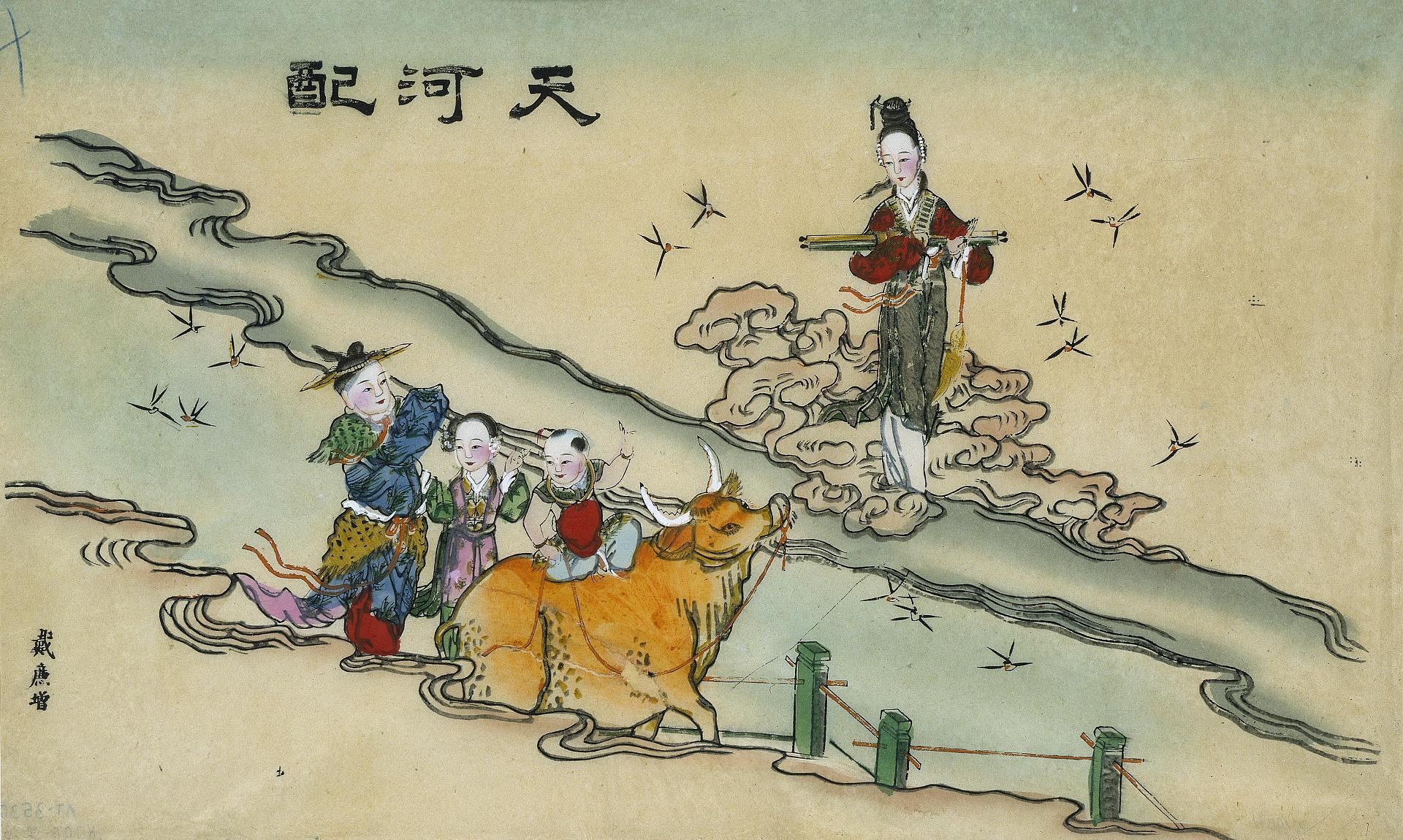

Calling this celebration the Chinese Valentine's Day is a handy reference point to our romantic leanings. However, it's not exactly on the same page. To be sure, it is among the most romantic of the traditional Chinese festivals, with roots in the Han Dynasty (202 BCE to 220 CE), though the legend may be much older.
At the start
Niulang's brother tells him to leave the family home.
Niulang has only an ox, given to him by his brother.
The Ox speaks
The ox urges Niulang to steal a bathing maiden's clothing.
This should make her fall in love with him.
Hiding the clothes
Zhinü discovers her clothes are gone.
Niulang's sincerity melts her heart; she agrees to marry him.
Found out
The emperor discovers the marriage, which he doesn't approve of.
Zhinü is pulled back into Heaven.
The barrier
The Queen Mother builds the Milky Way as a barrier to keep them apart.
Magpies intervene
Pitying the couple, the birds form a bridge so that the lovers may meet.
The Emperor relents
He allows the lovers to meet on the magpie bridge one night each year.


The Story Behind Qixi Festival
Young Niulang had family problems. His sister-in-law is cruel to him, and his brother does little to stand up for him. He's finally evicted from the family home, receiving only an old cow as his share of the family's wealth.
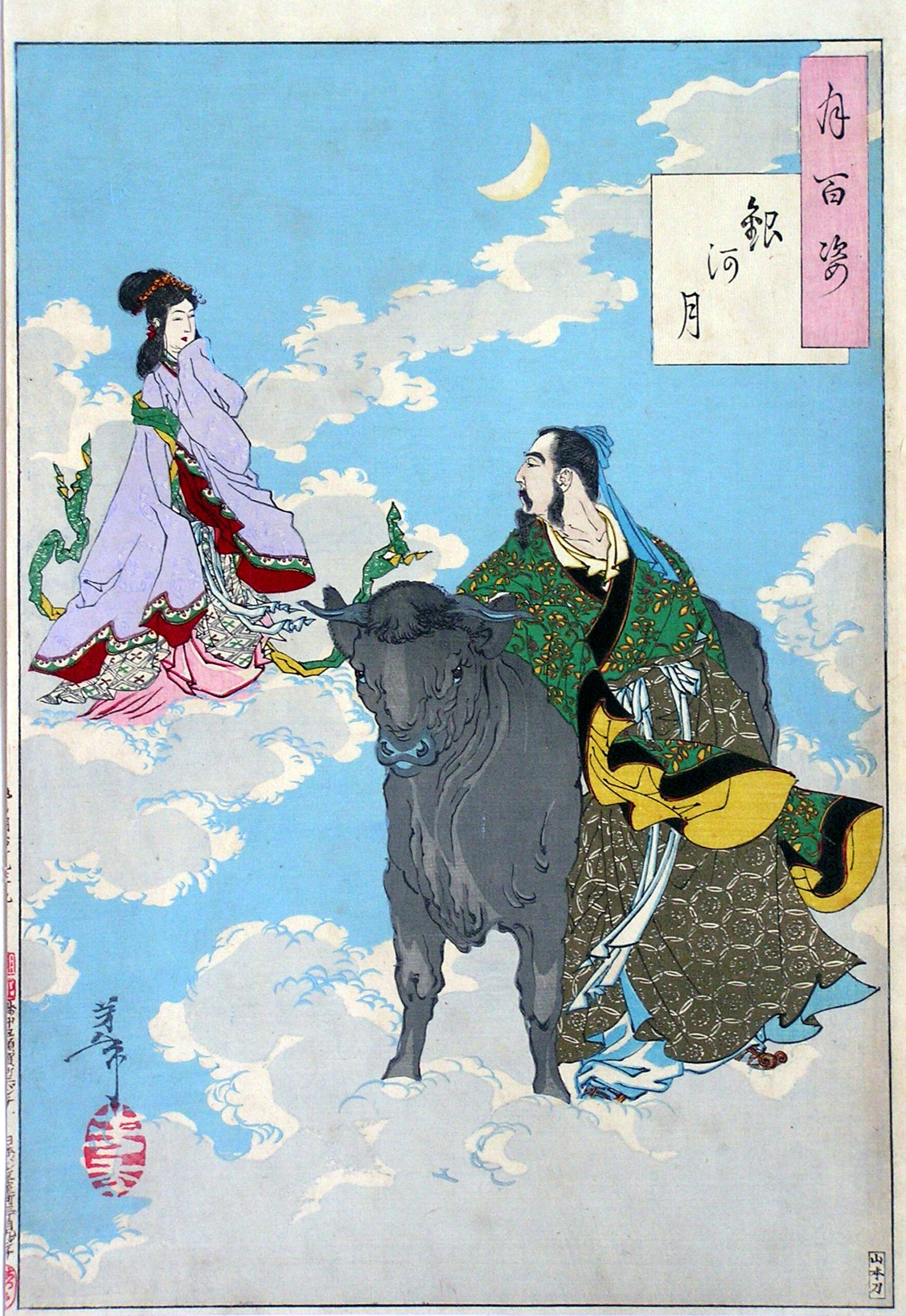
After some time wandering around the countryside, Niulang is astounded to hear his ox speak. The animal advises him to go to a nearby spring, as fairies would be bathing there that night. If Niulang could snatch a fairy's clothes, she wouldn't be able to return to heaven without her heavenly garments.
Sure enough, Niuling spots the fairies in the water, so he hides one fairy's clothes. She challenges him about his trickery but soon comes to appreciate his sincerity, both as he confesses his guilt and his motives for taking her things.
Love blossoms between the pair; soon the 'fairy' weaver girl, Zhinü, no longer wants to return to her celestial home.
Shedding her heavenly clothes, Zhinü becomes mortal.
The pair marry and bring forth two children.
The Jade Emperor (Emperor of Heaven) becomes furious at the news of losing one of his weaver girls, so he orders his minions to retrieve her. As Zhinü is being lifted away, Niulang's ox speaks again, to tell him how he could turn his skin into a flying coat. Niulang does so, quickly chasing after his love.
The Queen Mother of the West, intent on keeping the mortal out of heaven, draws a Silver River across the sky to block his path. Heartbroken, Niulang returns to Earth, to his children. A flock of magpies, witnessing the whole scene, take matters into their own wings.
They build a bridge with their bodies to span the Silver River so that the lovers may reunite. So moved by the couple's love is the Emperor of Heaven that he permits them to meet on the Magpie Bridge one night each year, on the seventh eve of the seventh lunar month.
To this day, magpie pairs represent marital happiness and faithful partnership in Chinese culture.
Find Zhinü and Niulang in the Night Sky
Unlike the statesman whose deeds the Dragon Boat Festival celebrates, these lovers have representation in the night sky still today. In fact, stargazing is a popular Qixi activity that lovers old and young partake of. If you're familiar with northern and equatorial constellations, you'll have no problem spotting them.
Zhinü as Vega
- the brightest star in the Lyra constellation
- the second brightest star in the northern hemisphere
Niulang as Altair
- the brightest star in the Aquila constellation
- the 12th brightest star in the night sky
Qixi Festival Traditional Customs
Would it surprise you to know that, of all the major Chinese festivals, Qixi puts the most emphasis on women? That is, if you can put aside the Mid-Autumn harvest festival, which is a celebration of the goddess Chang'e.
Historical Qixi Activities
Though Niulang and Zhinü share top billing in this story, Chinese society leans heavily towards Zhinü's life and deeds during celebrations3. Needle-threading competitions were a top traditional Qixi activity. The wise ox got his share of attention too; children would weave flower garlands to decorate their oxen's horns.
Praying to Zhinü for wisdom was a common custom. If a woman were married, she might ask Zhinü to bless her with a child. Then, as now, couples would plan their weddings to coincide with the Qixi festival, as it is considered an auspicious time.
Typical offerings include tea, fruit, and a tasty, thin pastry called qiao guo (巧果) stuffed with red bean paste or sesame paste. It's not uncommon to carve the fruit into delightful shapes: birds, flowers, and animals.
Qixi in Modern Times
Around the world, people tend to think of Qixi as Chinese Valentine's Day but the comparison doesn't land. For one, people in China 'observe' the February 14 Valentine's Day of Western cultures, but it's more of a fun shopping day. Not so much a mandate for lovers to shower each other in gifts and chocolates, but that is changing.
Today's younger Chinese adapt traditional cultural apects of Qixi to their digital environment. It's not uncommon to send/receive a digital red envelope (红包 - hóngbāo) from one's parents and grandparents. And maybe even from retailers or platforms users subscribe to, though the amounts are much less than from loved ones.
Qixi (七夕 - qīxī) is literally 'seven eve'.
The seventh day of the seventh month of the lunisolar calendar is the day the magic happens. Projecting out a few years, you can mark your calendars for your chance to revel in this story1.
| 📅 Year | 📆 Date |
|---|---|
| 2026 | August 19 |
| 2027 | August 8 |
| 2028 | August 26 |
| 2029 | August 16 |
| 2030 | August 5 |
The Xiuqiu Marriage Ball
Did you know that the Chinese Zhuang ethnic group, from the Guanxi Zhuang autonomous region, has a distinctive romantic tradition? It's called a marriage ball (绣球 - xiùqiú), a silk ball that young women put great care into stitching2. In fact, 'xiùqiú' literally means 'embroidered ball'.
This custom's backstory features denied love, much as the Qixi celebration does, but it's of the terrestrial type. A poor youth in a neighbouring village, A Di, fell in love with the beautiful A Xiu. But a boy from a well-to-do family spotted her heading to market and wanted her for himself.
Once he learnt that A Di had a claim on her, he used his social power to have him imprisoned, thinking A Xiu would have no choice but to be his. Instead, she carried the beautiful decoration she'd spent months sewing to the jail to hang in A Di's cell.
This ritual takes place on the third day of the third lunar month. It coincides with the sānyuèsān or Shangsi Festival, a day of purification in preparation of spring.
From this tale, the Zhuang people gained the tradition of 'tossing the marriage ball' (抛绣球 - pāo xiùqiú). Boys and girls circulate while facing each other; when a young woman sees a boy she fancies, she tosses him her ball. If he tosses it back with a small gift attached, he's considered to have accepted her proposal.
Other than the romance angle and backstory similarities, this festival bears no connection to Qixi and, furthermore, today, this ritual is mainly for the tourist trade. However, as young Chinese explore their traditional culture, this charming custom is making its way around the country. It's yet more proof the Chinese people have a decidedly romantic bent. It also testifies to women's power in traditional Chinese culture.
Qixi Festival in Today's World
Still today, Chinese people use the phrase 'niulang zhinü' to describe happily married couples. Where English speakers might say "They're soulmates" or the like, in China, you'd say "They're Niulang Zhinü".
During China's Lantern Festival, it's not uncommon to find such couples writing touching love declarations on their paper lanterns before casting them into the heavens together.
Commercialising Qixi
Having long left stitching competitions behind, today's Qixi festival blends traditional and modern elements. You're more likely to find puppet shows in neighbourhoods or rural areas. Increasingly, those arenas are surrounded with vendor stalls.
More and more, luxury brands are capitalising on this romantic Chinese festival4. They promote specials for the occasion, and slant their ad copy to suggest that their products are a testament to your love. These campaigns provoke mixed reactions across Chinese society.
Restaurants, cinemas, and shops typically offer Qixi deals. You and your sweetheart might dine on a set menu before catching the latest romantic comedy.
Afterwards, browse the night markets to see the specials they're promoting.
Qixi Influence on Other Cultures
Like so many Chinese festivals, including the tomb-sweeping festival called Qing Ming, Qixi has made its way to other Asian countries. This chart describes how the Chinese Qixi festival translates in other cultures.
| 🗾Country | 📛 What it's called | 📆When it's celebrated | 🎉Unique features |
|---|---|---|---|
| Japan | Tanabata Festival | Date varies according to location, always between July and August. Celebrations begin on July 7. | Writing wishes and attaching them to bamboo. The bamboo and decoration are burnt at the end of the festival. Festivals vary by region. Typically feature competitions. Often feature rustling decorations. |
| South Korea | Chilseok Festival | The seventh day of the seventh lunisolar month. | Ritual bathing. Eat wheat noodles and grilled wheat cakes. |
| Vietnam | Thất Tịch Festival | The seventh day of the seventh lunisolar month. | Explains seventh-month rains that discourage marriage. Eat sweet bean soup |
References
- “Qixi Festival, 2021 Double Seventh Festival, Chinese Valentine’s Day.” Www.travelchinaguide.com, www.travelchinaguide.com/essential/holidays/qixi.htm. Accessed 1 May 2026.
- 李松. “Silk Balls Preserve Love Tradition from Past.” Chinadaily.com.cn, 2017, www.chinadaily.com.cn/a/201712/22/WS5a3c5e7ca31008cf16da2cd5.html. Accessed 16 Dec. 2024.
- Knott, Kylie. “SCMP.” South China Morning Post, 9 Aug. 2024, www.scmp.com/lifestyle/family-relationships/article/3273853/what-qixi-festival-chinese-valentines-day-story-traditions-and-food-explained. Accessed 2 May 2026.
- Love. “China Skinny.” China Skinny, 2 Sept. 2020, chinaskinny.com/blog/qixi-festival/. Accessed 1 May 2026.
Summarise with AI:
Did you like this article? Leave a rating!

 Loading...