A decimal number is any number that contains a decimal point. The decimal point separates the whole number part on the left from the fractional part on the right. For example, in the number 4.75, the digit 4 is the whole number part, and 0.75 is the fractional part, which is less than 1.
Decimal numbers let us express quantities that fall between whole numbers — such as measurements, prices, and scientific readings — with as much precision as we need.
For a full explanation of terminating, recurring, and non-recurring decimals, see Types of Decimal Numbers.


The Decimal Point
The decimal point (written as a full stop in the UK: 4.75) acts as a boundary between the whole number part and the fractional part. Every digit to the left of the decimal point represents a whole unit or a multiple of ten. Every digit to the right represents a fraction of one unit.
| Position | ||||||
|---|---|---|---|---|---|---|
| Hundreds | Tens | Units | . | Tenths | Hundredths | Thousandths |
| 100 | 10 | 1 | . | 1/10 | 1/100 | 1/1000 |
Example: In the number 325.678:
- 3 is in the hundreds place (value 300)
- 2 is in the tens place (value 20)
- 5 is in the units place (value 5)
- 6 is in the tenths place (value 6/10 = 0.6)
- 7 is in the hundredths place (value 7/100 = 0.07)
- 8 is in the thousandths place (value 8/1000 = 0.008)
Reading and Writing Decimal Numbers
To read a decimal number aloud, say the whole number part, then say 'point', then read each digit after the decimal point individually.
| Number | How to read it |
|---|---|
| 4.7 | Four point seven |
| 12.35 | Twelve point three five |
| 0.068 | Zero point zero six eight |
| 100.5 | One hundred point five |
To write a decimal number from a description, place each digit in its correct place-value column. For example, 'forty-five and nine hundredths' is written as 45.09 — the zero in the tenths column is essential as a placeholder.
Decimal Numbers as Fractions
Every decimal number can be written as a fraction. The numerator is the number written without the decimal point, and the denominator is 1 followed by as many zeros as there are decimal places.
| Decimal | Fraction | Reason |
|---|---|---|
| 0.3 | 3/10 | 1 decimal place → denominator 10 |
| 0.47 | 47/100 | 2 decimal places → denominator 100 |
| 1.625 | 1625/1000 | 3 decimal places → denominator 1000 |
To reverse the process — converting a fraction with a denominator of 10, 100 or 1000 into a decimal — move the decimal point to the left by as many places as there are zeros in the denominator.
The denominator has three zeros, so move the decimal point three places to the left: 347 → 0.347
Rounding Decimal Numbers
Rounding reduces the number of decimal places while keeping the value as close as possible to the original.
Look at the digit immediately after the place you are rounding to:
- If it is 5 or more, round up (increase the previous digit by 1).
- If it is 4 or less, round down (leave the previous digit unchanged).
The third decimal place is 4, which is less than 5, so we round down.
Answer: 7.38
Truncating Decimal Numbers
Truncation simply cuts the number off at a given decimal place without any rounding. All digits after the cut are dropped.
Drop everything after the second decimal place. Answer: 5.78 (compare with rounding, which gives 5.78 here too — but see below)
Converting Decimals to Fractions
Decimal numbers can be expressed by a decimal fraction. It has two parts: a whole and a decimal. For example, in a decimal number 3.25, 3 is a whole number, and 25 is the decimal part.
To express a decimal number as a decimal fraction, write the number without the decimal point as the numerator and as the denominator a 1, followed by as many zeros as there are decimal places in the decimal number. In other words, we can say that the denominator of a decimal fraction is the unit followed by zeros.
There are fractions whose numerator is 1 and the denominator is a power of 10. Consider the following examples:
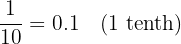





Place Value Examples
Sometimes you are given a decimal number and asked about the place values of its digits. Remember that the digits of the whole number part of a decimal number are arranged from right to left as units, tens, hundreds, thousands, ten thousands, and so on.
1. 35678
In the above number, 8 is a unit, 7 is tens, 6 is hundreds, 5 is thousands and 3 is ten thousand.
The above two examples show how to write the values of the digits of the whole numbers. The case is different for the decimal part of the number. The numbers after the decimal point are sequenced from left to right and are termed as tenths, hundredths, thousandths, ten-thousandths and so on. Consider the following set of numbers in decimal format.
2. 34.619
In the above number, 32 is the whole number part and 619 is the decimal part of the number. The place value of all the digits is as follows:
- The place value of 6 is tenths
- The place value of 1 hundredths
- The place value of 9 is thousands
- The place value of 4 is units
- The place value of 3 is tens
4. 157.543
In the above number, 157 is the whole number part, and 543 is the decimal part of the number. We will start with the decimal part from left to right. The place values of all the digits are as follows:
- The place value of 5 is tenths, that is, the first decimal place
- The place value of 4 is hundredths
- The place value of 3 is thousandths
Now, let us proceed to the whole number part.
- The place value of 7 is units
- The place value of 5 is tens
- The place value of 1 is hundreds
Rounding Decimals
The process of rounding decimals to the nearest integers is as follows:
- To round off a decimal number, you should know the place value up to which you want to round off the number.
- Once you know the place value, look at the digit immediately to the right of that place value.
- If the digit is smaller than 5, the previous digit remains unchanged.
- If the digit is greater than or equal to 5, increase the previous digit by 1.
You may be given the number of decimal places or specific place values in rounding questions. The following examples will help clarify the concept.
Since we need to round off the above number up to four decimal places, we will see the fifth decimal digit. The fifth digit is 5, which means that we will increase the fourth digit by one unit. The resultant decimal number up to four decimal places is 6.7815.
Practice Exercises
Write down the value of the digit 6 in each of the following numbers: (a) 46.3 (b) 5.162 (c) 0.006
(a) 6 units = 6 (b) 6 hundredths = 0.06 (c) 6 thousandths = 0.006
Write the number 'two hundred and three, and seven hundredths' as a decimal.
203.07
In the number 84.519, which digit is in the hundredths place?
1 (the digit 1 is in the hundredths place)
Write each decimal as a fraction in its simplest form: (a) 0.5 (b) 0.25 (c) 0.125
(a) 1/2 (b) 1/4 (c) 1/8
Convert each fraction to a decimal: (a) 9/10 (b) 37/100 (c) 3/1000
(a) 0.9 (b) 0.37 (c) 0.003
Round 3.4726 to: (a) 1 decimal place (b) 2 decimal places (c) 3 decimal places
(a) 3.5 (b) 3.47 (c) 3.473
Truncate 8.9963 to: (a) 1 decimal place (b) 2 decimal places
(a) 8.9 (b) 8.99
A runner's time is recorded as 10.8472 seconds. Round this to the nearest hundredth of a second.
10.85 seconds
Summarise with AI:
Did you like this article? Rate it!


 Loading...
what will be the answer when 12.345 is subtracted from 234.00 multiplied by 778.90 and divided by67.23
If we follow the order of operations (multiply and divide first, then subtract):
1. (234.00 \times 778.90 = 182,262.6)
2. (182,262.6 \div 67.23 \approx 2711.03)
3. (2711.03 – 12.345 \approx 2698.69)
**Final answer: ≈ 2,698.69**
If it is (0.0072÷6)
find the square root in decimal form of 6.7081
find the square root in decimal form of 6.7081
find the square root in decimal form of 6.7081
find the square root in decimal form of 6.7081
find the square root in decimal form of 6.7081
find the square root in decimal form of 6.7081
find the square root in decimal form of 6.7081
find the square root in decimal form of 6.7081
find the square root in decimal form of 6.7081
find the square root in decimal form of 6.7081
find the square root in decimal form of 6.7081
find the square root in decimal form of 6.7081
find the square root in decimal form of 6.7081
find the square root in decimal form of 6.7081
find the square root in decimal form of 6.7081
find the square root in decimal form of 6.7081
find the square root in decimal form of 6.7081
find the square root in decimal form of 6.7081
find the square root in decimal form of 6.7081
find the square root in decimal form of 6.7081
find the square root in decimal form of 6.7081
find the square root in decimal form of 6.7081
find the square root in decimal form of 6.7081