Not all decimal numbers behave in the same way. Some end after a few digits; others go on forever. Understanding the different types of decimal number is essential for GCSE Maths, as it underlies the distinction between rational and irrational numbers and the method for converting recurring decimals to fractions.
Prerequisite: This article assumes you are familiar with place value and the decimal point. For a reminder, see What Are Decimal Numbers?.


Overview: The Two Main Categories
| Type | Description | Examples |
|---|---|---|
| Terminating | Finite digits after the decimal point | 0.5, 3.14, 7.625 |
| Non-terminating recurring | Infinite digits, but a block repeats | 0.333..., 1.272727... |
| Non-terminating non-recurring | Infinite digits, no repeating pattern | pi = 3.14159..., sqrt(2) = 1.41421... |
Terminating Decimals
A terminating decimal is a number that has a finite number of digits after the decimal point.
It comes to an end — it doesn’t go on forever.
Examples:

All of these stop after a certain number of digits.
Worked Example
Convert the fraction seven-eighths into a decimal.
We divide 7 by 8:

The decimal ends after three places, so it is terminating.
Converting a recurring decimal to a fraction
The algebraic method uses the fact that multiplying by a power of 10 shifts the decimal by the length of the repeating block.
A terminating decimal has a finite number of digits after the decimal point. It comes to a definite end.
| Number | Note |
|---|---|
| 0.7 | 1 decimal place |
| 3.14 | 2 decimal places |
| 0.125 | 3 decimal places |
| 12.5000 | Trailing zeros do not change the value — this is still terminating |
Which fractions give terminating decimals?
A fraction in its lowest terms produces a terminating decimal if and only if the denominator has no prime factors other than 2 and 5.
| Fraction | Denominator factored | Decimal |
|---|---|---|
| 1/2 | Denominator 2 = 2¹ | 0.5 — terminating |
| 3/4 | Denominator 4 = 2² | 0.75 — terminating |
| 7/8 | Denominator 8 = 2³ | 0.875 — terminating |
| 1/5 | Denominator 5 = 5¹ | 0.2 — terminating |
| 3/20 | Denominator 20 = 2² × 5 | 0.15 — terminating |
| 1/3 | Denominator 3 (prime ≠ 2, 5) | 0.333... — recurring |
| 2/7 | Denominator 7 (prime ≠ 2, 5) | 0.285714... — recurring |
40 = 2^3 x 5. The denominator has only factors of 2 and 5, so 9/40 is a terminating decimal. Divide: 9 / 40 = 0.225 
Non-Terminating Recurring Decimals
A recurring decimal has an infinite number of digits after the decimal point, but a block of one or more digits repeats indefinitely in a fixed pattern. Because they can be expressed as fractions, recurring decimals are rational numbers.
A non-terminating decimal goes on forever — it has an infinite number of digits after the decimal point. A recurring decimal has an infinite number of digits after the decimal point, but a block of one or more digits repeats indefinitely in a fixed pattern. Because they can be expressed as fractions, recurring decimals are rational numbers.
Notation
A bar (vinculum) is placed over the repeating block:
| Written out | Bar notation | What repeats |
|---|---|---|
| 0.333... | 0.3̅ (bar over 3) | digit 3 repeats |
| 0.272727... | 0.2̅7̅ (bar over 27) | block 27 repeats |
| 1.416666... | 1.41̅6̅ (bar over 6 only) | mixed: 41 is non-repeating, then 6 repeats |
These are of two types:
- Recurring (Repeating)
- Non-Recurring (Non-Repeating)
Recurring Decimal Numbers
A recurring decimal has a set of digits that repeat indefinitely in a fixed pattern.
Examples:



The bar (overline) indicates the repeating digits.
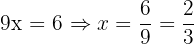
Worked Example 1 — Pure Recurring Decimal
Convert  into a fraction.
Let:

Multiply both sides by 10:

Subtract the first equation from this:


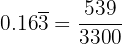
Worked Example 2 — Mixed Recurring Decimal
Convert  into a fraction.
Let:

Multiply by 1000 (to move the decimal just before the repeating part):

Multiply by 10 (for one repeat shift):

Subtract:



Non-Recurring Decimal Numbers (Irrational Numbers)
A non-terminating, non-recurring decimal has an infinite number of digits after the decimal point, and those digits never settle into a repeating pattern. These numbers cannot be written as fractions and are called irrational numbers.
| Number | Decimal expansion | Note |
|---|---|---|
 | 3.14159265358979... | The digits are known to trillions of places; no block repeats |
 | 1.41421356237... | Irrational — proved by contradiction |
 | 1.73205080757... | Irrational |
| e (Euler's number) | 2.71828182845... | Irrational |
is non-terminating and non-recurring. 1.41421356237... The digits continue without end, and no repeating block can be identified. A formal proof that is irrational (and therefore non-recurring) uses proof by contradiction: assume =  in lowest terms, then
  , which forces both p and q to be even — contradicting the assumption that p/q is in lowest terms.
Worked Examples
Convert 0.777... to a fraction.
Let x = 0.777...  Subtract:


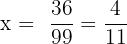
Convert 0.363636... to a fraction.
The repeating block (36) has 2 digits, so multiply by 100. Let x = 0.363636...  Subtract:

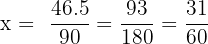
Convert 0.5166... (mixed recurring: 0.51666...) to a fraction.
The repeating block (6) has 1 digit. The non-repeating part (51) has 2 digits. Let x = 0.5166...  (shift past the non-repeating part)
  Subtract:

Rounding Decimal Numbers
Sometimes, we need to round decimals to a specific place value (e.g., 1 decimal place, 2 decimal places).
Rule:
- Identify the digit in the place value you’re rounding to.
- Look at the next digit (to the right): If it’s 5 or more, round up; if it’s less than 5, leave it.
Worked Example
Round 567.81456 to 3 decimal places:
The value in the 3rd decimal place position is 4. The next digit is 5, so we round up, taking the previous digit from 4 → 5.
Final answer: 567.815
Summary
Decimal numbers express whole and fractional parts using a decimal point. They can be terminating, recurring, or non-recurring. Terminating and recurring decimals are rational, while non-recurring decimals are irrational. Recognising these types helps in understanding number patterns, rounding, and fraction conversions.
Practice Exercises
Classify each of the following as terminating (T), recurring (R), or non-recurring irrational (I):
(a) 0.625
(b) 0.142857142857...
(c) 0.08
(d) 3.141592653...
(a) T — 0.625 terminates
(b) R — block 142857 repeats (= 1/7)
(c) T — 0.08 terminates
(d) I — pi is irrational
Without dividing, determine whether each fraction produces a terminating or recurring decimal:
(a) 7/16
(b) 5/12
(c) 11/25
(d) 3/14
(a)  : terminating
(b)  : recurring (factor of 3)
(c)  : terminating
(d)  : recurring (factor of 7)
Convert 0.888... to a fraction in its simplest form.
Let x = 0.888... → 10x = 8.888... → 9x = 8 → x = 8/9
Convert 0.454545... to a fraction in its simplest form.
Let x = 0.454545... → 100x = 45.454545... → 99x = 45 → x = 45/99 = 5/11
Convert 0.1333... (i.e. 0.13̅ — the 3 repeats, the 1 does not) to a fraction.
Let x = 0.1333... 10x = 1.333... 100x = 13.333... 100x - 10x = 13.333... - 1.333... → 90x = 12 → x = 12/90 = 2/15
A student claims that 0.9999... is not equal to 1. Use the algebraic method to show that 0.999... = 1.
Let x = 0.9999... → 10x = 9.9999... → 10x - x = 9 → 9x = 9 → x = 1. Therefore 0.999... = 1.
Summarise with AI:
Did you like this article? Rate it!


 Loading...
what will be the answer when 12.345 is subtracted from 234.00 multiplied by 778.90 and divided by67.23
If we follow the order of operations (multiply and divide first, then subtract):
1. (234.00 \times 778.90 = 182,262.6)
2. (182,262.6 \div 67.23 \approx 2711.03)
3. (2711.03 – 12.345 \approx 2698.69)
**Final answer: ≈ 2,698.69**
If it is (0.0072÷6)
find the square root in decimal form of 6.7081
find the square root in decimal form of 6.7081
find the square root in decimal form of 6.7081
find the square root in decimal form of 6.7081
find the square root in decimal form of 6.7081
find the square root in decimal form of 6.7081
find the square root in decimal form of 6.7081
find the square root in decimal form of 6.7081
find the square root in decimal form of 6.7081
find the square root in decimal form of 6.7081
find the square root in decimal form of 6.7081
find the square root in decimal form of 6.7081
find the square root in decimal form of 6.7081
find the square root in decimal form of 6.7081
find the square root in decimal form of 6.7081
find the square root in decimal form of 6.7081
find the square root in decimal form of 6.7081
find the square root in decimal form of 6.7081
find the square root in decimal form of 6.7081
find the square root in decimal form of 6.7081
find the square root in decimal form of 6.7081
find the square root in decimal form of 6.7081
find the square root in decimal form of 6.7081