The square root of a number x is a value y such that when multiplied by itself, it produces the original number:
Calculating the square root of a decimal number without a calculator relies on converting the decimal into a fraction or using power-of-ten index laws.
1. The Fraction Conversion Method
The most reliable non-calculator method for finding the square root of a terminating decimal is to write it as an equivalent common fraction whose denominator is a power of 10:
Because the square root of a quotient equals the quotient of the square roots:
- Convert to a fraction: Count the decimal places. If there are 2 decimal places, write over 100; if 4 decimal places, write over 10,000; if 6 decimal places, write over 1,000,000.
- Take the square root of the numerator and denominator independently.
- Convert back to a decimal by dividing by the power of 10.
2. The Decimal Place Halving Rule
When squaring a decimal, the number of decimal places doubles:
Conversely, when taking the square root of a perfect square decimal:
The Even Decimal Place Rule:
A decimal can only have an exact rational terminating square root if it has an even number of decimal places (2, 4, 6, etc.) and its integer digits form a perfect square.
3. Odd Decimal Places and Surd Representation
If a decimal has an odd number of decimal places, its square root is an irrational surd rather than a terminating decimal:
Notice that 2, because , not .


Practice Questions & Solutions
Calculate the exact value of:
(a) 
(b) 
(a) Evaluate
Step 1: Convert the decimal to a fraction with a denominator of 100

Step 2: Apply the square root to numerator and denominator

Step 3: Convert back to decimal form

(b) Evaluate
Step 1: Convert the decimal to a fraction with a denominator of 10,000
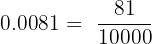
Step 2: Take the square root of numerator and denominator
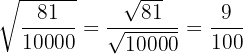
Step 3: Convert back to decimal form

Evaluate the square roots:
(a) 
(b) 
(a) Evaluate
Step 1: Convert to an improper fraction
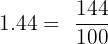
Step 2: Take the square root of numerator and denominator

Step 3: Convert back to decimal form

(b) Evaluate
Step 1: Convert to an improper fraction
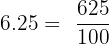
Step 2: Take the square root of numerator and denominator
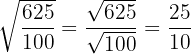
Step 3: Convert back to decimal form

Find the exact values of:
(a) 
(b) 
(a) Evaluate
Step 1: Convert to a fraction with 4 decimal places
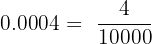
Step 2: Apply the square root
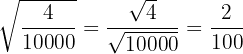
Step 3: Convert to decimal form

(b) Evaluate
Step 1: Convert to a fraction with 6 decimal places
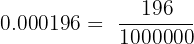
Step 2: Apply the square root

Step 3: Convert to decimal form
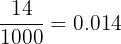
Evaluate the numerical expression:

Evaluate
Step 1: Evaluate each individual square root


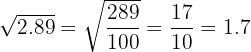
Step 2: Substitute the evaluated roots into the expression

Step 3: Carry out multiplications



Step 4: Combine the terms

Write  in the simplified surd form
 , where a and b are integers.
Simplify into surd form
Step 1: Write as a fraction

Step 2: Distribute the square root

Step 3: Rationalise the denominator by multiplying by 

A square tile has an area of  . Calculate the perimeter of the tile.
Step 1: Find the side length s of the square
The area of a square is  :
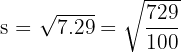
Since  :

Step 2: Calculate the perimeter

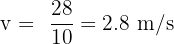
Under uniform acceleration from rest, final speed is given by  .
Calculate the exact value of  when
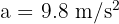 and
 .
Step 1: Calculate the value inside the radical



Step 2: Evaluate the square root of 7.84
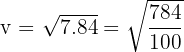
Since  :
The area of one square face of a solid cube is  .
(a) Find the edge length of the cube in metres.
(b) Calculate the total surface area across all six faces of the cube.
(c) Calculate the volume of the cube, writing your answer in standard form  .
(a) Find the Edge Length of the Cube
The area of a square face is given by  , where s represents the edge length.
Step 1: Convert the decimal into a fraction with a denominator of 10,000

Step 2: Apply the square root to numerator and denominator
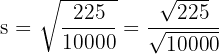
Since  and
 :

The edge length of the cube is  .
(b) Calculate the Total Surface Area
A cube consists of six identical square faces:

Substitute the face area  :


The total surface area is  .
(c) Calculate the Volume of the Cube
The formula for the volume of a cube is  :

Calculate using fractions or powers of 15:


Convert into standard scientific form , where  :
Move the decimal point 3 places to the right:

Evaluate the exact value of:

Evaluate
Step 1: Simplify the decimal fraction inside the square root
Multiply numerator and denominator by 10 to clear the denominator's decimal:

Step 2: Take the square root of 0.36

Evaluate the following expression, giving your answer in standard scientific form :

Evaluate
Step 1: Separate the numerical factor and the power of ten

Step 2: Evaluate the square root of each component

Using index laws 
Step 3: Combine in standard scientific notation

(In standard decimal notation:  ).
Summarise with AI:
Did you like this article? Rate it!


 Loading...
what will be the answer when 12.345 is subtracted from 234.00 multiplied by 778.90 and divided by67.23
If we follow the order of operations (multiply and divide first, then subtract):
1. (234.00 \times 778.90 = 182,262.6)
2. (182,262.6 \div 67.23 \approx 2711.03)
3. (2711.03 – 12.345 \approx 2698.69)
**Final answer: ≈ 2,698.69**
If it is (0.0072÷6)
find the square root in decimal form of 6.7081
find the square root in decimal form of 6.7081
find the square root in decimal form of 6.7081
find the square root in decimal form of 6.7081
find the square root in decimal form of 6.7081
find the square root in decimal form of 6.7081
find the square root in decimal form of 6.7081
find the square root in decimal form of 6.7081
find the square root in decimal form of 6.7081
find the square root in decimal form of 6.7081
find the square root in decimal form of 6.7081
find the square root in decimal form of 6.7081
find the square root in decimal form of 6.7081
find the square root in decimal form of 6.7081
find the square root in decimal form of 6.7081
find the square root in decimal form of 6.7081
find the square root in decimal form of 6.7081
find the square root in decimal form of 6.7081
find the square root in decimal form of 6.7081
find the square root in decimal form of 6.7081
find the square root in decimal form of 6.7081
find the square root in decimal form of 6.7081
find the square root in decimal form of 6.7081