Shakespearean language can be an incredible challenge for people. Literature has changed a lot, much of this owing to Shakespeare himself. For instance, hundreds of words in the English language have come from the pioneers.
The Bard’s skilful manipulation of language in the play helps to build atmosphere, develop characters, and convey themes. This guide will delve into the different ways Shakespeare uses language to great effect in The Tempest.




Magical and Poetic Language
Shakespere’s plays use a lot of magical themes, and the language often represents this. Prospero, the central character in The Tempest, wields his power through both magic and language.
His speeches often blend commands with incantations, creating a sense of his mystical authority. For example, in Act V, Scene 1, Prospero’s lines:
Ye elves of hills, brooks, standing lakes and groves,
And ye that on the sands with printless foot
Do chase the ebbing Neptune, and do fly him
When he comes back...
This passage showcases the poetic and rhythmic quality of Prospero’s language, which underscores his command over the natural elements and his role as a powerful sorcerer. The use of vivid imagery and personification here enhances the magical ambiance of the play, and he harks to the god of Neptune.
Comic Relief and Language
When you are analysing The Tempest for your GCSEs, make sure you don’t forget the fact that it has comic elements. A lot of people fail to mention this!
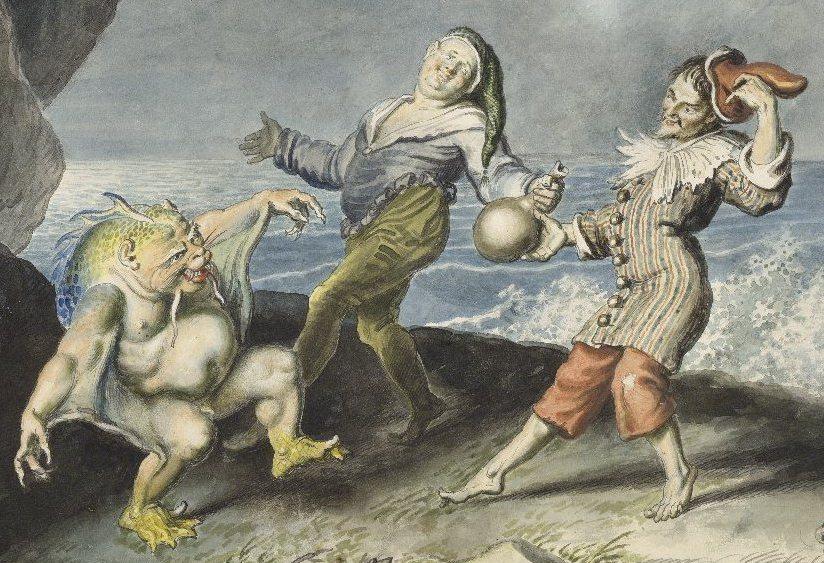
Shakespeare’s use of certain characters allow him to introduce this comic relief, particularly through the characters of Stephano and Trinculo. Their drunken antics and humorous dialogue provide a contrast to the more serious themes of the play. For example, in Act II, Scene 2, Trinculo’s humorous observation about Caliban:
What have we here? a man or a fish? dead or alive? A fish: he smells like a fish; a very ancient and fish-like smell…
The use of wordplay, puns, and in this case, a silly slapstick image in their interactions adds levity to the play and showcases Shakespeare’s mastery of language in creating humour.
Formal Speech of the Nobles
The language of the shipwrecked nobles, such as Alonso, Sebastian, and Antonio, tends to be more formal than the other characters. Their speech reflects their status and the political themes at the heart of the play.
For example, in Act II, Scene 1, Gonzalo’s idealisticvision of a utopian society contrasts with Antonio and Sebastian’s cynical and conspiratorial dialogue. This juxtaposition highlights the themes of power and ambition, as well as the moral contrasts between characters.
'I' th' commonwealth I would by contraries / Execute all things; for no kind of traffic / Would I admit; no name of magistrate;'
Soliloquies
“Soliloquy; an act of speaking one's thoughts aloud when by oneself or regardless of any hearers, especially by a character in a play.”
Shakespeare uses soliloquies and asides in The Tempest to provide insight into characters’ inner thoughts and motivations. This is something that is a theme across all of Shakespeare’s work, and it helps him to get the message across and showcase some of the characters’ otherwise private thinking.
Caliban’s Raw and Curse-Filled Language
Caliban’s language contrasts sharply with that of Prospero and Ariel, reflecting his connection to the earth and his status as the island’s native inhabitant.
Caliban's speeches are often coarse and filled with curses, as seen in Act I, Scene 2:
You taught me language; and my profit on't
Is, I know how to curse. The red plague rid you
For learning me your language!
Caliban’s speech here highlights his resentment and anger towards Prospero for colonising the island and enslaving him. The roughness of his language underscores his raw, untamed nature and his deep connection to the island’s primal forces.
Despite his harsh words, Caliban also delivers some of the play’s most beautiful and poetic lines, revealing a complex character capable of appreciating the island’s beauty.
Metaphor
The Tempest itself seems to be a metaphor for the emotional and political upheaval experienced by the characters. It represents the chaos of the natural world that mirrors the turmoil within the human world. The storm disrupts the established order, just as Prospero seeks to reorder and restore his position.
The relationships between Prospero, Ariel, and Caliban are rife with metaphors of slavery and freedom.
One of the most profound metaphors in the play is the comparison of life to a dream, highlighting the theme of illusion versus reality. Prospero’s famous speech in Act IV, Scene 1, reflects this:
We are such stuff
As dreams are made on; and our little life
Is rounded with a sleep.
Rhyme
Much of The Tempest is written in iambic pentameter, a rhythmic pattern consisting of ten syllables per line, with an unstressed syllable followed by a stressed syllable (da-DUM da-DUM da-DUM da-DUM da-DUM). This is the most common metre in Shakespeare’s plays, often used in blank verse (unrhymed iambic pentameter).
The use of rhyme helps with the flow and performative elements of the play. Rhyme and rhythm are crucial in establishing the play’s mystical and dreamlike atmosphere. The rhythmic variations and the use of rhymed verse in Ariel’s songs, for instance, contribute to the enchantment and magic of the island.
Conclusion
Using poetic and magical language, Shakespeare builds the mystical world of the island. The varied speech patterns of characters like Prospero, Ariel, Caliban, and the nobles reveal their unique personalities and social standings.
Soliloquies and asides provide deep insights into the characters’ motivations and themes of the play, while comic relief and wordplay offer entertainment and a break from the drama’s intensity. There’s a lot to unpack when it comes to the language used in The Tempest!
What could the island be seen as a metaphor for?
How does Shakespeare differentiate the characters using language?
Summarise with AI:
Did you like this article? Rate it!

 Loading...