In A-Level Chemistry, we refine our understanding of the atom by moving from simple circles to Principal Quantum Shells. These are specific energy levels where electrons exist. This article explores how we know these shells exist through light and energy measurements.









Evidence from Light: Emission Spectra
If you provide an atom with energy (like heat or electricity), its electrons can "jump" from a lower energy level to a higher one. This is absorption. However, electrons are unstable at high levels and eventually fall back down, releasing that energy as light. This is emission.
The Line Spectrum
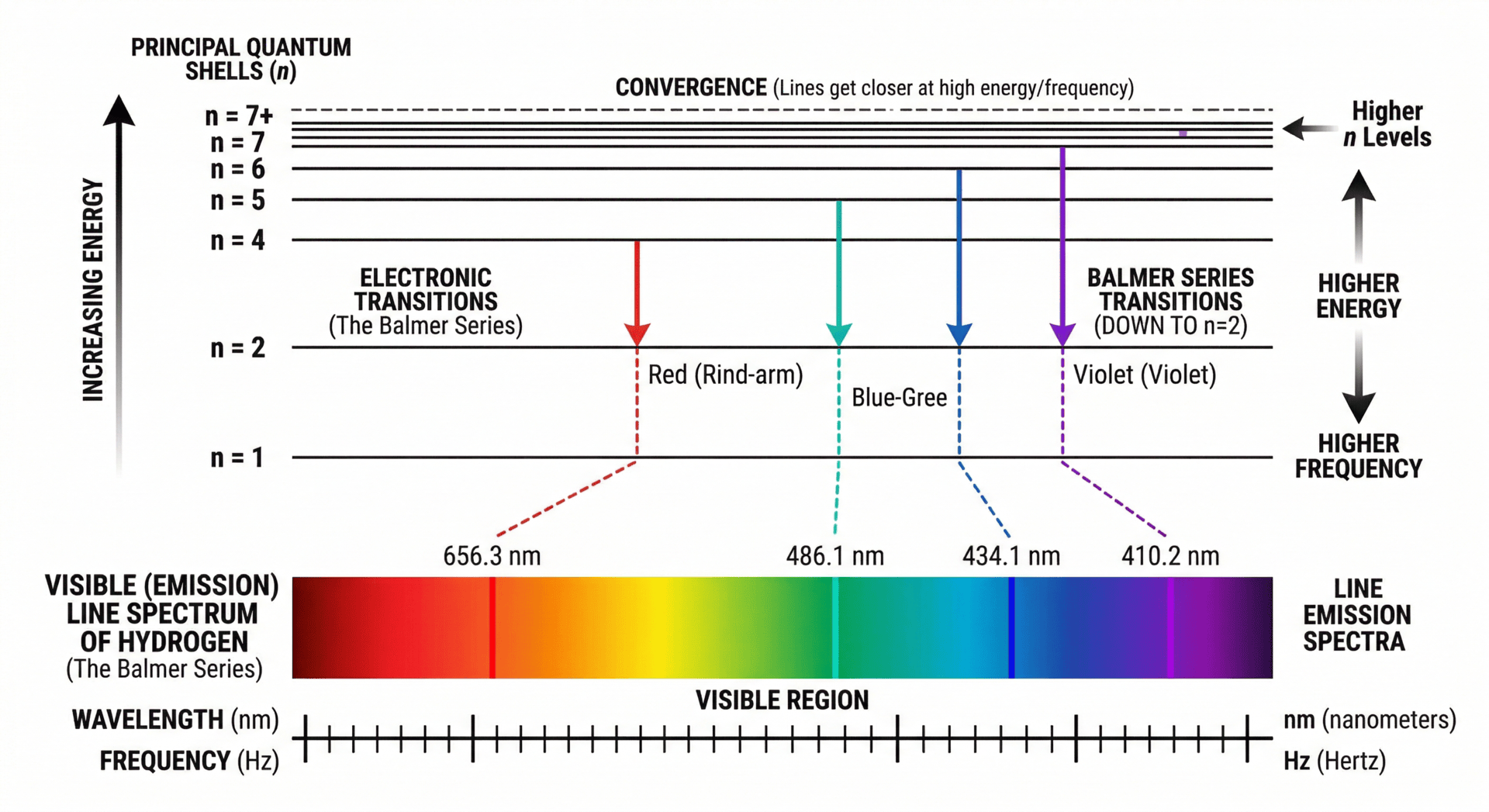
When the light emitted by an element like Hydrogen is passed through a diffraction grating, it creates a line emission spectrum rather than a continuous rainbow.
- Quantisation: Each line represents a specific frequency of light, which corresponds to a specific "packet" of energy called a quantum.
- Discrete Levels: The fact that we see lines instead of a continuous blur proves that electrons can only exist in fixed energy levels. They cannot exist "between" shells.
- Convergence: Notice that the lines get closer together at higher frequencies (the blue/violet end). This is called convergence. It happens because the energy gaps between the principal quantum shells decrease as you move further from the nucleus. Eventually, the lines merge at a limit that corresponds to the ionisation energy of the atom.
The Balmer Series: The visible lines in the hydrogen spectrum specifically represent electrons falling from higher shells down to the n = 2 shell.
Evidence from Energy: Successive Ionisation Energies
Ionisation energy (IE) is the energy required to remove one mole of electrons from one mole of gaseous atoms. By looking at successive ionisation energies—removing electrons one by one from the same atom—we find a "map" of the shells.
Reading the IE Graph
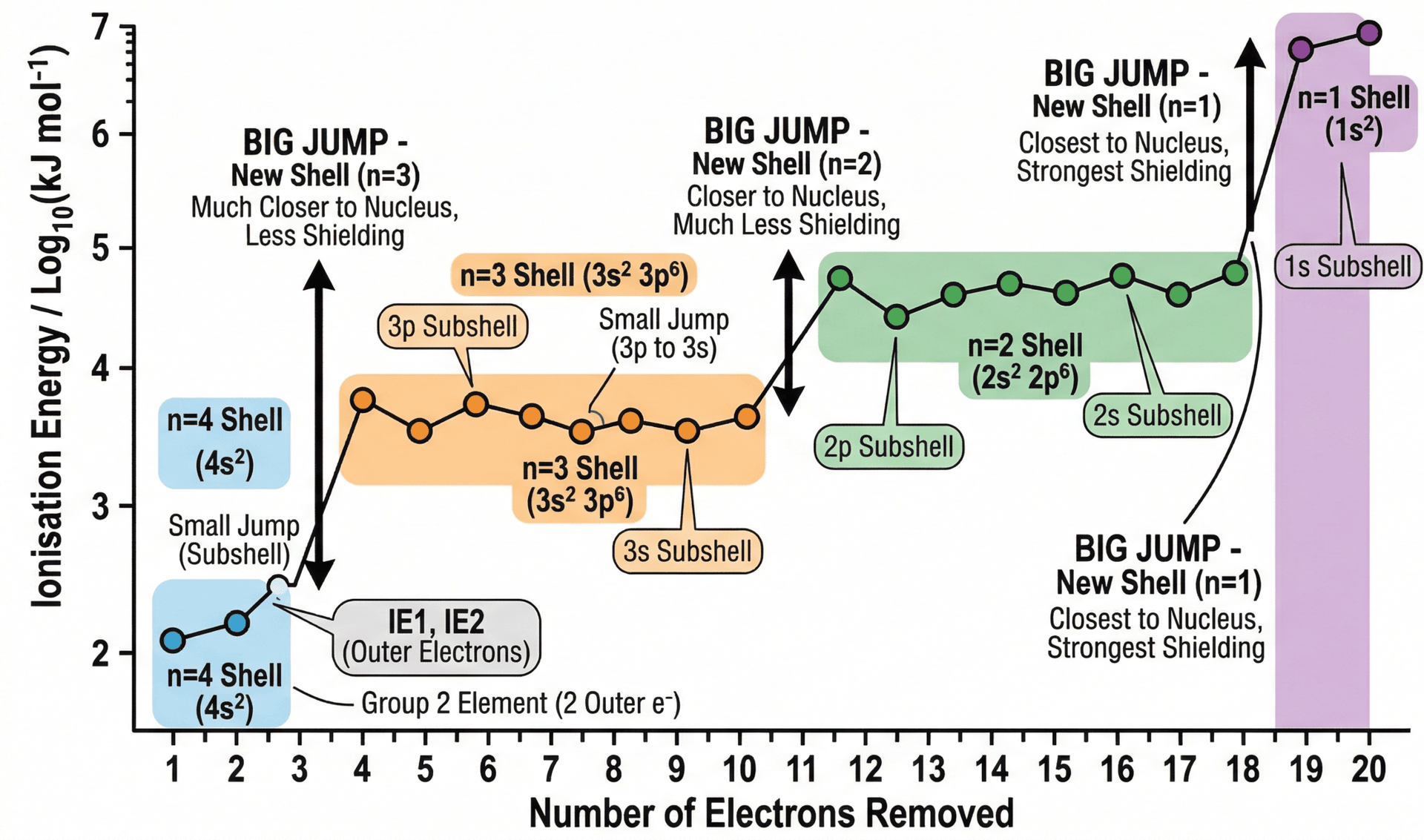
If we plot the log of ionisation energy against the number of electrons removed (e.g., for Calcium), we see distinct patterns:
- The Big Jumps: A massive increase in energy indicates that the electron is being removed from a new principal quantum shell that is closer to the nucleus and experiences less shielding.
- The Small Jumps: Smaller increases within a group of electrons indicate a change in subshell (moving from a p-subshell to an s-subshell).
- General Increase: Even within the same subshell, IE increases slightly with each removal because you are removing a negative electron from an increasingly positive ion, resulting in a stronger nuclear pull.
Organising the Shells
Principal quantum shells are identified by the Principal Quantum Number (n). The lower the value of n, the closer the shell is to the nucleus and the lower its energy.
Maximum Electron Capacity
Each shell has a fixed limit on how many electrons it can hold, calculated by the formula 2n²:
| Principal Quantum Number (n) | Maximum Electrons (2n²) |
|---|---|
| n = 1 (First shell) | 2 |
| n = 2 (Second shell) | 8 |
| n = 3 (Third shell) | 18 |
| n = 4 (Fourth shell) | 32 |
Exam Focus: Common Pitfalls
- Mistaking the Balmer Series: Remember that for Hydrogen, the visible lines represent jumps to n = 2, not n = 1 (jumps to n = 1 fall into the UV range).
- Shielding and IE: When explaining a "Big Jump" in ionisation energy, you must mention that the new shell is closer to the nucleus and experiences less shielding.
- Logarithmic Scales: Successive IE graphs often use a "log 10" scale on the y-axis because the jump in energy between shells is so vast it wouldn't fit on a standard linear graph.
Related Articles:
Continue your A-Level Chemistry Revision with the following articles:
- Physical Chemistry: Ionisation Energy
- Physical Chemistry: Atomic Orbitals
- Physical Chemistry: Electronic Configuration
Summarise with AI:
Did you like this article? Rate it!

 Loading...