Electronic configuration is the map of where electrons live within an atom. In A-Level Chemistry, moving beyond the simple "2,8,8" model from GCSE is essential. Understanding how electrons occupy specific subshells and orbitals allows us to predict how elements will react, their magnetic properties, and their position in the Periodic Table.









Structure of the Electron Cloud
Electrons are not just in "shells"; they are organized into a hierarchy of levels, subshells, and orbitals.
Principal Quantum Shells
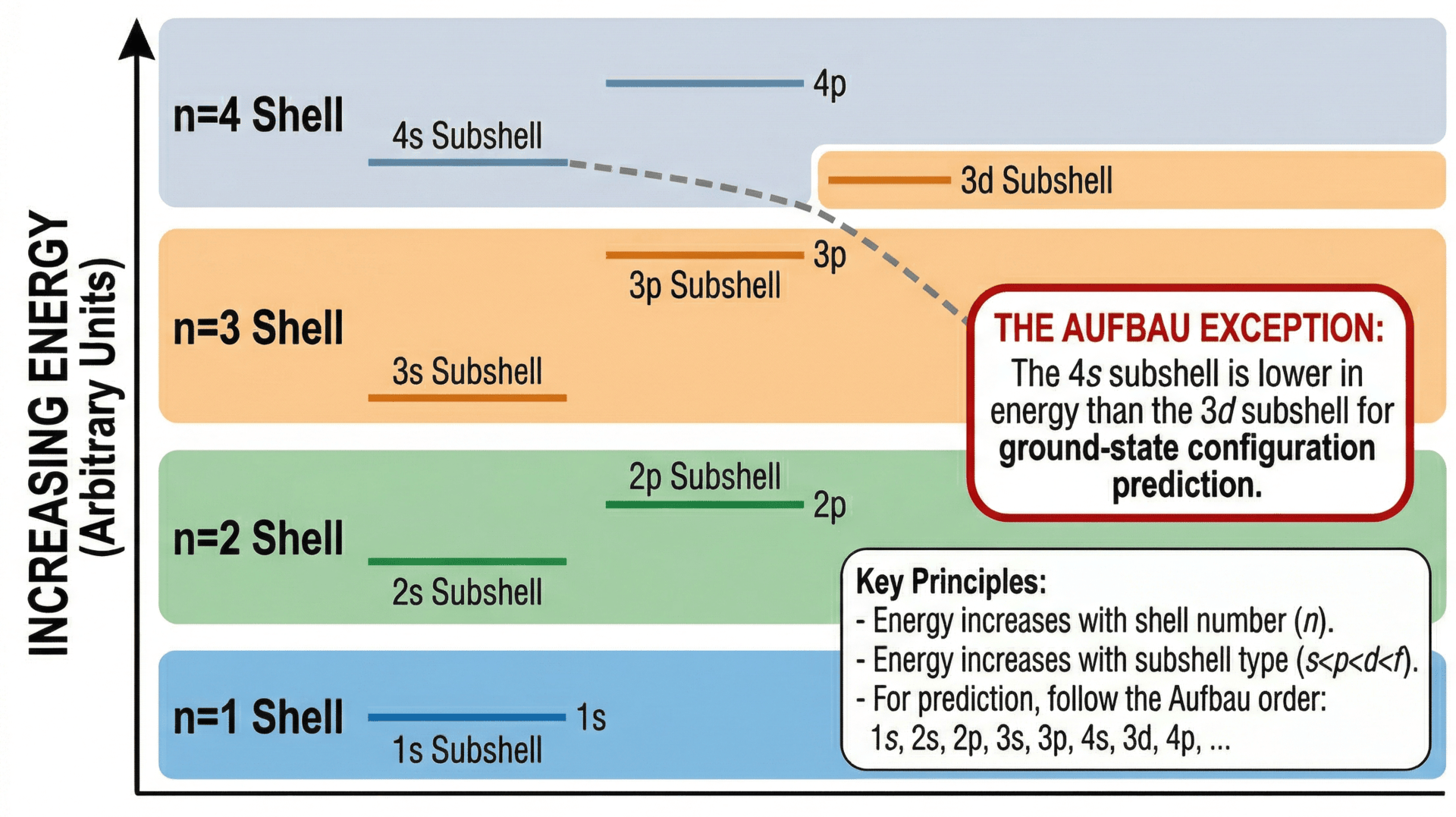
The Principal Quantum Number (n) represents the main energy level of an electron. As n increases, the distance from the nucleus and the energy of the shell increase.
- n = 1 is the lowest energy level, closest to the nucleus.
- n = 4 is higher in energy than n = 2.
Subshells and Orbitals
Each shell is divided into subshells (s, p, and d). Each subshell contains a specific number of orbitals, which are regions of space where there is a high probability of finding an electron.
| Subshell | Number of Orbitals | Max Electrons | Relative Energy |
|---|---|---|---|
| s | 1 | 2 | Lowest |
| p | 3 | 6 | Low |
| d | 5 | 10 | High |
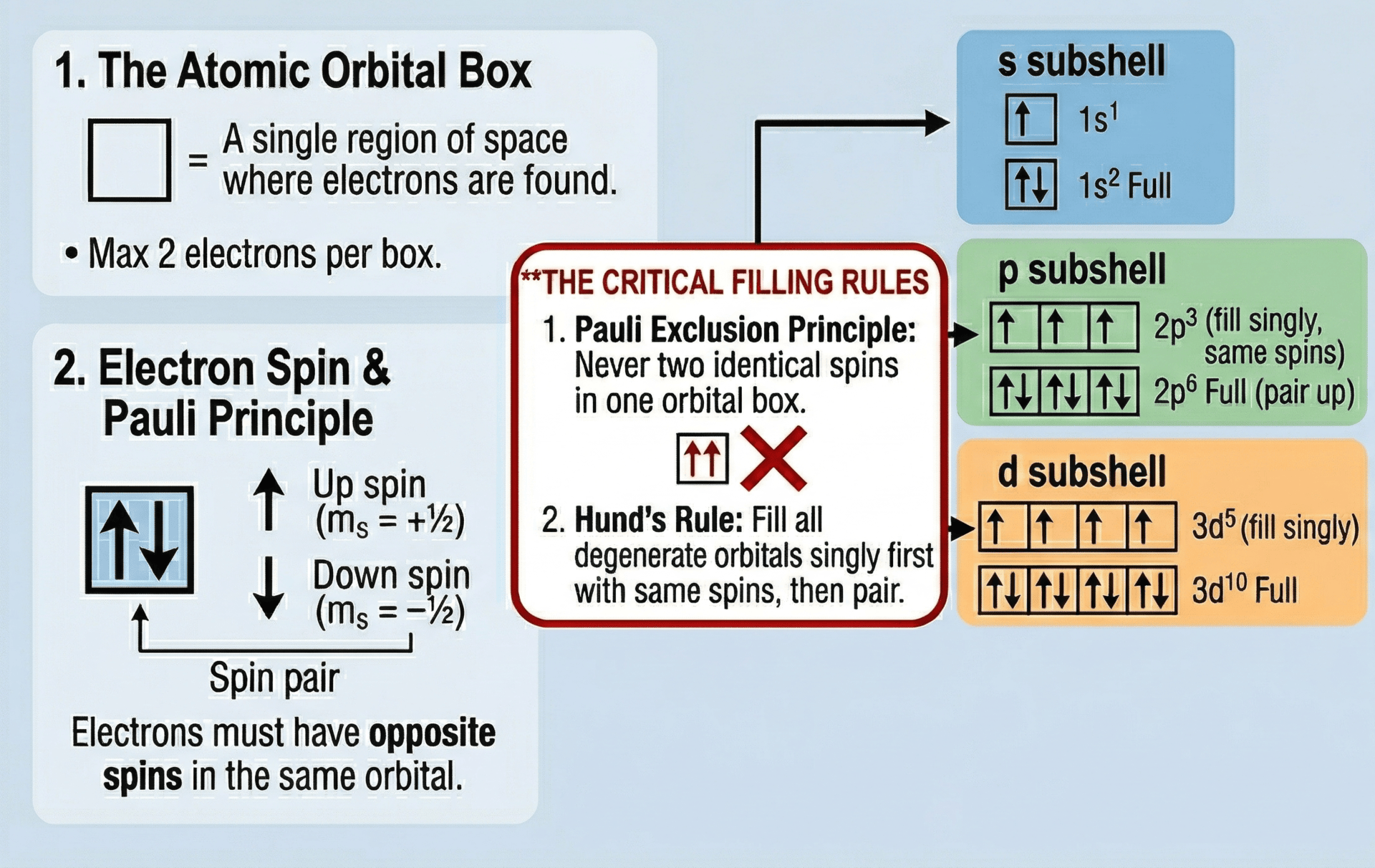
Degenerate Orbitals: Orbitals within the same subshell (e.g., the three 2p orbitals) have the exact same energy level.
Rules for Filling Orbitals
To determine the configuration of an atom, we follow three fundamental principles:
The Aufbau Principle
Electrons occupy the lowest energy orbitals first.
- The 4s Exception: Usually, subshells fill in numerical order. However, the 4s subshell is lower in energy than the 3d subshell. Therefore, 4s fills before 3d begins.
Hund’s Rule (The "Bus Seat" Rule)
Electrons prefer to occupy orbitals singly before pairing up. This minimizes spin-pair repulsion between the negatively charged electrons.
- If you have three electrons in a p subshell, one will go into p(x), one into p(y), and one into p(z).
The Pauli Exclusion Principle
Two electrons in the same orbital must have opposite spins, represented by upward and downward arrows in "electrons in boxes" notation.
Writing Configurations & Box Notation
Full Configuration
This lists every occupied subshell and the number of electrons it contains.
- Hydrogen (1 electron): 1s¹
- Sodium (11 electrons): 1s² 2s² 2p⁶ 3s¹
Shorthand (Noble Gas) Configuration
We use the symbol of the previous Noble Gas to represent the "core" electrons, focusing only on the outer shell.
- Calcium (20 electrons): [Ar] 4s²
- Gallium (31 electrons): [Ar] 3d¹⁰ 4s² 4p¹
- Note: While 4s fills first, we often write 3d before 4s in the final string to keep principal quantum numbers (n=3) grouped together.
Configurations of Ions
Ions form when atoms gain or lose electrons.
- Anions (Negative): Electrons are added to the next available orbital.
- Cations (Positive): Electrons are removed from the highest energy level.
The Transition Metal Rule
Transition metals fill the 4s orbital before 3d, but they lose 4s electrons first when forming ions.
- Iron (Fe): [Ar] 3d⁶ 4s²
- Iron (II) Ion (Fe²⁺): [Ar] 3d⁶ (The 4s electrons are removed before the 3d electrons).
Stability Exceptions: Chromium and Copper
Chromium and Copper do not follow the standard Aufbau rules because a half-filled or fully-filled d-subshell provides extra stability.
- Chromium (Cr): [Ar] 3d⁵ 4s¹ (instead of 3d⁴ 4s²)
- Copper (Cu): [Ar] 3d¹⁰ 4s¹ (instead of 3d⁹ 4s²)
Exam Focus: Common Pitfalls
- Pitfall 1: Filling 3d before 4s. Always remember that 4s is lower in energy for neutral atoms.
- Pitfall 2: Removing 3d electrons before 4s when forming transition metal ions. Always empty 4s first.
- Pitfall 3: Drawing arrows in the same direction within a single box. Spins must be opposite.
Related Articles:
Continue your A-Level Chemistry Revision with the below articles:
- Physical Chemistry: Ionisation Energy
- Physical Chemistry: Atomic Orbitals
- Physical Chemistry: Quantum Shells
Summarise with AI:
Did you like this article? Rate it!

 Loading...