


Key Concepts and Definitions
1. The 3D Straight Line
In 3D geometry, a line is a one-dimensional path that extends infinitely. Unlike 2D geometry, a line in 3D requires three coordinates (x, y, z) to describe any point on it. It is often defined by a point it passes through and a direction vector (v) that tells us its orientation.
2. The Plane
A plane is a flat, two-dimensional surface that extends infinitely in 3D space with no thickness. A plane is defined by a normal vector (n), which is a line that stands perfectly perpendicular (at 90°) to every single line resting on that plane.
3. Orthogonal Projection
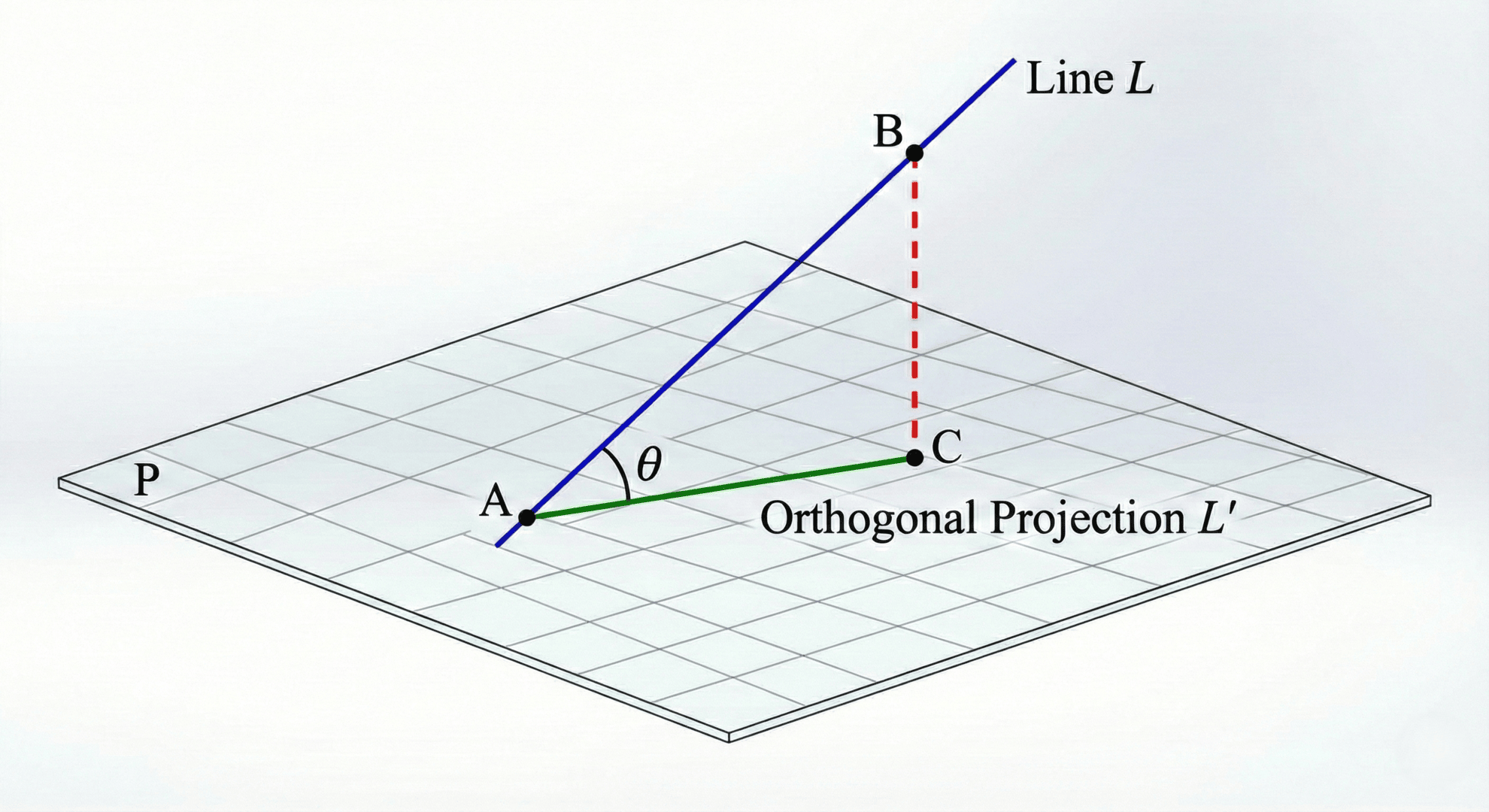
Imagine holding a flashlight directly above a slanted stick so that the light shines straight down onto the floor. The shadow the stick casts on the floor is its orthogonal projection. In geometry, this is the line on the plane that sits directly "underneath" our original line.
4. Angle Between a Line and a Plane
The angle between a line and a plane (θ) is officially defined as the angle between the line and its orthogonal projection on that plane.
- If the line is parallel to the plane, the angle is 0°.
- If the line is perpendicular to the plane, the angle is 90°.
How to Calculate the Angle
There are two primary methods depending on whether you are working with a geometric shape (like a cuboid) or coordinate vectors.
Method A: The Geometric Method (SOHCAHTOA)
In 3D shapes, you can often form a right-angled triangle where:
- The hypotenuse is the line itself.
- The adjacent side is the orthogonal projection.
- The opposite side is the vertical height from the line to the plane.
Using sin(θ) = Opposite / Hypotenuse is the most common way to find the angle.
Method B: The Vector Method
If you have the direction vector of the line (v) and the normal vector of the plane (n), the angle θ is found using:
sin θ = |v · n| / (|v| |n|)
Note: We use sine here instead of the usual cosine used for two lines because the normal vector is already at 90° to the plane. The calculation actually finds the complement of the angle.
Practice Questions & Solutions
A cuboid has dimensions 3 cm by 4 cm by 12 cm. Calculate the angle between the long diagonal of the cuboid and its base.
1. Find the base diagonal (d): Using Pythagoras on the 3 cm and 4 cm sides: d = √(3² + 4²) = 5 cm.
2. Identify the triangle: The long diagonal, the base diagonal (5 cm), and the vertical height (12 cm) form a right-angled triangle.
3. Apply trigonometry: tan(θ) = Opposite / Adjacent = 12 / 5 = 2.4.
4. Calculate the angle: θ = arctan(2.4) ≈ 67.4°.
A square-based pyramid has a base side of 10 m and a vertical height of 12 m. Calculate the angle between one of the slant edges and the base.
1. Find the full base diagonal: √(10² + 10²) = 10√2 m.
2. Find the distance to the center: The distance from a corner to the center of the base (directly under the apex) is half the diagonal: (10√2) / 2 = 5√2 ≈ 7.07 m.
3. Identify the triangle: We have a right triangle with a height of 12 m and a base of 7.07 m.
4. Apply trigonometry: tan(θ) = 12 / 7.07 ≈ 1.697.
5. Calculate the angle: θ = arctan(1.697) ≈ 59.5°.
Find the angle between the line r = (2i - j + 3k) + λ(3i + 4j + k) and the plane 2x - y + z = 5.
1. Extract vectors: Direction vector of the line v = (3, 4, 1). Normal vector of the plane n = (2, -1, 1).
2. Dot product (v · n): (3 × 2) + (4 × -1) + (1 × 1) = 6 - 4 + 1 = 3.
3. Magnitudes: |v| = √(3² + 4² + 1²) = √26. |n| = √(2² + (-1)² + 1²) = √6.
4. Apply the vector formula: sin(θ) = |v · n| / (|v| |n|) = 3 / (√26 × √6) ≈ 0.24.
5. Calculate the angle: θ = arcsin(0.24) ≈ 13.9°.
In a triangular prism, a line segment connects a top vertex to the midpoint of the opposite bottom edge. If the vertical height is 5 cm and the horizontal distance to that midpoint is 12 cm, find the angle of inclination to the base.
1. Identify the triangle components: The "Opposite" side is the height (5 cm) and the "Adjacent" side is the horizontal distance (12 cm).
2. Apply trigonometry: tan(θ) = 5 / 12 ≈ 0.4167.
3. Calculate the angle: θ = arctan(0.4167) ≈ 22.6°.
Determine the angle between the x-axis and the plane x + y + z = 10.
1. Extract vectors: The x-axis direction vector is v = (1, 0, 0). The plane's normal vector is n = (1, 1, 1).
2. Dot product: (1 × 1) + (0 × 1) + (0 × 1) = 1.
3. Magnitudes: |v| = 1. |n| = √(1² + 1² + 1²) = √3.
4. Apply formula: sin(θ) = 1 / (1 × √3) ≈ 0.577.
5. Calculate the angle: θ = arcsin(0.577) ≈ 35.3°.
Summarise with AI:
Did you like this article? Rate it!


 Loading...
I WANT TO CONTINUE WITH SOLVED PROBLEMS OF APPLICATION OF CROSS PRODUCTS OF VECTORS