


Introduction
Solving two equations at once can often feel like a puzzle with too many moving parts. In algebra, this is known as a system of linear equations. While there are several ways to find where two lines meet, the elimination method is frequently the most direct and efficient strategy.
By strategically adding or subtracting equations, we can "cancel out" one variable, allowing us to solve for the other with ease. This guide will walk you through the logic behind the method, provide a clear roadmap for solving any problem, and offer plenty of original practice to sharpen your skills for your GCSE or A-Level exams.
Theory: Understanding Elimination
The goal of the elimination method is to create a single equation with only one variable. This is achieved by ensuring the coefficients (the numbers multiplying the variables) of either x or y are identical or exact opposites.
When to Choose Elimination
The elimination method is most effective when:
- Both equations are presented in the form ax + by = c.
- The coefficients of one variable are already the same.
- One coefficient is a simple multiple of the corresponding coefficient in the other equation.
The Standard Procedure
- Step 1: Align the Equations - Ensure both equations are in the same standard form so that the variables and constants are lined up vertically.
- Step 2: Balance the Coefficients - If the coefficients do not match, multiply one or both equations by a constant value.
- Step 3: Eliminate a Variable -
- If the matching coefficients have different signs, add the equations.
- If the matching coefficients have the same sign, subtract one equation from the other.
- Step 4: Solve and Substitute - Solve the resulting equation for the remaining variable, then plug that value back into one of the original equations to find the second variable.
- Step 5: Verify - Always check your final answers in the equation you didn't use for substitution to ensure accuracy.
Method Comparison
The following data highlights which method to prioritize based on the equation structure:
| Equation Structure | Recommended Method | Efficiency |
|---|---|---|
| Both in ax + by = c form | Elimination | High |
| One variable is isolated (e.g. y = 2x + 3) | Substitution | High |
| Large or fractional coefficients | Elimination | Medium |
| Visualising the intersection point | Graphing | Low |
Worked Example: A Step-by-Step Walkthrough
Solve the following simultaneous equations:
Equation 1:
Equation 2:
1. Match the coefficients: To eliminate y, we look at the coefficients.
Equation 1 has +3. Equation 2 has -1.
We can multiply Equation 2 by 3 to give:
2. Add the equations: Now we add Equation 1 and the New Equation 2 to eliminate the y variable:
3. Solve for x: Divide both sides by 10:
4. Substitute to find y: Substitute x = 4 into the original Equation 2:
Final Solution: x = 4, y = 3
The Distributive Property: When multiplying an equation by a constant, ensure you multiply every single term, including the constant on the right side of the equals sign.
Subtraction Hazards: When subtracting equations, it is helpful to put the second equation in parentheses to remind yourself to distribute the negative sign across all terms.
Check Your Work: A quick substitution of both values into the original equations can save you from simple arithmetic mistakes.
Practice Questions & Solutions
Solve by matching x:


Subtract the second from the first:


Substitute into the second:


Solve by multiplying one equation:


Multiply the second by 2:

Subtract from the first:

Substitute into the second:


Solve the following:


Multiply the first by 2:

Subtract the second from this:

Substitute into the first:


Solve by multiplying both:


Multiply first by 2 and second by 3:


Subtract first from second:
Substitute into the first:

Solve:

Add the equations:


Substitute into the second:



Solve:


Multiply the second by 3:

Add to the first:


Substitute into the first:

Solve:


Multiply the second by 2:

Subtract the first from this:

Substitute into the first:



Solve:


Multiply the second by 2:

Subtract the first from this:


Substitute into the first:

Solve:


Multiply the first by 2:

Add the second:

Substitute into the first:



Solve:


Multiply the second by 2:

Subtract the first from this:

Substitute into the first:


Solve:


Multiply first by 3 and second by 5:


Add them:


Substitute into the second:



Solve:
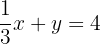

Multiply the first by 3:

Subtract the second:

Substitute into the second:

Solve:


Multiply the first by 2:

Subtract the second:

Substitute into the first:

3 Pens and 2 Pencils cost £2.10. 5 Pens and 4 Pencils cost £3.70. Find the cost of one pen (x) and one pencil (y).
Equations:


Multiply the first by 2:

Subtract the second:

Substitute:



Pen = £0.50, Pencil = £0.30.
At a local cinema, adult tickets cost £12 and child tickets cost £7. On a particular afternoon, a total of 50 tickets were sold, and the total revenue collected was £475. How many adult tickets (a) and how many child tickets (c) were sold?
First, we set up two equations based on the number of tickets and the total cost:


To eliminate the variable c, multiply the first equation by 7:

Now, subtract this new equation from the second equation:


Divide by 5 to find the number of adult tickets:

Substitute this value back into the first equation to find the number of child tickets:


The cinema sold 25 adult tickets and 25 child tickets.
A rectangle has a perimeter of 40 cm. It is known that twice the length (l) plus three times the width (w) equals 52 cm. Find the dimensions of the rectangle.
The perimeter of a rectangle is calculated as 2l + 2w. We can form the following system of equations:


Since the coefficient of l is the same in both equations, we can subtract the first equation from the second:


The width of the rectangle is 12 cm. Now, substitute this value into the perimeter equation:


Subtract 24 from both sides:


The dimensions of the rectangle are 8 cm by 12 cm.
The sum of two numbers, x and y, is 25. The difference between twice the first number and the second number is 14. Determine the values of both numbers.
Based on the problem description, we can write the following equations:


In this case, the y coefficients are opposites (+1 and -1). We can eliminate y by adding the two equations together:


Divide by 3 to solve for x:

Now, substitute x = 13 into the first equation to find y:


The two numbers are 13 and 12.
Solve the following system which contains a mix of decimals and algebraic fractions:

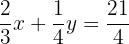
First, clear the decimals from the first equation by multiplying every term by 10:

Next, clear the fractions from the second equation by multiplying every term by the lowest common multiple of the denominators, which is 12:


Now we have a standard system. To eliminate y, multiply the first equation by 3 and the second by 5:


Add the two equations together:


Substitute x = 6 into the simplified version of the first equation:



The solution is:

Solve the system by first expanding the brackets and simplifying the expressions:


Expand and simplify the first equation:


Expand and simplify the second equation:


To eliminate y, multiply the simplified second equation by 4:

Now, subtract the simplified first equation from this new equation:


Substitute x = 2 into the simplified first equation:


The solution is:

A student has 20 coins in a jar, consisting only of 50p coins (x) and 20p coins (y). The total value of the coins is £7.60. Determine the number of each type of coin held in the jar.
First, we create an equation for the total number of coins:

Next, we create an equation for the total value in pounds. Note that 50p is £0.50 and 20p is £0.20:

To make the second equation easier to work with, multiply every term by 10 to clear the decimals:

Now, multiply the first equation by 2 so that the y-coefficients match:

Subtract this equation from the simplified value equation:


Divide by 3 to find the number of 50p coins:

Substitute x = 12 back into the first equation to find the number of 20p coins:


The student has 12 coins of 50p and 8 coins of 20p.
Summarise with AI:
Did you like this article? Rate it!


 Loading...
What is eligible
Hi , I m Abhishek Mittal , a passionate maths assistant professor, having experience more than 10 years with almost all top brands (Cuemath, Byjus, FIITJEE, Allen) online and offline and in-person .
Want to join Superprof , Kindly guide me.
Hi Abhishek, thanks so much for reaching out! With your experience, you’d be a fantastic fit for Superprof.
Joining is simple:
1. Visit the Superprof website and click “Become a tutor”.
2. Create your profile, add your teaching experience, qualifications and subjects.
3. Upload a clear photo and write a friendly, detailed description of your teaching style — this really helps students choose you.
4. Set your rates and availability, and once your profile is validated, students can start contacting you directly.
If you need help setting up or optimising your profile, feel free to write to our customer services team at hello@superprof.com — they’ll be happy to guide you!
nice work
Thank you! 😊 We’re glad you found the worksheet helpful. Keep up the great work with your studies!