 where
where  and
and 
In words, we can say that the logarithm of x with base a is y. A logarithm tells us the "number of times" a base is multiplied to get a specific number. For example,

tells us a number of times 2 is multiplied to get the answer 4. Similarly,

tells us the number of times 3 is multiplied by itself to yield the number 9. Just like addition and subtraction are two opposite operations, logarithms and exponential functions are opposite to each other. A logarithmic function can be converted into an exponential form like this:

In words, we can say that a raised to the power y is x. We know that when any number is raised to a power 0, the answer is 1. In logarithmic form, we can conclude that the logarithm of a number 1 is equal to 0. Mathematically it can be written as

. Remember that the base of the exponential and logarithmic function is the same. For example, the logarithmic form of the exponential function

is

. The base of the exponential function
is

, whereas the base of the logarithmic function
is also
. Remembering this relationship will be very useful for you in understanding the logarithmic functions and will help to avoid any confusion while converting them into the exponential form or vice versa. In this article, we will see how learn graphing logarithms, evaluating simple logarithms, natural and common logarithms and applying logarithm rules to solve complex logarithmic functions. Find a good maths tutor near me here.


Graphing Logarithms
If we take the inverse of any function and graph it on a coordinate axis, then the graph of the inverse will be a reflected form of the graph of the original function. Since logarithmic functions are inverse of exponential functions, therefore the graph of the logarithmic function will be a reflection of the graph of the exponential function. Lets us consider an exponential function

. Graphically, it will be represented as follows: 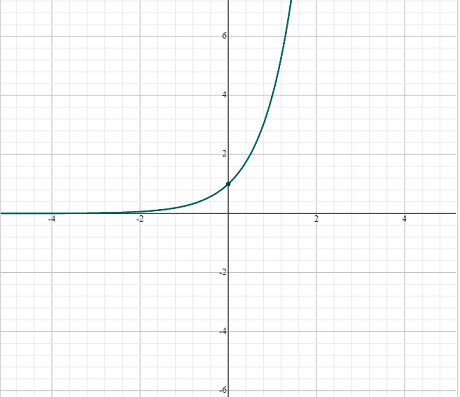
is

. The graph of the logarithmic function will be reflected about the line

. 

values in the exponential function become the

values in the corresponding logarithmic function and
values in the exponential function become
values in the corresponding logarithmic function. This makes construction of a table of values easier while graphing logarithmic functions because you can simply reverse the values of corresponding exponential functions to get the tables of values for the logarithmic function.
How to Evaluate Logarithms
Most calculators will only have an option to calculate the values of common logarithms. When you have to evaluate a logarithmic function in your exam, you are expected to follow a due procedure to write an answer in the form of a fraction or a number. The answer to a logarithmic function can be positive, negative or a fraction. Let us solve some examples related to logarithms.
Example 1
Evaluate

Solution
Convert the above log function into an exponential form:

We know that

. When we take square of

, we get the answer

. Hence,
should be multiplied 2 times to get
. It can be written as:


Example 2
Evaluate

Solution
Convert the above logarithmic function into an exponential form:

When we multiply 5 three times we get 125. But in the above question, we have got

instead of 5. We know that

. Hence, when we will multiply
six times, we will get 125. It can be written as:

So,

Example 3

Solution
The above logarithmic function has no base. When there is no base given, then we assume that it is a common logarithmic function with base ten. Hence, the above log function has base ten which can be written as:

Writing the above function exponentially, we will get the following algebraic expression:

We know that

and

. Since

, hence the value of
is -3.


Example 4
Evaluate

Solution
Write the above function into an exponential form like this:

We know that when we take reciprocal of a fractional number, the sign of the power is reversed. Therefore,

. Hence,

.
Example 5
Evaluate

Solution
Writing the above function in exponential form, we will get the following expression:

When 3 is multiplied 4 times, we get 81.

We know that we can write

as

, so the expression will be like this:


To isolate
on the left hand side of the expression, multiply both sides by 2 to get the final answer:

Common Logarithm
A common logarithm has base 10 and is represented as

. When we are not given the base of the logarithm, then we assume that it has base 10. The following table shows the answers to some of the common logarithms:
| Common logarithm (log x) | y |
|---|---|
| log 10 | 1 |
| log 100 | 2 |
| log 1000 | 3 |
| log 0.1 | -1 |
| log 0.01 | -2 |
| log 0.001 | -3 |
Natural Logarithm
The natural logarithm has a base of e (an irrational number with an approximate value of 2.718281828). It is represented by ln (x).
Solving Complex Logarithmic Functions
So far we have learned to solve simple logarithmic functions. However, sometimes we are given complex logarithms that can only be solved by applying various logarithmic rules. The summary of these logarithmic rules is presented in the following table.
| Logarithm Rules | Mathematical Notation |
|---|---|
| Logarithm product rule |  |
| Logarithm quotient rule |  |
| Logarithm power rule |  |
| Logarithm base switch rule |  |
| Logarithm root rule |  |
| Logarithm change of base rule |  |
Example 1
Evaluate

Solution
As you can see that this is a complex example which involves many logarithmic factors in a single expression. We will apply logarithmic rules to solve this expression. There are two logs with the same base 3 and other two log with the same base 5. Apply logarithm quotient rule to the first two factors of the expression because a negative sign is involved. Similarly, apply logarithm product rule to the last two factors of the expression because they have a positive sign between them.

According to the logarithm power rule,

, so we can write the expression

as

which is equal to

.


Once again we will employ logarithm power rule here. We know that

and

. We can write

as

and

as

.
= 
Converting

into exponential form we get

. Hence, we get an answer

. Similarly,

can be written exponentially as

. Once, again we get
. Put these two values in the above expression to get the final answer:
= 
=
Example 2
Expand

Solution
Apply the product rule to break down the single factor inside parenthesis into set of individual factors.

According to the logarithm power rule, , so we can write the expression  as
as  and
and  as
as  .
.

Among all the factors, we can solve only

. Suppose

. Convert it into exponential form to get the value for
.

Since,

, therefore

. Put this value in the expression:
= 
Summarise with AI:
Did you like this article? Rate it!


 Loading...
As a university professor, I always send my students to your websites to study key ideas that you explain in simple terms. You certainly do competent work.