Mother Earth provides a suitable amount of resources where life can thrive. Even the smallest detail on Earth is helpful in sustaining life that even includes the shape of the Earth. You must be thinking that Earth is a circle but the circle is a two-dimensional figure, however, Earth is a three-dimensional figure. What shape is our Earth? Let's talk about it.






What is a Hemisphere?
According to NASA (National Aeronautics and Space Administration), our Earth is a sphere. A sphere is a three-dimensional shape derived from a circle. Take an example of a ball, it is also a sphere, you can't call it a circle, you will call it a sphere. Now you must be wondering what is a hemisphere? For a better understanding, take a look at the below picture.
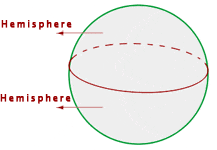
A hemisphere is each of the parts obtained by cutting a sphere by a plane through its centre. In simple words, you are familiar with semi-circle, right? A semi-circle exists in a two-dimensional region but if we take that semi-circle in the three-dimensional region, it turns into a hemisphere. Yes, the hemisphere is the half of a sphere and if you add two hemispheres then you will get a complete sphere.
Surface Area of a Hemisphere
Surface area means the total space occupied by the surface of a hemisphere. Basically, you are finding the circumference of the hemisphere. Use the below formula to find the surface area of a hemisphere.

Volume of a Hemisphere
However, the volume is different from the surface area. The surface area just covers the surface, on the other hand, the volume covers the whole object. Therefore, the volume of a hemisphere means the total space occupied by the hemisphere. Use the below formula to find the volume of a hemisphere:

Example
The dome of a cathedral has a hemispherical form with a diameter of 50 m. If the restoration costs 300 dollars per m², what is the total cost of the restoration?

 dollars
Calculate the volume of a hemisphere with a radius 10 cm.

Spherical Wedge
The spherical wedge is the part of a sphere between two planes that intersect at the diameter. Both planes are semidisk and wedge's base. Below are the pictures of a sphere where the spherical wedge is indicated.

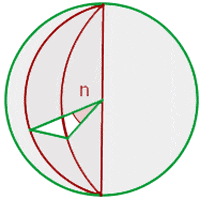
To find the volume of a spherical wedge, you can use the below formula. To use this formula, you will need the radius and the central angle of the spherical wedge.
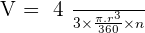
Where "n" is the central angle of the spherical wedge.
Volume of a Spherical Wedge
A spherical lune is a part of a spherical wedge. Basically, a spherical lune is the curvature part of the boundary of a spherical wedge. Take a look at the below picture. The red marks on the edge of the sphere entrap a space. That space is called a spherical lune. In simple words, a spherical lune is an area that is entrapped by two half circles that meet each other at the diameter.
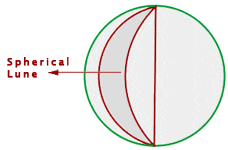
In case, if you want to find the area of the a spherical lune, the formula will remain the same just adjust the power of the radius from 3 to 2:

Where "n" is the central angle of the spherical wedge.
Spherical Cap
Let's do a fun activity to understand the spherical cap. We want you to take any spherical object in your house, it can be a ball or maybe a Christmas globe, the condition is that it should be a perfect sphere. Once you got your spherical object, visualize that you cut it like below.
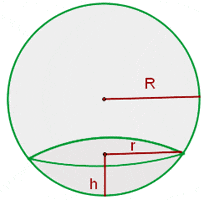
Cutting the sphere will create two regions. Both new parts of a sphere will be called spherical caps. Basically, what you did is divide a circle using a plane and spherical caps are formed by a plane that is cutting a circle into two parts. There is no specific point where the plane can cut, it can cut in any direction but two new formed parts will be called spherical caps. Therefore, in simple words, a spherical cap is each of the parts of the sphere determined by a secant plane.
You can find the radius of the sphere with the help of the radius of the plane and the height between the plane and the sphere. Below is the formula to find the radius of the sphere using the spherical cap.

Area of a Spherical Cap
Once you found the radius of the spherical cap, you can proceed with the area of the spherical cap. Finding the area is pretty simple, all you need to do is to multiply two pi with the product of the radius of a sphere and the height.

Volume of a Spherical Cap
The volume of a spherical cap means the total space occupied by the spherical cap. To find the volume, you can use the below formula, nothing additional information is required for the calculation of the volume.

Example
Calculate the area and volume of the following spherical cap.



Spherical Segment
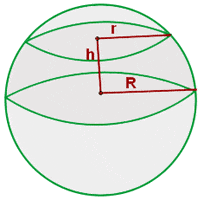
Area of a Spherical Zone
The area of the spherical zone is the same as the area of the spherical cap.

Volume of the Spherical Segment
To find the volume, you can use the below formula. All you need is the value of segment radius, radius of the sphere, and the height between the segment and the plane. If you have all the information available, just use the below formula to find the volume of a spherical segment.

Example
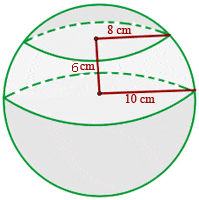
Calculate the area of the zone and the volume of a spherical segment whose radius circles are 10 and 8 cm and the distance between them is 6 cm.


Summarise with AI:
Did you like this article? Rate it!


 Loading...
What is frac and sqrt
Interested learning more