In geometry, we often deal with perfect shapes like the standard pyramid. However, real-world engineering and architecture frequently use "shortened" versions of these shapes. This is known as a truncated pyramid, or more formally, a frustum.
Whether you are studying for your GCSEs or moving into A-Level Geometry, mastering the surface area and volume of a frustum is essential for understanding 3D space and solid geometry.






What is a Truncated Pyramid?
A truncated pyramid is the solid part of a pyramid that remains after the top portion (the apex) has been removed by a plane cutting through it, usually parallel to the base.
Key Characteristics:
- Two Bases: It has a larger bottom base and a smaller top base. These bases are always similar polygons.
- Trapezoidal Faces: The "sides" (lateral faces) of a truncated pyramid are always trapezoids.
- Height (h): The perpendicular distance between the top and bottom bases.
- Slant Height (s or a): The height of the trapezoidal lateral faces, also known as the apothem of the truncated pyramid.
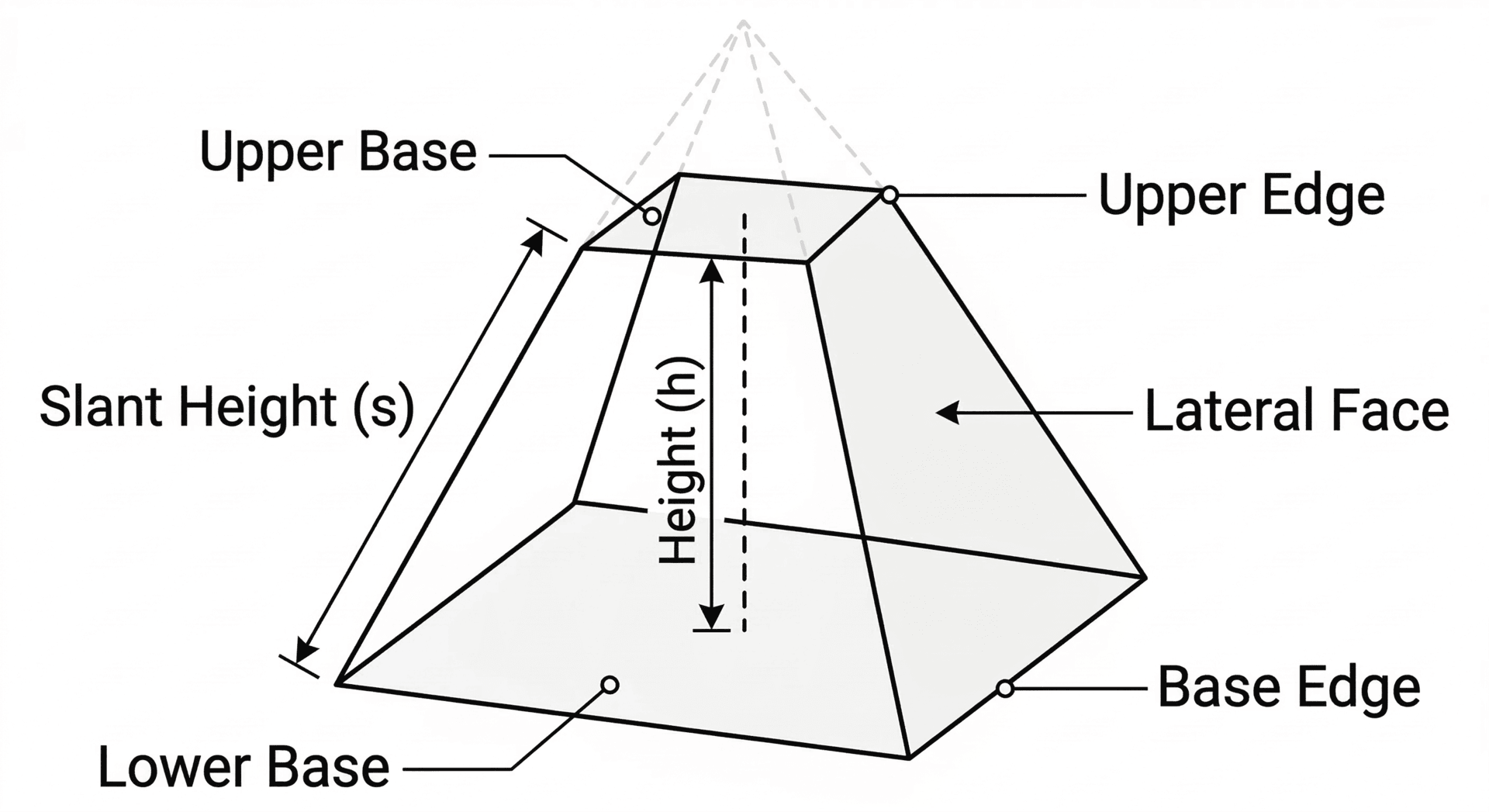
The Geometry of the Apothem
To calculate the surface area, you often need the slant height (apothem of the frustum). If you only have the vertical height (h), you can find the slant height using the Pythagorean Theorem.
Imagine a right-angled triangle inside the frustum:
- The vertical side is the height (h).
- The horizontal side is the difference between the apothems of the two bases.
- The hypotenuse is the slant height (s).
The formula for the slant height (s) is:
Formulas for Area and Volume
When calculating the dimensions of a truncated pyramid, we distinguish between the area of the sides (lateral area) and the total space the shape occupies (volume).
1. Surface Area
The surface area is split into two parts: the lateral area, which covers the four trapezoidal faces, and the total surface area, which includes the top and bottom bases.
- Lateral Area (A_L): This is calculated as half the sum of the perimeters of both bases, multiplied by the slant height (apothem).
- Total Surface Area (A_T): To find the total area, you add the area of the upper base (B_2) and the lower base (B_1) to the lateral area.
2. Volume
The volume of a truncated pyramid measures the 3D space inside the frustum. It depends on the vertical height and the relationship between the two base areas.
- Volume (V):
In this formula, the term
represents the geometric mean of the two base areas, which accounts for the gradual narrowing of the shape from the bottom to the top.
Worked Example: Square Frustum
Calculate the volume and total surface area of a truncated square pyramid with:
Lower base edge = 24 cm
Upper base edge = 14 cm
Slant height (s) = 13 cm
Vertical height (h) = 12 cm
Step 1: Find Base Areas and Perimeters




Step 2: Calculate Lateral Area (A_L)
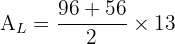

Step 3: Calculate Total Area (A_T)


Step 4: Calculate Volume (V)



Glossary of Key Terms
- Apothem (Base): The distance from the center of a regular polygon to the midpoint of any side.
- Apex: The top vertex of a pyramid where all lateral faces meet.
- Trapezoid: A quadrilateral with at least one pair of parallel sides.
- Locus: A set of points whose location is satisfied by a specific condition.
Practice Questions & Solutions
Define the term "Frustum."
The portion of a solid (usually a cone or pyramid) that lies between two parallel planes cutting through it.
A truncated pyramid has base areas of 25  and 9 . If the height is 6 cm, find the volume.
 .
.
True or False: The lateral faces of a regular truncated pyramid are isosceles trapezoids.
True.
If a square frustum has a lower perimeter of 40 cm and an upper perimeter of 20 cm with a slant height of 10 cm, what is its lateral area?

Why is the volume formula for a frustum different from a standard pyramid?
Because a frustum accounts for two different base sizes, requiring the "geometric mean"  to accurately calculate the space between them.
Curriculum References
This topic aligns with GCSE Maths (Higher Tier) under "Geometry and Measures" and A-Level Further Maths for volume of solids of revolution and composite shapes.
Explore more geometry articles:
Summarise with AI:
Did you like this article? Rate it!


 Loading...
What is frac and sqrt
Interested learning more