In physical chemistry, a covalent bond is not a rigid, static rod holding two atoms together at a fixed distance. Instead, it behaves more like a dynamic quantum mechanical spring. The atoms within a molecule vibrate continuously, their nuclei moving closer together and further apart around an energetically optimal equilibrium distance.
The physical dimensions and stability of this spring are characterised by two strictly interdependent properties: bond length and bond strength. Understanding the factors that govern these properties allows us to predict molecular geometry, stability, and the thermodynamic feasibility of chemical reactions—a core competency tested thoroughly across all A-Level Chemistry specifications.







Core Definitions
Covalent Bond:
The strong electrostatic attraction between a shared pair of electrons and the positively charged nuclei of the bonded atoms.
Bond Length:
The equilibrium distance between the nuclei of two covalently bonded atoms at the point of minimum potential energy. It is typically measured in nanometers (nm) or picometers (pm).
Bond Strength (Bond Enthalpy):
The average energy required to break one mole of a specific covalent bond in the gaseous state into isolated gaseous atoms under standard conditions. It is measured in kilojoules per mole (). Because bond breaking is an endothermic process, bond enthalpy values are always positive ().
The Fundamental Relationship and Energy Profile
The relationship between how close two nuclei are and the energy required to separate them is governed by Coulomb's Law. Generally, shorter covalent bonds are stronger covalent bonds.
When two isolated atoms approach one another to form a covalent bond, multiple electrostatic forces act simultaneously:
- Attractive forces between the positive nuclei of each atom and the negative cloud of the shared valence electrons.
- Repulsive forces between the two positively charged nuclei, and between the inner shell electrons of both atoms.
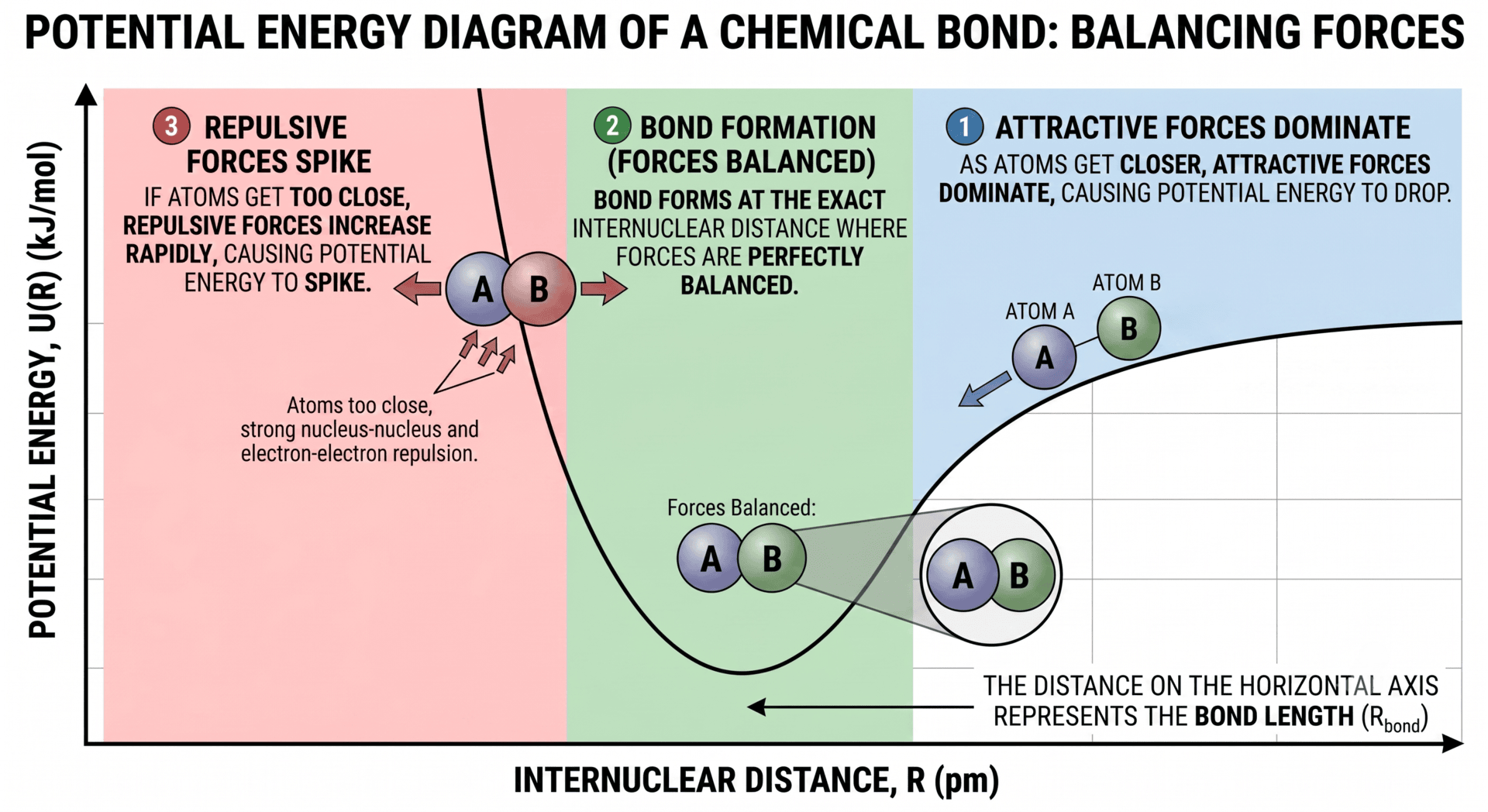
As the atoms get closer, the attractive forces dominate, causing the potential energy of the system to drop. However, if the atoms get too close, the repulsive forces between the nuclei increase rapidly, causing the potential energy to spike.
The bond forms at the exact internuclear distance where these attractive and repulsive forces are perfectly balanced. This corresponds to the lowest point on a potential energy diagram. The depth of this energy well represents the bond enthalpy, and the distance on the horizontal axis represents the bond length.
Multiple Covalent Bonds (Bond Order)
The primary factor determining the length and strength of a bond between two specific elements is the bond order—whether the bond is a single, double, or triple covalent bond.
- Single Bond: Consists of one shared pair of electrons localised between the nuclei (a single bond).
- Double Bond: Consists of two shared pairs of electrons (one bond and one bond).
- Triple Bond: Consists of three shared pairs of electrons (one bond and two bonds).
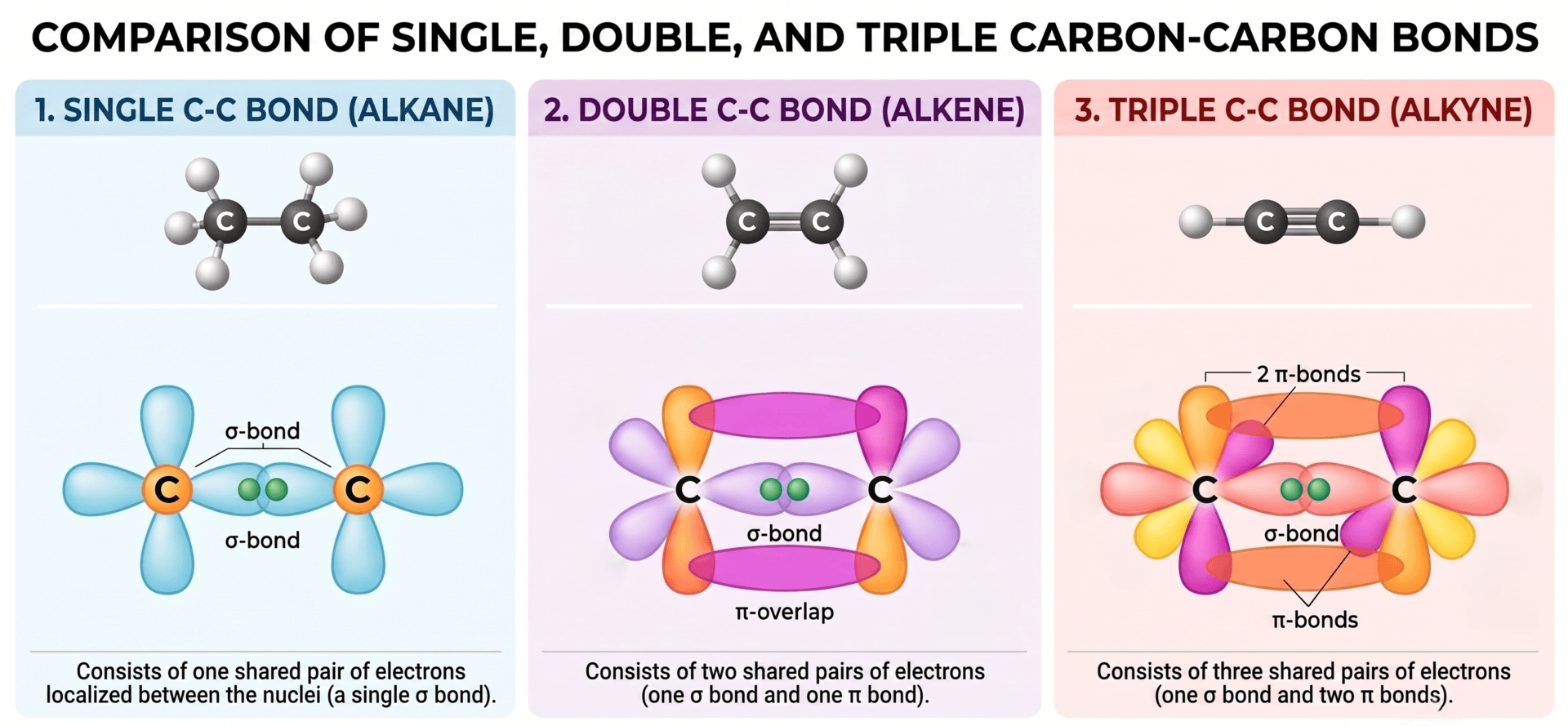
As the number of shared electron pairs between the two positive nuclei increases, the negative electron density concentrated in the internuclear space increases significantly. This localised concentration of negative charge exerts a much stronger electrostatic pull on both positive nuclei.
The increased attractive force pulls the nuclei closer together, which decreases the bond length. Because the nuclei are held tightly in a deep potential energy well by a high electron density, significantly more energy is required to separate them, which increases the bond strength.
| Bond Configuration | Example Molecule | Average Bond Length (nm) | Mean Bond Enthalpy (kJ mol^-1) |
|---|---|---|---|
Single  |  | 0.154 | 347 |
Double  |  | 0.134 | 614 |
Triple  |  | 0.120 | 839 |
Single  |  | 0.145 | 163 |
Double  |  | 0.125 | 409 |
Triple  |  | 0.110 | 944 |
Atomic Radii and Periodic Trends
Group Trends (Down a Group)
As you move down a group in the periodic table, the atomic radius of the elements increases. This is because each progressive period adds a new principal quantum electron shell, which increases inner-shell shielding and places the valence electrons further from the positive nucleus.
When a larger atom forms a covalent bond, its shared electron pair is located further away from its nucleus. Additionally, the larger physical size of the atomic shells prevents the two nuclei from getting close to each other, resulting in a longer bond length.
Because the shared electron pair is further from the positive nuclei, the electrostatic attraction between the shared cloud and the nuclei is significantly weaker. Consequently, less energy is required to break the bond, which results in a lower bond enthalpy.
This trend is clearly demonstrated by looking at the hydrogen halides down Group 17:
| Hydrogen Halide | Atomic Radius of Halogen (nm) | Bond Length of H-X (nm) | Bond Enthalpy of H-X ( ) ) |
|---|---|---|---|
 | 0.071 | 0.092 | 562 |
 | 0.099 | 0.127 | 431 |
 | 0.114 | 0.141 | 366 |
 | 0.133 | 0.161 | 299 |
Chemical Reactivity Link: This periodic trend explains why hydroiodic acid (HI) is a much stronger acid than hydrofluoric acid (HF). Because the bond is longer and weaker, it requires very little energy to dissociate in aqueous solution, readily releasing its H+ proton.
Exam Focus and Common Pitfalls
Exam Tip: When explaining bond enthalpy trends in an exam, you must always verify the physical states of the species. By definition, bond enthalpies apply strictly to substances in the gaseous state. If an exam question asks you to calculate a reaction's enthalpy change using bond enthalpies, and one of the reactants or products is given as a liquid (like ), you must factor in the enthalpy change of vaporisation to convert it to a gas before applying standard bond enthalpy values.
Another common pitfall is confusing the clearing of covalent bonds with the overcoming of intermolecular forces. When a simple molecular substance like liquid bromine () vaporises into a gas, the strong covalent bonds inside the molecules are completely unaffected. Only the weak London forces between the discrete molecules are broken. Covalent bonds are only broken during chemical reactions, not physical phase changes.
Worked Example
Problem: Using the data provided below, explain why the reaction of ethene with hydrogen gas to form ethane is an exothermic reaction.
- double bond enthalpy =
- single bond enthalpy =
- single bond enthalpy =
- single bond enthalpy =
Solution:
- Analyse the bonds broken (Reactants - Endothermic process):
- Breaking 1 mole of bonds =
- Breaking 1 mole of bonds = (Note: The 4 existing bonds in ethene remain intact, so we can omit them from both sides to simplify the calculation).
- Total energy required to break bonds =
- Analyse the bonds formed (Products - Exothermic process):
- Forming 1 mole of bonds =
- Forming 2 new moles of bonds =
- Total energy released when bonds form =
- Calculate the net enthalpy change of the reaction ():
Conclude: Because the energy released when forming the new, more stable single bonds is greater than the energy required to break the starting bonds, the overall net enthalpy change is negative, making the reaction exothermic.
Practice Questions & Solutions
Define the term bond enthalpy.
The average energy required to break one mole of a specific covalent bond in the gaseous state into separate gaseous atoms under standard conditions.
Predict and explain the trend in bond length and bond strength as you look across the series from a carbon-carbon single bond to a carbon-carbon triple bond.
As you progress from a single to a triple bond, the bond length decreases and the bond strength increases. This happens because a triple bond shares three pairs of electrons (6 electrons) compared to only one pair (2 electrons) in a single bond. The higher electron density between the two carbon nuclei increases the electrostatic attraction, pulling the positive nuclei closer together (shortening the bond) and requiring significantly more energy to break (strengthening the bond).
Explain, in terms of atomic structure, why the bond enthalpy of a chlorine-chlorine bond:
 ,
, 
is higher than that of an iodine-iodine bond:
 ,
,  .
.
A chlorine atom has a smaller atomic radius than an iodine atom because it has fewer filled principal electron shells, resulting in less electron shielding. This allows the bonded chlorine nuclei to get much closer together, reducing the Cl-Cl bond length. The shared pair of bonding electrons is closer to the positive chlorine nuclei, which creates a stronger electrostatic attraction that requires more thermal energy to break.
The bond length of a covalent bond corresponds to the minimum point on a potential energy curve. Explain what causes the potential energy to increase rapidly if the internuclear distance drops below this optimal value.
If the internuclear distance drops below the optimal bond length, the two positive nuclei are forced too close together, and their electron shells begin to overlap. This generates intense electrostatic repulsion between the identical positive charges of the nuclei and between the inner-shell electrons, causing the potential energy of the system to spike rapidly.
Write the chemical equation that precisely represents the process corresponding to the bond dissociation enthalpy of the H-Cl bond.
The bond dissociation enthalpy applies strictly to breaking one mole of gaseous bonds to form isolated gaseous atoms:

Related Articles:
Continue your A-Level Chemistry Revision with the following articles:
- Shapes of Covalent Compounds
- Physical Properties of Ionic Compounds
- Covalent Bonding and Covalent Dot-and-Cross Diagrams
Summarise with AI:
Did you like this article? Rate it!

 Loading...