While ionic bonding involves the complete transfer of electrons from a metal to a non-metal, many chemical systems achieve stability through a different mechanism. When non-metal atoms interact, they combine by sharing valence electrons to attain a stable, lower-energy electron configuration.
This sharing of electrons results in a covalent bond. Understanding the nature of this bond, its structural variations, and how to represent it using dot-and-cross diagrams is fundamental to mastering physical chemistry at A-Level.


1. The Nature of the Covalent Bond
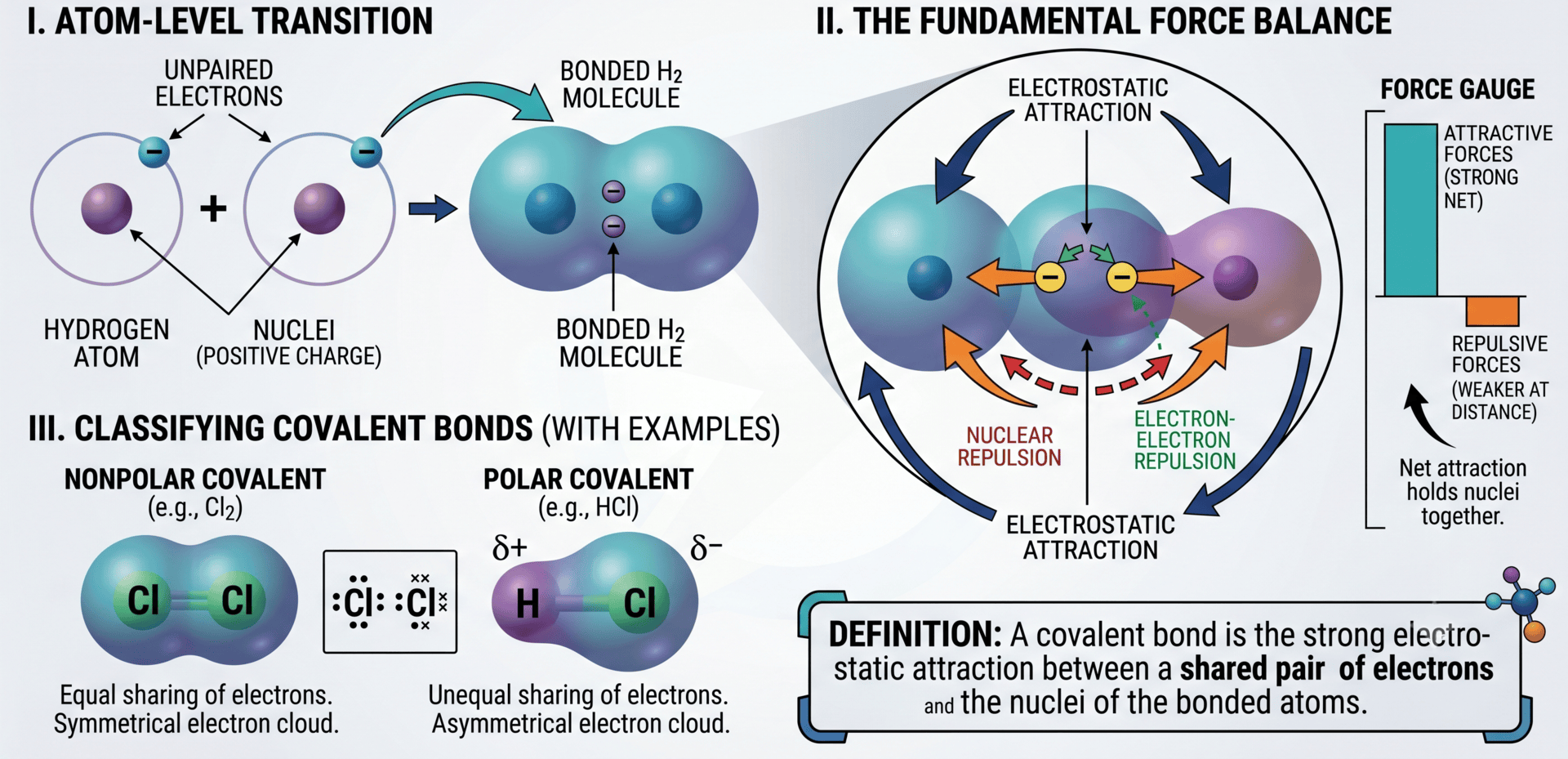
An A-Level definition of a covalent bond must focus on the precise forces at play. A covalent bond is defined as the strong electrostatic attraction between a shared pair of electrons and the nuclei of the bonded atoms.
When two non-metal atoms approach each other, the atomic orbitals in their outer shells overlap. The negatively charged shared pair of electrons is highly localised between the two positively charged nuclei. The balance of forces includes:
- Attractive forces: Between the shared electrons and both positive nuclei.
- Repulsive forces: Between the two positive nuclei themselves, and between the inner shells of electrons.
The stable covalent bond forms at a specific distance where these attractive and repulsive forces are perfectly minimised. This distance is known as the bond length.
Bond Strength and Bond Length
Covalent bonds vary significantly in their strength, which is measured by their bond enthalpy (the energy required to break one mole of a specific bond in the gaseous state). Bond strength is directly linked to bond length and the extent of orbital overlap:
| Bond Type | Example | Average Bond Length (nm) | Average Bond Enthalpy (kJ/mol) |
|---|---|---|---|
| Single (C–C) |  | 0.154 | 347 |
| Double (C=C) |  | 0.134 | 614 |
Triple (C C) C) |  | 0.120 | 839 |
A-Level Concept Progression: As the number of shared electron pairs increases between two specific atoms, the electrostatic attraction between the nuclei and the electron density increases. This pulls the nuclei closer together, resulting in a shorter bond length and a higher bond enthalpy.
2. Core Rules for Covalent Dot-and-Cross Diagrams
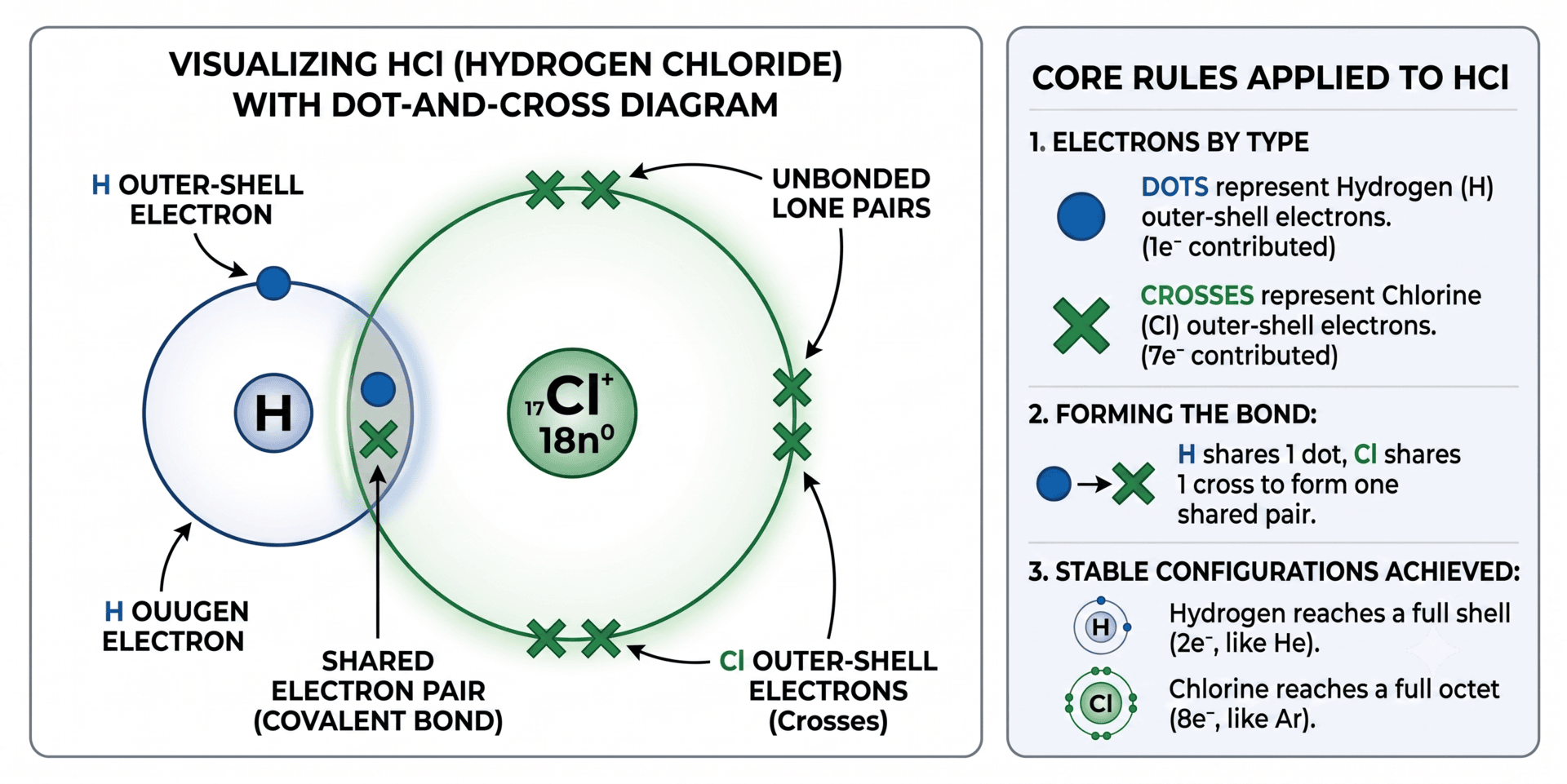
Dot-and-cross diagrams are visual tools used to represent the configuration of valence electrons in a molecule. In these diagrams:
- One atom's outer-shell electrons are represented as dots (
 ).
). - The other atom's outer-shell electrons are represented as crosses (
 ).
).
Step-by-Step Methodology for Drawing Simple Molecules
To construct an accurate dot-and-cross diagram, follow this structured process:
- Determine the total number of valence electrons: Identify the group number of each element in the molecule to find how many outer-shell electrons it possesses.
- Determine the number of bonds required: Calculate how many electrons each atom needs to share to attain a stable outer shell (the octet rule for Period 2 elements; two electrons for Hydrogen).
- Arrange the atoms: Place the central atom (usually the one that forms the most bonds) surrounded by terminal atoms.
- Draw the overlapping circles: Create intersecting boundary lines to represent the overlapping outer orbitals.
- Distribute the bonding pairs: Place shared pairs of electrons (
 ) into the intersection regions first.
 - Distribute non-bonding electrons (lone pairs): Place the remaining valence electrons around the outer spheres of the atoms. Ensure all non-metal atoms from Period 2 have a total of eight electrons within their outer circle.
3. Multiple Covalent Bonds
Some molecules require atoms to share more than one pair of electrons to fulfill their outer-shell requirements. This results in the formation of multiple covalent bonds.
Double Covalent Bonds
A double covalent bond consists of two shared pairs of electrons (four electrons in total shared between two nuclei).
- Carbon Dioxide (): Carbon belongs to Group 14 and has 4 valence electrons, meaning it requires 4 more electrons to complete its octet. Oxygen belongs to Group 16 and has 6 valence electrons, requiring 2 more. The central Carbon atom forms a double covalent bond with each of the two Oxygen atoms.
In the dot-and-cross diagram for , each overlapping region between Carbon and Oxygen must contain two dots and two crosses (2 and 2), leaving two lone pairs on each Oxygen atom.
Triple Covalent Bonds
A triple covalent bond consists of three shared pairs of electrons (six electrons in total shared between two nuclei).
- Nitrogen Gas (): Nitrogen is a Group 15 element with 5 valence electrons. To gain a stable octet, each Nitrogen atom must share 3 electrons with its partner. The resulting diatomic molecule features a highly unreactive triple bond:
The overlapping region contains three dots from one nitrogen atom and three crosses from the other (3 and 3), with one lone pair remaining on the outside of each atom.
4. Coordinate (Dative) Covalent Bonding
A critical A-Level curriculum requirement is understanding coordinate bonding, which is also referred to as dative covalent bonding.
Definition
A dative covalent bond is a covalent bond in which both electrons in the shared pair are provided by only one of the bonding atoms. Once formed, a dative covalent bond is identical in strength, length, and behaviour to a standard covalent bond. The distinction lies solely in the origin of the bonding electrons.
Conditions for Formation
For a dative covalent bond to form, two conditions must be met:
- One atom must possess a lone pair of electrons in its outer shell.
- The accepting atom or ion must have an electron-deficient outer shell with an empty orbital available to receive the pair.
In structural formulas, a dative bond is represented by an arrow ( ). The arrow originates from the atom donating the lone pair and points directly toward the atom accepting the pair.
Key Examples Required for Exams
1. The Ammonium Ion ()
An ammonia molecule reacts with a hydrogen ion () to form . The nitrogen atom in has three bonding pairs and one lone pair. The ion is a bare proton with an empty 1s orbital. Nitrogen donates its lone pair into the empty orbital of the ion.
2. The Hydronium Ion ()
When an acid dissolves in water, water molecules () form a dative bond with the released ions. Oxygen uses one of its two lone pairs to form a coordinate bond with the empty orbital of the proton.
3. Aluminium Chloride Dimer ()
At room temperature, aluminium chloride exists as a dimer (). Two separate molecules join together via dative covalent bonds. Chlorine atoms from each molecule use a lone pair to form a dative bond with the electron-deficient aluminium atom of the adjacent molecule.
5. Exceptions to the Octet Rule
While the octet rule applies consistently to Period 2 elements like Carbon, Nitrogen, and Oxygen, there are two major structural exceptions encountered at A-Level:
Electron-Deficient Molecules
Some elements form stable compounds with fewer than eight electrons in their outer shell.
- Boron Trifluoride (): Boron is a Group 13 element with 3 valence electrons. When it forms three single covalent bonds with Fluorine, its outer shell contains a total of only 6 electrons. It cannot expand further without reacting to form a dative bond (such as with ammonia).
Expansion of the Octet
Elements situated in Period 3 and below possess accessible, low-lying d-subshells in their valence shell. This allows them to accommodate more than 8 electrons in their outer shell when forming bonds with highly electronegative elements like Fluorine or Oxygen.
- Phosphorus Pentachloride (): Phosphorus (Group 15) uses all 5 of its valence electrons to form 5 single bonds with Chlorine, resulting in 10 electrons in its outer shell.
- Sulfur Hexafluoride (): Sulfur (Group 16) expands its valence shell to accommodate 12 electrons by forming 6 single covalent bonds with Fluorine atoms.
6. Covalent Structures & Physical Properties
The macroscopic physical properties of a covalent substance depend heavily on how the molecules are arranged structurally. Covalent materials fall into two distinct structural classifications:
Simple Molecular Lattices
Substances such as , , and exist as discrete individual molecules.
- Melting and Boiling Points: Low. When these substances melt or boil, the strong covalent bonds inside the molecules are completely unaffected. Instead, only the weak intermolecular forces (such as London forces or hydrogen bonds) holding the molecules together are broken.
- Electrical Conductivity: Non-conductors. These molecules do not contain free, mobile ions or delocalized electrons to carry an electrical charge.
Giant Covalent Lattices (Macromolecules)
Substances like Diamond, Graphite, and Silicon Dioxide () consist of vast, continuous 3D networks of atoms linked entirely by strong covalent bonds.
- Melting and Boiling Points: Extremely high. Melting requires breaking thousands of strong covalent bonds simultaneously throughout the giant structure, which requires an enormous input of thermal energy.
- Electrical Conductivity: Generally non-conductors, with the notable exception of Graphite and Graphene. In graphite, each carbon atom bonds to only three others in planar sheets, leaving one unbonded valence electron per atom delocalized within the structural layers. These delocalized electrons can move freely parallel to the sheets, allowing it to conduct electricity.
Exam Focus & Common Pitfalls
Exam Tip: A very common mistake in descriptive exam answers is failing to distinguish between covalent bonds and intermolecular forces. When describing the boiling of a simple molecular substance like water or bromine, never state that covalent bonds are broken. Always state explicitly that weak intermolecular forces between the molecules are overcome, while the covalent bonds remain fully intact.
When drawing dot-and-cross diagrams for polyatomic ions (like or ), remember to draw a large square bracket around the entire structure and display the net ionic charge outside the top right corner.
Worked Example
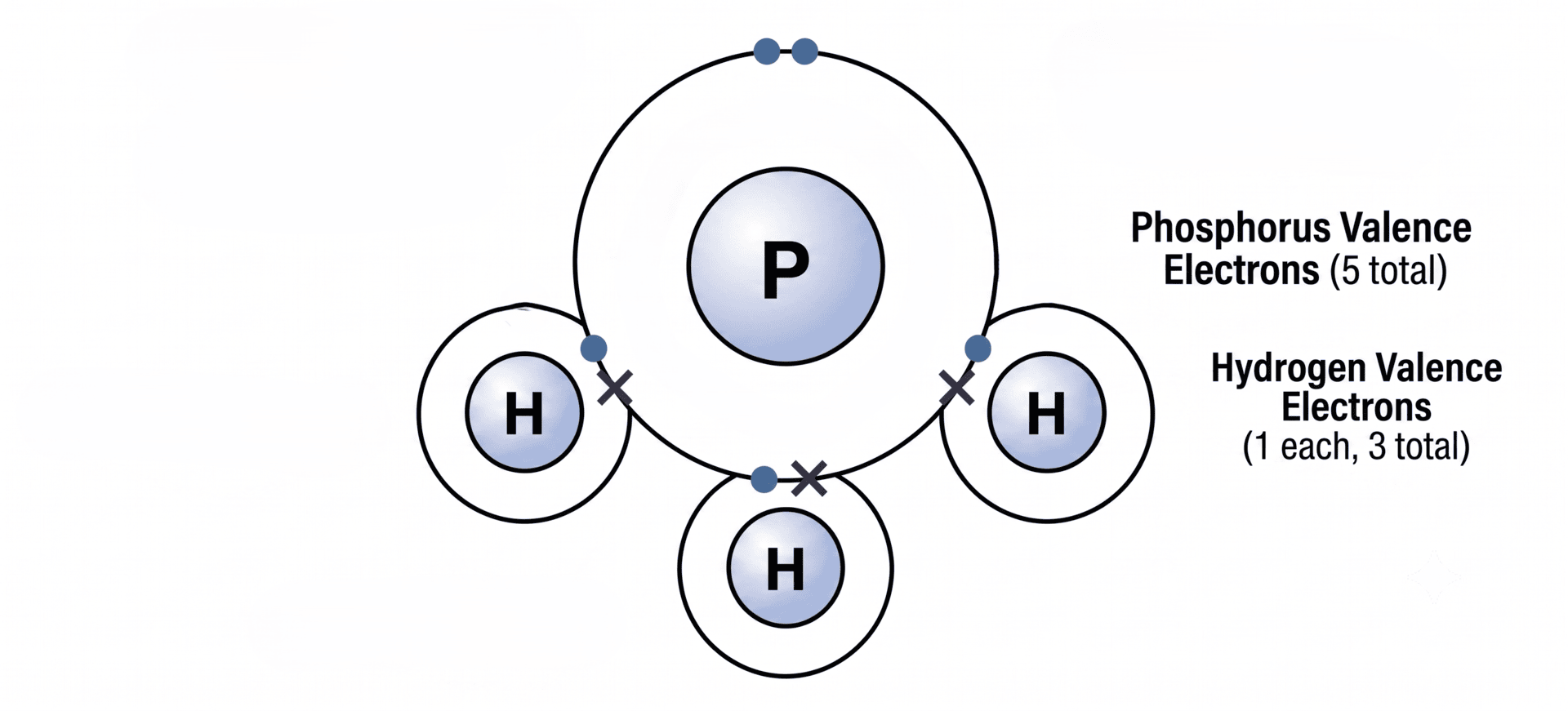
Draw the dot-and-cross diagram for a molecule of phosphine (). State whether it contains any dative bonds and predict whether it obeys the octet rule.
Solution:
- Valence Electron Count: Phosphorus is in Group 15 (5 valence electrons). Hydrogen is in Group 1 (1 valence electron).
- Bond Distribution: Phosphorus requires 3 electrons to complete its octet, so it forms 3 single covalent bonds, one with each Hydrogen atom.
- Diagram Construction: Draw three overlapping circles around a central Phosphorus atom. Place one dot and one cross () in each overlapping section.
- Remaining Electrons: Phosphorus has used 3 of its 5 electrons for bonding, leaving 2 electrons as a single lone pair on the central atom.
- Analysis: All bonds are formed by one electron originating from P and one from H, so there are no dative bonds. The Phosphorus atom is surrounded by 6 bonding electrons and 2 lone electrons, giving a total of 8, so it obeys the octet rule.
Practice Questions & Solutions
Define a covalent bond in terms of electrostatic forces.
A covalent bond is the strong electrostatic attraction between a shared pair of electrons and the nuclei of the bonded atoms.
Explain why the bond enthalpy of a nitrogen-nitrogen triple bond is significantly higher than a nitrogen-nitrogen single bond.
A triple bond consists of three shared pairs of electrons, whereas a single bond consists of only one shared pair. The higher electron density between the two nuclei increases the electrostatic attraction to the positive nuclei, pulling them closer together. This shorter bond length requires significantly more energy to break.
Deduce the number of bonding electrons and non-bonding outer electrons present in a molecule of sulfur dioxide assuming sulfur expands its octet to form two double bonds.
Sulfur forms two double bonds (one to each oxygen atom), meaning there are 4 shared pairs of electrons, giving a total of 8 bonding electrons. Each oxygen atom retains 2 lone pairs (4 non-bonding electrons each, totaling 8). Sulfur uses 4 of its 6 valence electrons in bonding, leaving 1 lone pair (2 non-bonding electrons). Therefore, there are 8 bonding electrons and 10 non-bonding outer-shell electrons in total.
State the conditions required for a molecule to form a dative covalent bond with another species.
The donor atom must possess a lone pair of electrons in its outer valence shell, and the accepting atom or ion must be electron-deficient with an empty orbital available to accept the electron pair.
Explain why diamond has an exceptionally high melting point, whereas carbon dioxide sublimates at a very low temperature, despite both containing covalent bonds.
Diamond has a giant covalent structure consisting of a continuous 3D network of carbon atoms held together by strong covalent bonds; melting requires a large amount of energy to break these strong chemical bonds. Carbon dioxide has a simple molecular structure; it is held together by weak intermolecular forces between discrete molecules, which require very little thermal energy to overcome.
Related Articles:
Continue your A-Level Chemistry Revision with the following articles:
Summarise with AI:
Did you like this article? Rate it!

 Loading...