A complete understanding of covalent molecules requires looking beyond flat, two-dimensional Lewis structures. In physical reality, molecules are dynamic, three-dimensional architectures. The specific spatial arrangement of atoms around a central hub dictates a substance's fundamental properties, including its melting and boiling behaviours, its molecular polarity, and how it interacts biologically with other chemical structures.
The geometry of a covalent species is determined by a core theory known as Valence Shell Electron Pair Repulsion (VSEPR) theory. This comprehensive guide provides the necessary tools to calculate electron environments, predict structural profiles, and master the exact language required to score full marks on your A-Level Chemistry exams.







Foundations of VSEPR Theory
The underlying mechanism of VSEPR theory is straightforward: electrons are negatively charged subatomic particles. Therefore, any concentrations of electrons residing in the outer valence shell of an atom will naturally experience a mutual electrostatic repulsion.
To minimize these repulsive forces and achieve a stable, lowest-energy configuration, the electron clouds surrounding a central atom push as far apart from one another as possible in three-dimensional space.
Bonding Pairs vs. Lone Pairs
When applying VSEPR theory, we categorize outer-shell valence electrons into two distinct groups:
- Bonding Pairs: Pairs of electrons shared inside a covalent bond between the central atom and a peripheral atom. These clouds are pinned down and extended between two positive nuclei.
- Lone Pairs: Non-bonding pairs of electrons residing exclusively on the central atom. Because these clouds are attracted to only a single positive nucleus, they sit closer to the central atom's nucleus and swell outward, occupying significantly more space than a localized bonding pair.
The Repulsion Hierarchy
Because lone pairs of electrons are physically larger and more charge-dense near the central nucleus, they exert a more powerful repulsive force than bonding pairs. The relative strength of electrostatic repulsion operates along a strict hierarchical gradient:
The Compression Effect on Bond Angles
The structural consequence of this hierarchy is known as bond angle compression. When a lone pair is introduced into a molecular network, it exerts a downward push on adjacent bonding pairs, squeezing them closer together.
A-Level Exam Rule: As a reliable standard for Period 2 elements, each lone pair added to a molecular framework alters the ideal electron geometry by compressing the expected bond angles by approximately 2.5°.
The 3D Drawing Convention (Wedges and Dashes)
To represent a three-dimensional molecular lattice on a flat sheet of paper or an exam paper, chemists utilise a universal stereochemical drawing convention. You must master these three distinct line profiles:
- Standard Solid Line: Represents a chemical bond sitting perfectly flat within the plane of the paper.
- Solid Wedge: Represents a chemical bond pointing directly out of the page toward the viewer.
- Hashed/Dashed Wedge: Represents a chemical bond pointing away from the viewer, receding behind the plane of the page.
Step-by-Step Method to Predict Shape
To accurately deduce the geometry of any covalent molecule or polyatomic ion under exam conditions, use this systematic counting protocol:
- Identify Central Valence: Find the group number of the central atom to establish its base valence electron count
- Account for Outer Atoms: Add 1 electron for each single covalent bond formed by a terminal atom
- Adjust for Ionic Charge: Subtract 1 electron for each net positive charge; Add 1 electron for each net negative charge
- Calculate Total Pairs: Divide the resulting sum by 2 to determine the total number of electron pairs
- Determine Lone Pairs: Subtract the number of bonded atoms from the total pairs to isolate the number of lone pairs
Once you have determined the total number of electron pairs (which defines the fundamental electron geometry) and separated them into bonding pairs and lone pairs, you can select the matching molecular shape from the master configuration matrix.
| Total Electron Pairs | Bonding Pairs | Lone Pairs | Base Electron Geometry | Actual Molecular Shape | Ideal Bond Angle(s) | Representative Example |
|---|---|---|---|---|---|---|
| 2 | 2 | 0 | Linear | Linear |  |  / /  |
| 3 | 3 | 0 | Trigonal Planar | Trigonal Planar |  |  / /  |
| 3 | 2 | 1 | Trigonal Planar | Bent / V-Shaped |  |  |
| 4 | 4 | 0 | Tetrahedral | Tetrahedral |  |  / /  |
| 4 | 3 | 1 | Tetrahedral | Trigonal Pyramidal |  |  / /  |
| 4 | 2 | 2 | Tetrahedral | Bent / V-Shaped |  |  / /  |
| 5 | 5 | 0 | Trigonal Bipyramidal | Trigonal Bipyramidal |  and and |  |
| 5 | 4 | 1 | Trigonal Bipyramidal | Seesaw |  and and  |  |
| 5 | 3 | 2 | Trigonal Bipyramidal | T-Shaped |  |  |
| 6 | 6 | 0 | Octahedral | Octahedral | |  |
| 6 | 4 | 2 | Octahedral | Square Planar | |  |
Core Molecular Geometries Overview
Two Electron Pairs: Linear
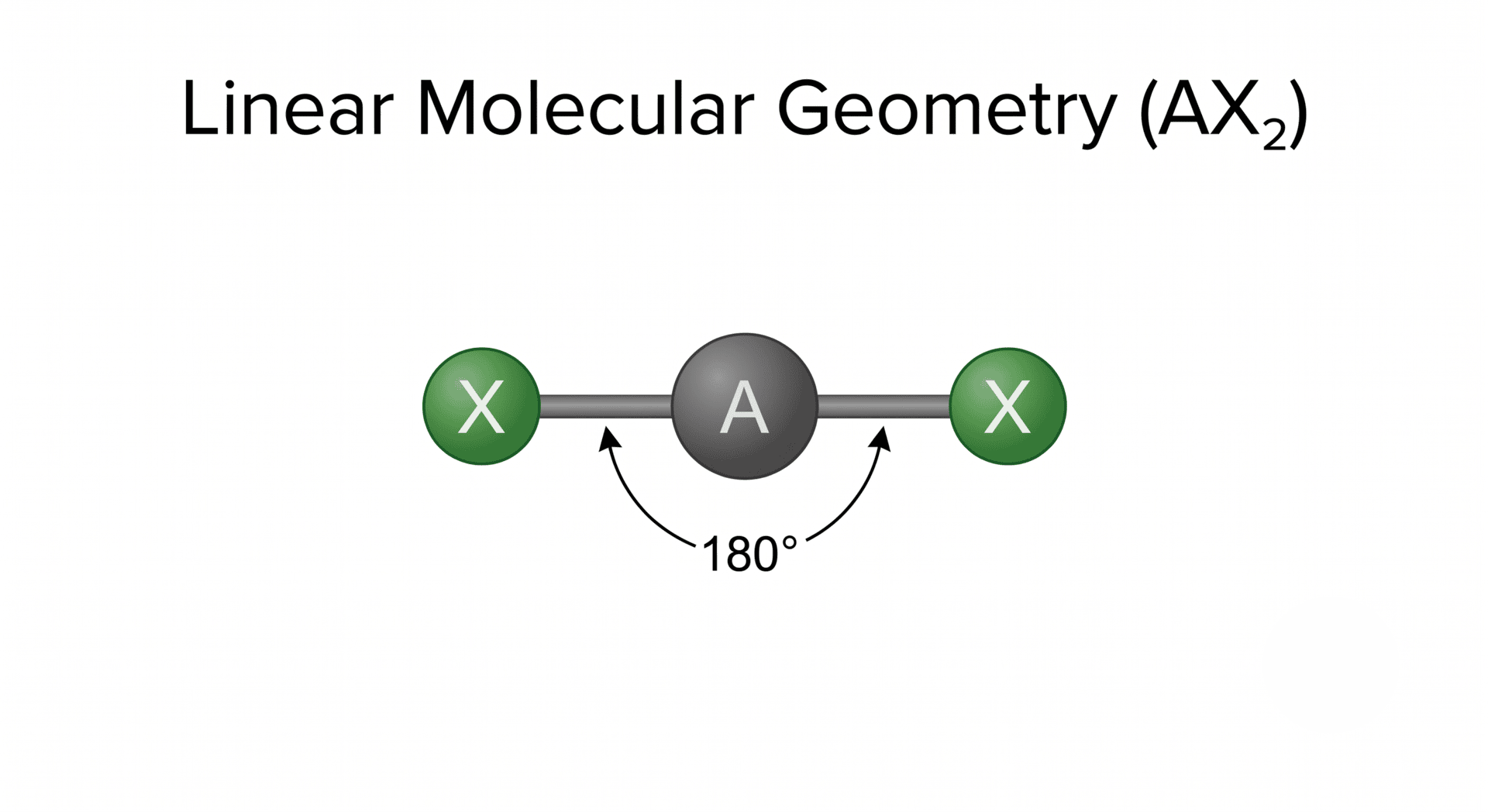
When a central atom is surrounded by only two electron concentration fields, the maximum possible spatial separation is achieved by positioning them on completely opposite sides of the nucleus.
- Bond Angle: Exactly 180
° - Geometry: The molecule forms a completely straight line.
- Example: Carbon Dioxide (
). Although carbon forms double bonds with oxygen, each double bond acts as a single, highly dense electron region. Because there are two electron regions and zero lone pairs on the carbon atom, the system adopts a linear shape.
Three Electron Pairs: Trigonal Planar
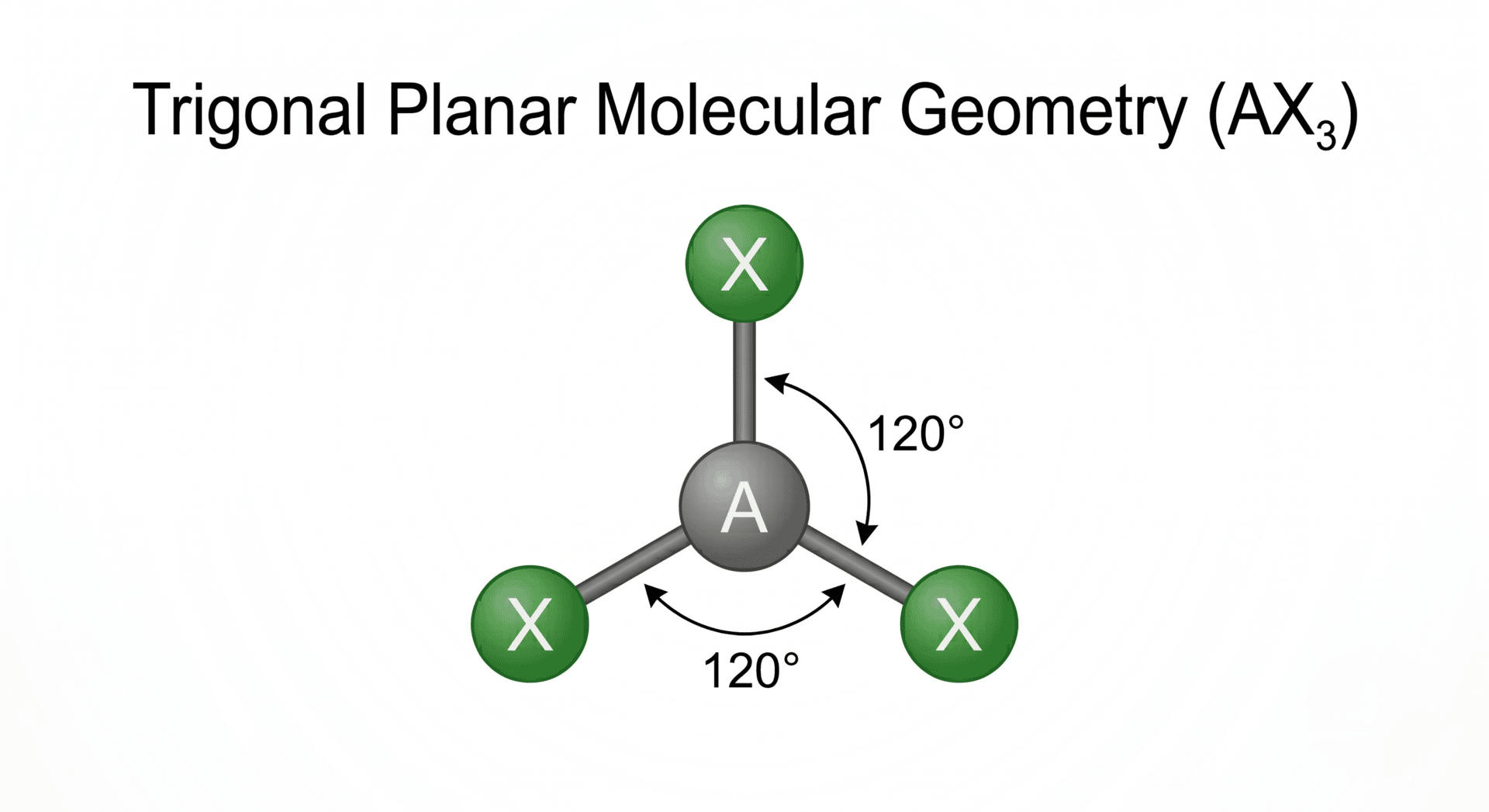
Three electron fields repel each other equally to point toward the corners of an equilateral triangle.
- All Bonding Pairs: If all three pairs are bonded (e.g., Boron Trifluoride,
), the molecule is Trigonal Planar with uniform bond angles of exactly 120° - One Lone Pair Introduction: In Sulfur Dioxide (
), the sulfur atom has two bonding domains and one lone pair. The lone pair pushes downward on the bonding domains, altering the shape to Bent (V-shaped) and compressing the internal bond angle down to approximately 117.5°
Four Electron Pairs: Tetrahedral Base
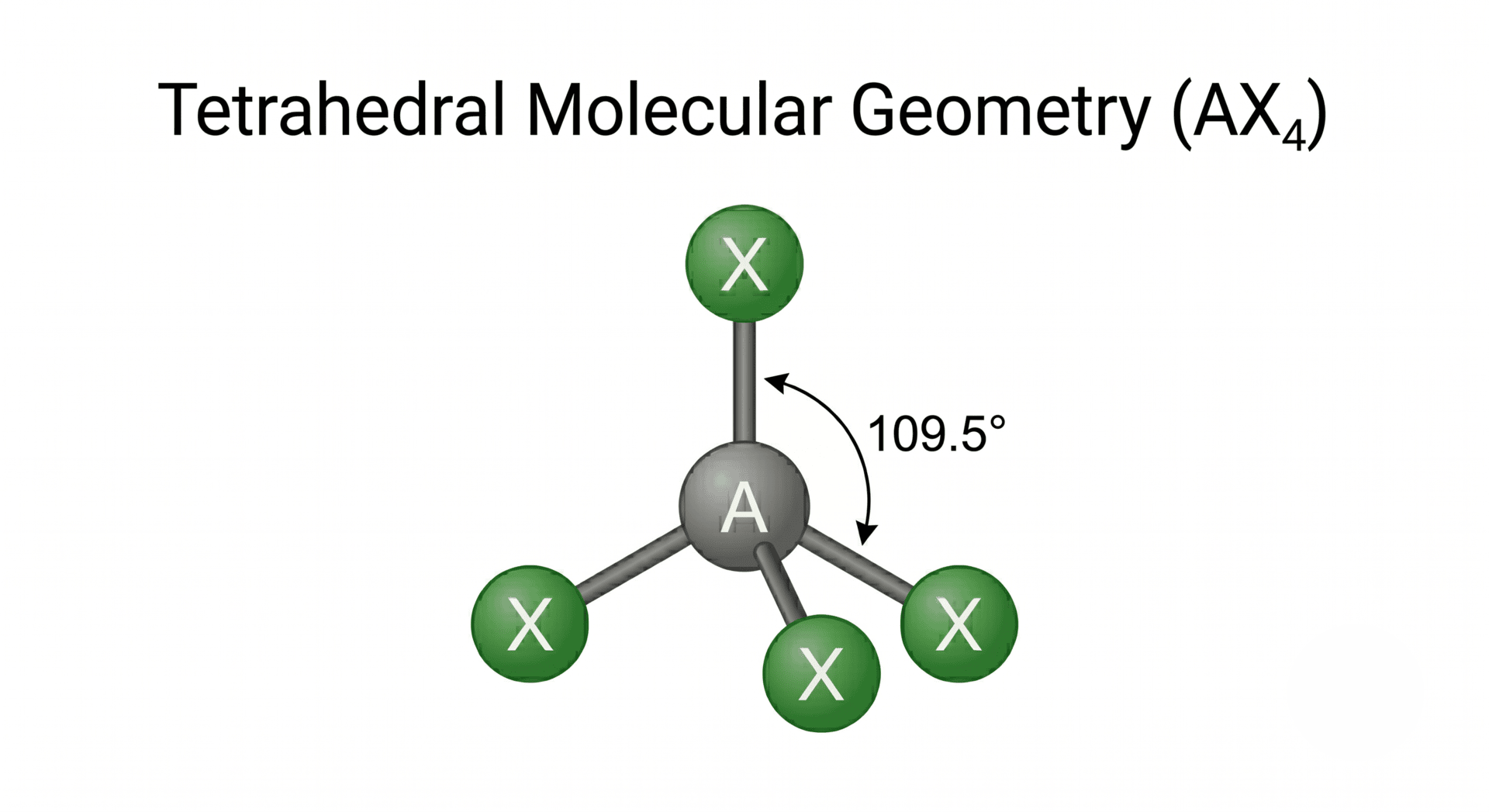
Four electron fields do not distribute themselves flatly at 90°
Methane (
Carbon uses 4 valence electrons to form 4 bonds with hydrogen. With 4 bonding pairs and 0 lone pairs, it forms a perfect Tetrahedral shape with standard bond angles of 109.5°
Ammonia (
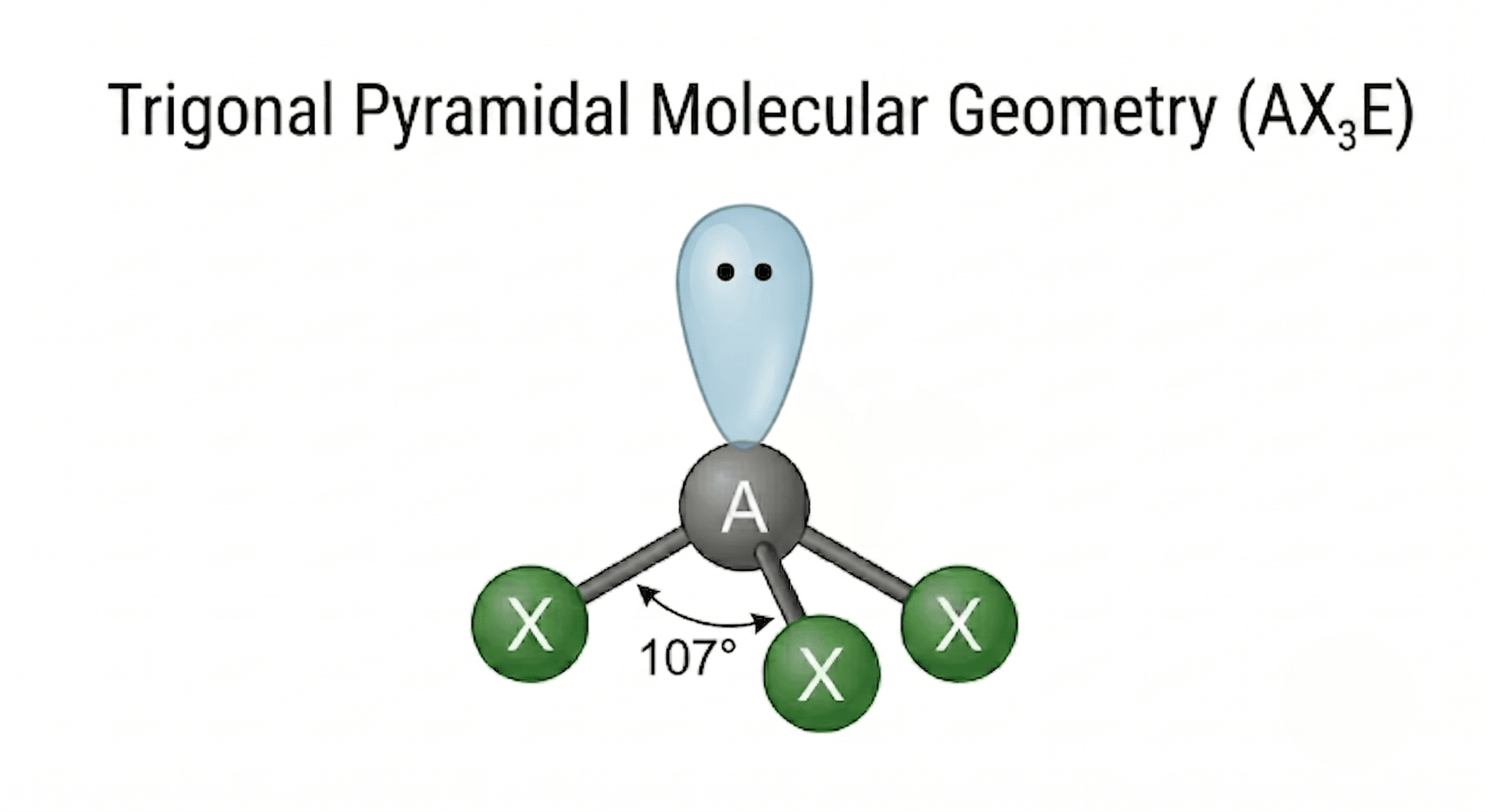
Nitrogen has 5 valence electrons, using 3 for bonding and leaving 2 as a single lone pair. The total electron count is 4 pairs (Tetrahedral base), but the molecular shape is classified as Trigonal Pyramidal. The superior repulsive force of the lone pair compresses the remaining H-N-H bond angles down to 107°
Water (
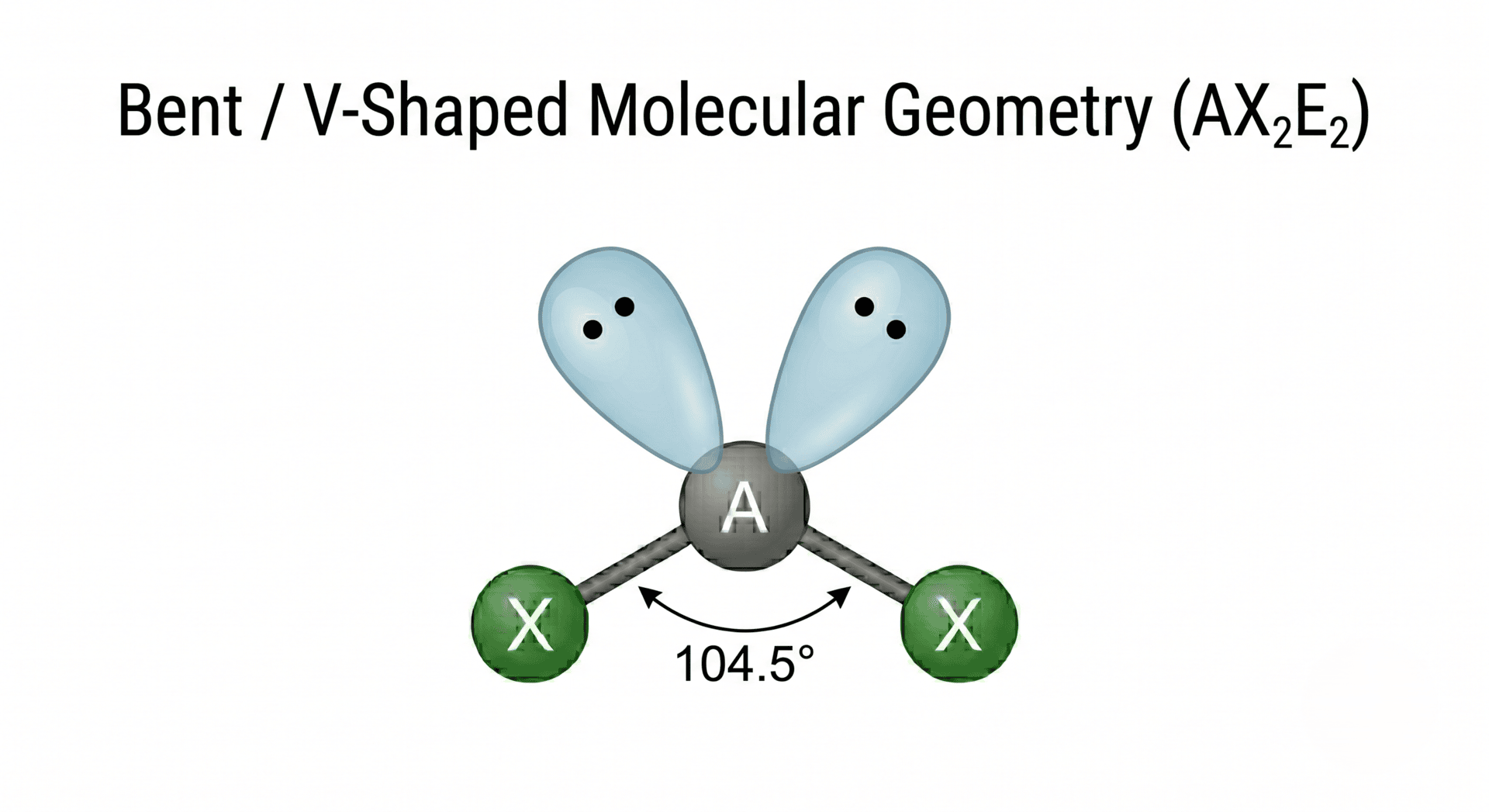
Oxygen contains 6 valence electrons, forming 2 single bonds and retaining 4 electrons as two separate lone pairs. The total electron count is 4 pairs (Tetrahedral base). However, the two lone pairs repel each other intensely while pushing down on the two bonding pairs. This results in a Bent / V-Shaped geometry with a significantly compressed bond angle of 104.5°
Five Electron Pairs: Trigonal Bipyramidal Base
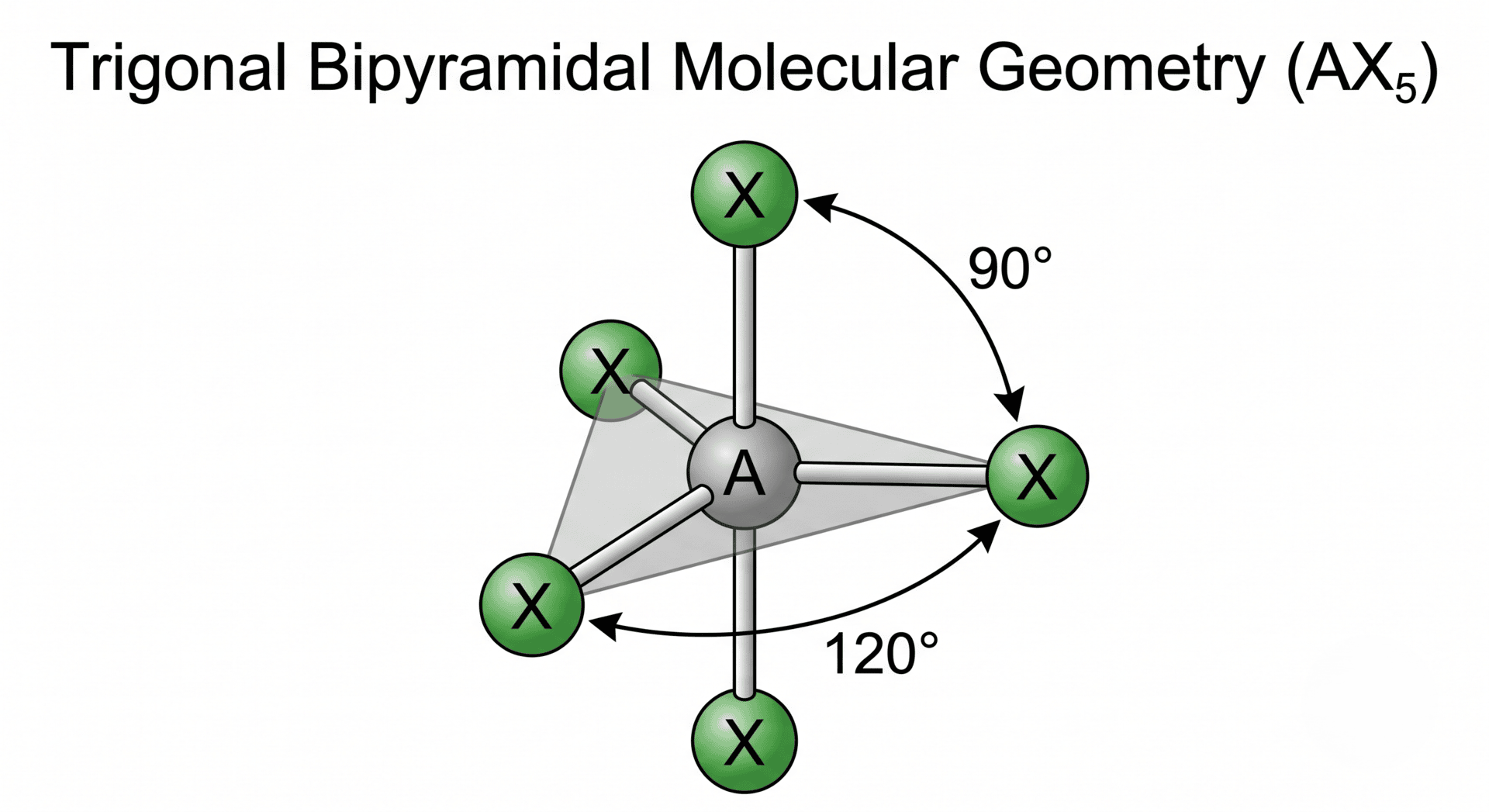
When an atom expands its octet to accommodate five electron pairs (common in Period 3 elements like Phosphorus), it adopts a Trigonal Bipyramidal arrangement. This structure features two distinct coordinate environments:
- Equatorial Positions: Three positions arranged flatly along the horizontal equator at 120
° - Axial Positions: Two positions pointing straight up and straight down vertically, creating a 90
°
Advanced A-Level Fact: If a lone pair enters a trigonal bipyramidal system, it will always selectively occupy an equatorial position first. This is because the equatorial position experiences less net repulsion (interacting with only two neighboring domains at 90°°).
Six Electron Pairs: Octahedral Base
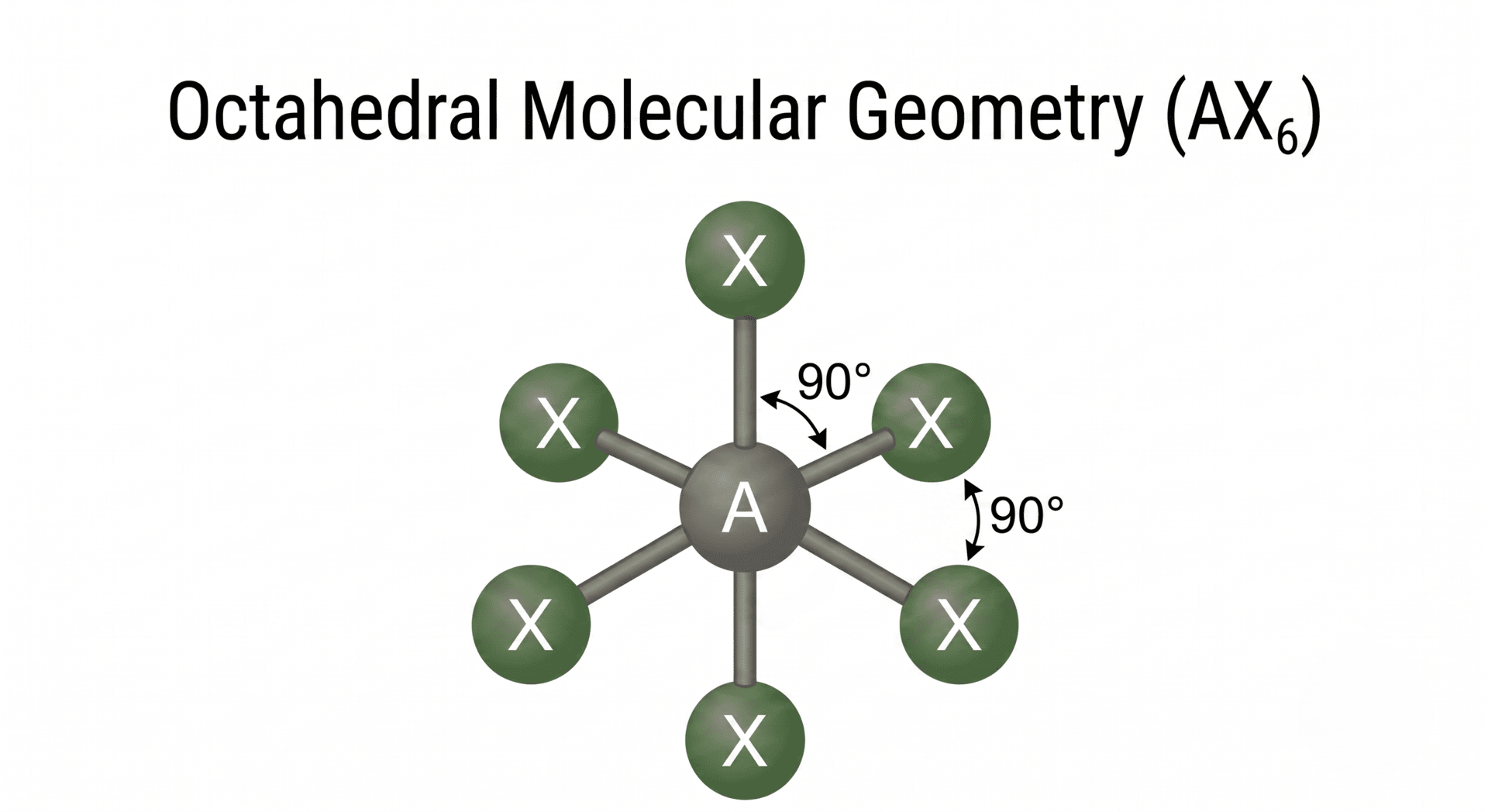
Six electron concentrations extend outward toward the corners of a regular octahedron.
- All Bonding Pairs: Sulfur Hexafluoride (
) contains 6 bonding pairs and 0 lone pairs. This yields a symmetric Octahedral profile where every single adjacent bond angle measures exactly 90° - Two Lone Pairs Introduction: In Xenon Tetrafluoride (
), xenon coordinates 4 bonding pairs and 2 lone pairs. To minimize their mutual electrostatic repulsion, the two powerful lone pairs position themselves as far apart as possible—exactly opposite one another (180°°
Shapes of Polyatomic Ions
To determine the molecular shape of an ion, apply the same counting rules but adjust the central electron pool to account for the ionic charge.
The Ammonium Ion (
- Nitrogen base valence = 5 electrons.
- Add 4 electrons from the 4 single bonds formed with hydrogen = 9 electrons.
- Adjust for the
+1net charge (subtract 1 electron) = 8 electrons. - Divide by 2 to find the total pairs = 4 electron pairs.
- Since there are 4 hydrogen atoms attached, there are 4 bonding pairs and 0 lone pairs.
- Result: The ammonium ion forms a perfect Tetrahedral geometry with an exact bond angle of 109.5
°
Exam Focus & Common Pitfalls
Exam Tip: When answering a multi-mark exam question on molecular shapes, you must construct your explanation in a specific logical order to secure full marks.
- State the total number of bonding pairs and lone pairs surrounding the central atom.
- State explicitly that electron pairs repel each other to move as far apart as possible.
- Note that lone pairs repel more intensely than bonding pairs.
- State the final molecular shape name and provide the exact numerical bond angle.
A very common error is confusing the electron geometry (the arrangement of all electron pairs) with the molecular shape (the observed position of the atoms alone). For example, the electron geometry of water is tetrahedral, but its molecular shape is bent. Always name the final shape based on the positions of the atoms, not the lone pairs.
Worked Example
Predict the molecular shape and state the expected bond angles for a molecule of phosphorus trichloride (). Justify your answer using VSEPR theory.
Solution:
- Calculate the electron pairs: Phosphorus is in Group 15 (5 valence electrons). It forms 3 single bonds with chlorine atoms (5 + 3 = 8 electrons). Dividing by 2 yields a total of 4 electron pairs.
- Assign pairs: Since there are 3 bonded chlorine atoms, the molecule has 3 bonding pairs and 1 lone pair.
- Apply VSEPR theory: The 4 electron pairs arrange themselves in a tetrahedral orientation to minimise electrostatic repulsion. However, the lone pair repels the bonding pairs more strongly than the bonding pairs repel each other.
- Conclude: The downward compression forces the bonding pairs closer together, resulting in a Trigonal Pyramidal molecular shape with a compressed bond angle of approximately
107.°
Practice Questions & Solutions
State the core principle of VSEPR theory used to determine the spatial arrangement of covalent molecules.
The core principle is that outer-shell valence electron pairs surrounding a central atom are negatively charged and will repel one another. To minimize this electrostatic repulsion, these electron pairs position themselves as far apart from one another as possible in three-dimensional space.
Predict the molecular shape and the precise bond angle of a boron trichloride ( ) molecule.
Boron is a Group 13 element with 3 valence electrons. It shares 3 electrons to form single covalent bonds with 3 chlorine atoms, giving 3 total electron pairs. With 3 bonding pairs and 0 lone pairs, the electron pairs repel equally within a single plane, resulting in a Trigonal Planar molecular shape with uniform bond angles of exactly 120°.
Explain why the bond angle in a methane molecule is 109.5°, whereas the bond angle in a water molecule is compressed to 104.5°.
Both molecules are surrounded by a total of 4 electron pairs, which adopt a tetrahedral base geometry to minimize repulsion. Methane contains 4 bonding pairs and 0 lone pairs, meaning all electron regions repel equally to maintain standard angles of 109.5°. Water contains 2 bonding pairs and 2 lone pairs. Because lone pairs exert a more powerful repulsive force than bonding pairs, they compress the adjacent  bonds closer together, reducing the internal bond angle by approximately 5° down to 104.5°.
Deduce the molecular shape name and state the bond angles for the carbonate ion 
Carbon contributes 4 valence electrons. The three oxygen atoms form bonds (accounting for 3 bonding regions), and the -2 charge adds 2 electrons to the valence pool (4 + 2 = 6 electrons). This equates to 3 distinct electron distribution regions surrounding the central carbon atom. With 3 bonding domains and 0 lone pairs, the ion adopts a symmetric Trigonal Planar molecular shape with uniform bond angles of exactly 120°.
Xenon tetrafluoride () contains 6 total electron pairs around its central atom, including 2 lone pairs. Explain why it adopts a square planar molecular shape rather than a see-saw configuration.
Xenon has 4 bonding pairs and 2 lone pairs, which adopt an octahedral base configuration to maximize separation. According to VSEPR theory, lone pair-lone pair repulsion is the strongest repulsive force. To minimize this interaction, the two lone pairs position themselves as far apart as possible—at an angle of 180° from each other along the vertical axis. This leaves the 4 bonding pairs positioned symmetrically in the horizontal plane, forming a highly stable, low-energy Square Planar molecular shape with 90° bond angles.
Related Articles:
Continue your A-Level Chemistry Revision with the following articles:
- Bond Length and Bond Strength
- Physical Properties of Ionic Compounds
- Covalent Bonding and Covalent Dot-and-Cross Diagrams
Summarise with AI:
Did you like this article? Rate it!

 Loading...