In physical chemistry, the physical macroscopic properties of any substance are a direct manifestation of its microscopic structure and the nature of the chemical bonds holding its particles together.
An ionic bond is defined as the strong electrostatic attraction between oppositely charged ions formed by the complete transfer of electrons from a metal atom to a non-metal atom. When countless millions of these ions interact, they do not form discrete, isolated molecules. Instead, they assemble into a continuous, highly ordered three-dimensional network. This overview breaks down how this structural arrangement determines the unique physical behaviours of ionic compounds.







The Giant Ionic Lattice Structure
The foundational blueprint of any ionic solid is a giant ionic lattice. The term "giant" indicates that the structural network repeats infinitely in all three spatial dimensions throughout the entire crystal sample.
In this configuration, every positive ion (cation) is immediately surrounded by a fixed number of negative ions (anions), and every anion is similarly surrounded by cations. This minimises repulsive forces and maximises attractive electrostatic forces.
The exact geometric arrangement depends on the relative sizes of the ions, a characteristic known as the coordination number. For example, in a standard sodium chloride () crystal lattice:
- Each sodium ion () is coordinated by six chloride ions ().
- Each chloride ion () is coordinated by six sodium ions ().
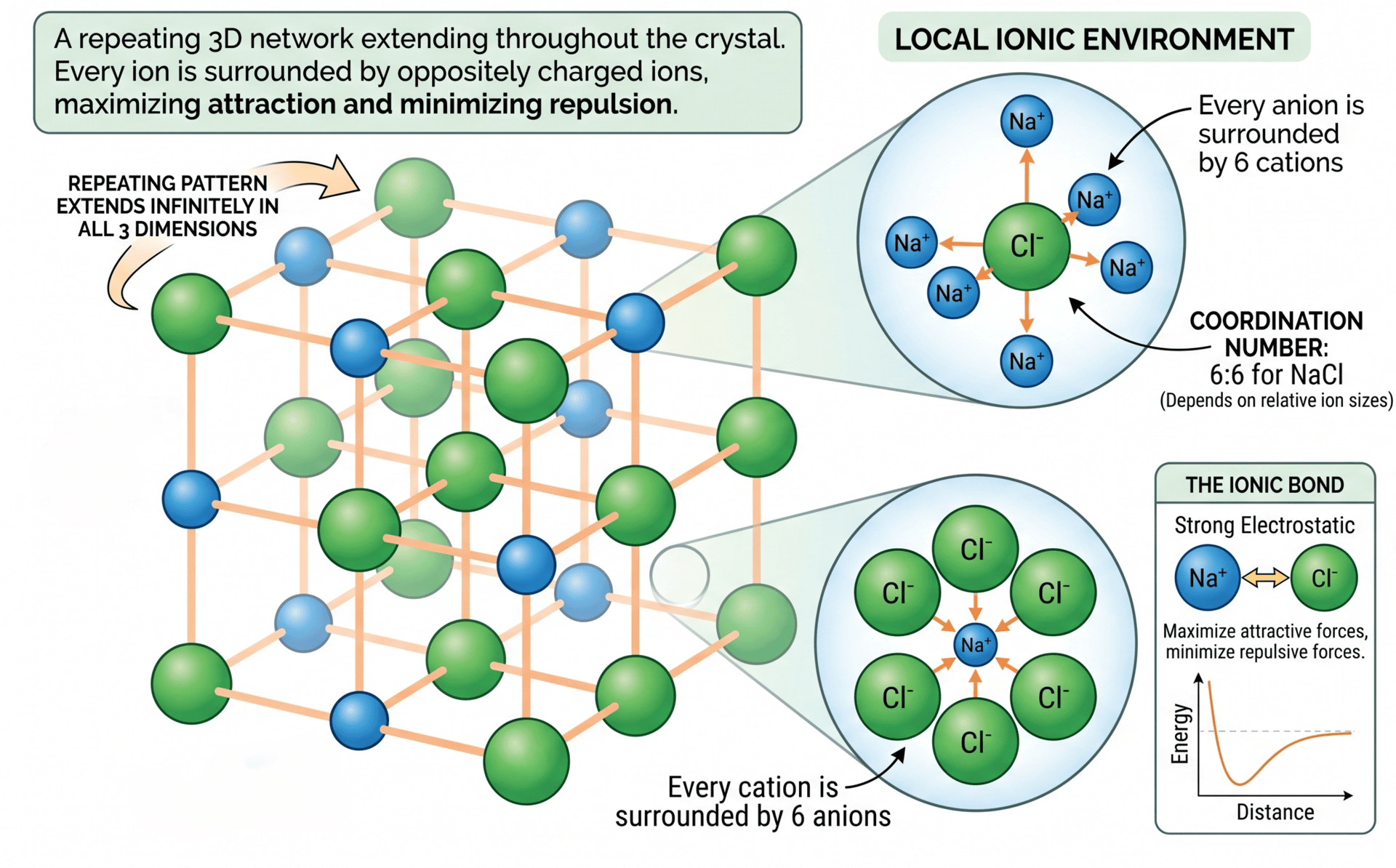
Because this structure represents a continuous web of alternating charges, there are no individual molecules. Therefore, a formula such as or does not represent a molecular formula, but rather the simplest empirical ratio of ions required to maintain electrical neutrality across the giant lattice.
Melting and Boiling Points
Ionic compounds are characterised by exceptionally high melting and boiling points. Turning a solid ionic crystal into a liquid requires inputting vast amounts of thermal energy to overcome the structural integrity of the lattice.
The Mechanics of Melting
When an ionic solid is heated, the ions gain kinetic energy and vibrate more intensely within their fixed lattice positions. To melt the substance, the thermal energy supplied must be large enough to break the strong electrostatic attractions operating uniformly throughout the giant 3D network. Because these bonds are highly stable and extend across the entire lattice, the temperature required to disrupt them is remarkably high.
Factors Affecting Bond Strength (Lattice Enthalpy)
The strength of the electrostatic forces within an ionic lattice can be quantified by its lattice enthalpy (the energy required to completely separate one mole of a solid ionic compound into its gaseous ions). The magnitude of these forces is governed by two key parameters:
1. Ionic Charge
The greater the net charge on the interacting ions, the stronger the electrostatic attraction between them.
- In Magnesium Oxide (), the lattice is composed of and ions.
- In Sodium Chloride (), the lattice consists of and ions.
Because the product of the charges in is four times greater than in , the electrostatic forces are significantly stronger. This is directly reflected in their melting points:
| Compound | Constituent Ions | Product of Charges | Melting Point (C) |
|---|---|---|---|
| Sodium Chloride |  and and  | 1 | 801 |
| Magnesium Oxide |  and and  | 4 | 2852 |
2. Ionic Radius
Smaller ions can pack more closely together within the giant lattice structure. Because the distance between the nuclei of the oppositely charged ions is minimised, the electrostatic attraction between them is stronger according to Coulomb's Law.
For example, Sodium Fluoride () has a higher melting point (993°C) than Sodium Iodide (, 661°C). This occurs because the fluoride ion () has a significantly smaller ionic radius than the iodide ion (), allowing it to form a more tightly bound, higher-energy lattice.
Electrical Conductivity
A substance can only conduct electricity if it contains mobile charge carriers that are free to move and transport an electric current through the material. The electrical conductivity of ionic compounds depends entirely on their physical state.
Solid State: Non-Conductors
In the solid state, ionic compounds are excellent electrical insulators. Although the crystal contains an enormous number of charged particles (ions), these ions are locked securely in fixed positions within the giant lattice. They can only vibrate about these fixed points and are completely unable to move or migrate when an external electric potential is applied. Because there are no mobile charge carriers, no current can flow.
Liquid and Aqueous States: Good Conductors
When an ionic compound is melted (molten) or dissolved in water (aqueous), its electrical conductivity changes dramatically:
- Molten State: High thermal energy breaks down the rigid structural framework of the giant lattice, unlocking the ions from their fixed positions.
- Aqueous State: Polar water molecules disrupt the lattice, separating the ions and surrounding them in solution.
In both states, the giant lattice is destroyed, leaving the individual positive and negative ions free to move. When a voltage is applied via electrodes, the positive cations migrate toward the negative electrode (cathode), while the negative anions move toward the positive electrode (anode). This movement of ions completes the electrical circuit, allowing a current to flow.
Mechanical Behaviour: Brittleness
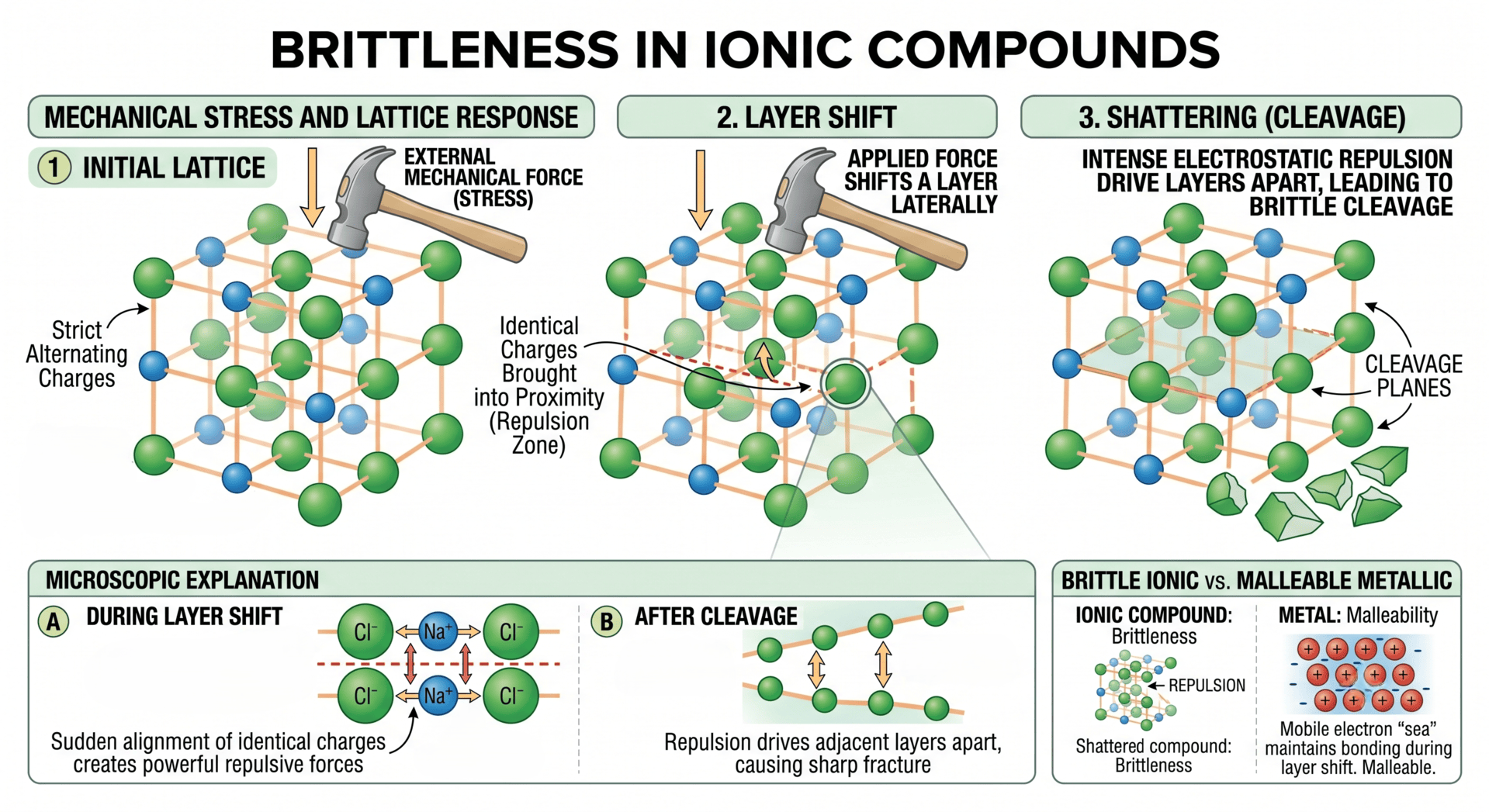
Unlike metals, which are malleable and ductile, solid ionic crystals are highly brittle. When struck with a mechanical force, such as a hammer, they do not bend or deform; instead, they shatter sharply along flat planes.
This behaviour is caused by the strict alternating arrangement of charges within the giant lattice. When an external stress or impact is applied to the crystal:
- A layer of ions is forced to shift laterally by a small distance relative to the layer beneath it.
- This shift brings ions of the same charge into direct alignment with one another (positive ions end up adjacent to positive ions, and negative ions next to negative ions).
- The sudden alignment of identical charges generates an intense, localised electrostatic repulsion between the layers.
This repulsion instantly drives the adjacent layers apart, causing the crystal structure to cleave cleanly along the boundary plane and shatter.
Solubility
The solubility of an ionic compound depends on a balance between the strength of its lattice and its interactions with the solvent molecules.
Solubility in Polar Solvents (e.g., Water)
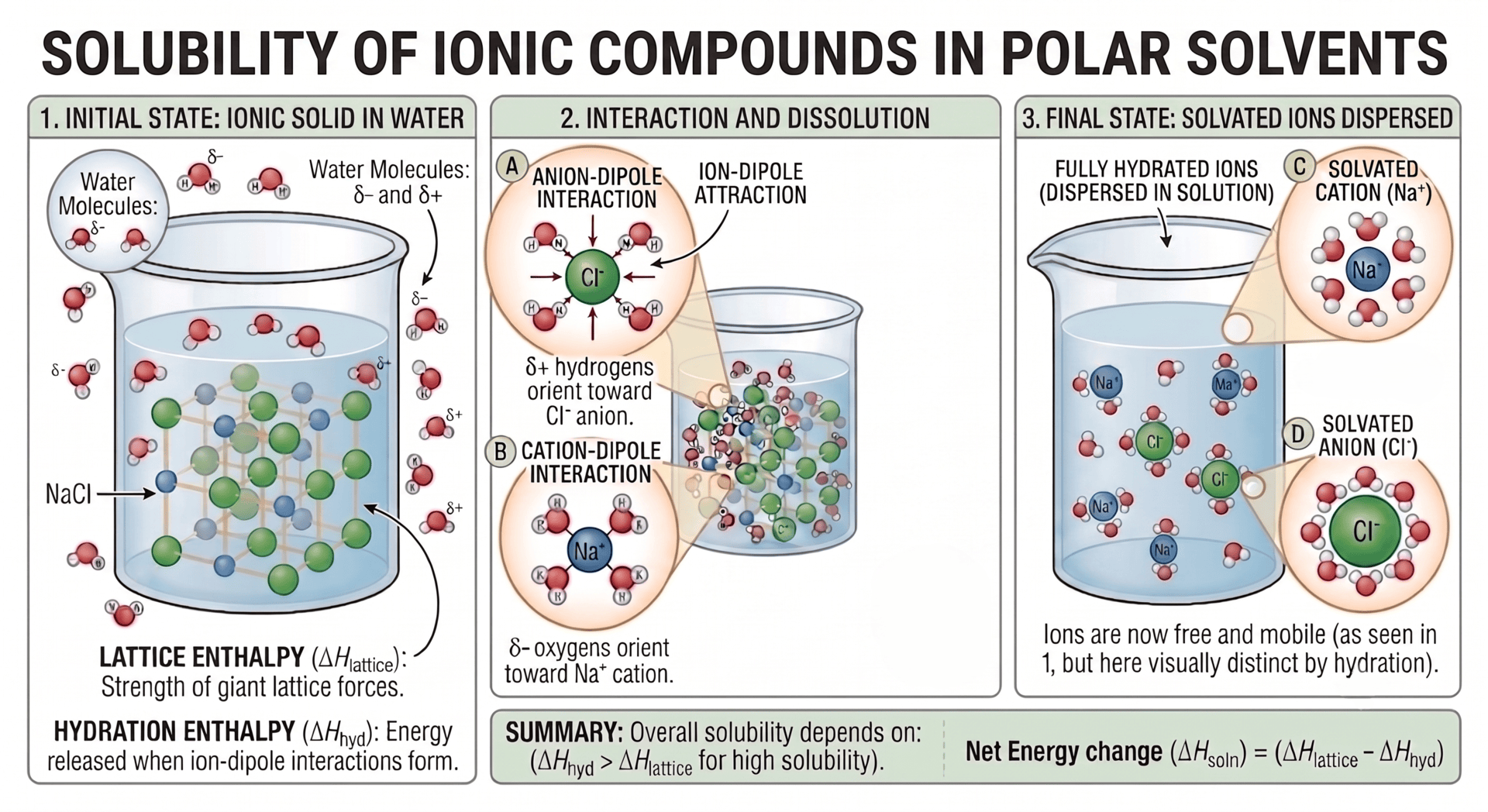
Many ionic compounds are highly soluble in polar solvents like water. Water molecules are polar because they feature a permanent dipole, resulting in a partial negative charge () on the oxygen atom and a partial positive charge () on the hydrogen atoms.
When a solid ionic crystal is placed in water, the polar water molecules cluster around the ions on the surface of the lattice:
- The oxygen atoms orient themselves toward the positive cations.
- The hydrogen atoms orient themselves toward the negative anions.
This interaction forms ion-dipole forces. If the energy released by these new ion-dipole interactions (the hydration enthalpy) is large enough to overcome the strong electrostatic forces holding the giant lattice together (the lattice enthalpy), the ions are pulled away from the crystal surface. The detached ions become fully hydrated, surrounded by shells of water molecules, and disperse throughout the solution.
Solubility in Non-Polar Solvents (e.g., Hexane)
Ionic compounds are universally insoluble in non-polar organic solvents like hexane or benzene. Non-polar solvent molecules lack permanent dipoles, meaning they cannot form stable ion-dipole interactions with the surface ions of an ionic crystal. Because there is no stabilising energy available to overcome the strong electrostatic forces of the giant ionic lattice, the crystal remains completely intact.
Exam Focus & Common Pitfalls
Exam Tip: The most common mistake A-Level students make in descriptive questions is confusing the charge carriers in ionic systems with those in metals. Solid or molten ionic compounds never contain free or delocalized electrons. When explaining the electrical conductivity of a liquid or aqueous ionic compound, you must explicitly state that the ions are free to move. Referring to "moving electrons" in this context will cause you to lose marks instantly.
Additionally, always use precise specification terminology. Do not simply state that ionic compounds have high melting points because they have "strong bonds." You must explicitly state that they have a giant ionic lattice containing strong electrostatic attractions between oppositely charged ions that require large amounts of energy to overcome.
Worked Example
Problem: Magnesium oxide () and sodium chloride () both form giant ionic lattices with identical cubic geometries. Explain, in terms of structure and bonding, why the melting point of magnesium oxide (2852°C) is significantly higher than that of sodium chloride (801°C).
Solution:
- Identify the structural classification: State that both compounds exist as giant ionic lattices containing strong electrostatic attractions between oppositely charged ions.
- Compare the ionic charges: Identify the charges of the constituent ions in each lattice. Magnesium oxide contains and ions, whereas sodium chloride contains and ions.
- Compare ionic size: Note that the ionic radius of is smaller than , and is smaller than , allowing the ions in to pack more closely together.
- Link to electrostatic forces and energy: Conclude that because the ions in have higher charges and smaller radii, the electrostatic attractions within its lattice are significantly stronger than those in . Consequently, much more thermal energy is required to overcome these forces and melt the lattice.
Practice Questions & Solutions
Describe the structure and bonding of solid potassium bromide (KBr).
Potassium bromide exists as a giant ionic lattice held together by strong, multi-directional electrostatic attractions acting uniformly between oppositely charged potassium ions ( ) and bromide ions (
 ).
).
Explain why solid sodium chloride does not conduct electricity, whereas aqueous sodium chloride is an excellent conductor.
In solid sodium chloride, the ions are locked into fixed positions within the rigid giant ionic lattice and cannot move to carry a charge. When dissolved in water to form an aqueous solution, the giant lattice is broken down, leaving the positive and negative ions free to move and carry an electrical current.
Predict and justify whether calcium sulfide (CaS) or potassium chloride (KCl) will have a higher melting point, assuming their lattices have similar geometries.
Calcium sulfide will have a significantly higher melting point. The ions in CaS ( and
and  ) have higher charges (+2 and -2) than the ions in KCl ( and , which are +1 and -1). The higher charges result in much stronger electrostatic attractions within the giant ionic lattice of CaS, requiring more thermal energy to break.
Explain the mechanism that causes a solid ionic crystal to shatter when struck with a sharp mechanical force.
An external force causes a layer of ions to shift slightly relative to the adjacent layer. This displacement aligns ions of the same charge directly next to one another. The resulting intense electrostatic repulsion pushes the layers apart, causing the crystal lattice to cleave and shatter along a flat plane.
Why are ionic compounds generally completely insoluble in non-polar organic solvents like cyclohexane?
Non-polar solvent molecules cannot form stable ion-dipole interactions with the surface ions of the ionic crystal. Because there is no stabilizing energy released to overcome the strong electrostatic attractions holding the giant ionic lattice together, the compound remains insoluble.
Related Articles:
Continue your A-Level Chemistry Revision with the following articles:
- Shapes of Covalent Compounds
- Bond Length and Bond Strength
- Covalent Bonding and Covalent Dot-and-Cross Diagrams
Summarise with AI:
Did you like this article? Rate it!

 Loading...