>

All questions on Chemistry

Why are d-block elements not as reactive as s-block elements

Why are d-block elements not as reactive as s-block elements

Answers
D block elements tend to have a more stable outer ring of electrons, when you reach D block elements they start adding electons to inner rings rather than outer so the added electrons create more stability. S block however are still lacking electrons so group 1 elements wish to lose their electrons as quickly as possbile making them very reactive, and group 7 wish to gain an electron. 
Iain H.
07 August 2017
Atoms have shells of electrons, a bit like layers of an onion. Atoms are most stable when they have full shells. The shells fill from inner to outerwards. The order is: 1st shell: 2s2nd shell: 8 (2s + 6p)3rd shell: 18 (2s + 6p + 10d)4th shell: 32 (2s + 6p + 10d + 14f)The s shell is the closest to the atom, and holds upto 2 electrons. When an atom is an s block elements, the atom has a full shell along with 2 s electrons in the next and most outwards shell. The easiest thing to do, in order to achieve stability, is to lose the 2 electrons. This is done by joining with another atom and donated the 2 extra electrons. The smaller the number of extra electrons, the easier they are to lose, and the easier it is to then end up with a full outer shell. This is why the s-block elements are so reactive.
Mehraz C.
12 August 2017
The reactivity of elements reduces as you move from left to right in a periodic table. S-block elements have one or two electrons in the outer most shell (valence shell) which makes them easier to move/share while reacting with other elements. On the other hand, in D-block the valence shell electron increases and its gets litter bit harder for them to react as compare to S-block elements.
mufaddal.murtaza
15 August 2017
The transition metals are characterized by partially filled d subshells in the free elements and cations. The ns and (n − 1)d subshells have similar energies, so small influences can produce electron configurations that do not conform to the general order in which the subshells are filled. In the second- and third-row transition metals, such irregularities can be difficult to predict, particularly for the third row, which has 4f, 5d, and 6s orbitals that are very close in energy. The increase in atomic radius is greater between the 3d and 4d metals than between the 4d and 5d metals because of the lanthanide contraction. Ionization energies and electronegativities increase slowly across a row, as do densities and electrical and thermal conductivities, whereas enthalpies of hydration decrease. Anomalies can be explained by the increased stabilization of half-filled and filled subshells. Transition-metal cations are formed by the initial loss of ns electrons, and many metals can form cations in several oxidation states. Higher oxidation states become progressively less stable across a row and more stable down a column.The s-block elements are the 14 elements contained within these columns. All of the s-block elements are unified by the fact that their valence electrons (outermost electrons) are in an s orbital. The s orbital is spherical and can be occupied by a maximum of two electrons. Elements in column 1 have one electron in the s orbital, and elements in column 2 (plus helium) have two electrons in the s orbital.
dykes
17 August 2017
The transition metals are less reactive than s block elements. This is due to their higher heats of sublimatiin , higher ionization energies and lesser hydration energies of their ions.
Abdulla
09 November 2020
Which is the most reactive agent in d block of modern periodic table?
Arnab Pal
07 June 2022
>
Add an answer

Similar questions

Reacting Carbon Dioxide with Lime water

You may often come across a question "What gas turns limewater cloudy?" The answer to this question is well known. Carbon dioxide is the only gas that turns lime water cloudy. You may be wondering what is lime water used for. Limewater is an aqueous solution of slaked lime and you will find it in antacids, medicines and lotions. But one of its most noteworthy property is that it is used to absorb carbon dioxide from the air. In this article, we have answered all the questions related to the reaction of lime water and .

What happens when Lime Water reacts to Carbon Dioxide?

Carbon dioxide reacts with limewater to form calcium carbonate, which precipitates out of the solution. The carbon dioxide and limewater react to produce water in addition to the calcium carbonate. Calcium carbonate is chalk, and when it is produced, it precipitates and solid particles of chalk appear. The appearance of this solid makes the liquid appear ‘milky’. The white milky suspension/precipitate is caused by the formation of calcium carbonate. The characteristic carbon dioxide test, is checking that the limewater is milky. This is because chalk is precipitating in the limewater. Bubbling carbon dioxide through the solution for an extended period of time makes the solution become clear and colorless. This happens as the carbon dioxide forms acidic carbonic acid when it dissolves in the water, the carbonic acid (H2CO3) reacts further with the calcium carbonate. This chemistry is important in understanding how hard water is formed and then limescale is formed in kettles and hot water boilers.

Carbon dioxide and lime water experiment
What happens when you mix carbon dioxide and lime water?

Written as an Equation

In its equation form that makes:

How to test for carbon dioxide?

Now, we will answer how to test for carbon-dioxide. One of the most effective ways to test for carbon dioxide gas is the limewater test. When carbon dioxide reacts with lime water (calcium hydroxide solution), a white precipitate of calcium carbonate is produced. The solution of calcium hydroxide is limewater and if carbon dioxide bubbles through the limewater, it turns cloudy white or milky.

How does carbon dioxide turns lime water milky?

When limewater which is a solution of calcium hydroxide, reacts with the carbon dioxide gas, an insoluble solid known as calcium carbonate is generated. The equation of this reaction is given below:

Now, the question arises why the solution turns milky. Well, the answer is simple, The reason for the milky solution is that calcium carbonate which is produced as a result of this reaction is a white precipitate. This nature of calcium carbonate also helps us to test for the presence of carbon dioxide gas. All you have to do is to bubble the gas through a solution of calcium hydroxide. If the gas is carbon dioxide, then the solution will turn milky. If not then the gas which is subjected to the test is not carbon dioxide. If you continue to bubble the carbon dioxide gas through limewater, you will witness another acid-base reaction that will dissolve the precipitate to generate soluble calcium hydrogen carbonate. The equation of this reaction is given below:

This reaction shows another phenomenon that we may have seen in our daily lives. The naturally occurring acid rain chemically erodes the limestone and results in the formation of a cave. As this solution evaporates, the reverse reaction occurs which results in the formation of stalagmites and stalactites.

What is the reaction between carbon dioxide and water?

When carbon dioxide reacts with water, it dissolves, while some of it reacts with water molecules to generate an acidic solution known as carbonic acid.  Limewater and reaction results in a carbonic acid. It is a weak acid and it is in an aqueous form, i.e., it is a water solution. The chemical equation of this reaction is given below:

Since it is a weak acid, therefore some of it dissociates to generate H+ ions. This depicts it is a slightly acidic solution that forms hydro carbonate ion.

All of these reactions are reversible.

Does lime water absorb carbon dioxide?

Yes, limewater absorbs carbon dioxide. When lime water and carbon dioxide reacts, calcium carbonate is generated along with the water. Calcium carbonate is an insoluble salt. The equation of this reaction is given below:

Why is lime water used in experiments?

Limewater is used in experiments because it is the easiest way to detect the presence of gas. Limewater is a calcium hydroxide solution that produces a white precipitate of calcium carbonate when it reacts with carbon dioxide. The white precipitate can be easily detected by the person conducting the experiment. Due to this fact, you will often see that limewater is used to detect the presence of carbon dioxide.

Copper Oxide and Sulphuric Acid Reaction

The reaction between copper(II) oxide and sulphuric acid is a classic chemistry experiment often used to demonstrate how acids react with metal oxides.

In this reaction, a base (the metal oxide) reacts with an acid to produce a salt and water. This specific reaction is widely used in schools to prepare crystals of copper(II) sulphate.

Reactants and Products

To understand this reaction, we must first identify the physical states and colours of the chemicals involved:

  • Copper(II) oxide (CuO): This is the reactant. It is a black solid powder. It is a base because it can neutralise an acid.
  • Sulphuric acid (H₂SO₄): This is the acid. It is typically used as a clear, colourless aqueous solution (dissolved in water).
  • Copper(II) sulphate (CuSO₄): This is the product (the salt). In solution, it is a characteristic bright blue colour.
  • Water (H₂O): This is the liquid by-product.
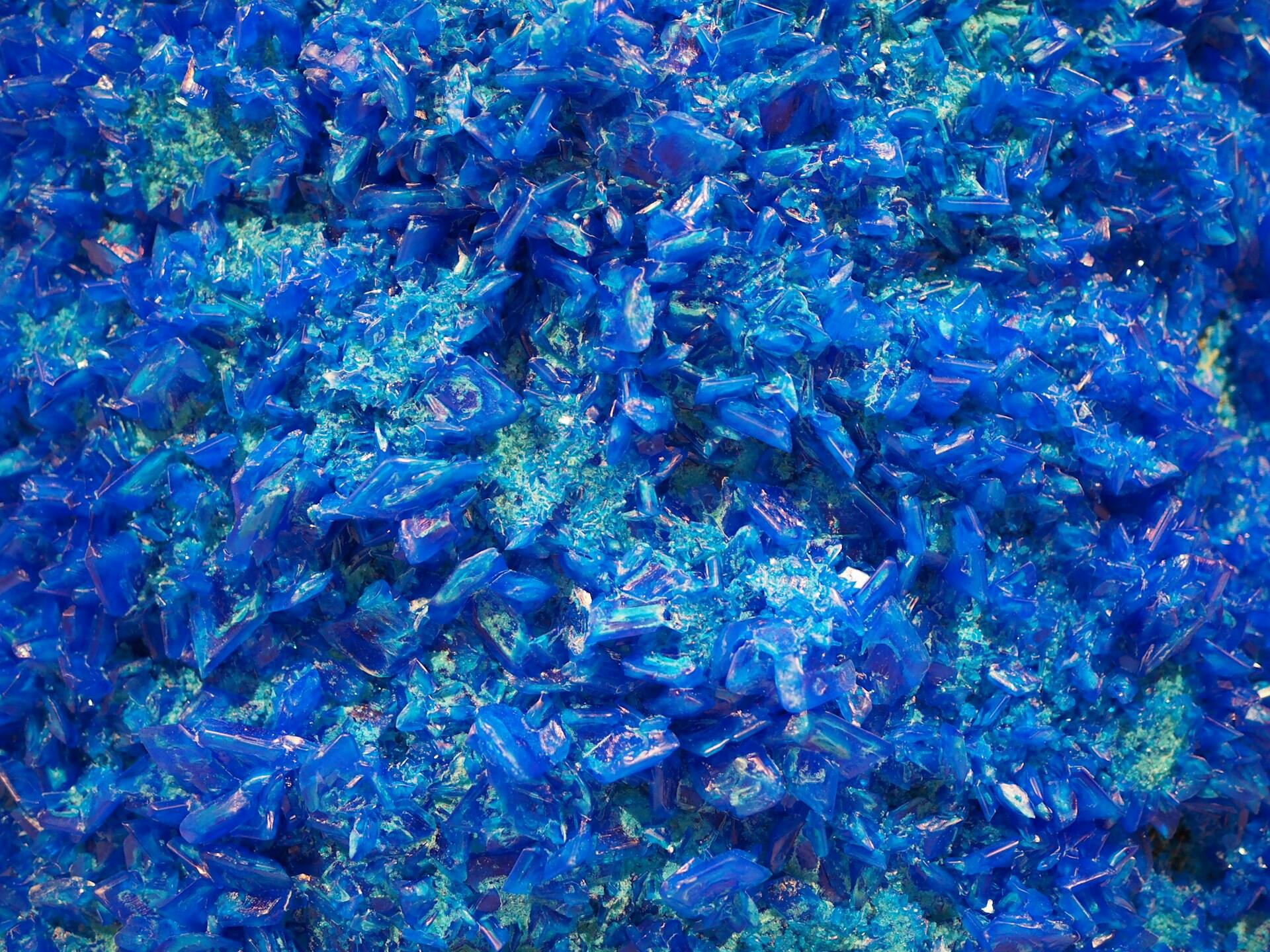
large, fine blue copper sulphate crystals
Copper Sulphate Crystals - Photo by Kunal Kalra on Unsplash

Chemical Equation

We can write this reaction in two ways.

Word Equation: Copper(II) oxide + Sulphuric acid → Copper(II) sulphate + Water

Balanced Symbol Equation: The symbol equation including state symbols is:

What Type of Reaction Is It?

This reaction is classified as a neutralisation reaction.

Neutralisation occurs when an acid reacts with a base. In this case, the copper(II) oxide acts as the base (specifically a metal oxide) and the sulphuric acid provides the hydrogen ions (H⁺).

The general formula for this type of neutralisation is:

Practical Overview & Observations

If you were to carry out this reaction in a laboratory to create copper sulphate crystals, you would follow these steps:

  1. Heat the acid: Warm dilute sulphuric acid in a beaker (do not boil it).
  2. Add the base: Add the black copper(II) oxide powder to the acid a little at a time, stirring constantly.
  3. Observe: The mixture will turn from colourless to blue.
  4. Excess: Continue adding copper oxide until no more reacts. You will see black powder sitting at the bottom of the beaker. This ensures all the acid has been neutralised.
  5. Filter: Filter the mixture to remove the excess black copper oxide. You are left with a clear blue solution of copper(II) sulphate.

The most important visual change is the black solid disappearing and the solution turning a transparent blue.

beenhere
Important Safety Points

Wear safety goggles to protect eyes from the acid.Handle warm acid with care to avoid burns.

Summary

  • Reactants: Black copper(II) oxide solid and colourless sulphuric acid.
  • Products: Blue copper(II) sulphate solution and water.
  • Type: Neutralisation (Acid + Metal Oxide).
  • Observation: Black powder dissolves; solution turns blue.