In this article, we will discuss the root hair cells of the plant in detail. We will specifically focus on their function and how they help the plant to maximize absorption of water by osmosis and mineral ions by active transport. But before jumping onto the root hair cells, first, let us discuss what is a transport system in plants and why this system is important.









Transport System in Plants
Plants need a transport system for the delivery of raw materials to the leaves so that they can photosynthesize. This system also plays a crucial role in the delivery of sugar to other parts of the plants. Transportation in plants is critical for their survival. For instance, trees carry water and nutrients it requires from their roots to the tips of the leaves.
As far as transportation in plants is concerned, the biggest constraint is water because it also acts as a limiting factor in the growth of the plants. To overcome this issue, trees and all other plants have a seamless transport system that helps in the absorption and translocation of water.
Transportation in plants occurs at the following three levels:
- Transportation of substances between the cells
- Long-distance transportation of sap within xylem and phloem.
- The release and uptake of water and solute by individual cells.
Root hair cells play a fundamental role in the absorption of water and mineral ions from the soil which is further transported to other parts of the plant.
In the next sections of the article, you will learn how water and mineral ions are absorbed by root hair cells through osmosis and active transport. But before discussing the entire process, first, let us see what are root hair cells.
What are Root Hair Cells?
Water absorption occurs in root hairs. Root hair cells are present in the roots of the plants. Root hairs refer to the long and thin hairs that can penetrate between the soil particles. The larger surface area of the root hairs allows them to absorb water. Root hair cells are adapted to uptake water through osmosis and mineral ions through active transport.
How Root Hair Cells Absorb Water and Mineral Ions From the Soil?
The process by which the water passes from the soil to the root hair cell cytoplasm is known as osmosis. This occurs because the water concentration in soil is higher than the cytoplasm of the root hair cell. Although the concentration of water in the soil water is higher, however, the concentration of dissolved solutes in soil is lower. On the other hand, the water concentration in the root hair cell cytoplasm is lower, but the concentration of dissolved solutes is higher.
To maintain the concentration gradient, water moves constantly from the soil into the root hair cell through osmosis. The root hair cells also absorb mineral ions from the soil against the concentration gradient by active transport. They have the larger surface area to volume ratio which maximizes their ability to absorb water and mineral ions from the soil. Root hair cells also have plenty of mitochondria that releases energy from glucose during respiration so that the energy can be provided to the cell for active transport.
Summary of the process
The above process can be summarized as:
- Root hair cells penetrate between the soil particles and are adapted for absorbing water and minerals from the soil.
- Root hair cells have an enhanced surface area which results in an increased rate of mineral ions absorption through active transport
- There is a higher concentration of dissolved minerals and sugars in the cytoplasm of the root hair cells that results in a lower concentration of water. It means a root hair cell cytoplasm is less watery
- This is the reason for the movement of water in and out of the cell through osmosis.
The following diagram shows a root hair cell.
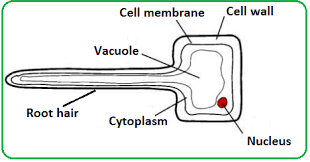
In the next section, we will discuss why water absorption and transportation are critical for certain functions in the plant.
Importance of Water for the Plant
The water absorbed by root hair cells is then transported through the roots to the remaining parts of the plants which serves different purposes such as:
- It acts as a reactant for the process of photosynthesis [Photosynthesis is a process by which plants make their food]
- It keeps the cells rigid to support leaves and shoots
- The water reaches leaves where it is evaporated to maintain temperature
- It carries dissolved minerals around the plants
Water Transport From Root to Leaf
So far, we have discussed how root hair cells absorb water and mineral ions from the soil. In this section, we will address another important question which is how water is carried from root to leaf.
- Water passes into the root hair cells through osmosis and using the same process it enters into the xylem vessels.
- After the water enters the xylem vessels, it is transported up to the leaves of the plants where it enters mesophyll cells.
- In short, the pathway of water is from root hair cells to root cortex cells, then further up to the xylem and from there to the leaf mesophyll cells.
In the next section, we will discuss how can we investigate the water pathway through a simple experiment.
Investigating the Water Pathway
You can investigate the pathway described above through the following method:
- Place a celery plant into a water beaker that had colored water in it. Simply add some food color to the water in a beaker to achieve colored water.
- After some hours, you will observe that the leaves of the celery will be of the same color as the water in the beaker.
Now, what does it prove?
Well, it proves that the water is taken up to the celery through roots. If you cut a cross-section of the celery, then you will observe that only specific areas of the stalk are dyed in the color of the water. This shows that water is transported through certain vessels through the stems. These vessels are known as xylem vessels.
Summarise with AI:
Did you like this article? Rate it!


 Loading...
i like the article
Hi Sam! Thank you! Great to hear that you found this resource useful.
welcome
Hi Suunu! Thanks for reaching out. Hope you’ve found this resource useful 😊!
i have learnt a lot which i did not know
am senior three student but this is cool
Am impressed
Am impressed
learning is the best