








Introduction
Life on Earth relies on a constant supply of elements like carbon, hydrogen, nitrogen, and oxygen. However, these resources are finite. We cannot create new matter; we must reuse what we have. This concept is known as the recycling of nutrients.
In an ecosystem, elements circulate between the living (biotic) and non-living (abiotic) worlds. This movement is driven by biological, chemical, and geological processes. Microorganisms, such as bacteria and fungi, play a crucial role in this recycling by breaking down dead matter (decomposition) and releasing nutrients back into the soil and atmosphere.
In this article, we will examine the three critical cycles: the Water Cycle, the Carbon Cycle, and the Nitrogen Cycle.
Check out our article on Ecology Terms to get a head start here.
The Water Cycle
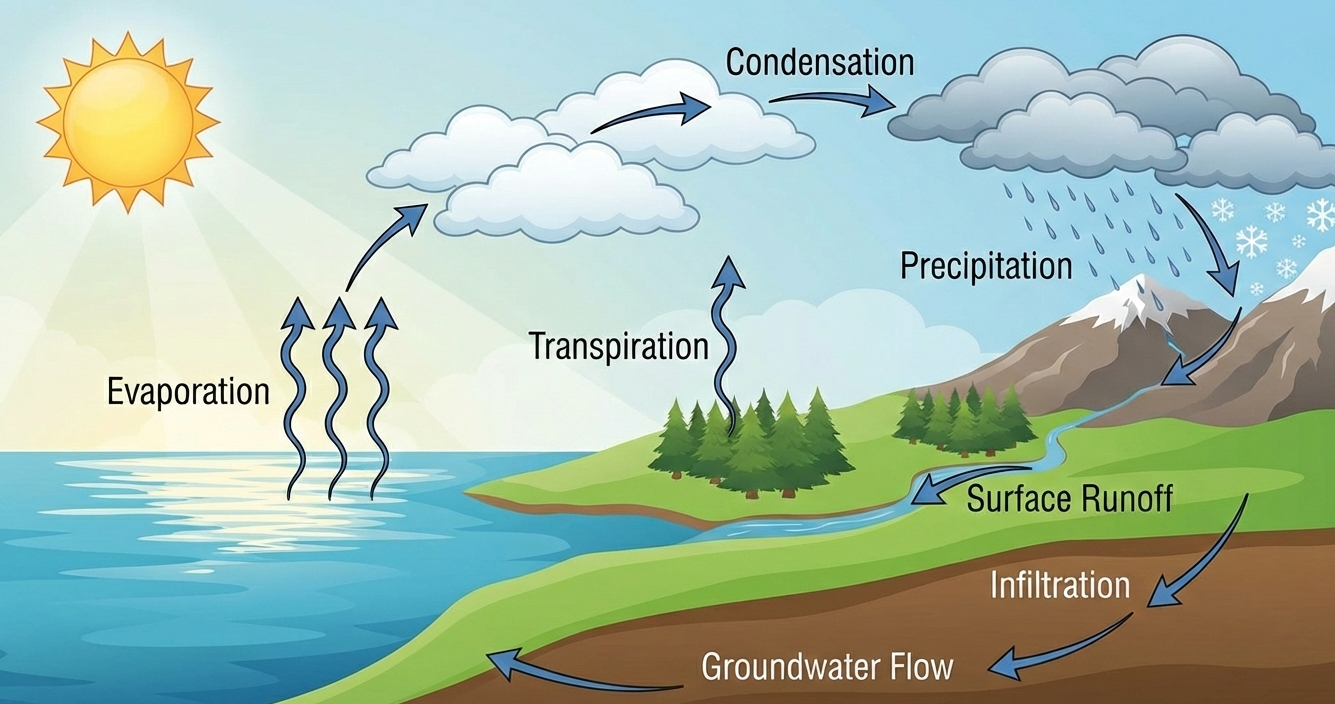
Water is essential for all living organisms. The water cycle describes how water moves continuously through the land, ocean, and atmosphere. It is a physical process driven primarily by energy from the Sun.
Key Processes
- Evaporation: The Sun heats water in oceans, lakes, and rivers. The water turns from liquid to gas (water vapour) and rises into the atmosphere.
- Transpiration: This is the loss of water vapour from plants. Plants absorb water through their roots (via the xylem) and release it into the air through tiny pores in their leaves called stomata.
- Condensation: As water vapour rises, it cools. It turns back into liquid water droplets, forming clouds.
- Precipitation: When water droplets in clouds become too heavy, they fall back to Earth as rain, snow, hail, or sleet. This is fresh water (it contains no salt).
- Surface Runoff & Infiltration: Water flows over the ground into rivers (runoff) or soaks into the soil (infiltration) to become groundwater stored in aquifers.
The Carbon Cycle
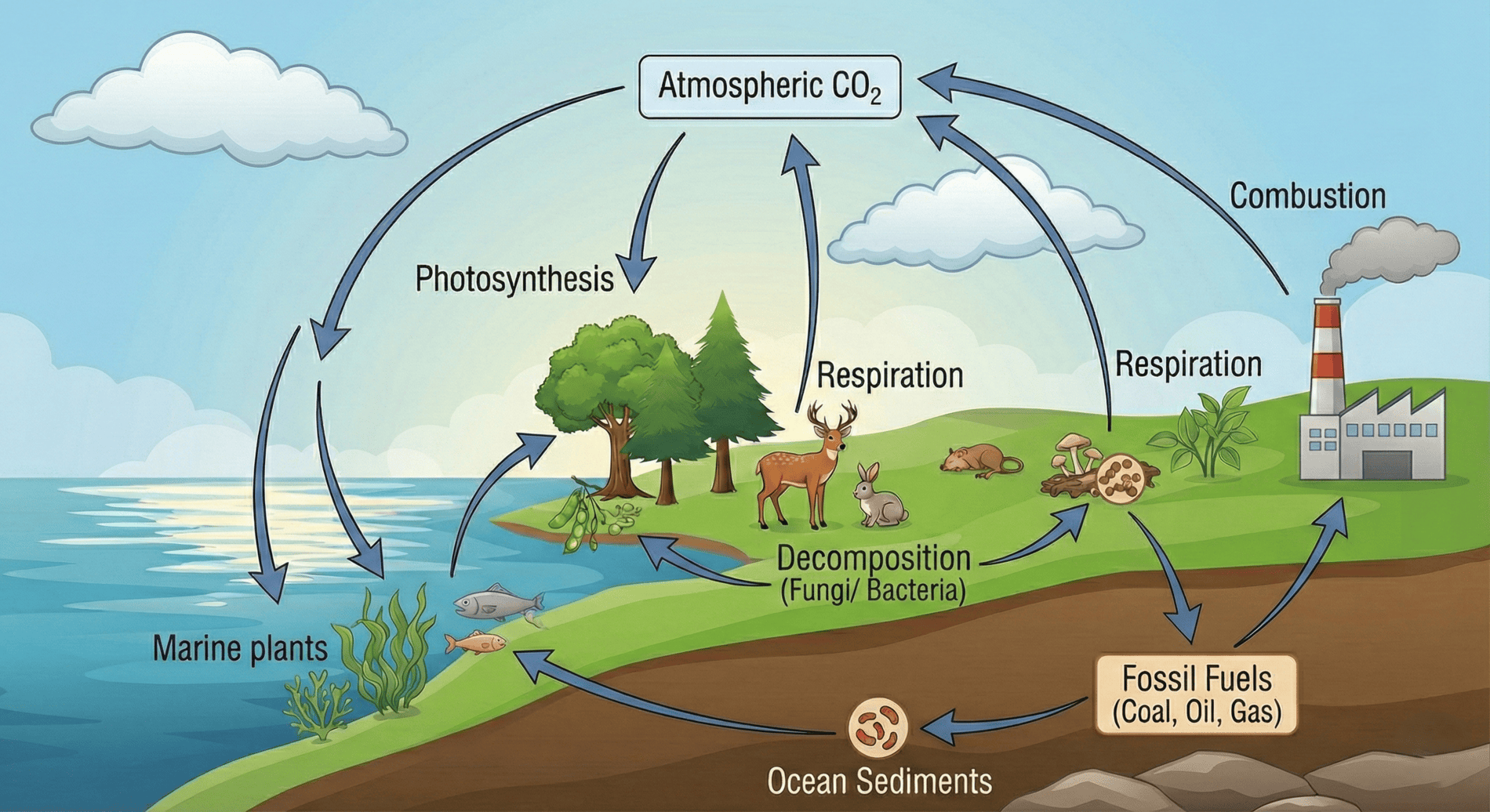
Carbon is the building block of life. It is found in carbohydrates, fats, proteins, and DNA. The carbon cycle is the movement of carbon between the atmosphere, oceans, soil, and living organisms.
Key Processes
1. Removing Carbon Dioxide from the Atmosphere
- Photosynthesis: Green plants and algae absorb carbon dioxide from the atmosphere. Using sunlight, they convert it into glucose (sugar) and oxygen.

2. Returning Carbon Dioxide to the Atmosphere
- Respiration: All living organisms (plants, animals, and microorganisms) need energy. They break down glucose using oxygen, releasing carbon dioxide back into the air.

- Combustion: Fossil fuels (coal, oil, and gas) are made of dead organisms that were buried for millions of years. When we burn them, the trapped carbon is released rapidly as carbon dioxide.
- Decomposition: When plants and animals die, decomposers (bacteria and fungi) break down their bodies. As these microorganisms respire, they release carbon dioxide into the atmosphere.
The Nitrogen Cycle
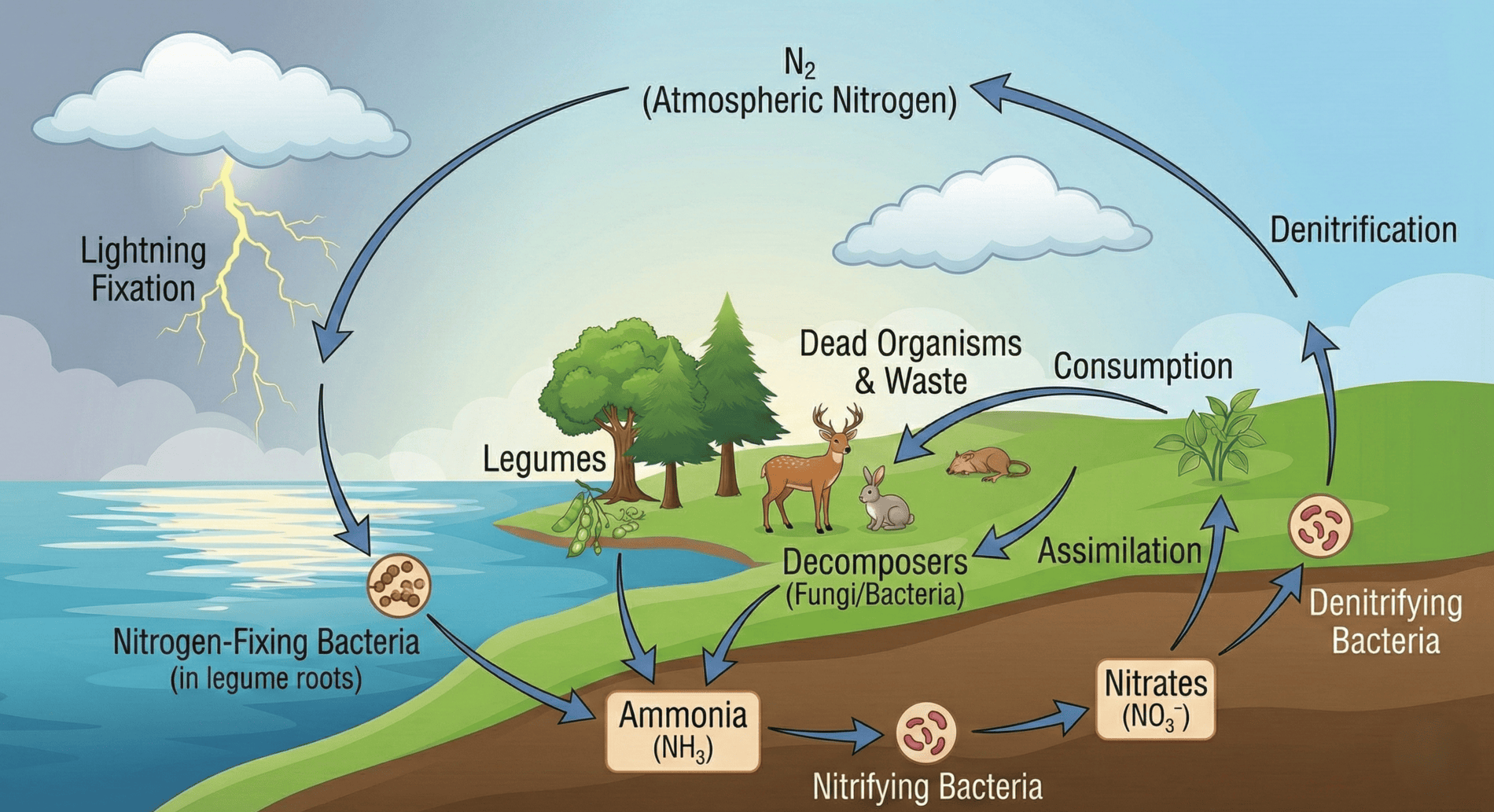
Nitrogen is essential for making proteins and DNA. Although 78% of the Earth's atmosphere is nitrogen gas, plants and animals cannot use it directly because it is too unreactive. It must be converted into a usable form, such as nitrates.
Key Stages
Stage 1: Nitrogen Fixation This is the process of turning nitrogen gas from the air into nitrogen compounds in the soil.
- Nitrogen-fixing bacteria: These live in the soil or in the root nodules of legumes (like peas and beans). They convert nitrogen gas into ammonia/nitrates.
- Lightning: The energy from lightning splits nitrogen gas, allowing it to react with oxygen to form nitrates, which dissolve in rain and enter the soil.
- Haber Process: Humans produce fertilisers industrially by turning nitrogen gas into ammonia.
Stage 2: Absorption and Assimilation - Plants absorb nitrates from the soil through their roots. They use the nitrogen to build plant proteins. Animals then eat the plants and convert plant proteins into animal proteins.
Stage 3: Ammonification (Decomposition) - When plants and animals die, or when animals produce waste (urine/faeces), bacteria and fungi break down the protein and urea. This releases nitrogen back into the soil as ammonia (ammonium ions).
Stage 4: Nitrification - Nitrifying bacteria in the soil convert the ammonia back into nitrates, which plants can absorb again. This keeps the cycle moving.
Stage 5: Denitrification - Denitrifying bacteria thrive in waterlogged soil (where there is low oxygen). They convert nitrates back into nitrogen gas, releasing it into the atmosphere. This reduces the fertility of the soil.
Learn more about Decomposition and Decay in our article here.
Summary of Bacteria in the Nitrogen Cycle
It is easy to confuse the different types of bacteria. Here is a summary table:
| Type of Bacteria | Role | Input | Output |
|---|---|---|---|
| Nitrogen-fixing bacteria | Turns air nitrogen into soil nutrients | Nitrogen gas | Nitrates/Ammonia |
| Decomposers | Breaks down dead matter | Proteins/Urea | Ammonia |
| Nitrifying bacteria | Converts ammonia to nitrates | Ammonia | Nitrates |
| Denitrifying bacteria | Releases nitrogen back to air | Nitrates | Nitrogen gas |
Practice Questions & Answers
Explain how carbon is cycled from the atmosphere into living organisms and back again. Describe the specific processes involved and the role of decomposers.
Carbon enters the biological world via photosynthesis, where plants and algae absorb atmospheric carbon dioxide to produce glucose. Animals obtain this carbon by feeding on plants. Carbon is returned to the atmosphere through aerobic respiration in both plants and animals. When organisms die, decomposers (bacteria and fungi) break down organic matter, releasing carbon back into the atmosphere as carbon dioxide through their own respiration.
Differentiate between the roles of nitrogen-fixing bacteria and denitrifying bacteria in an ecosystem.
Nitrogen-fixing bacteria convert inert atmospheric nitrogen gas into ammonia or nitrates, making nitrogen available for plant uptake. In contrast, denitrifying bacteria convert nitrates in the soil back into nitrogen gas, typically in anaerobic conditions like waterlogged soil, which reduces the fertility of the land.
Define the term transpiration and explain its significance in the water cycle.
Transpiration is the loss of water vapour from the aerial parts of a plant, primarily through the stomata in the leaves. It is a vital part of the water cycle as it acts as a biological "pump," moving water from the soil into the atmosphere, which later contributes to cloud formation and precipitation.
Topic Overview
Ecosystems rely on the continuous recycling of essential nutrients. The Water Cycle distributes moisture, the Carbon Cycle regulates energy and the atmosphere, and the Nitrogen Cycle provides the building blocks for proteins and DNA. Understanding these cycles helps us appreciate the delicate balance of nature and the vital role microorganisms play in sustaining life on Earth. Use the table below to help remember the key characteristics of each cycle:
| Cycle | Core Processes | Primary Reservoirs | Biological Importance |
|---|---|---|---|
| Carbon Cycle | Photosynthesis, Respiration, Combustion, Decomposition | Atmosphere (carbon dioxide), Fossil Fuels, Oceans, Living Biomass | Essential for building organic molecules like carbohydrates, proteins, and lipids. |
| Nitrogen Cycle | Nitrogen Fixation, Nitrification, Denitrification, Ammonification | Atmosphere (nitrogen), Soil (Nitrates/Ammonium) | Necessary for the synthesis of amino acids, proteins, and DNA/RNA. |
| Water Cycle | Evaporation, Transpiration, Condensation, Precipitation | Oceans, Atmosphere (Water Vapour), Ground Water (Aquifers) | Maintains turgor pressure in plants and provides the medium for metabolic reactions. |
Exam Board Resources
For detailed curriculum specifications and teaching notes on these cycles at the GCSE level, you can refer to the official exam board websites:
- AQA GCSE Biology: The "Ecology" section covers the importance of cycles, AQA Biology Specification (8461)
- Edexcel GCSE Biology: Detailed guidance on nutrient cycling is found under "Ecosystems and Material Cycles", Edexcel Biology Specification
- OCR Gateway Biology: Topic B6 focuses on "Global Challenges," including the carbon and nitrogen cycles, OCR Biology A Specification
Summarise with AI:
Did you like this article? Rate it!


 Loading...
i like the article
Hi Sam! Thank you! Great to hear that you found this resource useful.
welcome
Hi Suunu! Thanks for reaching out. Hope you’ve found this resource useful 😊!
i have learnt a lot which i did not know
am senior three student but this is cool
Am impressed
Am impressed
learning is the best