The cells, tissue, and organs of plants have specific adaptations so that they can perform certain functions that are critical for the survival of the plant. The root, stem, and leaves of the plant create an organ system that carries substances into, around, and out of the plant. Transpiration is an important function in plants that is essential for its various functions. In this article, we will discuss transpiration, its functions, and factors that affect it in detail.









Transpiration
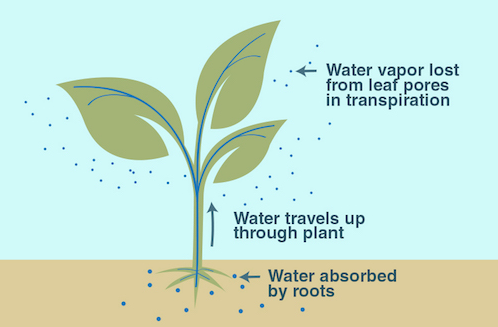
The water on the surface of the cells of palisade and spongy mesophyll cells evaporates and diffuses out of the leaf as the plant opens its stomata to allow carbon dioxide inside it. This process is referred to as transpiration.
A more formal definition of transpiration is given below:
Loss of water vapor from the leaves of the plant due to evaporation of water at the surfaces of mesophyll cells along with the diffusion of water vapors through stomata.
Process
- Water from the roots travels up the xylem and gets into the leaves of the plant to replace the water that was lost because of transpiration.
- There is a strong attraction between the water molecules that are present inside the xylem cells.
- This strong cohesion between the water molecules is attributed to hydrogen bonding.
- Hence, an uninterrupted column of water is pulled up the stem in the transpiration stream by evaporation from the leaves.
- The water taken up by the roots replace the water that travels through the xylem in the stem and leaf.
Functions of Transpiration
The process of transpiration is a result of photosynthesis. Plants only utilize 5% of the water for photosynthesis. Transpiration has many functions in plants which are listed below:
- Transpiration transports mineral ions
- It provides water to the plant to keep the cells turgid. The turgidity of the cells support the structure of the plant
- Due to transpiration, the leaves of the plant get water for photosynthesis. Remember that water is one of the factors that are crucial for photosynthesis.
- It helps to keep the leaves cool by converting water into water vapours. The plant is cooled down because the process of transpiration requires heat energy to convert water into water vapours.
Water uptake and transport across the root
The single-celled extensions of the epidermal cells in the roots are the root hair cells that grow between the soil particles. These cells absorb water and mineral ions present in the soil. Through the process of osmosis, water gets into the root hair cells. This occurs because soil water contains a higher water potential than the cytoplasm of the root hair cell. On the other hand, mineral ions enter through active transport.
Factors Affecting Transpiration
Many factors can affect the rate of transpiration in plants. Some of these factors are:
- Temperature
- Air movement
- Humidity
- Intensity of light
Let us now discuss how these factors affect the rate of transpiration.
Affect of temperature on transpiration
The increase in temperature increases the rate of transpiration. This is because the increase in temperature increases the molecular movement. Due to the enhanced molecular movement, more water molecules evaporate from the surfaces of the cell and the rate of the diffusions from the leaf increases.
Affect of air movement on transpiration
The increase in air movement increases the rate of transpiration. This is because more air movement means more water vapours are removed from the surfaces of the leaf and more water diffuses from the leaf.
Affect of Humidity on transpiration
The decrease in humidity increases the rate of transpiration. This is because of the reduced concentration of water molecules outside the leaf and the consequent increase in the diffusion of water from the leaf.
Affect of light intensity on transpiration
The increase in light intensity increases the rate of transpiration. This is due to the fact that an increase in light intensity increases the ability of the plant to photosynthesize and stomata open so that water can diffuse out of the leaf.
Plants living in various habitats have adapted to resist extremes of the above-discussed factors.
Investigating transpiration through potometers
The water uptake can be measured using a device known as a potometer. Under normal circumstances, the water uptake tells us the measure of the rate of transpiration.
A simple potometer refers to the piece of capillary tubing to which the plant is attached. The uptake of water is measured by recording the time a bubble in the tube takes to cover a specific distance.
The objective of the experiment
The objective of this experiment is to calculate the rate of water uptake of the plant.
Method
Follow the method below to conduct this experiment:
- Fill the potometer with water
- Cut a shoot from a woody plant. To guarantee that the xylem remains filled with water and prevents sir locks, the edge of the shoot is cut underwater.
- Insert the shoot in the rubber tubing at the end of the potometer
- Raise the potometer to take up the bubble of air
- Lower the potometer into the water. Record the distance covered by the air bubble over a time period.
Variables
The variables of this experiment are:
- Time which is an independent variable
- The distance is covered by the bubble along with the capillary tubing. It is a dependent variable.
- Temperature, sufficient water supply, and airflow or draughts. These are control variables.
Risks
Caution must be made when inserting the shoot of the plant into the rubber tubing connected to the capillary tube. Care should also be taken with the scissors used to cut the shoot of the plant.
Table and graph
Make a table of values and plot the graph. The gradient of the graph will tell the rate of water uptake.
Investigating the Effect of Environmental Factors on Water Using Potometers
The yield of the crop is affected when they do not get sufficient water. Different factors affect transpiration and water uptake which can be investigated through a potometer. Scientists simulate the conditions the plants usually encounter in the laboratory. For instance:
- A plant may encounter windy conditions. These conditions are simulated in the laboratory using a fan.
- Plants encounter airborne pollution which is simulated in the laboratory by smearing petroleum jelly on the surface of the leaf.
- Plants can encounter high light intensities due to sunny climates and artificial lighting in greenhouses. These conditions can be simulated in the laboratory using artificial lighting.
- Plants may be located in warm and hot climates. These conditions can be simulated in the laboratory using a heater or greenhouse.
Summarise with AI:
Did you like this article? Rate it!


 Loading...
i like the article
Hi Sam! Thank you! Great to hear that you found this resource useful.
welcome
Hi Suunu! Thanks for reaching out. Hope you’ve found this resource useful 😊!
i have learnt a lot which i did not know
am senior three student but this is cool
Am impressed
Am impressed
learning is the best