In this article, you will learn the transport of water and mineral ions in plants. We will specifically discuss the functions of xylem and phloem, root hair cells, pathway taken by water through root, stem, and leaf as root hair cell, root cortex cells, xylem and mesophyll cells, and pathway of water through the above-ground parts of a plant. So, let us get started.









Introduction
All kinds of organisms need a transport system to transport water and other substances to other parts of the body when they are required. Plants do not have a heart, blood, or circulation system like the human body has, but they have a network of veins or vascular bundles that run between roots to the leaves for the transportation of water and mineral ions. There are two types of vessels within a vascular bundle:
- Xylem vessel
- Phloem vessel
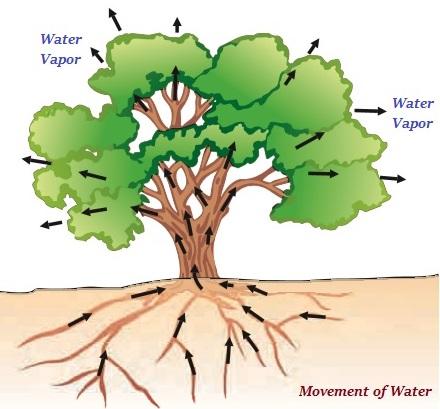
In the next section, we will discuss the functions of the xylem and phloem vessels.
Functions of Xylem and phloem Vessel
Vascular bundles are present in the stems and roots.
- Xylem: The xylem is in the centre of the vascular bundle. The xylem vessels are the dead cells that are stacked end to end. They form a tube-like structure and are responsible for the transportation of water and dissolved minerals. Complex organic material called lignin is present in the xylem which makes xylem cells rigid and woody. The direction of the flow of water through the xylem is one way from roots to leave.
- Phloem: The phloem is present in the outer area of vascular bundles. The phloem vessels contain living cells that are responsible for the transportation of sugar and amino acids. The transport in phloem is in many different directions where it is needed. This process of transportation of food is called translocation.
Absorption of Water by Root Hair Cells
The water is first absorbed by the roots using the process of osmosis. Osmosis is the movement of molecules from a high water potential to a region of low water potential with a help of a partially permeable membrane. The cells around the edge of the roots have extensions that stand out in the soil and they provide a larger surface area for the process of osmosis. These cells are called root hair cells. Water is then passed from root hair cells to the root cortex.
Pathway of Water from Root Cortex to Leaf Mesophyll Cells
The root cortex is the outer layer of a root that lies between the epidermis ( surface cells) and the vascular tissues. Water gets into the xylem from root cortex cells and from the xylem it enters the leaf from where it reaches the surrounding mesophyll cells. Mesophyll cells are a type of ground tissue found in plant leaves. The mesophyll cells are most important for the process of photosynthesis. There are two types of mesophyll cells: Palisade mesophyll cells and Spongy mesophyll cells.
Palisade mesophyll cells: The palisade mesophyll cells are closely arranged, column-shaped cells that are present towards the upper structure of the leaf. They are adapted in such a way so that they can absorb light efficiently.
Spongy mesophyll cells: They are loosely packed cells for efficient gas exchange. When the water enters the mesophyll cells, it forms a thin layer outside spongy mesophyll cells. Gases dissolve in this thin layer to move in and out of the cell.
Transpiration
Stomata are the pores that are found on the epidermis (surface ) of the leaves to let in the carbon dioxide during the process of photosynthesis. Special cells called guard cells control each pore’s opening or closing. When plants open their stomata, water present in the mesophyll cells evaporates and diffuses out of the leaf in form of water vapor. This process is called Transpiration.
This water loss is the unavoidable consequence of photosynthesis. Four factors affect the rate of transpiration. These include light intensity, temperature, wind speed, and humidity.
- Light intensity: When the light intensity increases, more stomata will open for the process of photosynthesis, and as a result rate of transpiration increases.
- Wind speed: When the wind speed increases it removes water from the leaf surfaces and as a result, more water diffuses from the leaf.
- Humidity level: When the humidity level increases the rate of transpiration slows down as humidity increases the concentration of water molecules outside the leaf and the diffusion of the water from the leaf decreases.
- Temperature: When the temperature increases the rate of transpiration also increases as the warmer air holds more water forcing the water to evaporate through stomata.
Functions of transpiration in Plants
Transpiration has several functions in plants such as:
- Transporting mineral ions
- Providing water to keep cells turgid to support the structure of the plant
- Providing water for the process of photosynthesis.
Potometer
A potometer also called a transpirometer is a device that can be used to measure the rate of transpiration. The rate of transpiration can be measured directly or indirectly. In the direct method. reduction in the mass of the potometer is observed over a period of time to assess the rate of transpiration. In the indirect method, the distance at which the water level drops cover in the graduated tube over a measured length of time indicates the rate of transpiration. Potometer does not measure the water that is lost due to photosynthesis.
Translocation
The products of photosynthesis such as sugars and amino acids are transported to different parts of the plant using the phloem tubes and this process is called translocation. Phloem is made up of living cells. These cells are of two types: sieve tube elements and companion cells. Sieve cells are used for transport and they have no nuclei while companion cells are used to provide the required energy for the transport. So Sieve tubes are completely dependant on companion cells. Transport of food takes place from source (leaves which make food) to sinks ( e.g. bulbs and roots) where food is stored. In winters, when plants have no source (leaves), the phloem tubes may transport the food from the storage organs (sinks) such as bulbs and roots to other plants of the plant where needed to support the respiration.
In springs which is usually a growth period the storage organs (e.g. roots) would become the sources and the many growing areas of the plants would become sinks. When the plant is fully grown usually during the summer. the leaves photosynthesize and produce a large quantity of sugars; so they become the sources and roots become the sinks.
Summarise with AI:
Did you like this article? Rate it!


 Loading...
i like the article
Hi Sam! Thank you! Great to hear that you found this resource useful.
welcome
Hi Suunu! Thanks for reaching out. Hope you’ve found this resource useful 😊!
i have learnt a lot which i did not know
am senior three student but this is cool
Am impressed
Am impressed
learning is the best