In analytical geometry, the position of any point in a two-dimensional plane can be described using different coordinate reference systems:
- Cartesian Coordinates: Defined by an ordered pair of perpendicular directed distances (x, y) measured along horizontal and vertical axes intersecting at the origin O(0, 0).
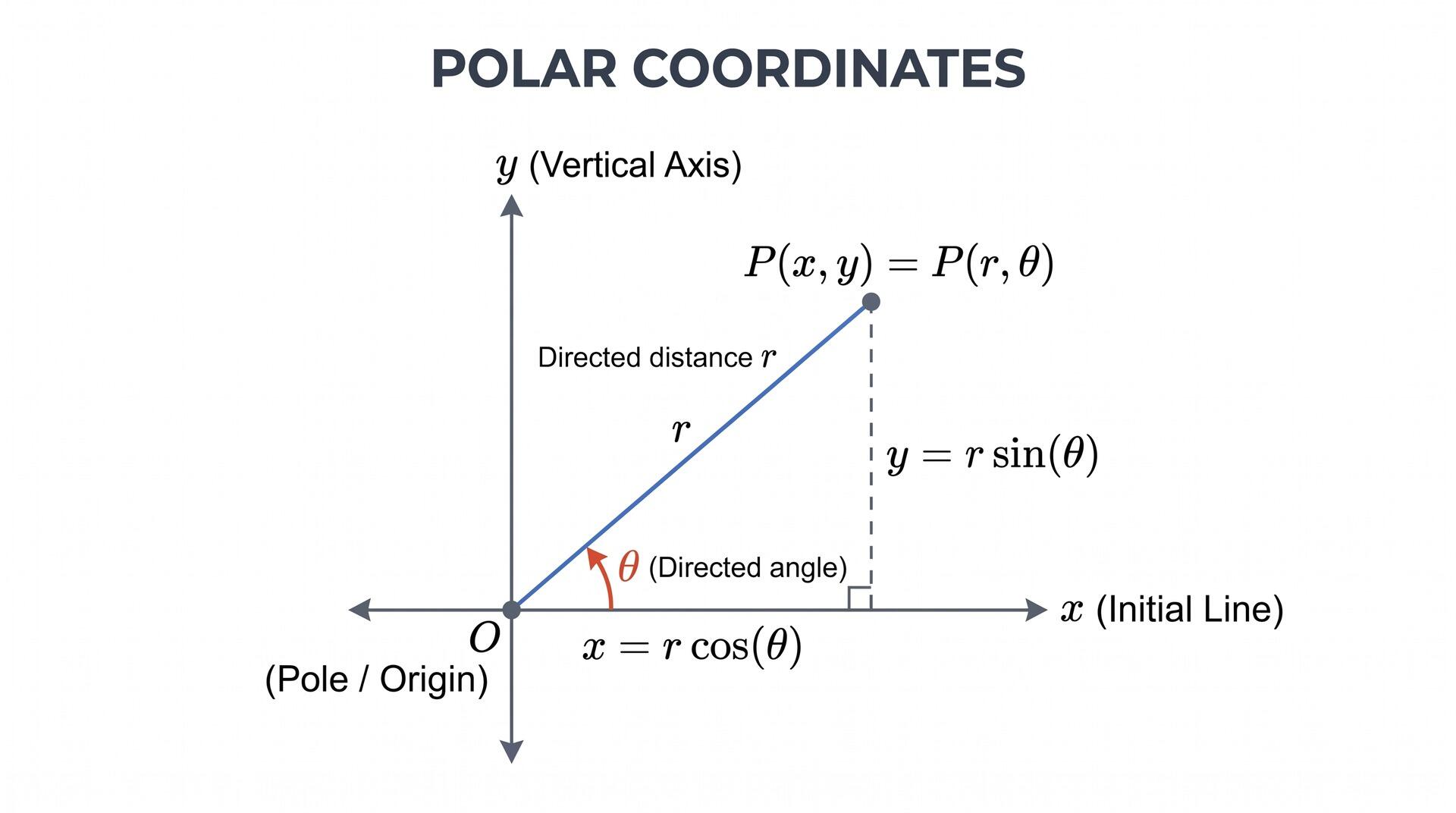
- Polar Coordinates: Defined by an ordered pair , where r represents the directed distance from a fixed reference point called the pole (origin), and represents the directed angle measured counter-clockwise from a fixed reference ray called the initial line (the positive x-axis).
Why Coordinate Systems Matter
- Real-World Applications: While rectangular Cartesian grids are ideal for computer screens, architecture, and linear mechanics, polar coordinates naturally model rotational, radial, and orbital phenomena. Radar and sonar stations track objects via range (r) and bearing (), astronomers chart celestial orbits, robotic arms calculate joint rotation angles, and antenna engineers map directional radiation patterns.
- Academic Relevance: Polar coordinates form a cornerstone of A-Level Further Mathematics. They connect directly to the geometry of complex numbers in modulus-argument form (), parametric curves, and integration techniques for calculating areas enclosed by polar loops.


Core Theory
1. Definitions and Terminology
- The Pole (O): The fixed origin point where r = 0.
- The Initial Line: The fixed horizontal ray extending to the right from the pole (coinciding with the positive x-axis in Cartesian coordinates).
- Radial Distance (r): The direct distance from the pole to the point P. In standard A-Level specifications, .
- Polar Angle / Argument (): The angle between the initial line and the ray OP.
- Angles measured counter-clockwise from the initial line are positive.
- Angles measured clockwise from the initial line are negative.
- Angles are almost universally expressed in radians.
Standard Intervals for :
Examiners will specify one of two standard principal ranges for the polar angle:
- Symmetric Principal Range: (most common in UK A-Level Further Maths).
- Positive Principal Range:.
2. Converting Polar Coordinates to Cartesian Coordinates
Given a point with polar coordinates , apply basic right-angled triangle trigonometry to find the corresponding Cartesian coordinates (x, y):
These formulas hold universally for all values of across all four quadrants.
3. Converting Cartesian Coordinates to Polar Coordinates
Given a point with Cartesian coordinates (x, y), calculate the radial distance r and the argument :
A. Calculating Radial Distance (r)
By Pythagoras' theorem:
B. Calculating the Polar Angle ()
From trigonometry:
The Quadrant Adjustment Rule:
Simply calculating on a calculator only produces values in the interval . You must inspect the signs of x and y to place in the correct quadrant:
Let be the acute reference angle:
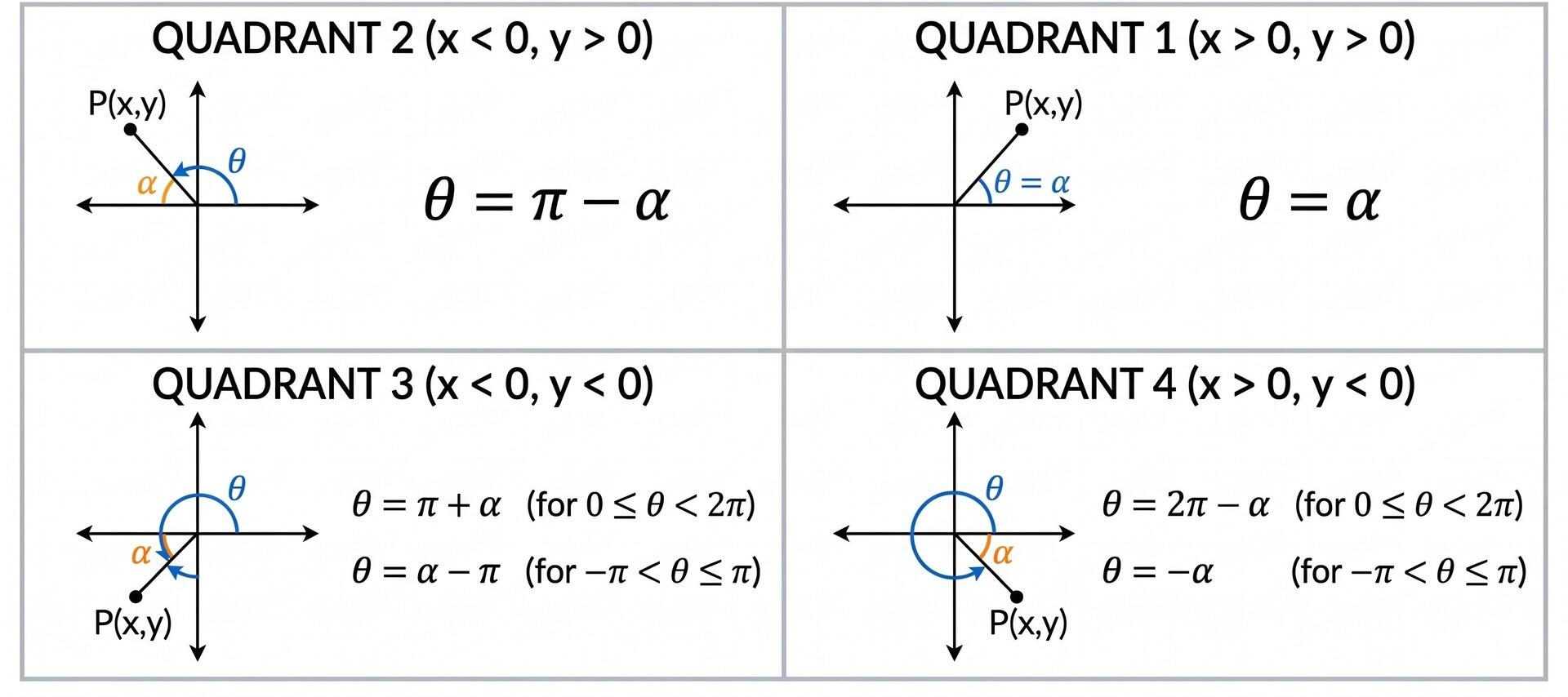
- Quadrant 1 (x > 0, y > 0):
- Quadrant 2 (x < 0, y > 0):
- Quadrant 3 (x < 0, y < 0):
- For :
- For :
- Quadrant 4 (x > 0, y < 0):
- For :
- For :
4. Non-Uniqueness of Polar Coordinates
In Cartesian coordinates, every point on the plane has a unique pair (x, y). In polar coordinates, a single geometric point has infinitely many representations:
- Adding or subtracting full rotations of produces the same point:
- If negative values of r are permitted, reflecting through the pole produces:
5. Transforming Equations Between Coordinate Systems
A. Cartesian to Polar Form
Replace every occurrence of x and y with their polar trigonometric definitions:
- Substitute
- Substitute
- Substitute
- Simplify using trigonometric identities (e.g., , double-angle formulas).
B. Polar to Cartesian Form
Aim to create the recognizable terms , , or :
- If the equation contains or , multiply both sides by r.
- If the equation contains or , convert to reciprocals and cross-multiply.
- Replace with , with x, and with y.
Worked Examples
Worked Example 1: Converting Polar Coordinates to Cartesian Coordinates
Convert the following points from polar coordinates  into Cartesian coordinates (x, y), giving exact answers:
(a) Point A with polar coordinates 
(b) Point B with polar coordinates 
(c) Point C with polar coordinates 
Step 1: Convert Point A
Use the conversion relations  and
 :


The Cartesian coordinates for Point A are  .
Step 2: Convert Point B


The Cartesian coordinates for Point B are  .
Step 3: Convert Point C


The Cartesian coordinates for Point C are  .
Worked Example 2: Converting Cartesian Coordinates to Polar Coordinates
Convert each of the following points from Cartesian coordinates into polar coordinates such that  and
 :
(a) Point P with coordinates 
(b) Point Q with coordinates 
(c) Point R with coordinates 
(d) Point S with coordinates 
Step 1: Convert Point P (Quadrant 1)
Calculate the radial distance:

Since  and
 , the point lies in Quadrant 1:

The polar coordinates are  .
Step 2: Convert Point Q (Quadrant 2)
Calculate the radial distance:

Since  and , the point lies in Quadrant 2:
Find the acute reference angle:


The polar coordinates are 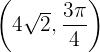 .
Step 3: Convert Point R (Quadrant 3)
Calculate the radial distance:

Since and  , the point lies in Quadrant 3:
Find the acute reference angle:

For the range :

The polar coordinates are  .
Step 4: Convert Point S (Quadrant 4)
Calculate the radial distance:

Since and , the point lies in Quadrant 4:

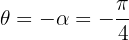
The polar coordinates are 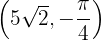 .
Worked Example 3: Converting Cartesian Equations to Polar Equations
Transform each Cartesian equation into an equivalent polar equation of the form  or
 :
(a) The circle given by 
(b) The straight line given by 
(c) The rectangular hyperbola given by 
Step 1: Transform the circle equation
Expand the bracket:

Cancel 9 from both sides:

Substitute  and :

Factor out r:

Since  corresponds to the pole (which is already included when
 in
 ):
Step 2: Transform the straight line equation
Substitute and :

Divide both sides by  (for
 ):
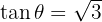
Solve for the angle  :

(This represents the half-line extending from the pole at angle  for
 ).
Step 3: Transform the hyperbola equation
Substitute and :

Factor out  :

Apply the double-angle identity  :

Divide by  :

Worked Example 4: Converting Polar Equations to Cartesian Equations
Convert each polar equation into an equivalent Cartesian equation in terms of x and y, and identify the resulting geometric curve:
(a) 
(b) 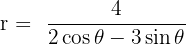
(c) 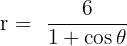
Step 1: Transform
Multiply both sides of the equation by r:

Substitute 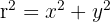 and
 :

Rearrange and complete the square for y:



Geometric curve: A circle centered at  with a radius of 4.
Step 2: Transform
Multiply across by the denominator:

Expand the bracket:

Substitute  and :

Geometric curve: A straight line with gradient  and y-intercept
 .
Step 3: Transform
Multiply across by the denominator:


Substitute :

Square both sides:
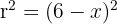
Substitute :

Subtract  from both sides:

Geometric curve: A parabola with its vertex at  opening to the left.
Worked Example 5: Finding Intersections of Polar Curves
Find the coordinates of all points of intersection between the circle  and the cardioid
 for the interval
 -\pi <\theta \le \pi[/latex].
Step 1: Equate the two polar equations


Step 2: Solve for 
Subtract  from both sides:

Step 3: Determine the angle and radial distance r
Within the interval 
Substitute  back into either curve equation:

This gives the intersection point  .
Step 4: Check for intersection at the pole ()
In polar coordinates, curves can intersect at the pole even if they reach it at different values of :
For the circle :

The circle passes through the pole.
For the cardioid :

The cardioid passes through the pole.
Since both curves pass through the pole, the pole  is an intersection point.
The points of intersection are and the pole  .
Summarise with AI:
Did you like this article? Rate it!


 Loading...
