When vectors are given in coordinate or column vector form, the fastest and most precise way to add them is algebraically — by adding their corresponding components. This article covers that method in full: from 2D addition through to 3D, finding the magnitude and direction of the resultant, the algebraic properties of vector addition, and a set of worked examples that escalate in difficulty.
This article focuses on the algebraic method for adding vectors. For the graphical approach — the head-to-tail and parallelogram methods — see Adding Vectors: Graphical Methods.


1. Vectors: A Brief Reminder
A vector is a quantity that has both magnitude (size) and direction. We distinguish it from a scalar, which has magnitude only. Displacement, velocity, force, and acceleration are all vectors; speed, mass, and temperature are scalars.
Vectors are written in several equivalent ways. You need to recognise and work with all of them:
| Notation | Example (2D) | Notes |
|---|---|---|
| Bold letter | a | Used in printed text; handwritten as a with underline or arrow |
| Arrow over letter |  | Common in handwriting |
| Column vector |  | Lists x-component then y-component |
| Component form | (3, -2) | Ordered pair; equivalent to column vector |
| Unit vector (i, j) form |  | i is the unit vector in x-direction, j in y-direction |
For a full introduction to vectors — including how to represent them, measure their magnitude, and work with unit vectors — see Vectors in the Plane and Unit Vector.
2. Adding Vectors by Components
The core principle is simple: add the x-components together to get the x-component of the resultant, and add the y-components together to get the y-component. The result is the resultant vector.
If a = (a₁, a₂) and b = (b₁, b₂), then: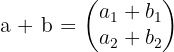
Worked Example
1. Add a = (3, 5) and b = (2, -1).
 The resultant vector is (5, 4).
2. Three vectors p = (1, 6), q = (-4, 2), r = (3, -5). Find p + q + r.
 The resultant vector is (0, 3) — pointing directly upward along the y-axis.
Column Vector Notation
Column vectors are common in GCSE and A-Level. The rule is identical — add the top numbers together and the bottom numbers together:

Unit Vector (i, j) Notation
Group the i-components and j-components separately:
Worked Example
4. Find (5i + 2j) + (3i - 7j). 
3. Magnitude of the Resultant Vector
Once you have the resultant vector, you usually need its magnitude — the scalar size of the result. Use the Pythagorean theorem on the components.
For a 2D resultant r = (r₁, r₂):

Worked Example
5: In Example 1, the resultant was (5, 4). Find its magnitude.
 The magnitude of the resultant is √41, or approximately 6.40 units.
6: Two displacement vectors are u = (6, 0) and v = (0, 8). Find the magnitude of u + v.
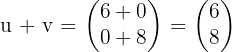
 The magnitude of the resultant displacement is 10 units.
4. Direction of the Resultant Vector
The direction of the resultant is the angle it makes with the positive x-axis (or with a reference direction such as North in navigation problems). Use the arctangent of the y-component over the x-component.
For a resultant r = (r₁, r₂):
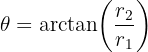
Take care with the quadrant: if r₁ is negative, add 180° to the calculator result; if r₁ is positive and r₂ is negative, the angle is negative (below the x-axis).
Worked Example
7. Find the magnitude and direction of the resultant of a = (4, 3) and b = (2, 1).
Step 1 — Add components:
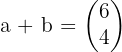
Step 2 — Magnitude:

Step 3 — Direction:
 The resultant has magnitude 2√13 ≈ 7.21 and acts at approximately 33.7° above the positive x-axis.
5. Adding Vectors in Three Dimensions
The component method extends directly to 3D: simply add x, y, and z-components separately.
For a = (a₁, a₂, a₃) and b = (b₁, b₂, b₃):
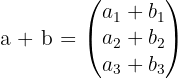
The magnitude of a 3D resultant r = (r₁, r₂, r₃) is:

Worked Example
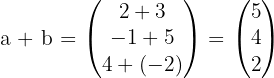
8. Find a + b and |a + b| where a = (2, -1, 4) and b = (3, 5, -2).

For a full treatment of three-dimensional vectors, including 3D direction angles and the cross product, see 3D Vectors.
6. Vector Subtraction
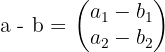
Subtracting vector b from vector a means reversing the sign of every component of b, then adding:
Worked Example
9. Find a - b where a = (7, 2) and b = (3, 5).
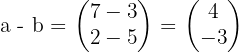
Check: |a - b| = √(16 + 9) = √25 = 5.
7. Properties of Vector Addition
Vector addition obeys four algebraic laws that mirror those of ordinary number addition:
| Property | Formal statement | What it means |
|---|---|---|
| Commutative |  | The order of addition does not change the resultant |
| Associative |  | The grouping of additions does not change the resultant |
| Additive identity |  | Adding the zero vector (0, 0) leaves any vector unchanged |
| Additive inverse |  | Every vector has an opposite; their sum is the zero vector |
These properties hold in both 2D and 3D. You can verify any of them by substituting specific component values and confirming that both sides give the same result.
Property No.1: Associative
It doesn't matter what way you group, it will always result in the same. In simple words, the way in which the vectors are grouped does not change the result.

Property No.2: Commutative
The arrangement of vectors (when you are adding) doesn't affect the overall result. In fact, they will always result in the same.

Property No.3: Additive Identity
If you add a null vector to any vector, the result will always remain the same.

Property No.4: Additive inverse or opposite
If a vector is added to a vector with the same magnitude but in the opposite direction, the overall result will always be equal to zero.

8. Scalar Multiplication
Scalar multiplication means to multiply a vector by a scalar number. The direction of the vector will remain the same, but the length of the vector may vary when you multiply any vector by a scalar number. For example, we have a vector  , now if we multiply the vector by the value
  (which is a scalar number), we will get
  . It means that the vector magnitude has increased three times the size of the previous vector.
Basically, there are two conditions for scalar multiplication. The first one is that the number multiplied to the vector should be a scalar quantity. The second condition is that the direction of the vector will never change if you are performing scalar multiplication. Scalar multiplication will not always result in an increase in magnitude; sometimes it can decrease the value of the original vector. For example, if you multiply the vector by  , the magnitude of the vector will decrease, which will ultimately decrease the length of the vector.
9. Properties of Scalar Multiplication
Property No.1: Associative
It doesn't matter what way you group, it will always result in the same. In simple words, the way in which the vectors are grouped does not change the result.

Property No.2: Right distributivity

Property No.3: Left distributivity

Property No.4: Multiplicative identity
This property states that if you multiply any vector with a unit, it will always result in the same vector.

Example
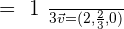
Given  , determine so that
  .
.
Find more Maths tutors here on Superprof.
10. Real-world Application of Vector Addition
Applied worked example: A drone flies 120 m due East, then 50 m due North. Find the magnitude and direction of its total displacement.
Take East as the positive x-direction and North as the positive y-direction.
Displacement 1: d₁ = (120, 0)
Displacement 2: d₂ = (0, 50)
Total displacement:
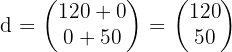
Magnitude:

Direction:

The drone is 130 m from its start point, on a bearing of approximately N 67.4° E (or 067.4°).
Summarise with AI:
Did you like this article? Rate it!


 Loading...