Metallic bonding accounts for the high electrical conductivity, mechanical malleability, and high melting points characteristic of metals.
Mark Scheme Definition:
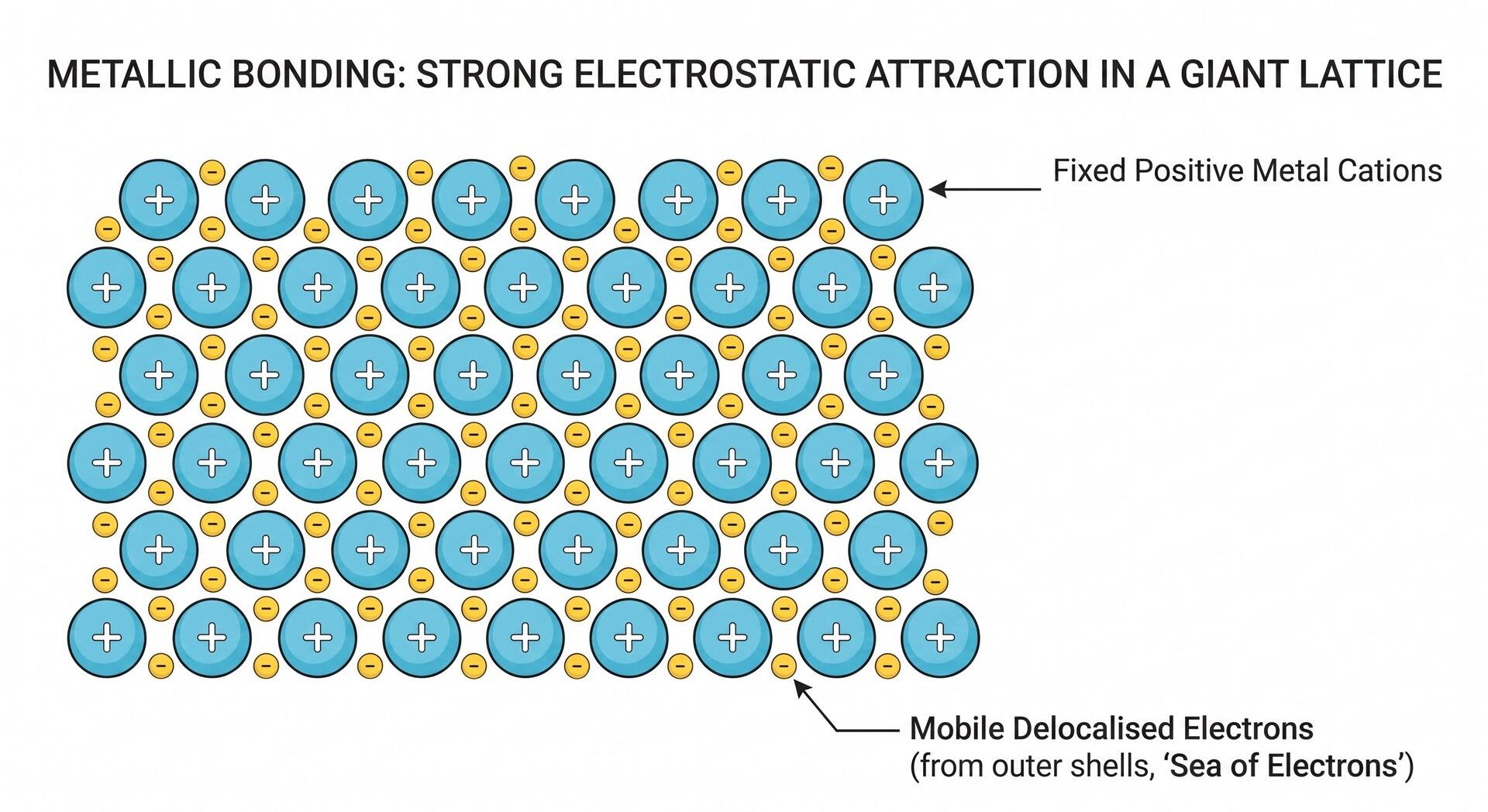
Metallic bonding is the strong electrostatic attraction between positively charged metal cations and a sea of delocalised electrons in a giant metallic lattice.
- Delocalised Electrons: Valence electrons that are free to move throughout the entire 3D structure.
- Metal Cations: Arranged in regular, repeating close-packed layers.


Factors Affecting Metallic Bond Strength & Trends
The strength of metallic bonding is proportional to the charge density of the metal cations:
- Across a Period ():
- Increases: Cation charge increases (), number of delocalised electrons per atom increases (), and ionic radius decreases.
- Result: Higher charge density stronger electrostatic attraction higher melting points.
- Down a Group ():
- Decreases: Cation charge and delocalised electrons remain constant, but ionic radius increases (more shielding).
- Result: Weaker electrostatic attraction lower melting points.
Key Physical Properties
- Electrical & Thermal Conductivity: Mobile delocalised electrons drift toward the positive terminal under an applied potential difference and transfer thermal kinetic energy rapidly through the structure.
- High Melting and Boiling Points: Substantial thermal energy is required to overcome the strong electrostatic attractions throughout the giant lattice.
- Malleability & Ductility: Regular layers of metal cations can slide over one another without breaking the bond; the non-directional sea of delocalised electrons shifts with them, preventing electrostatic repulsion.
| Metal | Group | Cation | Delocalised electrons per atom | Melting Point (°C) | Electrical Conductivity |
|---|---|---|---|---|---|
| Sodium (Na) | Group 1 | Na(+) | 1 | 98 | Good |
| Magnesium (Mg) | Group 2 | Mg(2+) | 2 | 650 | Very Good |
| Aluminium (Al) | Group 3 (13) | Al(3+) | 3 | 660 | Excellent |
| Potassium (K) | Group 1 | K(+) | 1 | 63 | Good |
Exam Pitfalls & Examiner Tips
Common Error #1: Referring to the lattice as "metal atoms in a sea of electrons." You must state positive metal ions or metal cations.
Common Error #2: Stating that molten metals conduct via mobile ions. Metals conduct in both solid and liquid states via mobile delocalised electrons. (Only molten ionic compounds conduct via mobile ions).
Practice Questions & Solutions
Explain why magnesium (Mg) has a much higher melting point than sodium (Na).
Mg(2+) has a higher ionic charge than (Na+) and contributes 2 delocalised electrons per atom (compared to 1 for Na(+)).
The Mg(2+) cation is smaller than (Na+), giving it a higher charge density.
Electrostatic attraction between cations and the delocalised electron sea is stronger in Mg, requiring significantly more thermal energy to break down the lattice.
Explain, in terms of structure and bonding, why copper is malleable.
Copper consists of a giant metallic lattice with cations arranged in regular layers.
When a force is applied, these layers can slide over each other.
The delocalised electron sea moves flexibly with the ions, maintaining the metallic bond and preventing repulsive shattering.
Explain why aluminium (Al) is a better electrical conductor than sodium (Na).
Aluminium contributes 3 valence electrons per atom to the delocalised sea (Al(3+)), whereas sodium contributes only 1 electron per atom (Na(+)).
Aluminium has a higher density of mobile charge carriers (delocalised electrons) to carry current.
Related Articles:
Continue your A-Level Chemistry Revision with the following articles:
Summarise with AI:
Did you like this article? Rate it!

 Loading...