Intermolecular forces (IMFs) are the attractive forces that exist between separate, adjacent molecules. Unlike intramolecular forces—such as strong covalent, ionic, or metallic bonds that hold atoms together inside a chemical structure—intermolecular forces dictate physical properties including melting points, boiling points, viscosity, and solubility.
A solid grasp of intermolecular forces is essential across all UK A-Level Chemistry specifications (AQA, Edexcel, OCR A/B). Examination papers regularly feature questions asking students to compare boiling points of organic compounds, explain physical anomalies such as the properties of water, or draw explicit hydrogen bonding diagrams with partial charges and lone pairs.


Core Theory
Intermolecular forces are weak attractive forces acting between simple covalent molecules. They are significantly weaker than intramolecular covalent bonds.
There are three primary types of intermolecular forces, listed in order of increasing strength:
- London Dispersion Forces (Instantaneous Dipole–Induced Dipole Forces)
- Permanent Dipole–Permanent Dipole (PD–PD) Forces
- Hydrogen Bonding
London Dispersion Forces (Instantaneous Dipole–Induced Dipole)
London dispersion forces exist between all simple covalent molecules, regardless of whether they are polar or non-polar. They arise due to the continuous movement of electrons within atomic and molecular orbitals:
- At any given instant, electron density around an atom or molecule may be distributed unevenly.
- This temporary asymmetry generates an instantaneous (temporary) dipole.
- This temporary dipole induces a dipole in an adjacent, neighbouring molecule.
- The resulting electrostatic attraction between the temporary region of one molecule and the induced region of another forms a weak London dispersion force.

Factors Affecting the Strength of London Forces
- Total Number of Electrons (Molecular Size): Molecules with more electrons possess larger electron clouds. Larger electron clouds are more easily distorted (more polarizable), resulting in stronger temporary dipoles and stronger London dispersion forces. Example: Going down Group 7 (halogens), is a gas at room temperature while is a solid because has significantly more electrons ( vs ).
- Molecular Shape and Surface Contact Area: Straight-chain isomers pack together closely, maximising the surface contact area between molecules. Branched isomers are more spherical, which prevents close packing and reduces contact surface area. Example: Pentane () has a higher boiling point () than its branched isomer 2,2-dimethylpropane ().
Permanent Dipole–Permanent Dipole (PD–PD) Forces
Permanent dipole–permanent dipole forces occur only between polar molecules that possess a permanent molecular dipole.
- Polar molecules arise when there is a significant difference in electronegativity () between bonded atoms and the molecule is unsymmetrical.
- The region of one polar molecule electrostatically attracts the region of an adjacent polar molecule.
Specification Detail:
Polar molecules experience both London dispersion forces and permanent dipole–permanent dipole forces simultaneously. The total intermolecular attraction is the combined sum of both forces.
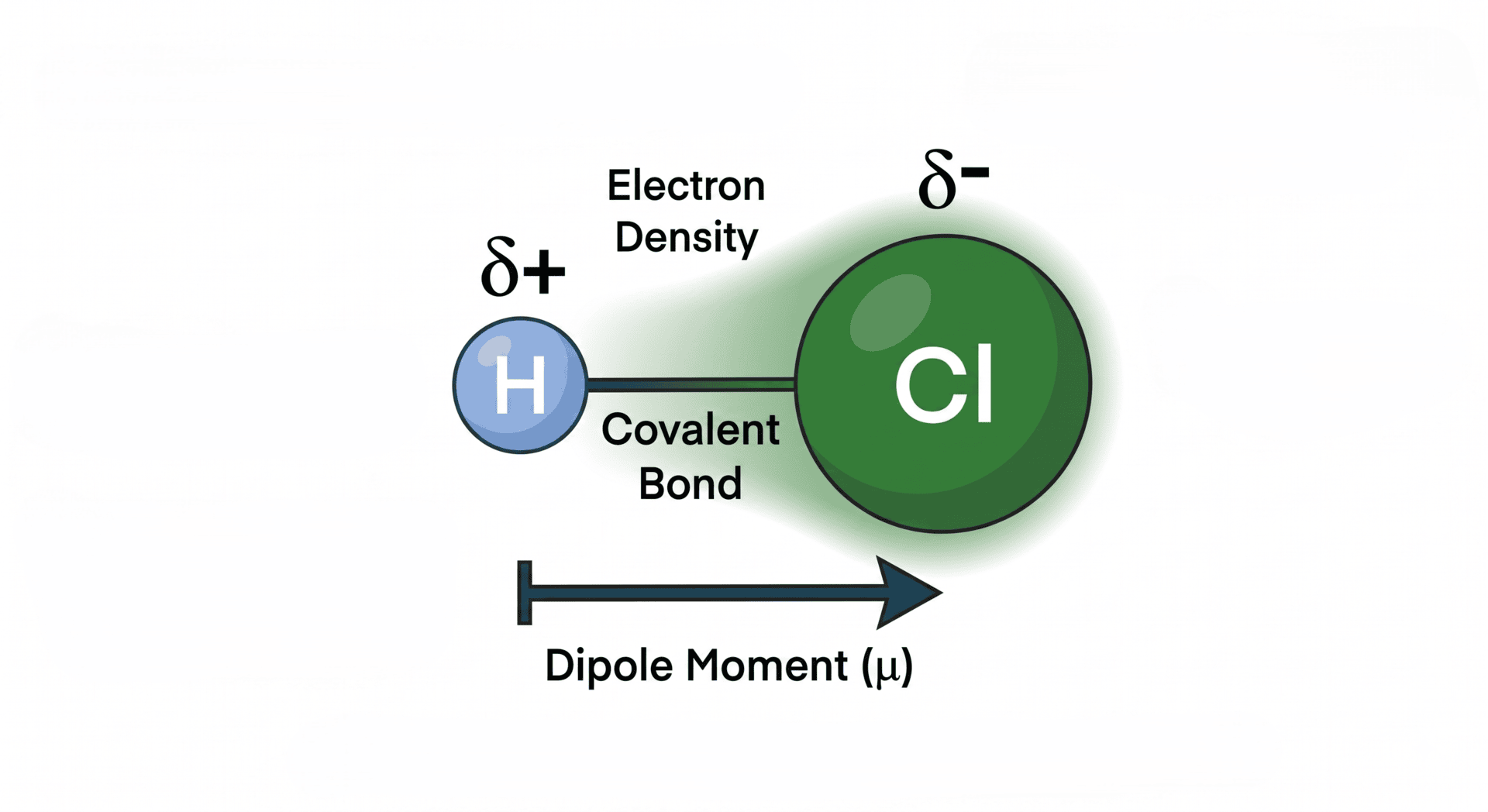
Example: Hydrogen chloride () possesses a permanent dipole because chlorine (3.0) is more electronegative than hydrogen (2.1). The end of one molecule attracts the end of a neighboring molecule.
Hydrogen Bonding
Hydrogen bonding is the strongest type of intermolecular force (typically around 10% the strength of a true covalent bond). It is a special, extreme case of permanent dipole–permanent dipole attraction.
Specification Condition for Hydrogen Bonding:
A hydrogen bond forms only when a hydrogen atom is directly covalently bonded to a highly electronegative atom possessing at least one lone pair of electrons: Fluorine (F), Oxygen (O), or Nitrogen (N).
Mechanism:
- F, O, and N are exceptionally electronegative. Bonding to hydrogen creates a strongly polar covalent bond ().
- Because hydrogen has no inner electron shells, its single electron is drawn toward the electronegative atom, leaving its tiny nucleus (a proton) exposed.
- The strong positive charge density of the atom exerts a powerful electrostatic attraction toward a lone pair of electrons on an F, O, or N atom of an adjacent molecule.
Physical Properties Caused by Hydrogen Bonding
- Unusually High Melting and Boiling Points: Molecules capable of hydrogen bonding (e.g., , , ) have substantially higher boiling points than expected based on their molar mass alone. Extra thermal energy is required to break these strong hydrogen bonds between molecules.
- Ice is Less Dense than Liquid Water: In liquid water, hydrogen bonds break and reform continuously. As water freezes into ice:
- Water molecules arrange into a stable, 3D tetrahedral open crystal lattice.
- Hydrogen bonds hold the molecules further apart on average than in the liquid state.
- This open cage structure increases the volume for a given mass, making ice less dense than liquid water.
Summary
| Intermolecular Force Type | Requirements / Conditions | Relative Strength | Example Molecules |
|---|---|---|---|
| London Dispersion Forces (LDF) | Present in all molecular substances; caused by temporary induced dipoles. | Weakest |  |
| Permanent Dipole–Dipole (PD–PD) | Present only in polar molecules with permanent dipoles. | Medium |  |
| Hydrogen Bonding | H atom directly bonded to F, O, or N with a lone pair. | Strongest |  |
Exam Focus & Common Pitfalls
Examiner Tip #1: Never Say "Covalent Bonds Break" When Boiling Water
A classic A-Level mark scheme trap! When water boils, covalent bonds inside the molecule do NOT break. Only the hydrogen bonds between water molecules are overcome.
Examiner Tip #2: Drawing Hydrogen Bonds Correctly
When asked to draw a hydrogen bond in an exam, mark schemes strictly mandate:
- Show all partial charges ( and ) on relevant atoms.
- Show the lone pair on the electronegative atom (O, N, or F).
- Draw the hydrogen bond as a dashed line extending directly from the lone pair to the atom.
- Ensure the bond angle around the hydrogen atom is approximately (linear).
Examiner Tip #3: Structure Comparative Answers in 3 Steps
- Identify the primary intermolecular force present in each compound.
- Compare the relative strengths of these forces (referencing electron count or polarity).
- State which compound requires more thermal energy to overcome its intermolecular forces.
Practice Question & Solutions
Propan-1-ol, , and propanone,  , have similar relative molecular masses (60.0 and 58.0 respectively).
Predict which compound has the higher boiling point and explain your reasoning in terms of intermolecular forces.
Identify IMFs in Propan-1-ol: Propan-1-ol contains an -OH group, allowing it to form hydrogen bonds between molecules (alongside London forces and permanent dipole–dipole forces).
Identify IMFs in Propanone: Propanone contains a polar carbonyl group but no hydrogen attached directly to oxygen. It forms permanent dipole–dipole forces and London forces, but cannot hydrogen bond with itself.
Compare strengths: Hydrogen bonding in propan-1-ol is significantly stronger than the permanent dipole–dipole forces in propanone.
Conclusion: Propan-1-ol has a higher boiling point because more thermal energy is required to overcome its stronger intermolecular forces.
Ethanol,  , is completely miscible with water, whereas ethane,
  , is insoluble in water.
Explain this difference in solubility.
Water Structure: Water molecules form extensive hydrogen bond networks with one another.
Ethanol Interaction: Ethanol contains a polar -OH group. It can form hydrogen bonds with water molecules. The energy released when these new hydrogen bonds form is sufficient to overcome existing intermolecular forces in both liquids, making them miscible.
Ethane Interaction: Ethane is a non-polar hydrocarbon that forms only weak London forces. It cannot form hydrogen bonds with water. Interactions between ethane and water are too weak to disrupt the strong hydrogen bonds between water molecules, rendering ethane insoluble.
Dichloromethane,  , is a polar liquid at room temperature.
State all the types of intermolecular forces present between dichloromethane molecules.
Explain why tetrachloromethane,  , is non-polar despite containing four polar C-Cl bonds.
Types of intermolecular forces in dichloromethane:
London dispersion forces (present in all molecules).
Permanent dipole–permanent dipole forces (due to polar C-Cl bonds and non-symmetrical shape).
Non-polarity of tetrachloromethane:
has a symmetrical tetrahedral geometry.
Although each C-Cl bond is polar due to electronegativity differences, the four individual bond dipole moments cancel out vectorially in 3D space.
The net molecular dipole moment is zero, rendering the overall molecule non-polar.
Related Articles:
Continue your A-Level Chemistry Revision with the following articles:
Summarise with AI:
Did you like this article? Rate it!

 Loading...